

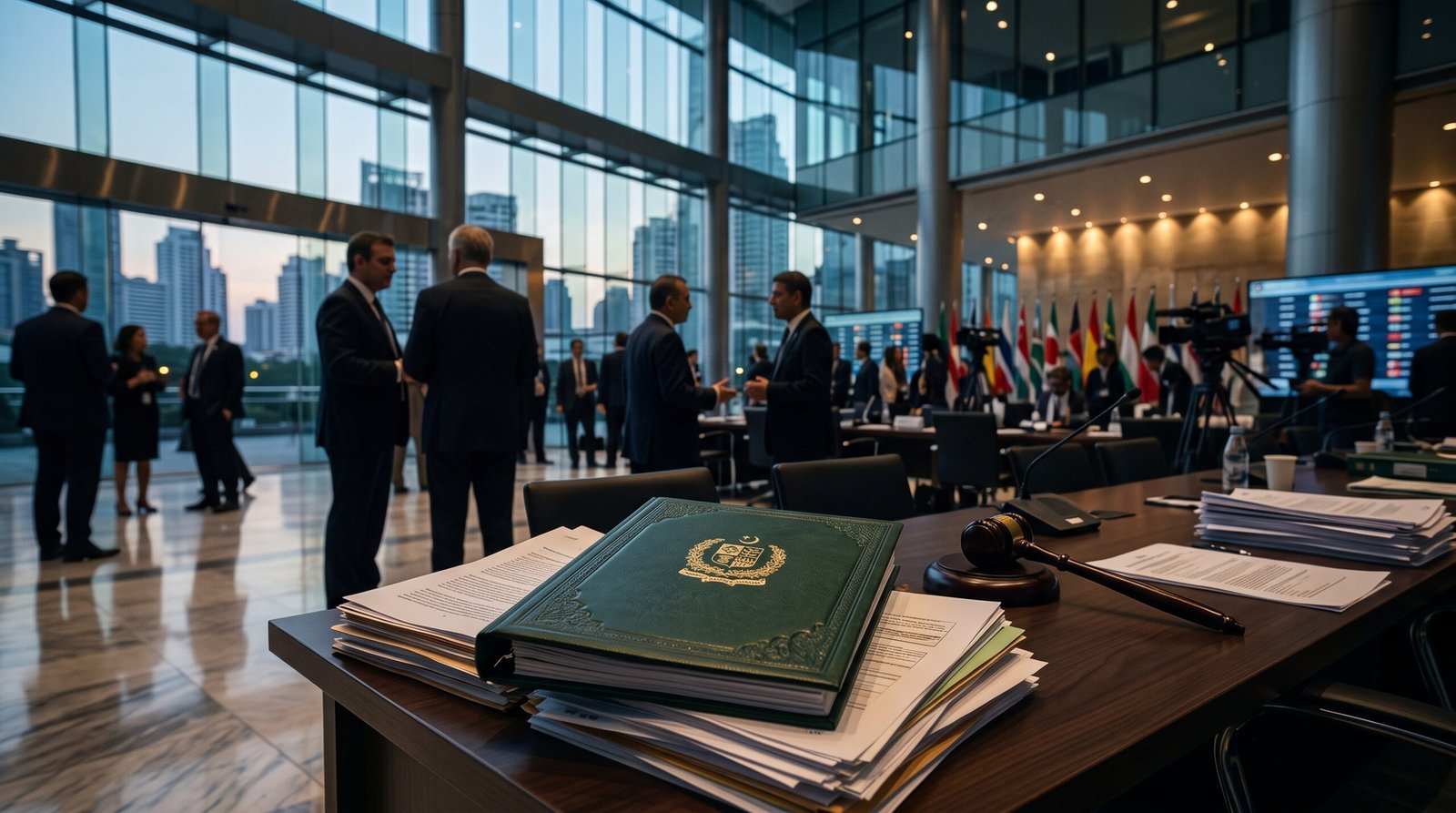
Pakistan has formally assumed the chairmanship of the Governing Council of the Borrowers’ Platform during the World Bank Group–International Monetary Fund (IMF) Annual Meetings 2026 in Bangkok, Thailand, marking a strategic pivot toward institutional coordination on sovereign debt management and external development financing.
Federal Minister for Finance and Revenue Muhammad Aurangzeb accepted the leadership role on behalf of Pakistan, framing the member state-led initiative as a collaborative forum for developing nations confronting severe debt sustainability headwinds. Outlining Pakistan’s priorities under the platform’s 2026–27 work plan, Aurangzeb emphasized technical cooperation, institutional reform exchanges, and the deployment of innovative financing instruments, noting that the body is designed for mutual learning rather than serving as a collective bargaining or crisis-management mechanism.
“The finance minister emphasized the need to ensure that sovereign debt supports development rather than constraining economic growth.”
Aurangzeb commended the government of Egypt for its foundational leadership in establishing the institutional framework of the initiative, reiterating Pakistan’s focus on achieving measurable structural outcomes.
On the sidelines of the annual gatherings, Aurangzeb met with IMF First Deputy Managing Director Dan Katz to assess Pakistan’s performance under its current IMF-supported program. The bilateral discussions reviewed fiscal discipline, foreign exchange reserve buffers, inflation trajectories, and external sector stabilization, with both sides welcoming the staff-level agreement and acknowledging steady improvements in key macroeconomic indicators.
The finance minister highlighted rising investor confidence, upgrades in sovereign credit ratings, and Pakistan’s renewed access to international capital markets, reiterating Islamabad’s commitment to fiscal consolidation, aggressive taxation overhauls, and state-owned enterprise privatization. Discussions also evaluated external vulnerabilities stemming from the ongoing Middle East conflict, specifically its impact on global energy prices and domestic inflation, while balancing targeted fiscal relief for vulnerable households against broader budgetary discipline.
Aurangzeb is heading Pakistan’s official delegation in Bangkok across the October 12 to 18 summit, an itinerary encompassing more than 60 scheduled bilateral meetings with multilateral institutions, bilateral lenders, commercial banks, and credit rating agencies as Pakistan transitions from stabilization toward an export- and investment-led economic model.