

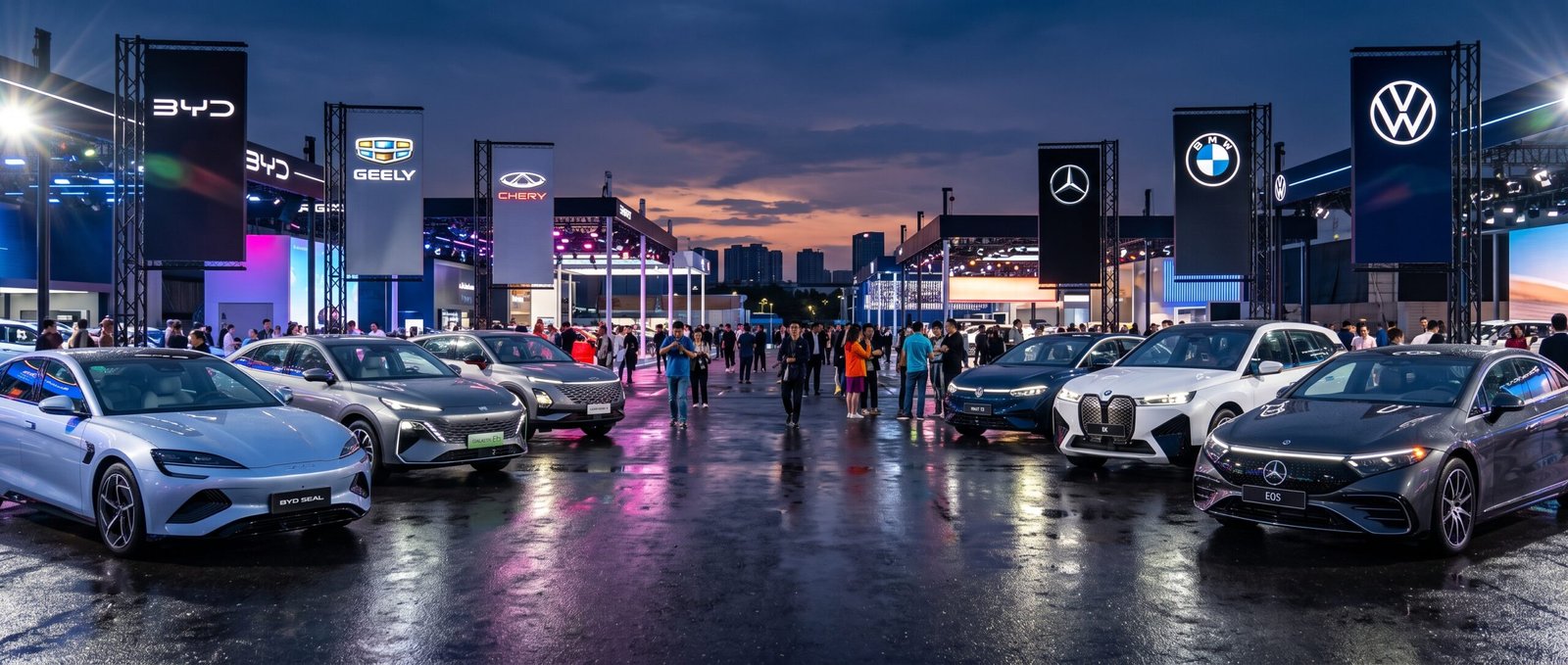
LAHORE, October 16, 2026: For decades, Germany’s automotive industry represented the pinnacle of engineering excellence, technological innovation and international prestige. Mercedes-Benz symbolised luxury, BMW built its reputation around driving dynamics, Audi championed advanced technology, and Volkswagen established itself as one of the world’s most influential mass-market manufacturers.
Today, that hierarchy is being challenged by an increasingly formidable competitor: China.
What began as a manufacturing industry heavily dependent on foreign technology and international joint ventures has evolved into a global automotive powerhouse capable of developing sophisticated electric vehicles, advanced batteries and software-driven mobility platforms at speeds and costs that traditional manufacturers are struggling to match.
Chinese automotive groups including BYD, Geely, Chery, SAIC Motor, Changan and Great Wall Motor are expanding beyond their domestic market, targeting Europe, Southeast Asia, Latin America, the Middle East and emerging economies such as Pakistan.
The consequences extend far beyond competition between individual carmakers. They raise fundamental questions about the future of Germany’s industrial economy, the profitability of traditional automotive manufacturing and whether a century of European engineering dominance can survive the transition towards electrification.
Yet the evidence points towards a more complicated conclusion than an outright Chinese takeover.
China is increasingly dominating electric-vehicle manufacturing and battery supply chains, while Germany retains considerable strength in premium vehicles, established international distribution networks and automotive engineering.
The real battle is over which country will define the next generation of cars.
China Controls Around 60% Of Global Electric-Car Sales
The scale of China’s transformation becomes apparent when examining figures from the International Energy Agency (IEA).
According to the IEA’s Global EV Outlook 2026, global electric-car sales exceeded 20 million units in 2025, representing approximately one-quarter of all new cars sold worldwide.
Chinese-headquartered automakers accounted for approximately 60% of those global electric-car sales, compared with around 15% each for European and North American manufacturers.
China also produced nearly three-quarters of the world’s electric cars during 2025, reinforcing its position as the industry’s principal manufacturing centre.
The dominance extends into batteries, where Chinese manufacturers accounted for more than 80% of global battery-cell production.
These figures suggest that China’s competitive advantage is no longer confined to lower labour costs or inexpensive vehicles. It increasingly encompasses the entire electric-vehicle ecosystem, from battery materials and cell manufacturing to vehicle assembly and export logistics.
The IEA estimates that global electric-car sales could reach 23 million units in 2026, accounting for approximately 28% of the worldwide passenger-car market.
Crucially, these figures include electric vehicles beyond Germany’s traditional luxury segment. China’s overall EV leadership should therefore not be confused with dominance of every automotive category.
German Carmakers Lose Ground In Their Most Important Asian Market
Perhaps the most damaging development for Germany is occurring inside China itself.
For decades, Volkswagen, Mercedes-Benz, BMW and Audi benefited enormously from Chinese demand. German engineering, European prestige and established manufacturing partnerships helped these companies command substantial market shares.
That advantage has deteriorated as Chinese consumers increasingly favour domestic manufacturers offering advanced digital interfaces, intelligent driving systems, competitive pricing and sophisticated electric powertrains.
The deterioration became particularly evident during the second quarter of 2026.
According to company sales figures reported in July, Volkswagen, Mercedes-Benz and BMW each suffered year-on-year sales declines of at least 30% in China between April and June.
Volkswagen recorded a particularly sharp decline of 36.6%.
Marco Schubert, Volkswagen’s sales executive, acknowledged the difficult trading environment, stating:
“The situation remains challenging in China.”
He explained that Volkswagen had been unable to escape the broader market contraction despite encouraging initial demand for newly introduced, locally developed electric vehicles.
The figures underline a structural challenge. German manufacturers that once helped establish China’s modern automotive industry are now competing against domestic companies that have become leaders in technologies increasingly valued by Chinese consumers.
However, the second-quarter contraction was also influenced by a wider decline in Chinese automotive demand. It would therefore be misleading to attribute every lost German sale directly to a Chinese competitor.
Read More: Tencent Signs Massive $7 Billion Oracle Deal For 100,000 AI Chips To Bypass US Curbs
Volkswagen CEO Warns Of Enormous Pressure
The threat has become sufficiently serious for senior German automotive executives to acknowledge it publicly.
Speaking alongside the Paris Motor Show on October 13, 2026, Volkswagen Group Chief Executive Oliver Blume warned that Europe’s mass-market automotive industry was facing enormous pressure from Chinese competition and the transition towards affordable electric vehicles.
Volkswagen, Stellantis and Renault collectively account for more than 60% of European automotive production, making their competitiveness critical to the continent’s manufacturing economy.
Blume said:
“We cannot build our future on export profits alone. Our European businesses must be profitable, resilient and competitive.”
He also warned:
“We must secure Europe’s industrial base.”
His remarks came as Volkswagen continued a major restructuring programme involving extensive workforce reductions and the possibility of factory closures.
The significance of these comments lies in the changing economics of automotive production.
Traditional European manufacturers must simultaneously invest in electric platforms, battery technology, software development and increasingly automated factories while maintaining legacy combustion-engine operations.
Chinese manufacturers, particularly newer electric-vehicle specialists, have often been able to develop their businesses around more integrated production systems.
The result is growing pressure on European manufacturers’ costs, margins and development cycles.
The Numbers: Chinese Challengers Versus German Giants
Despite China’s commanding position in electric vehicles, German manufacturers continue to maintain substantial global sales volumes.
The following comparison uses full-year 2025 figures, providing a more reliable basis for assessing the competitive landscape than isolated monthly sales results.
Global Vehicle Deliveries And Sales — 2025
- Volkswagen Group: Approximately 8.98 million vehicles.
- BYD: Approximately 4.60 million new-energy vehicles.
- BMW Group: Approximately 2.46 million vehicles.
- Mercedes-Benz Cars: Approximately 1.80 million passenger cars.
The figures are based on manufacturer disclosures. Volkswagen’s total includes commercial vehicles, while BYD’s total includes new-energy passenger and commercial vehicles. They therefore illustrate scale rather than a perfectly like-for-like passenger-car comparison.
BYD’s 4.6 million new-energy vehicle sales in 2025 included approximately 2.26 million fully electric passenger cars and 2.29 million plug-in hybrids.
Volkswagen, meanwhile, delivered approximately 983,000 battery-electric vehicles, BMW delivered 442,072 fully electric vehicles, and Mercedes-Benz Cars delivered approximately 168,800.
The comparison reveals two different realities.
Volkswagen remains considerably larger than BYD in total worldwide vehicle deliveries, but BYD has established a substantial lead over individual German groups in battery-electric vehicle volumes.
For Mercedes-Benz and BMW, the competitive challenge is particularly significant because both depend on their ability to charge premium prices.
Volkswagen’s Profitability Comes Under Pressure
Sales volumes alone do not tell the entire story.
Volkswagen Group reported revenue of approximately €321.9 billion in 2025, compared with €324.7 billion a year earlier.
Its operating profit, however, fell from approximately €19.1 billion to €8.9 billion.
That represents a decline of more than 53%, while the operating margin contracted from 5.9% to 2.8%.
The deterioration reflected multiple pressures, including restructuring, changing product economics and difficult market conditions.
The implications are significant.
Volkswagen continues to generate enormous revenues, but declining profitability limits its flexibility to finance future technologies while maintaining employment, factories and existing product lines.
BYD presents a different financial picture.
The Chinese manufacturer reported revenue of approximately RMB804 billion for 2025 and net profit of RMB32.6 billion.
Despite strong vehicle sales, BYD’s profit declined by approximately 19%, demonstrating that Chinese manufacturers are themselves struggling with aggressive price competition.
This is an important qualification to the narrative of Chinese dominance.
Chinese manufacturers may be gaining sales and technological influence, but rapid expansion does not necessarily guarantee sustainable profitability.
Europe Becomes The New Automotive Battleground
China’s next major target is Europe, the historical home of Mercedes-Benz, BMW, Audi, Volkswagen, Porsche and several other internationally recognised automotive brands.
The competition intensified during 2026 as Chinese manufacturers expanded their European distribution networks, introduced additional electric and hybrid models and invested in after-sales infrastructure.
According to Schmidt Automotive Research figures reported in October, Chinese brands captured approximately 15% of Europe’s electric-vehicle market during the second quarter of 2026, compared with 9.5% in the first quarter of 2024.
Chinese manufacturers also increased their presence in plug-in hybrids.
Exports of Chinese hybrid vehicles to the European Union reached approximately $7.5 billion during the first half of 2026, compared with $2.5 billion a year earlier.
The threefold increase reflected growing European demand for fuel-efficient vehicles and manufacturers’ efforts to diversify beyond fully electric cars.
However, Volkswagen remained the leading force in the EU plug-in hybrid market, holding approximately 31.8% of the segment.
The European Union’s additional tariffs on Chinese-made battery-electric vehicles have complicated the competitive landscape, while emerging arrangements to restrict hybrid imports could introduce further uncertainty.
Automotive analyst Felipe Munoz of Car Industry Analysis has highlighted the difficult strategic choice facing Europe between protecting domestic manufacturing and permitting greater Chinese competition.
Bill Russo, founder of Shanghai-based automotive consultancy Automobility, suggested that import restrictions could accelerate Chinese investment in European factories.
He said:
“If access through imports becomes more constrained, investing closer to the customer becomes more attractive.”
This creates an unusual possibility: Chinese automotive groups could increasingly manufacture vehicles inside Europe, transforming themselves from import competitors into participants in the continent’s industrial economy.
Chinese Manufacturers Face Their Own Survival Crisis
The rapid expansion of Chinese automotive companies has created an increasingly crowded domestic industry.
More than 100 Chinese automotive brands are competing for market share, investment and consumer attention.
Weakening domestic demand and persistent discounting have forced manufacturers to seek additional growth overseas.
An October 15 Reuters report highlighted the importance of European expansion to Chinese manufacturers facing consolidation at home.
Francois Roudier, secretary general of the International Organization of Motor Vehicle Manufacturers, described the consequences of failing to establish a sustainable European export business:
“If they drop exports in Europe, they die.”
The remark illustrates the intensity of the competitive environment.
While BYD, Chery and SAIC have established meaningful international operations, smaller Chinese manufacturers face substantial obstacles, including dealer-network investment, spare-parts availability, warranty obligations and uncertain resale values.
Philip Nothard, insight director at Cox Automotive, expects the industry eventually to consolidate around a relatively small number of successful Chinese manufacturers.
He predicted:
“We’ll see a big four or five (Chinese automakers), then others who will come and go.”
Consequently, the expansion of Chinese automotive brands should not be interpreted as evidence that every Chinese manufacturer will become a long-term global competitor.
From German Engineering To Chinese Software: A Historic Reversal
Perhaps the clearest indication of the industry’s transformation is the growing willingness of European manufacturers to learn from Chinese competitors.
For decades, Chinese automotive companies relied heavily on foreign joint ventures, manufacturing partnerships and technology transfers.
Today, several European manufacturers are collaborating with Chinese companies to accelerate electric-vehicle development.
Volkswagen has partnered with XPeng in China, while Stellantis has established relationships with Leapmotor and Dongfeng.
At the Paris Motor Show in October, Stellantis Chief Executive Antonio Filosa acknowledged the potential benefits of combining European and Chinese engineering expertise.
He said:
“There are certainly areas where we can complement each other.”
The collaboration extends beyond batteries into vehicle architecture, development processes, electronics and software.
Opel Chief Executive Florian Huettl praised the pace of work involving Chinese partners, describing it as:
“Remarkable speed.”
Stefan Bratzel, an automotive analyst at Germany’s Center of Automotive Management, offered a particularly striking assessment:
“For years it was the Chinese who learned from the Germans. Now that process has to be reversed.”
The observation captures the broader technological shift.
Traditional German automotive strengths were developed around internal-combustion engines, transmission engineering, chassis dynamics, manufacturing precision and mechanical refinement.
Electric vehicles have introduced a different set of competitive priorities.
Battery efficiency, software integration, charging performance, digital interfaces and development speed have become increasingly important.
Chinese manufacturers have invested heavily in these areas, allowing them to compete on more than price alone.
Is China Redefining Automotive Luxury?
The challenge facing Mercedes-Benz, BMW and Audi extends beyond mass-market electric vehicles.
Chinese premium manufacturers including Zeekr, Denza, NIO and Li Auto are increasingly targeting customers who previously associated luxury primarily with European brands.
Their vehicles frequently emphasise advanced displays, digital connectivity, driver-assistance systems, spacious interiors and sophisticated electric powertrains.
The underlying commercial proposition is straightforward: offer a high level of technology and comfort at a price that undercuts established premium manufacturers.
Geely’s Zeekr brand provides a particularly interesting example.
At the introduction of the Zeekr 8X SUV in April 2026, the company emphasised advanced safety technology and digital convenience features.
A Geely executive described the company’s premium positioning as:
“Value for money.”
This approach challenges the conventional luxury model built around brand heritage, bespoke materials and exclusivity.
However, technological features do not automatically translate into superior ownership experiences.
Mercedes-Benz and BMW continue to benefit from established reputations for engineering, refinement and performance, while Porsche retains a distinctive position in high-performance sports cars.
The long-term question is whether younger luxury buyers will continue paying substantial premiums for European brand heritage when Chinese alternatives offer comparable technology and increasingly competitive refinement.
Germany Is Fighting Back
It would be premature to conclude that German automotive manufacturers are incapable of responding.
Volkswagen delivered approximately 983,000 fully electric vehicles in 2025, an increase of 32% compared with the previous year.
Its European electric-vehicle operations performed particularly strongly, demonstrating that Chinese competition has not eliminated demand for German products.
BMW also recorded substantial electric-vehicle growth in Europe during 2025, while its Neue Klasse platform represents a major investment in next-generation electric architecture.
Mercedes-Benz is similarly investing in electric drivetrains, software and new model development.
Mercedes-Benz Group Chairman Ola Källenius described the company’s transformation in its annual sales announcement:
“In 2025 we kicked-off the biggest product and tech launch program at Mercedes-Benz.”
The company is betting that advanced electric technology combined with its established luxury identity will allow it to defend its market position.
BMW’s response has been equally ambitious.
Jochen Goller, the company’s board member responsible for customer, brands and sales, said BMW planned to introduce more than 40 new or revised vehicles with different powertrain options by 2027.
The company also recorded growth in Europe and the Americas during 2025, helping offset weaker Chinese demand.
These developments suggest that Germany’s automotive industry is undergoing a difficult transition rather than an inevitable collapse.
Read More: Apple’s iPhone 18 Bet: What the New Pro Models and Foldable Duo Mean for Pakistan
Pakistan: Chinese Automakers Challenge Traditional Brand Preferences
Pakistan offers a revealing example of how China’s automotive expansion is changing consumer choices in emerging markets.
For decades, Pakistan’s passenger-car market has been dominated by Japanese manufacturers, particularly Toyota, Suzuki and Honda. German luxury vehicles, meanwhile, have maintained a relatively small but prestigious position among affluent buyers.
The arrival and expansion of Chinese automotive brands have introduced a different competitive dynamic.
Manufacturers and brands including Haval, BYD, Changan, Deepal, MG, Omoda, Jaecoo and Jetour are competing across conventional petrol, hybrid, plug-in hybrid and fully electric vehicle categories.
Their appeal increasingly centres on modern styling, technology, equipment levels and pricing.
The success of Sazgar’s Haval operations provides one indication of changing consumer preferences.
According to Pakistan Automotive Manufacturers Association data reported by PakWheels, Haval recorded sales of 2,208 vehicles in April 2026, an increase of approximately 27% compared with March.
Jetour recorded 305 units during the same month.
These figures demonstrate the growing visibility of Chinese manufacturers, although they should not be interpreted as proof that Chinese brands have overtaken Japanese manufacturers in Pakistan’s overall passenger-car market.
The comparison with German vehicles is more complicated.
Mercedes-Benz, BMW and Audi largely operate in Pakistan through imported vehicles and a much smaller premium-market ecosystem.
Comprehensive, publicly accessible sales figures covering all new and used German luxury imports are insufficient to calculate a reliable Chinese-versus-German market share.
Nevertheless, Chinese manufacturers are increasingly offering vehicles with features that were once associated with considerably more expensive European models.
Large digital displays, panoramic roofs, advanced driver-assistance systems, premium interior appointments and electrified powertrains are becoming available across a wider range of price categories.
For Pakistani consumers, this creates a new purchasing question: whether established German engineering and brand prestige justify their higher acquisition and maintenance costs when Chinese alternatives offer substantial equipment and technology advantages.
However, the long-term competitiveness of Chinese vehicles in Pakistan will depend on more than initial showroom appeal.
Spare-parts availability, battery replacement costs, dealer coverage, warranty support, vehicle reliability and resale values will ultimately determine whether Chinese manufacturers can establish the same enduring consumer confidence enjoyed by established Japanese and German brands.
The Reliability And Resale Value Question
One of the biggest unresolved issues in the Chinese automotive expansion is long-term ownership performance.
German manufacturers have spent decades establishing global servicing networks and cultivating brand loyalty.
Chinese manufacturers are expanding their networks rapidly, but many newer brands have relatively limited long-term operating histories outside China.
This creates uncertainty around depreciation, spare-parts supply, battery durability and post-warranty maintenance costs.
Electric vehicles also introduce different ownership economics.
They generally require less routine mechanical maintenance than combustion-engine vehicles, but expensive battery or electronic-system repairs can significantly affect the financial viability of older vehicles.
Similarly, frequent model updates and aggressive price reductions may benefit new buyers while reducing the resale values of existing vehicles.
European automotive markets, where leasing plays a substantial role in new-car transactions, are particularly sensitive to residual values.
Consequently, Chinese manufacturers will need to establish confidence not only among private buyers but also among leasing companies, insurers, fleet operators and used-car dealers.
Until comparable long-term reliability and depreciation data become available across multiple markets, sweeping claims that Chinese vehicles are either more reliable or less reliable than German alternatives would be difficult to substantiate.
Can Chinese Cars Really Replace Mercedes-Benz, BMW And Porsche?
The answer depends on the segment.
In affordable electric vehicles, Chinese manufacturers have already established substantial technological and manufacturing advantages.
In mainstream passenger cars and family SUVs, Chinese companies are increasingly competitive on equipment, pricing and powertrain efficiency.
In premium electric vehicles, brands such as Zeekr, Denza and NIO are challenging traditional assumptions about luxury and technological sophistication.
However, the highest levels of automotive luxury and performance remain more difficult to penetrate.
Mercedes-Maybach, BMW’s flagship luxury models and Porsche’s performance vehicles compete on attributes that extend beyond specifications.
Brand heritage, driving characteristics, craftsmanship, exclusivity, global servicing infrastructure and established customer relationships remain important.
A Chinese electric SUV may offer more digital features than a German competitor at a lower price, but that does not necessarily mean it provides an identical driving or ownership experience.
Equally, German manufacturers cannot assume that established reputations will indefinitely justify substantial price premiums.
As Chinese engineering and manufacturing capabilities improve, traditional luxury brands will face increasing pressure to demonstrate the tangible advantages of their products.
The Global Automotive Balance Is Changing
The transformation of the automotive industry is unlikely to produce a single national winner.
China has developed a powerful position in electric-vehicle production, batteries, manufacturing scale and increasingly software-driven automotive technology.
Germany retains considerable advantages in established premium markets, high-performance engineering and international brand recognition.
The United States remains an important market with powerful domestic manufacturers and significant regulatory barriers to Chinese automotive imports.
Japan continues to maintain global influence through Toyota, Honda and other manufacturers, particularly in hybrid technology and established international distribution networks.
South Korea, meanwhile, remains an important competitor through Hyundai and Kia.
The industry’s future will therefore be shaped by several competing technological and commercial strategies rather than a straightforward replacement of German manufacturers by Chinese brands.
China’s greatest achievement may ultimately be forcing the world’s established automotive companies to reconsider how vehicles are designed, developed, manufactured and priced.
For Germany, the challenge is no longer simply to produce technologically advanced vehicles.
It must produce vehicles that remain commercially competitive against Chinese manufacturers capable of combining advanced technology with lower production costs and increasingly sophisticated designs.
For China, the challenge is to convert domestic manufacturing strength into sustainable international businesses with reliable after-sales networks, strong residual values and lasting profitability.
The consequences of this competition will extend across supply chains, employment, international trade and industrial policy.
Germany’s automotive industry is not disappearing, and Chinese manufacturers are not guaranteed to dominate every global market.
But the balance of technological influence is shifting.
The central question is no longer whether Chinese manufacturers can compete with Germany’s automotive giants. They already can. The question is whether Mercedes-Benz, BMW, Volkswagen and Porsche can adapt quickly enough to protect the advantages that made them global leaders in the first place.