

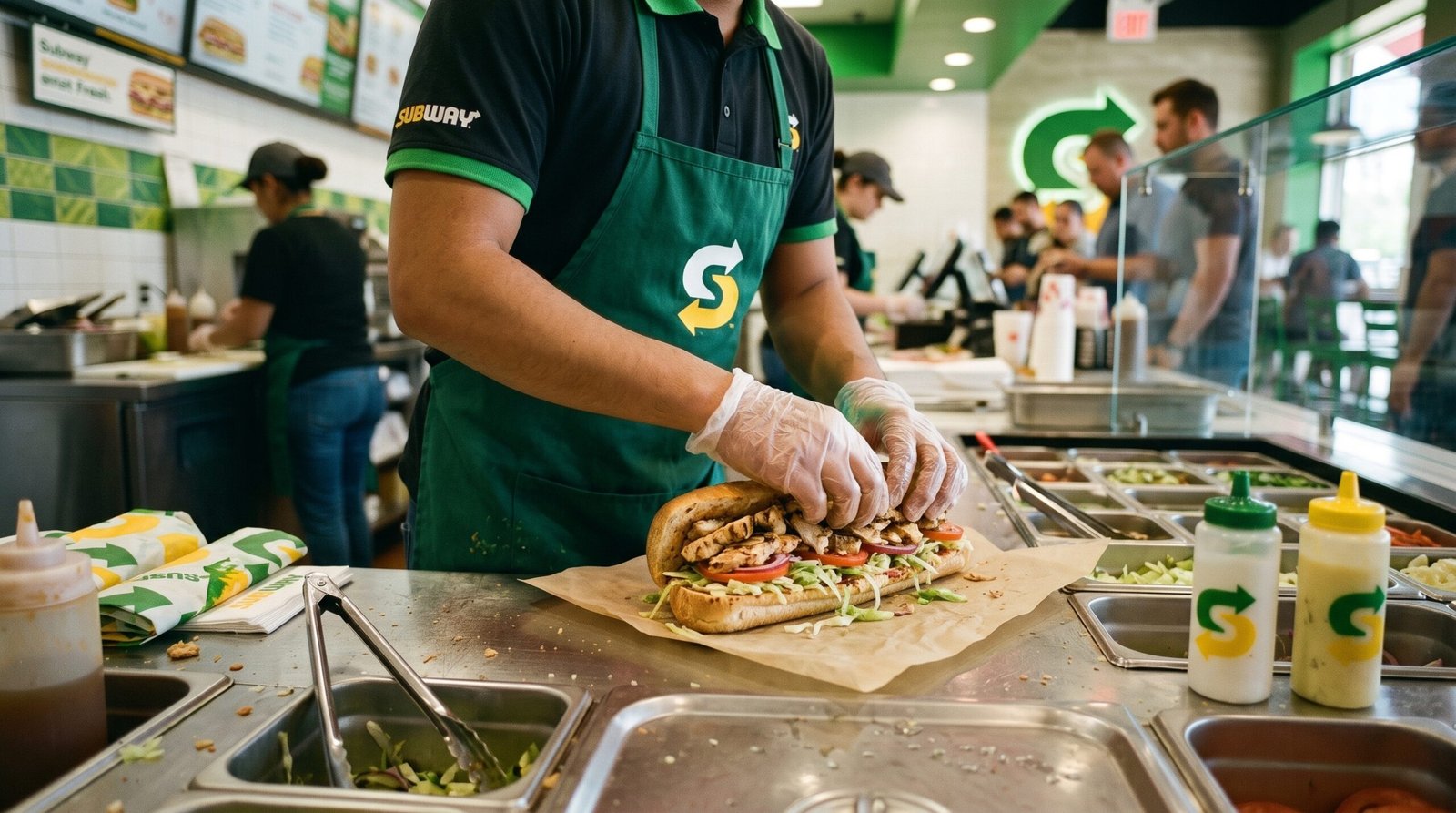
LAHORE: In an intriguing development in Pakistan’s fast-food industry, restaurants previously operating under the internationally recognised Subway brand are being converted into Substation, a Pakistani sandwich business seeking to establish its own identity, expand its product range and compete in a market historically dominated by international franchises.
The transformation is particularly significant because Substation is not simply introducing another sandwich restaurant into an already competitive market. At least one of its outlets previously operated under the Subway brand, according to firsthand reporting by The Scoop, while the emerging chain is now advertising six locations across Lahore, Islamabad and the M2 motorway.
During a visit to a Substation restaurant in Lahore, The Scoop spoke with a restaurant representative who confirmed that the location had previously operated as Subway. The representative also indicated that multiple former Subway outlets were undergoing conversion to the Substation identity under the same management.
Although the representative referred to approximately six conversions in Lahore, the brand’s own packaging identifies six advertised locations nationwide, including three in Lahore, one in Islamabad and two at the Bhera motorway service areas. The precise number of former Subway restaurants converted, and whether all six advertised Substation outlets previously operated under the international brand, remains unverified.
Nevertheless, the transition presents an interesting case study in the economics of international restaurant franchising, the emergence of independent Pakistani food brands and the changing relationship between global restaurant chains and local operators.
The central question is whether restaurant operators with experience running an international franchise can successfully build an independent brand capable of competing with the very international chain whose business model they previously operated.
From Subway’s Global Identity To A Pakistani Brand
Subway has spent decades establishing itself as one of the world’s most recognisable quick-service restaurant brands, building its international reputation around submarine sandwiches, customisable ingredients and a standardised franchise model.
For operators in Pakistan, the international brand offered consumer recognition, established operating procedures, training systems and a globally familiar menu.
However, international franchise relationships also involve commercial obligations, brand standards and varying degrees of operational control.
Substation’s emergence suggests that some operators previously associated with Subway have chosen a different commercial direction, replacing the international identity at certain locations with a locally developed restaurant brand.
The Scoop’s visit revealed that Substation has retained the fundamental submarine sandwich concept while introducing a distinct red-and-white visual identity, a diversified menu, premium product categories and flavours tailored to Pakistani preferences.
The brand’s positioning is captured in its promotional slogan, “More Than Subs”, displayed prominently on its packaging.
That phrase appears to reflect a broader commercial ambition: positioning Substation not merely as a replacement for Subway, but as a restaurant business offering sandwiches, wraps, salads, SubDogs, quesadillas and other fast-food products.
The exact ownership structure of Substation and the contractual circumstances surrounding the former Subway outlets have not been independently established.
Consequently, the transition should not automatically be interpreted as evidence of a dispute with Subway, dissatisfaction with franchise fees or a coordinated termination of franchise agreements.
Those possibilities require documentary evidence or confirmation from the businesses involved.
Six Locations Advertised Across Pakistan
One of the most significant findings from The Scoop’s reporting is the geographical footprint displayed on Substation’s branded packaging.
The packaging identifies six restaurant locations across three distinct markets.
| Location | City or area |
| MM Alam Road | Lahore |
| DHA EME | Lahore |
| G1 Market, Johar Town | Lahore |
| F-6 Markaz | Islamabad |
| M2 North, Bhera | Motorway service area |
| M2 South, Bhera | Motorway service area |
The locations suggest a strategy combining established urban commercial areas with motorway traffic.
In Lahore, MM Alam Road provides access to one of the city’s prominent restaurant and retail districts, while Johar Town and DHA EME serve substantial residential and commercial catchments.
The Islamabad location places the brand in the capital’s F-6 Markaz, an established commercial centre.
Meanwhile, the two Bhera motorway locations offer access to travellers using the Lahore-Islamabad M2 corridor.
Motorway service areas represent a different business environment from conventional urban restaurants.
They cater to travellers seeking convenient meals, often within limited timeframes, and benefit from traffic generated by long-distance journeys.
However, they also involve different operating conditions, including potentially variable customer volumes, supply logistics and service-area commercial arrangements.
The presence of two advertised motorway locations could therefore provide Substation with a customer base beyond its urban restaurant network.
The packaging establishes that the brand is advertising these six locations, although their current operating status, individual ownership arrangements and sales performance have not been independently verified.
Substation’s Menu Reveals A Deliberate Pricing Strategy
An examination of Substation’s in-store digital menu provides insight into how the Pakistani brand intends to position itself against established international and domestic competitors.
Rather than offering a single sandwich category, Substation divides its products into four principal ranges: Classic Range, Signature Flavours, Premium Picks and Gourmet Range.
The categories create a structured pricing ladder, allowing customers to select products according to their preferences and spending capacity.
The Classic Range includes Chicken Chapli, Chicken Mughlai and Roasted Chicken Breast, with six-inch sandwiches priced at Rs625.
Signature Flavours include Chicken Fajita, Chicken Tikka and Chicken Tandoori, priced at Rs675 for six inches.
Premium Picks include Chicken Teriyaki, Chicken BBQ, Buffalo Chicken and Chicken Peri Peri, with six-inch sandwiches priced at Rs725.
At the higher end, the Gourmet Range includes Turkey Shurkey, Tuna Twist, Philly Cheesesteak and Station Italiano, priced at Rs1,260 for six inches.
The 12-inch Gourmet Range is priced at Rs2,390.
The menu photographed by The Scoop displayed the following prices:
| Category | Six-inch sandwich | Twelve-inch sandwich |
| Classic Range | Rs625 | Rs1,150 |
| Signature Flavours | Rs675 | Rs1,299 |
| Premium Picks | Rs725 | Rs1,399 |
| Gourmet Range | Rs1,260 | Rs2,390 |
Prices recorded from Substation’s in-store digital menu in October 2026. Displayed prices are exclusive of applicable taxes and may vary by location.
The price difference between the classic and gourmet categories is striking.
A six-inch gourmet sandwich costs approximately 102 per cent more than a classic sandwich.
This suggests that Substation is not pursuing a purely low-cost positioning.
Instead, it is attempting to serve multiple consumer segments, from customers seeking relatively affordable everyday sandwiches to those willing to pay premium prices for speciality products.
Such differentiation can potentially improve average transaction values, but it also creates expectations regarding ingredients, portion sizes, preparation standards and overall customer experience.
At Rs1,260 for a six-inch gourmet sandwich, Substation competes not only with other sandwich businesses but also with premium burger outlets, pizza restaurants and casual dining establishments.
Its ability to justify those prices will be central to the brand’s commercial success.
Pakistani Flavours Meet International Sandwich Concepts
A distinctive feature of Substation’s menu is the combination of locally familiar flavours and internationally recognisable sandwich varieties.
Products such as Chicken Chapli, Chicken Mughlai, Chicken Tikka and Chicken Tandoori reflect an effort to appeal to Pakistani taste preferences.
At the same time, the brand continues to offer internationally familiar options such as Chicken Teriyaki, Buffalo Chicken, Philly Cheesesteak and Italian-inspired sandwiches.
This combination is commercially relevant because international restaurant brands operating in Pakistan frequently face the challenge of balancing global menu consistency with local consumer preferences.
An independent restaurant brand may have greater flexibility to introduce or discontinue products without navigating international approval systems, although the degree of flexibility under any particular franchise arrangement depends on its contractual terms.
Substation’s menu also includes salads and wraps across several sandwich categories, giving customers alternatives to conventional submarine sandwiches.
The wider product range includes SubDogs, quesadillas and other side orders.
Its SubDog category features Original, Mexican and BBQ Bacon varieties.
The Original SubDog is advertised at Rs625 for six inches and Rs1,099 for twelve inches, while the Mexican and BBQ Bacon versions are priced at Rs725 and Rs1,199 respectively.
Substation has also promoted a Wrap of the Day concept featuring rotating flavours across the week.
These offerings indicate an attempt to encourage repeat visits, diversify customer choices and build a recognisable product identity beyond the conventional sandwich format.
However, a broader menu also increases operational complexity.
Managing more ingredients, maintaining inventory levels, controlling wastage and ensuring consistent preparation across multiple restaurants can become increasingly challenging as a business expands.
For Substation, operational discipline will be as important as menu innovation.
Also Read: Bookme Targets 100 Million Users, Eyes 50% Of Transaction Value From International Markets
Why Do Restaurant Operators Move Away From International Franchises?
The conversion of former Subway restaurants into Substation raises a fundamental question about the economics of international restaurant franchising in Pakistan.
International franchise arrangements generally offer access to brand recognition, operating systems, training, marketing support and established business procedures.
In return, operators commonly undertake contractual obligations that may include initial franchise fees, recurring royalties, advertising contributions and compliance with brand standards.
The precise financial terms vary between companies, markets and individual agreements.
For restaurant operators in Pakistan, the economics of international franchising must also be assessed against local business conditions.
Commercial rents, electricity tariffs, food inflation, labour costs, imported ingredients, currency fluctuations and changing consumer spending patterns can all influence profitability.
In such circumstances, establishing an independent brand may offer certain commercial advantages.
Operators may potentially gain greater control over pricing, menu development, marketing campaigns, sourcing arrangements and restaurant design.
They may also eliminate some international franchise-related payments, depending on their previous agreements.
However, the financial advantages are not automatic.
Independent brands must finance their own marketing, establish customer trust, develop operating systems and maintain quality standards without relying on the reputation of an international chain.
For Substation, the precise reasons behind the conversions remain undisclosed.
The restaurant representative who spoke with The Scoop confirmed the former Subway identity of the location but did not provide a definitive explanation for the commercial decision.
Therefore, franchise fees, royalty obligations and operational flexibility should be regarded as possible industry considerations rather than established reasons for Substation’s creation.
The Financial Mathematics Behind Franchise Independence
The financial implications of operating independently can nevertheless be substantial.
Consider a hypothetical restaurant generating Rs5 million in monthly revenue.
If a franchise agreement required combined royalty and marketing contributions equal to 12.5 per cent of sales, the operator would pay approximately Rs625,000 every month.
That would amount to Rs7.5 million annually.
Across six restaurants generating comparable revenue, the illustrative annual amount would reach Rs45 million.
These figures are hypothetical and do not represent verified sales, royalties or payments associated with Subway or Substation in Pakistan.
The calculation merely illustrates how recurring franchise-related charges can influence restaurant economics.
An independent operator might redirect some of these resources towards advertising, staff development, restaurant improvements or product innovation.
However, establishing a new brand also involves considerable expenditure.
Signage replacement, packaging, menu development, digital marketing, technology, staff training and customer acquisition can require substantial investment.
The financial viability of Substation’s model would therefore depend on its actual revenue, food costs, rent, labour expenditure, rebranding investment and other operating expenses.
Without access to the company’s financial statements or management accounts, it would be premature to conclude that operating independently is necessarily more profitable.
An Existing Restaurant Network Could Provide An Advantage
One potentially important aspect of Substation’s emergence is the possibility that former Subway locations provide an established operating foundation.
Opening a completely new restaurant typically involves substantial expenditure on property, kitchen equipment, furniture, refrigeration, ventilation, branding and staff recruitment.
It also requires time to establish local awareness and attract repeat customers.
Converting an existing restaurant into a new brand may reduce certain start-up costs if premises, equipment and operating systems can be retained.
Experienced employees and established supplier relationships may also help maintain continuity.
However, the extent to which Substation has retained former Subway equipment, employees, leases or supplier arrangements has not been independently verified.
Moreover, rebranding an established location carries risks.
Customers who previously visited because of Subway’s international identity may not automatically transfer their loyalty to a new restaurant brand.
The operator must convince consumers that the replacement offers comparable or superior value, consistency and overall experience.
That requires sustained marketing and reliable product delivery rather than merely changing the name displayed outside the restaurant.
Can A Pakistani Brand Compete With Subway On Quality?
The ultimate competitive challenge for Substation will be consumer perception.
International restaurant brands have historically benefited from strong recognition and the perception of standardised food quality.
However, Pakistani consumers increasingly have access to domestic restaurant chains offering modern interiors, distinctive products and competitive pricing.
Substation appears to be positioning itself within this evolving market.
Its menu reflects both local flavour preferences and premium international-style products, while its branding seeks to create an independent identity.
Online customer feedback provides some indications of consumer interest, including favourable comments about taste, freshness and portions.
Nevertheless, individual customer reviews cannot establish that Substation is consistently better than Subway.
A reliable comparison would require assessment of equivalent products, ingredients, prices, portion sizes and service quality across multiple locations.
Consistency will be especially important.
A sandwich prepared at MM Alam Road must deliver a comparable experience to one served in Islamabad or at a motorway service area if the brand intends to establish a reputation for quality.
Maintaining that consistency across geographically dispersed outlets requires robust procurement, training, food safety and quality-control systems.
For a developing Pakistani restaurant chain, these operational capabilities could ultimately determine whether the brand can compete sustainably against an established international rival.
Subway Is Preparing For Expansion, Not Withdrawal
The emergence of Substation should not be interpreted as evidence that Subway is withdrawing from Pakistan.
On 26 August 2026, Subway announced a master franchise agreement with Blue Sub (Pvt.) Ltd, outlining plans to develop 200 additional restaurants in Pakistan over the following decade.
The proposed expansion indicates that the international chain continues to view Pakistan as a market with significant growth potential.
The arrangement envisages a broader restaurant footprint and renewed development of the Subway brand.
This creates a potentially interesting competitive environment.
Subway possesses international recognition, established franchise systems and experience operating across numerous markets.
Substation, meanwhile, is attempting to build an independent Pakistani identity while drawing on the operational familiarity associated with former Subway premises.
The two businesses may increasingly compete for similar customers, particularly those seeking customisable sandwiches, wraps and convenient fast-food meals.
However, the scale of competition should not be overstated.
Subway’s planned expansion is a forward-looking development target, while Substation’s packaging currently advertises six locations.
Their respective ownership structures, sales volumes and market shares have not been established on a comparable basis.
The competitive significance of Substation will therefore depend on whether it can expand beyond its current advertised footprint and sustain a differentiated product proposition.
Also Read: How SMASH, Howdy And Pakistan’s Homegrown Burger Chains Took On McDonald’s And Hardee’s
The Bigger Question: Is Pakistan’s Franchise Model Changing?
Substation’s emergence highlights a wider issue facing Pakistan’s restaurant industry.
For decades, international franchise affiliations offered local investors a relatively established route into the branded fast-food business.
Global restaurant names provided credibility, recognisable products and operating systems that might otherwise take years to develop.
However, the growth of Pakistani restaurant brands has demonstrated that domestic operators can also build consumer recognition through distinctive menus, branding, service and marketing.
Digital delivery platforms and social media have made it easier for independent restaurants to reach customers without relying exclusively on the reputation of an international franchise.
At the same time, increasing operating costs have encouraged restaurant businesses to reassess pricing, sourcing and operational efficiency.
The Substation transition raises the possibility that some operators with international franchise experience may see an opportunity to develop their own intellectual property and brand equity.
Instead of paying for the use of an established international name, they may seek to create a business whose brand value they control.
Such a strategy can potentially generate long-term benefits if the brand achieves sustainable growth.
However, it also transfers significant commercial risk to the operator.
International franchise systems provide infrastructure and expertise that independent businesses must develop or acquire themselves.
The question is not whether Pakistani brands are inherently better than international franchises, but whether particular operators can create greater value through independent ownership and management.
Can Substation Become A National Sandwich Chain?
With six locations advertised across Lahore, Islamabad and the M2 motorway, Substation has a visible presence beyond a single city.
Its footprint spans conventional urban commercial areas and motorway service locations, suggesting that the brand is serving different customer groups.
However, the company has not disclosed independently verifiable financial results, national expansion targets or details of its corporate structure.
It remains unclear whether all six locations are operated by one company, whether any are independently franchised or whether the business intends to pursue a broader national franchise model.
These questions will become increasingly relevant if Substation expands.
Scaling a restaurant business requires investment in supply chains, centralised procurement, food safety systems, technology, marketing and workforce development.
For a sandwich chain, consistency in bread, sauces, protein portions, vegetables and preparation methods is especially important.
Differences between outlets can quickly undermine consumer confidence, particularly when customers expect a standardised experience.
Substation will also need to determine whether its premium products can generate sufficient sales to support profitability while maintaining affordable options for price-sensitive consumers.
The menu’s wide pricing range provides flexibility, but it also creates challenges in product positioning and cost management.
From An International Franchise To An Independent Identity
The transition from Subway to Substation offers a compelling illustration of how Pakistan’s restaurant industry may be evolving.
The Scoop’s firsthand reporting confirms that at least one Substation restaurant previously operated under the Subway brand, while a restaurant representative described a wider conversion process involving multiple outlets under the same management.
Substation’s own packaging advertises six locations across Lahore, Islamabad and the Bhera motorway service areas.
Its menu, meanwhile, demonstrates a deliberate effort to establish a distinct product identity through Pakistani flavours, premium sandwich categories, SubDogs, wraps and other offerings.
Yet important questions remain unanswered.
The company’s legal ownership, the precise number of converted Subway outlets, the reasons behind the transition and the financial implications of operating independently have not been established through documentary evidence.
What is apparent is that Substation is attempting to compete in a market where international brand recognition is no longer the only determinant of restaurant success.
With Subway simultaneously pursuing an ambitious expansion strategy in Pakistan, the emergence of a domestic alternative operating from former franchise premises creates an interesting test of consumer loyalty and commercial execution.
For restaurant investors, the development raises a fundamental question: is the greater long-term opportunity in operating a recognised international franchise, or in building an independent Pakistani brand?
For Substation, the answer will depend on whether its operators can transform experience gained in the international franchise environment into a sustainable business with its own identity, customer loyalty and growth potential.
Ultimately, the success of Substation will not be measured by the number of Subway signs it replaces, but by whether it can establish a restaurant brand that customers recognise, trust and continue to choose on its own merits.