

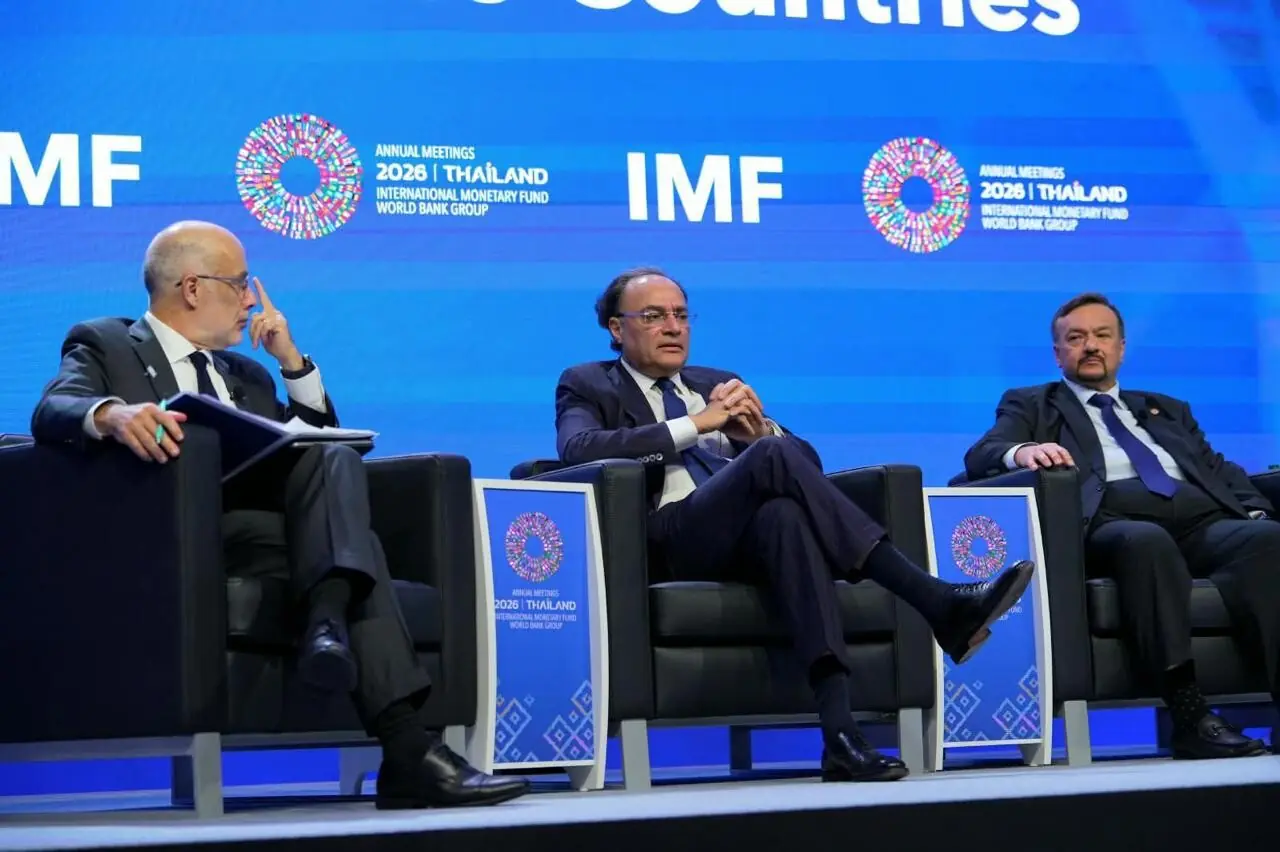
Federal Minister for Finance and Revenue Muhammad Aurangzeb has announced that Pakistan’s macroeconomic recovery is on track to achieve or exceed a 4% gross domestic product (GDP) growth rate during the current fiscal year. Speaking to global institutional investors at the World Bank Group–IMF Annual Meetings 2026 in Bangkok, Aurangzeb anchored his economic projections on three consecutive years of primary surpluses and a national fiscal deficit that has contracted to a 22-year low.
Capital Market Restructuring And Sovereign Debt
To capitalize on this macroeconomic stabilization, the Ministry of Finance is executing a sweeping capital market strategy designed to restructure the sovereign’s external liabilities without expanding the overall debt stock.
Aurangzeb confirmed plans to issue a novel “rupee-denominated, dollar-settled international bond,” alongside additional tranches of yuan-denominated “Panda bonds” and Islamic “Sukuks.” The administration is explicitly utilizing this renewed access to international capital markets to mitigate sovereign risk.
“He outlined financing diversification through Sukuk, Panda bonds and a proposed rupee-denominated, dollar-settled international bond, emphasising lower borrowing costs, longer debt maturities and reduced rollover risks.”
During direct negotiations with S&P Global Ratings, the finance minister aggressively lobbied to elevate Pakistan’s sovereign credit profile into the “double-B” rating category. He briefed the credit agency on the sovereign’s successfully executed September bond issuance, expanding foreign exchange reserves, and a structural reduction in central bank swap and forward liabilities.
In response, S&P executives established that sovereign upgrades remain strictly contingent upon policy continuity, a lower interest burden, and the expansion of external liquidity buffers.
Institutional Privatization And Global Capital Pursuit
Flanked by Secretary Finance Imdadullah Bosal and State Bank of Pakistan (SBP) Governor Jameel Ahmad, Aurangzeb executed a series of high-level investor roundtables organized by Citi, Jefferies International, Barclays, and Standard Chartered.
The Pakistani delegation marketed a robust domestic initial public offering (IPO) pipeline and explicitly courted foreign capital for the impending privatization of the nation’s electricity distribution network and major commercial airports. The administration assured global creditors of its strict adherence to the IMF-supported mandate, emphasizing aggressive tax-base expansion—specifically targeting agricultural income taxation—alongside state-owned enterprise (SOE) restructuring and digital tax enforcement.
Strategic Minerals And Multilateral Financing
Expanding beyond traditional debt markets, Aurangzeb secured strategic infrastructure development commitments during bilateral discussions with Imad Fakhoury, the International Finance Corporation (IFC) Regional Vice President for the Middle East and Central Asia.
The focal point of the negotiation was locking in IFC leadership to finance the massive Reko Diq strategic minerals extraction project. The officials also structured frameworks for private-sector capital deployment in affordable housing, advanced electricity metering, and agricultural cold-chain infrastructure.
Simultaneously, the finance minister engaged Ambassador Yon of the US State Department to advance a bilateral trade framework. The macroeconomic dialogue covered critical energy diversification through US imports, Financial Action Task Force (FATF) follow-ups, and project financing via the US Development Finance Corporation and EXIM Bank.
“The meeting also discussed Boeing aircraft acquisition and financing, aviation clearances, digital asset regulation and potential remittances and Eurobond tokenisation applications.”
The US bilateral talks concluded with structural reviews of critical minerals cooperation, project security, and the integration of digital asset tokenization within Pakistan’s sovereign frameworks.
Read More: Finance Minister Reaffirms Strict IMF Reform Mandate Amid Sovereign Debt Restructuring In Bangkok