

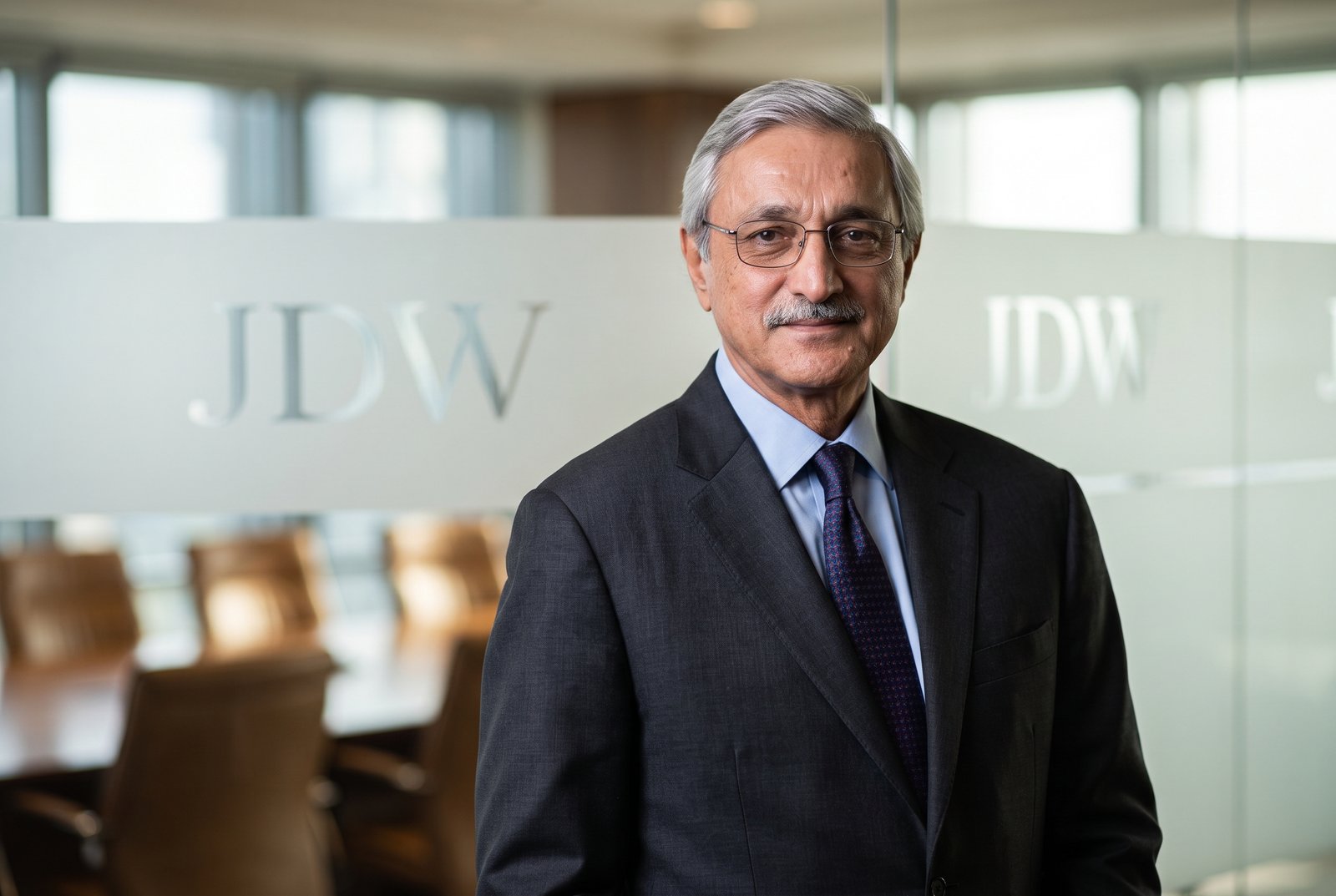
LAHORE: Jahangir Khan Tareen may have walked away from electoral politics, but the industrial enterprise with which his name has long been associated is entering another significant phase of expansion.
JDW Sugar Mills Limited, one of Pakistan’s prominent publicly listed sugar producers, is no longer simply a business built around crushing sugarcane and selling refined sugar. Its operations extend to ethanol production, electricity generation, agricultural farming and the commercial utilisation of sugarcane by-products.
The company’s financial disclosures reveal a business undergoing an important transformation. For the nine months ended June 30, 2026, JDW reported consolidated profit after tax of approximately Rs4.96 billion, compared with Rs3.41 billion during the corresponding period of the previous financial year.
That represents growth of approximately 45.6 per cent, an improvement of Rs1.55 billion.
At the centre of this transformation is an ethanol production facility with an initial designed capacity of 230,000 litres per day, marking a significant expansion into an industrial product with international market potential.
For Tareen, who announced his retirement from politics following the February 2024 general elections, the developments present a compelling contrast: his electoral career has receded, but his association with a substantial industrial enterprise continues.
The distinction is important. JDW is a publicly listed company with multiple shareholders and a formal management structure. It cannot accurately be described as Tareen’s exclusively owned business, even though he remains one of its prominent corporate figures.
From Political Power To Corporate Boardrooms
Jahangir Khan Tareen’s political career placed him among Pakistan’s most recognisable business figures.
A former federal minister, senior Pakistan Tehreek-e-Insaf leader and later chairman of the Istehkam-e-Pakistan Party, Tareen occupied an unusual position at the intersection of agriculture, industry and national politics.
His political influence became particularly visible during the formation of the PTI-led federal government following the 2018 general elections.
However, his political trajectory had already been complicated by the Supreme Court’s 2017 disqualification decision, subsequent differences within PTI and controversies surrounding the sugar industry.
Following the 2024 general elections, Tareen announced his resignation as chairman of the Istehkam-e-Pakistan Party and his withdrawal from politics.
His retirement announcement marked the end of an important chapter in his public career.
Nevertheless, withdrawal from electoral politics should not be confused with complete disengagement from public affairs.
In May 2024, Tareen was named among the members of Prime Minister Shehbaz Sharif’s Economic Advisory Council, demonstrating that his business background continued to attract attention in economic policymaking circles even after his retirement announcement.
The available record therefore supports a narrower conclusion: Tareen retired from active party and electoral politics rather than disappearing entirely from economic or public life.
Who Actually Controls JDW Sugar Mills?
JDW Sugar Mills Limited was incorporated in May 1990 and subsequently converted into a public limited company in August 1991.
The company is listed on the Pakistan Stock Exchange under the symbol JDWS.
Its ownership structure is more complex than the popular description of JDW as simply Jahangir Tareen’s sugar mill.
According to the company’s corporate governance disclosures for the financial year ended September 30, 2025, Tareen served as an executive director.
Raheal Masud was identified as chief executive officer, while Makhdoom Syed Ahmed Mahmud chaired the board.
Other directors included Syed Mustafa Mehmud, Ijaz Ahmed, Samira Mahmud and independent directors.
This governance structure demonstrates that JDW operates through a board comprising several individuals with distinct responsibilities.
The Pakistan Stock Exchange identifies 57,776,661 issued shares in the company, with a free float of approximately 15 per cent.
That relatively limited free float makes the identity of major shareholders particularly relevant to understanding corporate control.
However, a definitive assessment of Tareen’s current beneficial ownership requires examination of the latest shareholder register, associated holdings and any indirect interests.
It would be misleading to attribute JDW’s entire market capitalisation or consolidated profits personally to Tareen.
JDW’s Industrial Structure Extends Beyond Sugar
JDW’s consolidated operations include several subsidiaries.
According to its annual report for the year ended September 30, 2025, these included Deharki Sugar Mills (Private) Limited, Ghotki Power (Private) Limited, Sadiqabad Power (Private) Limited and Faruki Pulp Mills Limited.
The reported ownership interests were:
| Subsidiary | JDW Holding |
| Deharki Sugar Mills | 100% |
| Ghotki Power | 100% |
| Sadiqabad Power | 100% |
| Faruki Pulp Mills | 57.47% |
These companies illustrate the group’s diversification across sugar production, energy and industrial processing.
Such integration matters because sugar manufacturing produces several commercially valuable by-products.
Molasses can be converted into ethanol, while bagasse can be used to generate electricity. Other residues may also have agricultural or industrial applications.
Consequently, the financial performance of a vertically integrated sugar producer cannot be assessed solely through the retail price of sugar.
The Ethanol Expansion: A New Growth Engine?
Perhaps the most significant recent development at JDW is its investment in ethanol production.
The company’s FY2025 annual report confirms that its ethanol project commenced trial production on July 12, 2025, before beginning full production on August 1, 2025.
The facility was designed for an initial production capacity of 230,000 litres per day.
JDW subsequently reported that the plant was operating above its original design capacity, exceeding 250,000 litres per day at the time described in its annual report.
The distinction between design capacity and reported operating output is important. Higher operating rates do not necessarily establish that the plant can sustain the same production level throughout an entire year.
Ethanol is produced from molasses, a by-product of sugar manufacturing, and has applications in industrial processing, chemicals, pharmaceuticals and fuel blending in markets where regulations permit its use.
For sugar manufacturers, ethanol production provides an opportunity to monetise raw materials that would otherwise be sold as intermediate products.
Rather than depending exclusively on sugar sales, integrated producers can potentially generate revenue from several stages of sugarcane processing.
This creates a fundamentally different commercial model from that of a standalone sugar mill.
The economics, however, depend on molasses availability, feedstock costs, international ethanol prices, exchange rates, plant utilisation and export logistics.
A large production capacity does not automatically translate into proportionately large profits.
JDW’s actual ethanol revenue, operating margins and capital returns therefore deserve close examination before the project can be described as a proven financial success.
What Do JDW’s Latest Financial Results Reveal?
The group’s nine-month results for FY2026 provide an important indication of its financial direction.
JDW’s consolidated profit after tax increased from approximately Rs3.41 billion in the nine months ended June 2025 to Rs4.96 billion during the corresponding period of 2026.
The improvement represents an increase of approximately Rs1.55 billion, or 45.6 per cent.
These figures demonstrate substantial year-on-year profit growth despite the broader challenges associated with Pakistan’s agricultural and manufacturing sectors.
Nevertheless, higher consolidated profits do not, by themselves, establish how much of the improvement originated from ethanol.
Sugar prices, inventory valuation, financing costs, operating efficiency, production volumes and electricity revenue may all influence consolidated profitability.
A meaningful financial assessment must therefore distinguish between the group’s overall earnings and the individual contributions of its business segments.
JDW’s half-year financial disclosures also reported a second interim cash dividend of Rs5 per share for FY2026, in addition to an earlier Rs20 per share distribution.
The cumulative Rs25 per share illustrates the company’s shareholder distributions during the period, although dividends should not be confused with the total profit earned by its shareholders.
Electricity: Another Business Built Around Sugarcane
JDW’s diversification into electricity generation predates its latest ethanol investment.
The company operates two bagasse-based power facilities with a combined installed capacity of 53.4 megawatts.
The first, a 26.6 MW facility at JDW Unit-II in Sadiqabad, commenced commercial operations in June 2014.
The second, a 26.8 MW facility at JDW Unit-III in Ghotki, began commercial operations in October 2014.
Both use bagasse, the fibrous material remaining after sugarcane is crushed, as an energy source.
According to JDW’s FY2025 annual report, the power operations recorded gross revenue of approximately Rs7.04 billion and delivered 383,551 megawatt-hours of electricity during the financial year.
This is an important component of the group’s industrial structure.
While sugar production remains dependent on agricultural conditions and market prices, electricity generation can provide another source of revenue through contractual power arrangements.
However, the economics of these projects also depend on tariff structures, operating expenses, receivables and the financial condition of the electricity purchasing system.
The existence of power generation assets does not automatically mean that every rupee of reported electricity revenue translates into additional profit.
Corporate Farming: Controlling More Of The Supply Chain
JDW’s business model extends beyond manufacturing facilities into agricultural production and research.
The company reports operating corporate farms and investing in mechanised harvesting, irrigation technology, sugarcane breeding and disease management.
Its FY2025 annual report describes the use of GPS-enabled agricultural equipment, precision farming, drone spraying and improved seed development.
The company also reported installing 53 solar-powered irrigation turbines during 2025.
Its mechanised harvesting operations included 20 harvesters, with stated capacity to harvest more than 500,000 tonnes of sugarcane over approximately 15,000 acres per season.
Such investments can potentially improve agricultural productivity and reduce harvesting losses.
They may also strengthen a manufacturer’s ability to secure consistent sugarcane supplies, an important consideration in a sector where procurement competition and crop availability can materially affect operations.
The wider economic question is whether improvements in agricultural productivity translate into better returns for growers, lower production costs, higher industrial margins or some combination of these outcomes.
For JDW, corporate farming is therefore more than an ancillary business. It forms part of an integrated supply-chain strategy.
How Much Of Pakistan’s Sugar Market Does JDW Control?
JDW’s position in Pakistan’s sugar industry is central to understanding the significance of its diversification.
The group operates multiple sugar production facilities across Punjab and Sindh, including its own manufacturing units and its wholly owned subsidiary, Deharki Sugar Mills.
However, the number of mills owned by a group is not sufficient to establish its national market share.
A reliable calculation requires actual sugar production by JDW and its subsidiaries for a specified crushing season, divided by Pakistan’s total sugar production during the same period.
Installed crushing capacity, sugarcane processed and finished sugar output are three different measurements.
Using them interchangeably can produce misleading market-share estimates.
This distinction is particularly important when examining Pakistan’s sugar industry, where ownership concentration, production capacity, domestic supply and export permissions frequently become subjects of political and regulatory debate.
JDW’s precise share of national sugar production should therefore be calculated from matching company and industry figures rather than inferred from its prominence.
The Sugar Controversies That Followed Tareen’s Political Career
No serious examination of Jahangir Khan Tareen’s business interests can ignore the controversies surrounding Pakistan’s sugar industry.
In 2020, sugar prices, export policies, subsidies and allegations of coordinated industry conduct became subjects of government investigations and public debate.
The Competition Commission of Pakistan also investigated possible anti-competitive practices involving the sugar industry.
In September 2020, the CCP conducted an inspection at JDW’s Lahore headquarters as part of its investigation into suspected cartelisation and exchanges of commercially sensitive information.
The investigation raised questions about the circulation of information concerning sugar stocks, production, sales and crushing activities.
However, regulatory inspections and investigative allegations must be distinguished from final findings of liability.
The existence of an investigation does not, by itself, establish that JDW or Tareen committed a particular violation.
Any assessment of these historical controversies must consider subsequent regulatory proceedings, judicial decisions and the responses of the parties concerned.
The broader policy issue remains significant: Pakistan’s sugar industry operates in a market where government interventions, agricultural procurement, import and export decisions, and the conduct of major producers can all influence commercial outcomes.
Can Ethanol Reduce Dependence On Sugar Prices?
JDW’s entry into large-scale ethanol production offers an opportunity to examine whether Pakistan’s sugar industry is moving towards a more diversified business model.
Sugar prices can be volatile, influenced by production levels, crop conditions, government policy and market demand.
Ethanol, by contrast, creates exposure to industrial and international commodity markets.
This diversification can provide additional revenue opportunities, but it introduces its own risks.
International ethanol prices fluctuate, export markets have varying quality requirements, and molasses prices can change depending on domestic and overseas demand.
Furthermore, ethanol production remains linked to sugarcane processing because molasses is an important feedstock.
Consequently, diversification does not eliminate agricultural risk.
JDW’s ethanol investment is significant because it demonstrates an effort to extract greater commercial value from the sugarcane supply chain.
Whether that strategy produces sustainably higher shareholder returns will become clearer through subsequent financial reporting.
What Does The Expansion Mean For Pakistan’s Economy?
The wider implications extend beyond JDW.
Pakistan’s agricultural processing sector has historically faced challenges involving productivity, energy costs, access to finance and limited value addition.
Industrial conversion of agricultural by-products into higher-value products offers one potential avenue for improving export earnings.
Ethanol can be an internationally traded product, while bagasse-based electricity generation can reduce dependence on conventional fuels.
Modern farming practices may also contribute to higher yields and more efficient use of agricultural resources.
However, the national economic benefits depend on actual export receipts, domestic value addition, employment, tax contributions and resource efficiency.
A project that is commercially successful for its shareholders is not necessarily equivalent to a measurable national economic gain of the same magnitude.
JDW’s FY2025 annual report states that the group contributed approximately Rs28.44 billion to the national exchequer in taxes and duties.
That figure should be interpreted as the company’s reported group-level contribution rather than an independently calculated measure of net economic benefit.
What Comes Next For Jahangir Tareen?
The most interesting question surrounding Jahangir Khan Tareen may no longer be whether he intends to return to electoral politics.
Instead, it concerns the direction of the industrial enterprise with which he has been associated for decades.
JDW’s ethanol facility, electricity operations, agricultural investments and expanding industrial integration suggest that the group’s commercial future will increasingly be shaped by activities beyond conventional sugar production.
The company’s FY2025 disclosures also identify Tareen as chairman of its nomination and risk management committees, underscoring his continuing role in corporate governance.
That is a different kind of influence from holding elected office, but it remains relevant to the company’s strategic direction.
At the same time, the available public disclosures do not establish that Tareen personally directed every investment decision or that the group’s latest financial improvements can be attributed exclusively to him.
Those distinctions matter when examining a listed company with multiple shareholders, directors and professional managers.
The Bigger Picture
Jahangir Khan Tareen’s departure from active electoral politics represents a significant change in his public career.
Yet JDW Sugar Mills’ recent industrial expansion demonstrates that the business associated with his name remains commercially active.
The company’s consolidated profit growth, investment in ethanol, established electricity operations and agricultural integration offer a case study in how Pakistan’s traditional sugar producers are attempting to build additional revenue streams.
Whether this transformation ultimately produces sustainable profitability, stronger exports and broader economic benefits will depend on the performance of these investments over time.
For investors, the crucial questions concern earnings, debt, cash flows and returns on capital.
For regulators, they concern competition, transparency and market conduct.
For policymakers, they concern whether agricultural processing can become a more productive and export-oriented component of Pakistan’s economy.
And for Jahangir Khan Tareen, the story is now less about electoral contests and more about the continuing evolution of a business enterprise that remains closely associated with his public identity.
He may have retired from politics, but the next chapter of JDW’s industrial development is already under way.
Read More: Gohar Ejaz’s Formula: Pakistan Can Grow Exports Without Devaluing The Rupee