

LAHORE: Pakistan’s sugar industry operates at the intersection of agriculture, industrial production, financial markets and government policymaking. Despite producing millions of tonnes of sugar annually, the country continues to face recurring controversies involving prices, export permissions, imports, stock availability and allegations of anti-competitive behaviour.
The industry is not merely a collection of sugar mills processing agricultural produce. It is an extensive commercial network involving sugarcane growers, industrial groups, financial institutions, distributors, exporters and businesses engaged in ethanol production, electricity generation and other related activities.
Its economic significance is considerable. Based on reported domestic consumption volumes, Pakistan’s annual retail sugar market can approach or exceed Rs1 trillion, depending on prevailing prices.
Yet fundamental questions remain about how the market functions.
Who controls the largest share of sugar production? How concentrated is ownership? Who benefits from export permissions? What happens when domestic prices rise? And why has an industry repeatedly investigated for alleged anti-competitive practices continued to feature prominently in national economic controversies?
The latest development has brought these questions back into focus.
On October 13, 2026, the State Bank of Pakistan (SBP) issued revised instructions concerning the export of 200,000 metric tonnes of sugar, following federal approval and the submission of mill-wise allocations through the Pakistan Sugar Mills Association (PSMA).
The revised arrangements had been endorsed by Punjab and Sindh, while Khyber Pakhtunkhwa’s endorsement remained pending under the latest instructions.
The decision comes against the backdrop of a historical Rs44 billion competition penalty, subsequent legal proceedings, fresh allegations of coordinated sugarcane procurement and a controversial period during which Pakistan authorised substantial sugar exports before subsequently approving imports to stabilise domestic supplies.
Although none of these developments alone establishes that the industry operates as a cartel, together they provide compelling grounds for examining the transparency, competitiveness and accountability of Pakistan’s sugar market.
The Rs44 Billion Sugar Cartel Case: What Actually Happened?
In August 2021, the Competition Commission of Pakistan (CCP) imposed penalties totalling approximately Rs44 billion on the PSMA and its member sugar mills over alleged violations of competition law.
The proceedings concerned suspected anti-competitive practices, including coordination among competing businesses.
The case became one of the largest competition enforcement actions in Pakistan’s history.
However, its subsequent legal developments are frequently overlooked in public discussions.
The original CCP adjudicating bench comprised four members who were equally divided. Two supported findings of violations and the imposition of penalties, while two dissented.
The then chairperson exercised a casting vote.
The Competition Appellate Tribunal subsequently set aside the order because of the procedure used to resolve the split decision.
In May 2025, the tribunal directed that the matter be reheard by a chairperson or member who had not participated in either of the original conflicting opinions.
On July 9, 2025, the CCP announced fresh hearing notices, with proceedings scheduled for August.
The distinction is important.
The approximately Rs44 billion figure represents the historical penalty imposed in 2021, not an independently established outstanding liability following the tribunal’s intervention.
The final outcome of the rehearing and any subsequent appeals requires confirmation.
Nevertheless, the case remains significant because it demonstrates the seriousness of the competition concerns that have surrounded the sugar industry.
It also raises a broader question about enforcement.
If a major competition case remains unresolved for years because of procedural and legal disputes, what does that mean for the effectiveness of market regulation?
Who Controls Pakistan’s Sugar Mills?
One of the most important aspects of the industry is ownership concentration.
The number of operating sugar mills does not necessarily indicate the number of independent competitors.
Several factories may belong to the same corporate group or be controlled by related shareholders.
This distinction matters when evaluating market power.
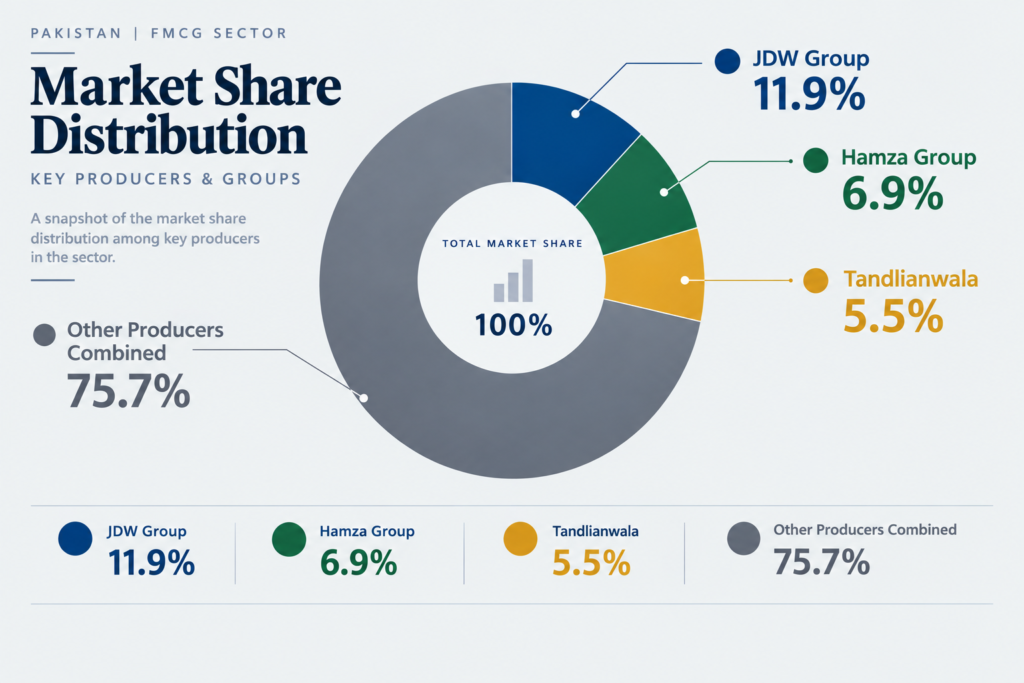
According to PACRA’s April 2026 sugar-sector assessment, the three largest identified production groups accounted for approximately 24.3% of Pakistan’s sugar output in marketing year 2024.
Major Sugar Groups By Production Share — MY2024
| Sugar group | Market share |
| JDW Group | 11.9% |
| Hamza | 6.9% |
| Tandlianwala | 5.5% |
| Other producers combined | 75.7% |
JDW Group emerged as the largest identified producer, accounting for nearly 12% of national output.
Hamza followed with 6.9%, while Tandlianwala accounted for 5.5%.
These three groups collectively produced almost one-quarter of the country’s sugar during the referenced period.
However, the remaining 75.7% should not be interpreted as a single competitive block. It includes numerous producers, some of which may share ownership or commercial affiliations.
The figures also relate to MY2024 and should not be presented as October 2026 market shares.
The more revealing investigation would identify the beneficial owners of every major sugar group and calculate concentration at the ownership level.
It would also examine regional markets.
Sugarcane is a bulky agricultural commodity that must generally be processed relatively quickly after harvesting.
Transporting it over long distances can be expensive and commercially impractical.
Consequently, a farmer’s choice of buyers may be restricted to a small number of mills operating within an economically viable distance.
This means that even an industry with numerous factories can contain local markets where growers face limited competition.
The Ownership Question: Tandlianwala And The Wider Corporate Structure
PACRA’s November 2025 assessment of Tandlianwala Sugar Mills provides an example of the ownership structures that deserve greater scrutiny.
According to the assessment, the Akhtar Group and associated family members controlled approximately 84% of the company.
The company has interests extending beyond conventional sugar production, including ethanol and carbon dioxide operations.
This illustrates two important characteristics of the industry.
First, beneficial ownership may be concentrated within particular business groups.
Second, sugar production can be part of a diversified industrial operation rather than a standalone business.
Ownership concentration does not itself establish anti-competitive behaviour.
However, understanding who controls the mills is essential to assessing market concentration, financial incentives and the distribution of export opportunities.
A comprehensive industry ownership register would allow regulators, investors and consumers to identify related-party interests and distinguish genuinely independent competitors from commonly controlled operations.
Pakistan’s Sugar Market: Nearly Rs1 Trillion At Rs150 Per Kilogramme
The financial scale of Pakistan’s sugar market becomes apparent when consumption is converted into expenditure.
According to the PSMA’s Annual Review 2025, average monthly domestic sugar consumption was approximately 553,662 tonnes.
Annualised, this represents around 6.64 million tonnes, equivalent to approximately 6.64 billion kilogrammes.
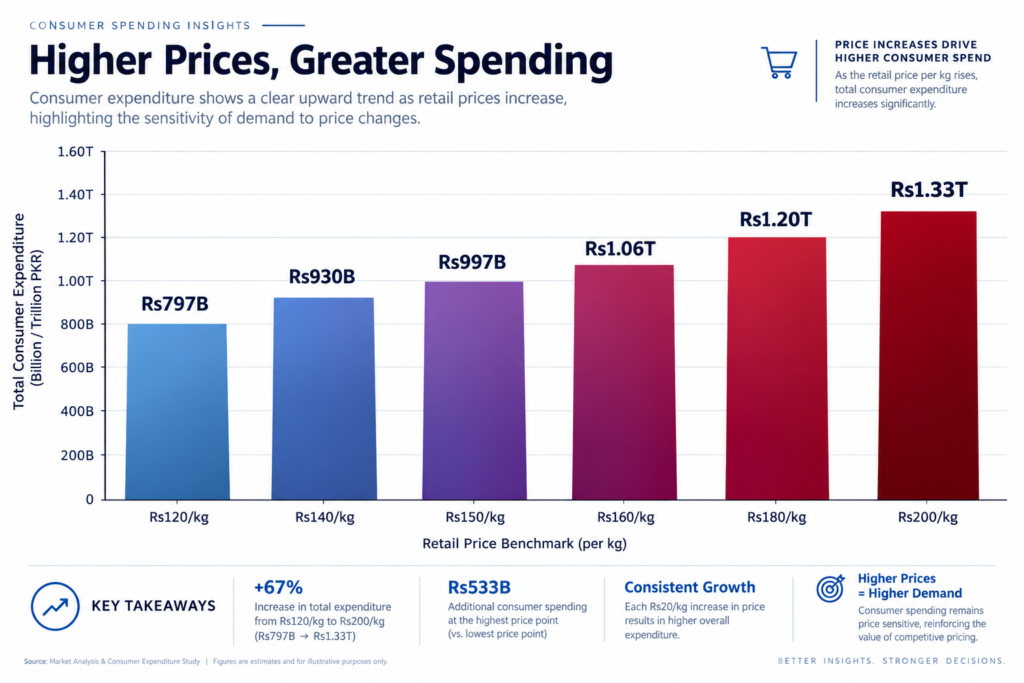
At an illustrative average retail price of Rs150 per kilogramme, this volume represents annual consumer expenditure of approximately Rs996.6 billion.
At Rs180 per kilogramme, the figure rises to approximately Rs1.196 trillion.
These estimates are based on annualised consumption and assumed prices rather than audited annual retail sales.
Nevertheless, they demonstrate the enormous financial implications of changes in sugar prices.
Pakistan’s Illustrative Annual Sugar Market Value
| Average retail price | Estimated annual expenditure |
| Rs120/kg | Rs797.3 billion |
| Rs140/kg | Rs930.2 billion |
| Rs150/kg | Rs996.6 billion |
| Rs160/kg | Rs1.063 trillion |
| Rs180/kg | Rs1.196 trillion |
| Rs200/kg | Rs1.329 trillion |
A sustained Rs10-per-kilogramme increase across this annualised consumption volume would translate into approximately Rs66.4 billion in additional annual expenditure.
A Rs20 increase would imply Rs132.9 billion, while a Rs30 increase would represent approximately Rs199.3 billion.
These figures do not represent profits earned by sugar mills.
The additional expenditure would be distributed across different stages of the supply chain, while production costs, taxes, inventories and changes in demand would affect the actual financial impact.
However, the calculations illustrate why sugar prices carry such significant consequences for households, businesses and inflation.
The Export–Import Paradox: Pakistan Sold Sugar Abroad, Then Approved Imports
One of the most consequential developments in Pakistan’s recent sugar policy was the sequence of export permissions followed by import approvals.
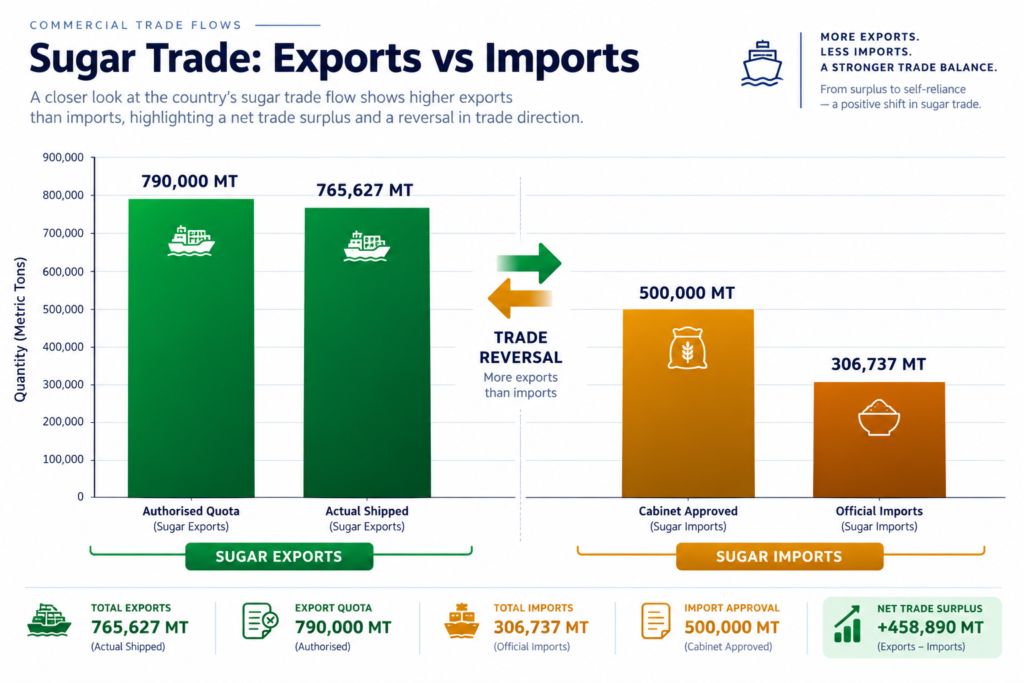
According to the PSMA’s Annual Review 2025, the government authorised exports totalling 790,000 tonnes through successive permissions.
The association reported cumulative exports of approximately 765,627 tonnes by September 2025.
However, the PSMA’s stock-accounting figures also record exports of 388,425 tonnes during the December 2024–September 2025 period.
These figures cover different accounting periods and should not be treated as contradictory or interchangeable.
The larger figure represents cumulative exports under the relevant government permissions, while the smaller figure relates to the association’s specified stock-accounting period.
The distinction matters because accurate comparisons require consistent reporting dates.
Pakistan subsequently approved imports of 500,000 tonnes to help stabilise domestic sugar prices.
A corporate briefing released through the Pakistan Stock Exchange later reported actual official imports of 306,737 tonnes.
Reuters also reported in August 2025 that Pakistan had arranged an initial sugar purchase of 30,000 tonnes at an estimated price of $582.50 per tonne, including cost and freight.
The policy sequence raises an important question.
How did Pakistan move from permitting substantial exports to approving large-scale imports?
The answer cannot be established simply by comparing the headline quantities.
Production estimates, opening inventories, domestic consumption, seasonal demand, export shipment dates and import arrivals must all be reconciled.
Nevertheless, the sequence demonstrates the importance of accurate forecasting and independent stock verification.
Pakistan’s Recent Sugar Trade Decisions
| Indicator | Reported quantity |
| Export permissions reported by PSMA | 790,000 tonnes |
| Cumulative exports by September 2025 | 765,627 tonnes |
| Exports during December 2024–September 2025 stock-accounting period | 388,425 tonnes |
| Government-approved imports | 500,000 tonnes |
| Actual official imports reported in PSX briefing | 306,737 tonnes |
| Fresh export authorisation in 2026 | 200,000 tonnes |
The export and import figures represent different measures and reporting periods.
They should not be added together or used to calculate a net trade balance without a consistent time series.
What Happened To Pakistan’s Sugar Stocks?
The PSMA’s 2025 annual review recorded sugar stocks of approximately 726,252 tonnes as of September 30, 2025.
This figure provides an important reference point for understanding domestic availability.
However, stock figures are meaningful only when examined alongside expected consumption, new production, imports and exports.
For example, at the PSMA’s reported average monthly consumption rate of 553,662 tonnes, stocks of 726,252 tonnes would represent approximately 1.31 months of consumption if no additional supplies became available.
That calculation is illustrative rather than a measure of actual shortage risk.
Pakistan’s sugar supply is seasonal, and inventories change substantially as new crushing operations begin.
The broader issue is whether stock declarations are independently verified before export permissions are granted.
A transparent national sugar balance sheet should reconcile production, opening stocks, domestic sales, exports, imports and closing inventories.
Without such a system, disputes over whether Pakistan has surplus sugar are likely to continue.
The Government’s Position: Exports Were Based On Available Surpluses
The federal government has maintained that previous sugar exports were authorised after reviewing domestic availability.
Federal Minister for National Food Security and Research Rana Tanveer Hussain previously stated that Pakistan exported approximately 750,000 tonnes of surplus sugar, generating around $402 million.
He said the government had maintained a strategic buffer stock of 500,000 tonnes.
The minister also argued that sugar prices initially declined following export permission, from Rs138 to Rs119 per kilogramme.
According to the government’s position, subsequent market disturbances were linked to hoarding and speculative activity rather than an underlying shortage.
These claims form an important part of the policy debate.
If exports were authorised against verified surpluses, the supporting production estimates, stock statements and consumption forecasts should be available for independent examination.
Similarly, allegations of hoarding should be assessed against documented enforcement proceedings and market transactions.
The question is not whether the government or industry is automatically correct.
It is whether the evidence supporting major policy decisions is sufficiently transparent to withstand independent scrutiny.
Ten Sugar Mills Face Fresh Allegations Of Coordinating Cane Prices
While most public attention focuses on consumer sugar prices, competition concerns also extend to the agricultural side of the industry.
On November 28, 2025, the CCP announced show-cause notices against ten sugar mills in Punjab over alleged coordination concerning sugarcane procurement prices and crushing schedules.
According to the commission, representatives of the mills participated in a meeting held on November 10, 2025, at Fatima Sugar Mills.
The CCP alleged that participants agreed to commence crushing operations on November 28 rather than November 15, the date notified by Punjab’s Sugarcane Commissioner.
It further alleged that the mills agreed on a sugarcane procurement price of Rs400 per maund, equivalent to 40 kilogrammes.
The ten mills named in the proceedings were:
- Fatima Sugar Mills
- Sheikhoo Sugar Mills
- Thal Industries Corporation
- Tandlianwala Sugar Mills, Rehman Hajra Unit
- JK-1 Sugar Mills
- Ashraf Sugar Mills
- Kashmir Sugar Mills
- Siraj Sugar Mills
- Two Star Sugar Mills
- Haq Bahoo Sugar Mills
These were regulatory allegations contained in show-cause proceedings, not final findings establishing liability.
The mills’ responses and the eventual adjudication are essential to determining the outcome.
Nevertheless, the case highlights an often-overlooked aspect of competition in Pakistan’s sugar market.
Farmers can be affected not only by the prices mills pay but also by when crushing begins.
Delays can create logistical and financial difficulties, particularly for growers with limited storage options or immediate payment obligations.
Where farmers have few alternative buyers, coordinated procurement decisions could potentially weaken their bargaining position.
The CCP’s allegations therefore raise questions about competition on both sides of the sugar supply chain.
October 2026: Another 200,000 Tonnes Approved For Export
The latest export decision has renewed scrutiny of how Pakistan allocates valuable commercial opportunities among sugar producers.
On September 15, 2026, the federal government announced a decision to permit the export of 200,000 metric tonnes of sugar following consideration by the Sugar Advisory Board.
On October 2, the SBP issued instructions to authorised banks regarding the processing of export transactions.
The central bank subsequently revised its instructions on October 13 after receiving updated mill-wise allocations and corrections to three mills’ names.
The allocations were communicated through the PSMA.
Punjab and Sindh endorsed the revised quotas for their respective mills, while Khyber Pakhtunkhwa’s endorsement remained pending under the latest circular.
Under the arrangements, exporters must use sight letters of credit or advance payments, with shipments to be made by sea.
Banks are required to conduct due diligence and submit weekly reports on export transactions and shipments.
No specific shipment deadline was prescribed.
Contemporary reporting indicates that the allocation exercise involved 79 mills, with quantities linked to crushing performance.
The complete individual allocation schedule requires separate examination before the largest beneficiaries can be identified conclusively.
The use of crushing performance as an allocation criterion may provide an administratively straightforward method of distributing export permissions.
However, it also raises questions about whether historical production advantages translate into greater access to export opportunities.
Larger producers may receive larger quotas because they process more cane.
That outcome is not inherently improper, but transparency is essential.
The public should be able to examine each mill’s allocated quantity, verified crushing figures and actual shipments.
How Much Is The New Export Quota Worth?
The financial value of the latest 200,000-tonne export authorisation depends on actual international prices and shipment volumes.
At an assumed export price of $400 per tonne, the entire quota would represent gross proceeds of approximately $80 million.
At $500 per tonne, the potential value would increase to $100 million.
At $600 per tonne, it would reach $120 million.
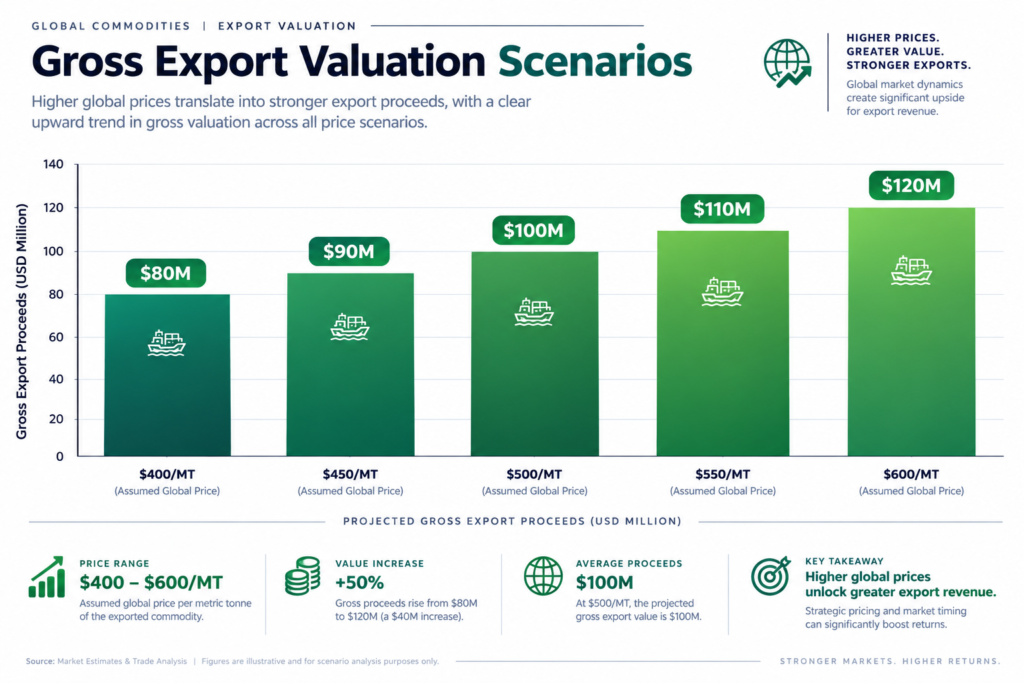
Illustrative Gross Value Of The 200,000-Tonne Export Quota
| Assumed export price | Potential gross value |
| $400 per tonne | $80 million |
| $450 per tonne | $90 million |
| $500 per tonne | $100 million |
| $550 per tonne | $110 million |
| $600 per tonne | $120 million |
These are hypothetical valuations, not verified export contracts or profit estimates.
Actual proceeds will depend on the quantities shipped and realised export prices.
Nevertheless, the calculations demonstrate that the latest decision creates access to a substantial international trading opportunity.
The critical question is how that opportunity is distributed among competing producers.
Why The PSMA’s Role Deserves Scrutiny
Industry associations perform legitimate functions, including representing members in policy discussions and communicating commercial concerns to regulators.
However, competition authorities generally distinguish between legitimate industry representation and coordination that restricts independent commercial decision-making.
The PSMA’s documented role in transmitting export allocations does not, by itself, establish unlawful conduct.
The latest allocations also involve government authorisation and provincial endorsement.
Nevertheless, the industry’s history of competition proceedings makes the transparency of the process especially important.
Regulators should be able to establish whether the association’s role was strictly administrative, how the allocation formula was determined and what safeguards governed the exchange of commercially sensitive information.
The broader question is whether an independent public authority should directly administer and publish export allocations rather than relying on an industry association to communicate them.
Production Figures: Why Pakistan Needs A Reliable National Sugar Balance Sheet
Pakistan’s sugar production figures vary depending on the reporting source and marketing-year definition.
The PSMA’s Annual Review 2025 reported production of 5,862,391 tonnes, including approximately 92,786 tonnes from sugar beet.
PACRA’s 2026 industry assessment, meanwhile, cited approximately 6.66 million tonnes for MY2025, compared with around 5.8 million tonnes for MY2024.
These figures should not be treated as directly comparable without reconciling their reporting periods and methodologies.
The differences highlight the importance of consistent national reporting.
According to PACRA, the provincial distribution of sugar production in MY2025 was as follows:
Provincial Sugar Production Shares
| Province | Share |
| Punjab | 68.5% |
| Sindh | 24.8% |
| Khyber Pakhtunkhwa | 6.7% |
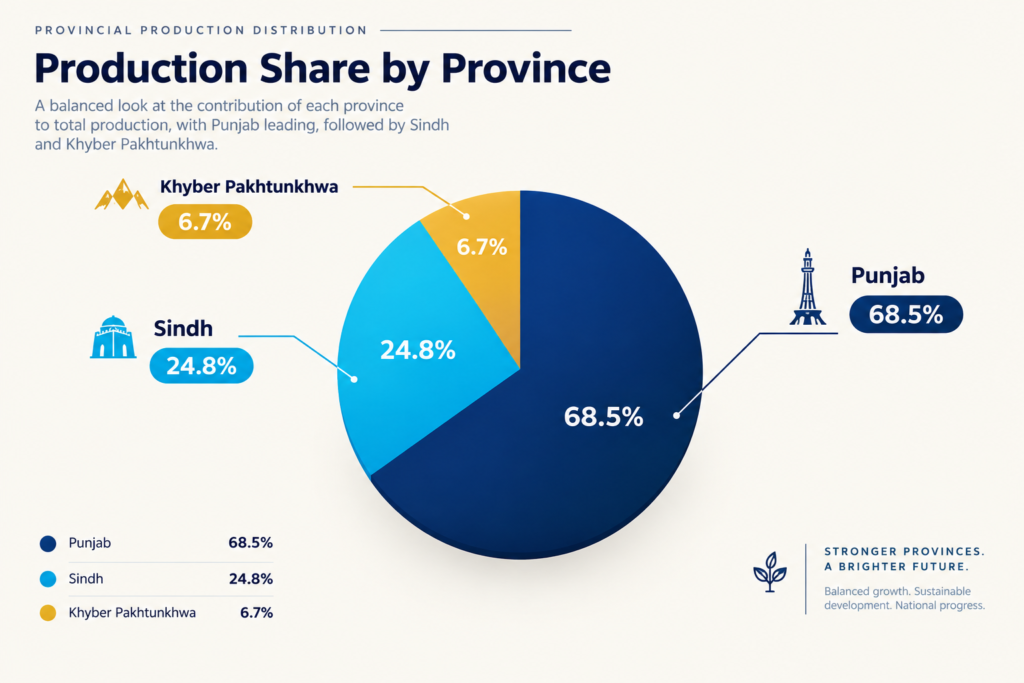
Punjab accounts for more than two-thirds of production under this assessment.
This concentration means that developments affecting Punjab’s sugarcane crop, crushing schedules and industrial operations can have significant consequences for national supply.
A transparent national balance sheet should provide independently reconciled figures for production, stocks, domestic consumption, imports and exports.
Such a system would allow policymakers to assess whether export permissions are consistent with expected domestic requirements.
The Hidden Economics Of Sugar: Ethanol, Molasses And Electricity
Sugar production is only one component of the industry’s broader financial structure.
Processing sugarcane generates molasses and bagasse, which can be used in other commercial activities.
Molasses provides feedstock for ethanol production, while bagasse can be used as fuel for boilers and electricity generation.
Some sugar groups operate distilleries, energy facilities and related industrial businesses.
This matters because a mill’s financial performance cannot always be assessed solely by comparing the price of sugar with the cost of sugarcane.
By-product operations may generate additional revenues or reduce operating costs.
However, those activities also involve capital expenditure, financing, maintenance and processing costs.
The appropriate measure is therefore consolidated profitability, supported by segment-level financial disclosures where available.
A comprehensive assessment should examine sugar sales, molasses, ethanol, electricity, financing costs, cane procurement expenses and sugar recovery rates.
Without this information, claims about the industry’s overall profitability remain incomplete.
Who Actually Benefits When Sugar Prices Rise?
Rising retail sugar prices do not automatically translate into equivalent profits for sugar mills.
The commodity passes through several commercial stages before reaching consumers.
Mills sell sugar to wholesalers, distributors and other buyers, who may subsequently supply retailers and industrial users.
Businesses holding inventories can benefit from price increases even when the original producer has already sold the commodity.
Conversely, higher raw material costs, financing expenses and operating costs may reduce mill profitability.
A proper analysis therefore requires comparison of ex-mill, wholesale and retail prices.
If sugar leaves a mill at Rs140 per kilogramme and reaches consumers at Rs170, the Rs30 difference cannot automatically be attributed to the mill.
Transport, taxes, handling, financing and distribution margins must be considered.
The Pakistan Bureau of Statistics publishes retail price data through its Sensitive Price Indicator system.
Comparing these figures with ex-mill prices, wholesale quotations and international market movements would help identify periods of unusual price divergence.
Such analysis would provide a stronger evidentiary basis for investigating market conduct than relying solely on retail price increases.
Market Concentration Is Not The Same As Cartelisation
The existence of large producers or politically connected business owners does not automatically establish a cartel.
Competition-law violations require evidence of prohibited conduct.
This may include price-fixing agreements, coordinated restrictions on output, market allocation, bid-rigging or unlawful exchanges of commercially sensitive information.
Similarly, high profits do not by themselves establish anti-competitive behaviour.
However, concentrated ownership and repeated allegations of coordination can justify closer regulatory scrutiny.
Pakistan’s sugar sector has experienced both substantial competition proceedings and recurring disputes over export permissions and pricing.
The challenge is to distinguish legitimate commercial activity from conduct that unlawfully restricts competition.
That requires independent investigations, legally sustainable decisions and transparent enforcement.
Farmers And Consumers: The Two Sides Of The Same Market
Sugar policy affects millions of consumers and a substantial agricultural supply chain.
Farmers depend on timely crushing, accurate weighing, competitive procurement prices and prompt payments.
Consumers depend on adequate supply and prices that reflect legitimate market conditions.
Industrial users, including bakeries, confectionery manufacturers and beverage companies, also rely on sugar as a major input.
Price increases can therefore affect the cost of numerous other food products.
A balanced policy framework must account for these interests alongside the legitimate financial requirements of sugar mills.
What Needs To Change?
Pakistan’s sugar industry requires a more transparent system of production reporting, stock verification, export allocation and competition enforcement.
First, national sugar inventories should be independently verified and regularly disclosed.
Second, export quotas should be published with mill-wise quantities, the allocation formula and actual shipment records.
Third, beneficial ownership information should be used to assess market concentration at the corporate-group level rather than simply counting factories.
Fourth, the CCP’s proceedings should be pursued transparently, with final decisions and appeal outcomes made publicly accessible.
Fifth, farmer payment records and crushing schedules should be monitored to detect potential procurement-market abuses.
Sixth, production and consumption estimates should follow consistent reporting periods so that policy decisions can be evaluated against reliable data.
Finally, financial analysis of the industry should account for material by-product operations, including ethanol and energy generation.
These reforms would not eliminate fluctuations in sugar prices, which can also reflect weather conditions, production costs and international market developments.
However, they would make it easier to distinguish legitimate market movements from potentially anti-competitive conduct.
The Questions Pakistan’s Sugar Industry Must Answer
Pakistan’s latest decision to permit another 200,000 tonnes of sugar exports presents an opportunity to examine the industry’s structure and governance.
Which mills received the largest quotas?
Who ultimately owns those mills?
Were their crushing figures and inventories independently verified?
How much sugar will actually be exported?
What prices will exporters receive?
And what safeguards are in place to protect domestic consumers if supply conditions change?
These questions can be answered through official records, corporate disclosures, customs data and regulatory proceedings.
The historical Rs44 billion competition case illustrates the difficulties of obtaining legally sustainable enforcement outcomes.
The subsequent allegations concerning coordinated cane procurement demonstrate that competition concerns extend to farmers as well as consumers.
The latest export allocation process now places transparency and the distribution of commercial opportunities under renewed scrutiny.
Pakistan’s sugar industry is too important to the national economy for major decisions to remain difficult to independently examine.
The fundamental question is not whether every sugar miller belongs to a cartel. It is whether Pakistan has built a sugar market in which competition can be independently verified, export decisions can be publicly scrutinised and neither farmers nor consumers are left bearing the consequences of opaque arrangements.
Until those questions are answered, the controversy surrounding Pakistan’s sugar industry is unlikely to disappear.
Read More: Sayeed Tariq Saigol Reveals What’s Next For Maple Leaf Cement After Pioneer Takeover
Sales taxes are not mentioned.
Rs. 1 trillion annual sugar sale revenue of mills means Rs. 170 billion collection for FBR.
If consumers purchase Rs. 1 trillion worth of sugar every year then @ 240 million population it translates to Rs. 4,200 per capita every year (or Rs. 12 per person per day) i.e. an increase in prices of 10 persons will impact each Pakistani to the tune of Rs. 1.20 per day.