

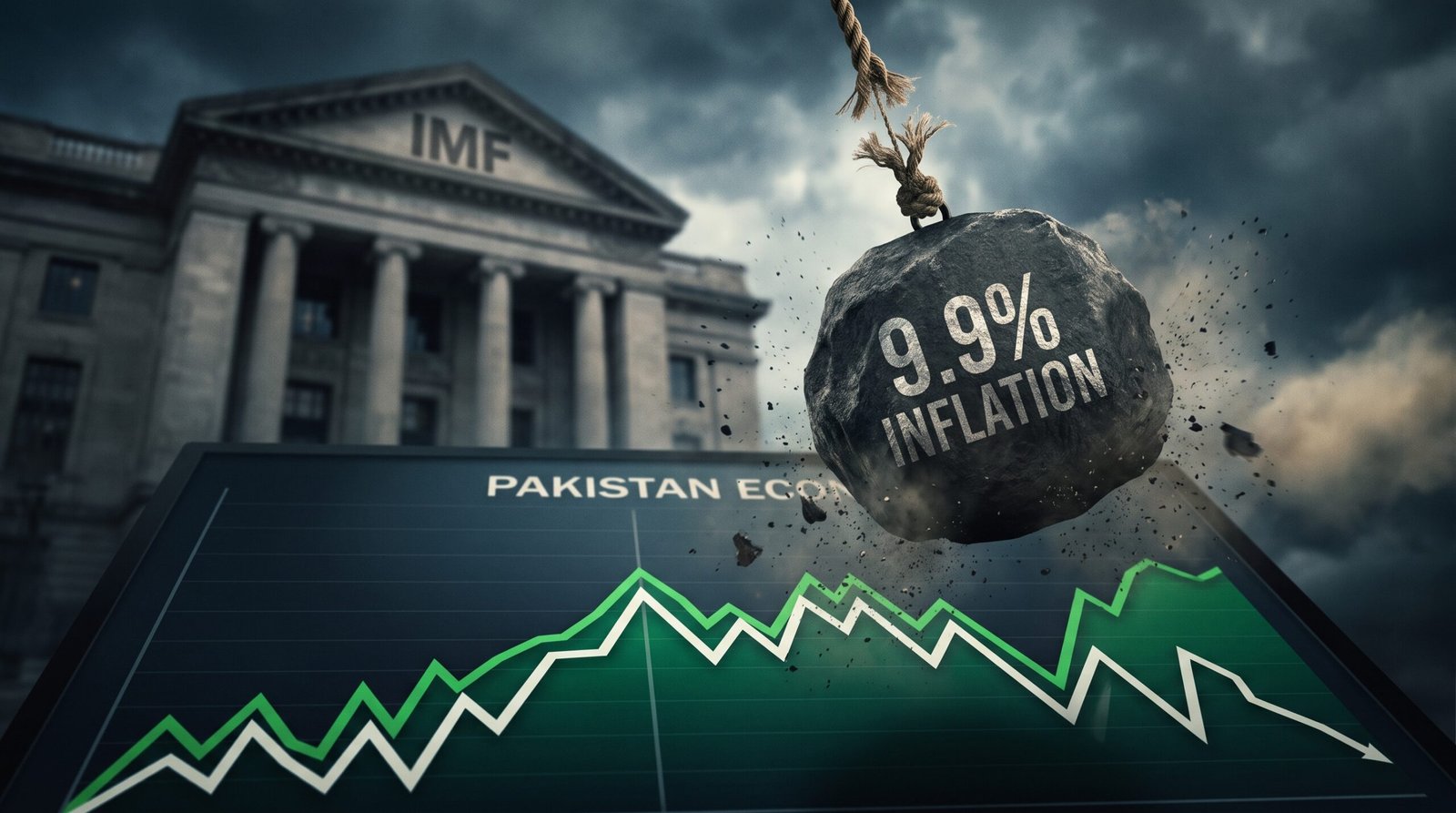
The International Monetary Fund (IMF) has bluntly contradicted the Pakistani government’s economic projections for the fiscal year 2026-27. According to the latest World Economic Outlook (WEO) released during the World Bank-IMF Annual Meetings, the IMF has raised Pakistan’s inflation forecast to 9.9%—a sharp jump from its previous 8.4% estimate—and held its GDP growth projection at a stagnant 3.5%.
These figures directly challenge Islamabad’s official targets of 8.2% for inflation and 4% for economic growth, exposing a significant reality gap between local authorities and international lenders.
The Drivers Behind the Downgrade
While the IMF did not isolate a specific domestic trigger for Pakistan’s revised inflation numbers, the broader context is clear. The IMF has raised inflation forecasts across the Middle East and Central Asia due to severe energy supply disruptions and price spikes driven by regional conflicts.
Domestically, Pakistani authorities remain stubbornly optimistic. Finance Minister Muhammad Aurangzeb recently claimed growth would “clock north of 4%,” and officials insist the 8.2% inflation target is viable. However, the ground reality tells a different story. The government has continued to pass surging fuel costs onto consumers. To offset this, they introduced a monthly subsidy scheme—Rs2,000 for motorcyclists and Rs3,000 for small-car owners. The IMF has openly criticized this move, labeling the relief as broad-based and fiscally irresponsible.
Mounting External Pressures
Adding to the grim outlook, the IMF revised Pakistan’s projected current account deficit upward to 1% of GDP. This translates to roughly $4.4 billion—a $450 million increase from previous estimates.
Pakistan is currently navigating yet another stringent IMF-supported stabilization program to avoid default. Historically, the government has struggled with structural bottlenecks, including a massive energy sector circular debt and a narrow tax base. The IMF’s skepticism is rooted in these recurring failures. Furthermore, the higher inflation forecast will likely force the State Bank of Pakistan to maintain a restrictive, high-interest-rate monetary policy, which directly suffocates private sector growth and investment.
The Global Picture
The local struggles are compounded by global headwinds. The IMF projects regional growth in the Middle East and Central Asia to plummet to 0.3% in 2026, assuming a prolonged closure of the Strait of Hormuz. Globally, growth is expected to remain hovering around 3.1% in 2026, with headline inflation reaching 4.7%. While global activity has shown some resilience due to tech and AI investments, the IMF warns that depleted energy inventories and geopolitical tensions could easily shatter this stability.
For Pakistan, the takeaway is clear: the IMF does not buy the government’s optimistic narrative. The country faces another year of high costs, restricted growth, and heavy reliance on external stabilization.