

LAHORE: Pakistan’s smartwatch industry is emerging as an increasingly competitive segment of the country’s consumer electronics market, with domestic brands challenging established international manufacturers through affordable pricing, aggressive digital marketing, celebrity endorsements and expanding distribution networks.
Once regarded as an expensive accessory associated primarily with Apple, Samsung and other international technology companies, smartwatches have become increasingly accessible to middle-income consumers, students, professionals and fitness enthusiasts.
Companies including Zero Lifestyle, Ronin, Audionic, Dany, Faster and Login are competing for customers alongside Xiaomi, Redmi, Amazfit, Huawei, Haylou, Garmin and other international brands.
However, the expansion of the industry raises questions extending well beyond consumer preferences.
How large is Pakistan’s smartwatch market? Which companies actually dominate sales? How much money is being generated through imported devices? Are Pakistani brands manufacturing technology or primarily importing Chinese products and selling them under domestic labels? And why does an industry with increasingly visible advertising campaigns lack reliable, publicly accessible market-share data?
An examination of customs valuation records, company disclosures, retail pricing, manufacturing claims and industry research reveals a fragmented business where marketing visibility is considerably easier to establish than commercial leadership.
A Market Potentially Worth Millions, But Nobody Knows Its True Size
Pakistan’s smartwatch industry operates within the broader wearable technology market, which includes wireless earbuds, headphones, smart bands, fitness trackers and other connected accessories.
A market estimate circulated in March 2025 placed Pakistan’s combined smartwatch and personal-audio wearables industry at approximately $120 million to $130 million, with projected annual growth of around 25 per cent.
At an illustrative exchange rate of Rs280 to the dollar, that valuation would represent approximately Rs33.6 billion to Rs36.4 billion.
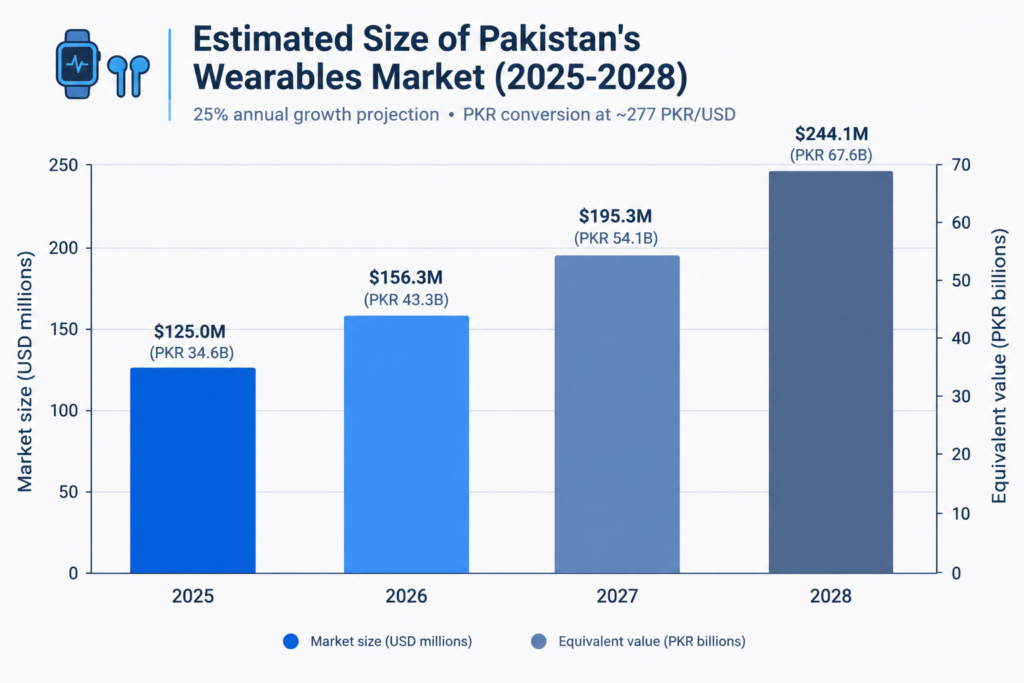
However, the figure cannot be treated as the independently verified size of Pakistan’s smartwatch market.
It includes multiple categories of consumer electronics, while the underlying methodology and brand-level sales data have not been independently established.
The distinction is important because wireless earbuds and other audio accessories may account for a substantial proportion of wearable technology sales.
Nevertheless, the estimate highlights the commercial expectations surrounding an industry benefiting from smartphone penetration, changing consumer preferences and the expansion of online shopping.
Pakistan’s population of more than 240 million provides a potentially substantial consumer base, particularly among younger consumers who increasingly regard smartwatches as fashion accessories rather than essential technology products.
Even modest penetration among smartphone users could support a sizeable industry.
Yet there is no comprehensive, publicly accessible national database identifying how many smartwatches are sold annually, which brands generate the highest revenue, or how much of the market is supplied through authorised imports, local assembly and informal distribution.
This information gap makes the industry particularly difficult to analyse.
A company may claim millions of customers, substantial manufacturing capacity or market leadership without providing smartwatch-specific figures that can be independently compared with competitors.
Consequently, Pakistan’s smartwatch market may be commercially significant, but its precise value and competitive structure remain uncertain.
What International Market Analysts Reveal About Pakistan’s Smartwatch Industry
The absence of comprehensive public market-share data does not mean Pakistan’s smartwatch industry has escaped the attention of international market research companies.
Research organisation 6Wresearch has produced dedicated studies examining Pakistan’s smartwatch industry, including market revenue, competitive dynamics, growth projections and company-level market shares.
Its Pakistan Smart Watches Market 2026–2032 study includes analysis of company revenue shares for 2025, indicating that specialist researchers have developed estimates of the industry’s competitive structure.
However, the underlying percentages are available through paid research rather than the publicly accessible report summary.
This distinction is particularly important for companies such as Zero Lifestyle, Ronin, Audionic, Dany and Faster, whose commercial visibility does not necessarily establish their relative positions in the market.
A company commanding a large share of unit sales may not lead in revenue, particularly when competing against premium international brands such as Apple and Samsung.
Conversely, a brand selling fewer but substantially more expensive devices could account for a disproportionately large share of market revenue.
International research provides additional context.
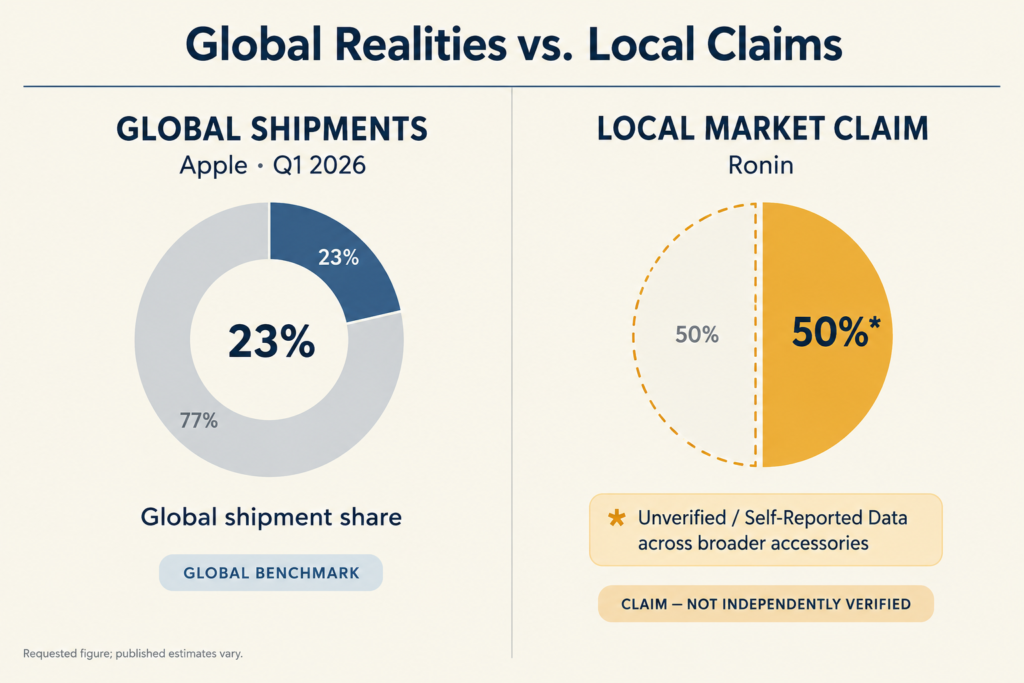
Counterpoint Research estimated Apple’s share of global smartwatch shipments at approximately 23 per cent during the first quarter of 2026, while the global smartwatch market recorded approximately 4 per cent growth in 2025.
These figures demonstrate the importance of established international manufacturers but cannot be applied directly to Pakistan, where purchasing power, retail prices, distribution channels and consumer preferences differ substantially.
Ronin has previously claimed a 50 per cent share within a broader technology accessories or wearables category. However, the claim cannot be treated as evidence that the company controls half of Pakistan’s smartwatch market in 2025 or 2026.
Similarly, customer-base figures publicised by Zero Lifestyle do not establish its share of smartwatch revenue or annual unit sales.
The central issue is the absence of comparable, independently verified data identifying each company’s smartwatch-specific performance.
For Pakistan’s industry to be evaluated credibly, market-share analysis must distinguish between premium and budget devices, revenue and unit volumes, and finished-product imports and domestic assembly.
Until these distinctions are addressed, claims of dominance by individual brands will remain difficult to substantiate.
Zero Lifestyle: Marketing Power or Genuine Market Leadership?
Among Pakistan’s domestic wearable technology brands, Zero Lifestyle has built a particularly visible consumer identity through digital advertising, celebrity endorsements and an emphasis on fashionable products.
The company has positioned itself as an affordable alternative to expensive international smartwatch brands, targeting consumers who want attractive designs, Bluetooth calling, AMOLED displays and fitness-tracking features without paying premium international prices.
Its marketing campaigns have featured prominent personalities including cricketer Shaheen Shah Afridi, actor Fawad Khan and musician Talha Anjum.
These associations reflect a deliberate attempt to transform the smartwatch from a functional electronic device into a lifestyle product.
The strategy is commercially understandable.
When multiple products offer similar features, brand recognition, presentation and consumer perception can become important factors in purchasing decisions.
However, Zero Lifestyle’s market position requires closer scrutiny.
The company has publicly claimed a customer base exceeding 1.5 million, while other corporate promotional material has referred to a figure above two million.
Neither figure, without a clearly defined reporting period and methodology, establishes how many individual smartwatch customers the company has served.
The company also sells products beyond smartwatches, making it inappropriate to equate its total customer base with smartwatch unit sales.
Another important aspect is its manufacturing model.
Zero Lifestyle’s corporate disclosures describe a manufacturing and research operation in Shanghai, China, alongside a Karachi-based operation responsible for domestic distribution, marketing and customer coordination.
This arrangement raises an important distinction between Pakistani brand ownership and domestic manufacturing.
A company can legitimately operate as a Pakistani brand while manufacturing its products overseas.
However, the economic benefits of overseas manufacturing differ from those associated with local industrial production.
The question for Zero Lifestyle is therefore not merely how many products it sells, but how much value it creates within Pakistan through product development, technical employment, distribution and other commercial activities.
Without independently verified manufacturing records, audited category-level revenue and smartwatch-specific sales figures, its actual market share remains unknown.
Ronin: Can Local Assembly Become Genuine Manufacturing?
Ronin represents another important business model within Pakistan’s wearable technology industry.
Founded in 2016, the company traces its origins to a small electronics business in Karachi’s Saddar market before expanding into technology accessories, audio products and smart wearables.
Unlike brands operating entirely through finished-product imports, Ronin has publicly described investments in domestic assembly and manufacturing facilities.
According to its corporate history, the company established an assembly and manufacturing facility in 2021 and subsequently expanded its operations.
It also claims to have achieved production and sales of approximately 1.2 million units per month across its wider technology accessories portfolio during 2025.
That figure is commercially significant, but it should not be confused with smartwatch sales.
Ronin’s product range includes earphones, earbuds, headphones, power banks and other accessories.
Consequently, the company’s combined production and sales volume cannot establish its position within the smartwatch category.
Ronin has also referred to a 50 per cent market-share achievement in its corporate history. However, the publicly available information does not sufficiently identify the exact product category, reporting period or independent methodology behind that claim.
More interesting is the company’s approach towards local assembly.
Its corporate material describes a model involving domestic production and assembly, alongside ambitions to expand into higher-value technical activities.
This represents a potentially important development for Pakistan’s electronics industry.
However, there is a substantial difference between assembling imported components and manufacturing the underlying technology.
Smartwatch production can involve industrial design, printed circuit board development, electronic component integration, firmware engineering, sensor calibration, testing and final assembly.
The economic value created domestically depends on which of these activities are actually performed in Pakistan.
A company assembling imported components may generate employment and technical expertise, but its local value addition will generally differ from that of a manufacturer developing proprietary hardware and software.
Ronin’s industrial ambitions therefore deserve attention, particularly if the company can demonstrate increasing domestic technical capability.
At the same time, its manufacturing claims require measurable evidence, including production volumes, component sourcing, investment, employment and local value addition.
Audionic, Dany, Faster and Login: The Battle Beyond Two Brands
Pakistan’s smartwatch market is not a contest between Zero Lifestyle and Ronin alone.
Audionic, Dany, Faster and Login are also part of the domestic consumer electronics landscape, competing through established distribution channels, product diversification and brand familiarity.
Audionic has developed recognition through audio products, speakers and other electronic accessories, while Dany, Faster and Login operate across different segments of the technology accessories market.
For companies with existing retail relationships, introducing smartwatches can be commercially attractive.
An established electronics brand may already have access to distributors, wholesalers, retailers, logistics networks and after-sales service arrangements.
These advantages can reduce some of the costs associated with entering a new product category.
However, broader brand recognition does not automatically translate into smartwatch market leadership.
A company generating substantial revenue from speakers, headphones or charging accessories may have a comparatively smaller smartwatch business.
Similarly, the number of retail outlets carrying a brand does not necessarily establish the volume of devices sold.
The absence of independently verified category-level data makes it difficult to determine whether Zero Lifestyle, Ronin, Audionic, Dany, Faster or Login commands the largest share of Pakistan’s domestic smartwatch market.
The competition is further complicated by Chinese brands offering comparable specifications at overlapping price points.
Xiaomi, Redmi, Amazfit, Haylou, CMF and other manufacturers compete with domestic brands through established hardware supply chains and international product development capabilities.
This creates pressure on Pakistani companies to differentiate themselves through pricing, design, customer service, warranty support and marketing.
FBR’s Customs Ruling Exposes the Economics of Imported Smartwatches
One of the most revealing developments in Pakistan’s smartwatch industry emerged in May 2026, when the Federal Board of Revenue revised customs assessment values for imported smartwatches, smart bands and smart rings.
Valuation Ruling No. 2076/2026 divided eligible non-GSM smartwatches into three categories for customs assessment.
Category A included recognised international and Chinese brands such as Xiaomi, Redmi, Amazfit, Haylou, Realme, Honor, Oppo, Vivo, CMF and several others.
Category B included Pakistani-market brands Dany, Faster, Login, Ronin and Zero.
Category C covered other lower-end brands.
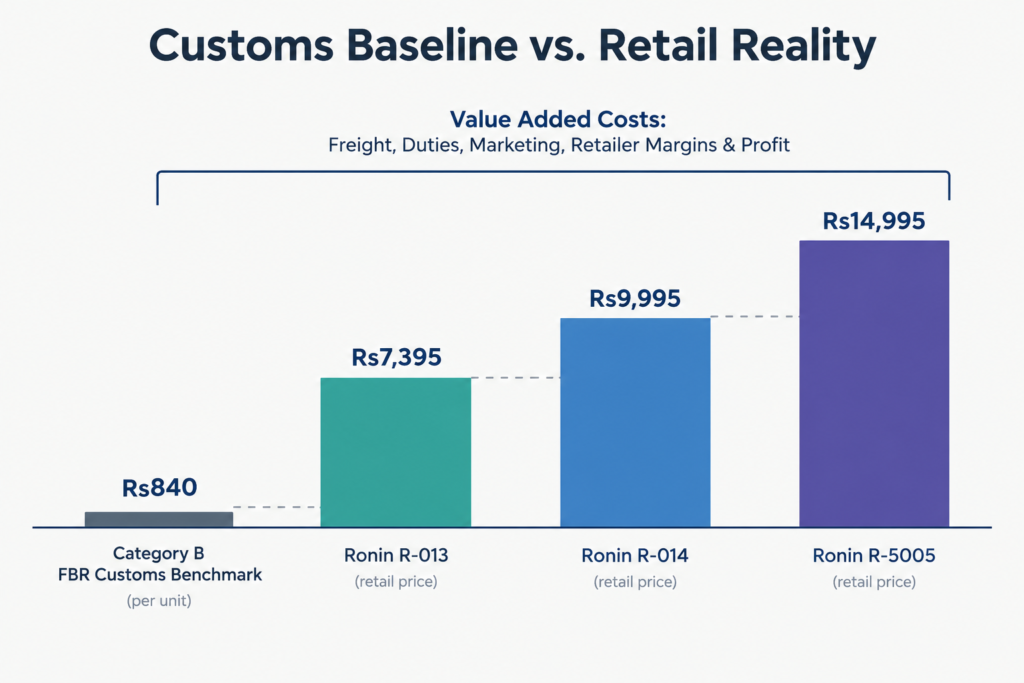
The ruling established customs assessment values of $5 per smartwatch for Category A, $3 for Category B and $1.50 for Category C.
At an illustrative exchange rate of Rs280 per dollar, these translate into approximately Rs1,400, Rs840 and Rs420, respectively.
These figures are customs assessment benchmarks, not verified manufacturing costs or final landed costs.
The ruling also specifies that imports with declared values above the prescribed benchmarks must be assessed using the higher declared values.
Premium brands including Apple, Samsung, Huawei, Garmin and Google are assessed separately at values above Category A.
Nevertheless, the distinction between the customs valuation of lower-priced smartwatches and their eventual retail prices raises legitimate questions about pricing structures.
For example, a smartwatch with a customs benchmark equivalent to Rs840 may eventually be marketed at several thousand rupees.
The difference cannot simply be labelled profit.
It must account for applicable duties and taxes, freight, packaging, distribution, retailer commissions, advertising, warranty expenses, returns, operational overheads and the actual purchase price.
But the comparison demonstrates why greater transparency over import economics would benefit consumers, policymakers and legitimate businesses.
Under-Invoicing: A Threat to Revenue and Fair Competition
The customs valuation exercise also highlighted concerns about inconsistent import declarations and possible under-invoicing in the wearable technology sector.
The FBR examined import records, declared transaction values and market information before revising the assessment framework.
Under-invoicing occurs when imported goods are declared below their actual transaction value, potentially reducing applicable customs duties and taxes.
Such practices can distort competition by allowing non-compliant importers to operate with artificially reduced costs.
Businesses accurately declaring imports may consequently face disadvantages against competitors benefiting from undervaluation.
The implications extend beyond lost government revenue.
Inconsistent import valuation can influence retail prices, profit margins and the ability of legitimate businesses to compete fairly.
However, the existence of a customs valuation ruling does not establish that any particular brand named in the ruling has engaged in under-invoicing.
Individual allegations would require transaction-level evidence, customs assessments or enforcement findings.
The broader question is whether Pakistan’s customs authorities have sufficient information and enforcement capacity to ensure consistent treatment of imported consumer electronics.
From Chinese Factories to Pakistani Wrists
China plays a central role in the global supply chain for affordable smartwatches.
Chinese manufacturers and component suppliers provide display panels, processors, batteries, sensors, printed circuit boards, straps and complete wearable devices to brands operating across international markets.
The original equipment manufacturer model allows businesses to source products developed and manufactured by specialised suppliers.
A related model, original design manufacturing, allows a supplier to design and manufacture products that are subsequently marketed under another company’s brand.
These arrangements are common in consumer electronics and are not inherently problematic.
They can allow smaller companies to enter markets without investing enormous sums in semiconductor development, manufacturing plants and engineering facilities.
However, the arrangements create questions about product differentiation.
If multiple brands source similar devices from overlapping manufacturing networks, differences in external appearance, software customisation, packaging, warranties and marketing may become more important than underlying hardware.
This does not mean every Pakistani smartwatch is identical or that every local company simply changes the logo on an imported device.
Such a conclusion would require product-level technical comparisons and supply-chain evidence.
Nevertheless, the prevalence of international contract manufacturing makes it essential to distinguish genuine product development from private-label sourcing.
For Pakistan, the economic challenge is whether domestic companies can gradually move towards more sophisticated activities rather than remaining dependent on imported finished products.
The Price War: What Are Consumers Actually Paying For?
Smartwatch pricing in Pakistan varies considerably according to brand, specifications, product positioning and distribution channel.
Domestic brands frequently compete within the affordable and mid-priced segments, while premium international manufacturers operate at significantly higher price points.
Ronin’s official retail catalogue, for example, has advertised models such as the R-013 Rugged at approximately Rs7,395, the R-014 Luxe at Rs9,995 and the Moment R-5005 at Rs14,995.
Prices may change with promotions, stock availability and product updates.
The growing availability of watches featuring AMOLED displays, Bluetooth calling, fitness tracking and multiple sports modes demonstrates how features once associated with relatively expensive devices have spread into lower-priced categories.
However, specifications alone do not establish product quality.
Two smartwatches may advertise similar displays, battery capacities and health-tracking features while differing substantially in sensor accuracy, software stability, build quality and long-term reliability.
The retail price also reflects more than the hardware.
Advertising expenditure, celebrity endorsements, product photography, packaging, digital marketing, delivery, warranty coverage and customer support all contribute to commercial costs.
The challenge for consumers is determining how much of the purchase price represents genuine product value and how much reflects brand positioning.
For companies, the challenge is maintaining profitability while competing in a market where discounts and promotional campaigns can influence buying decisions.
Celebrity Endorsements and the Business of Perception
Pakistan’s smartwatch industry has increasingly adopted marketing strategies associated with fashion, cosmetics and lifestyle brands.
Influencer partnerships, celebrity endorsements, social media campaigns and promotional discounts have become important tools for attracting customers.
The strategy reflects the nature of the product.
For many consumers, a smartwatch is not purchased solely for technical functionality. It is also an accessory that complements personal appearance and lifestyle.
This creates opportunities for brands capable of building strong identities.
However, marketing visibility should not be confused with financial performance.
A company may generate substantial online engagement without achieving equivalent sales growth.
Similarly, strong revenue growth may not translate into profitability if advertising expenditure, returns and warranty costs remain high.
Important measures of commercial performance include customer acquisition costs, repeat purchase rates, average selling prices, gross margins, inventory turnover and operating profitability.
These indicators are rarely disclosed by privately held consumer electronics businesses.
Consequently, the industry’s most visible brands are not necessarily its most profitable businesses.
E-Commerce, Retailers and the Hidden Costs of Selling
Online commerce has created new opportunities for smartwatch companies.
Brands can market products directly to consumers through their own websites, social media platforms and third-party marketplaces.
Direct-to-consumer distribution can reduce dependence on traditional retailers and potentially improve margins.
However, online selling introduces costs that are frequently overlooked.
Digital advertising, courier services, cash-on-delivery handling, failed deliveries, product returns, warranty replacements and customer support can absorb substantial portions of revenue.
For a brand selling relatively inexpensive products, even modest increases in return rates or customer acquisition costs can materially affect profitability.
Traditional electronics markets remain important because many customers prefer examining a device before making a purchase.
Retailers also provide access to customers who are less comfortable purchasing technology products online.
But wholesale distribution creates additional expenses through retailer margins, inventory financing and distribution commissions.
The balance between direct online sales and conventional retail distribution is therefore likely to influence the profitability of individual smartwatch businesses.
Health Monitoring: Are Consumers Getting Reliable Technology?
Health and fitness tracking has become one of the most prominent selling points for smartwatches.
Affordable devices increasingly advertise heart-rate monitoring, blood oxygen measurements, sleep analysis, calorie estimation and other wellness functions.
However, the presence of such features does not automatically establish their medical reliability.
Sensor accuracy can vary according to hardware quality, software algorithms, calibration, wearing conditions and individual characteristics.
Consumer smartwatches are generally intended to provide wellness information unless particular functions have undergone appropriate medical validation or regulatory authorisation.
This distinction is particularly important in Pakistan, where consumers may not always receive detailed explanations of product limitations.
Brands marketing health-related features should provide clear information about testing, measurement accuracy and the intended use of their devices.
Software support is another concern.
Smartwatches depend on companion smartphone applications, firmware updates and operating-system compatibility.
A device may remain physically functional but become less useful if software support ends or its companion application stops working properly.
Questions about data privacy, application permissions and the handling of personal health information also deserve greater attention.
Can Pakistan Build a Genuine Wearable Technology Industry?
Pakistan’s smartwatch market presents an opportunity for domestic industrial development, but turning consumer demand into manufacturing capability will require more than establishing brands.
Local assembly can create employment, develop technical skills and support industrial investment.
However, meaningful technological development requires progressively greater involvement in product design, electronics engineering, component integration, firmware development, quality testing and research.
The distinction between assembly and manufacturing is particularly important.
A company importing almost all components and performing final assembly locally creates a different level of domestic value addition from a business developing proprietary electronics and software.
Neither model should be dismissed without examining its economic contribution.
The central question is whether local businesses can gradually increase technical capability and reduce dependence on imported finished products.
Pakistan could potentially develop specialised wearable devices for fitness, occupational safety, industrial applications and other commercial uses.
But these opportunities would require stronger research capabilities, product testing, technical partnerships and sustained investment.
Competition based exclusively on promotional pricing and celebrity endorsements is unlikely to provide the same long-term industrial benefits.
Who Actually Controls Pakistan’s Smartwatch Market?
Despite the visibility of Zero Lifestyle, Ronin, Audionic and other domestic brands, determining the country’s largest smartwatch company remains difficult.
There is no sufficiently comprehensive, independently verified public dataset establishing brand-by-brand smartwatch sales volumes and revenue.
Specialist market research companies have developed proprietary estimates, but the relevant Pakistan-specific market-share percentages are not available in their public summaries.
Company claims about customers, manufacturing capacity and broader accessories sales cannot reliably substitute for category-specific market-share information.
Similarly, the presence of international brands in premium segments does not automatically establish their leadership in overall unit sales.
Market share can be measured in different ways.
A company selling a relatively small number of expensive smartwatches may generate more revenue than a competitor selling a much larger quantity of inexpensive devices.
Consequently, market leadership by units and market leadership by revenue may belong to different companies.
Any credible ranking would require comparable annual sales figures, average selling prices and a clearly defined reporting period.
Until such information becomes available, declarations that one particular brand dominates Pakistan’s smartwatch industry should be treated as company claims rather than independently established facts.
The Road Ahead: From Branding to Technology
Pakistan’s smartwatch industry has reached a stage where domestic brands are competing for consumer attention alongside established international technology companies.
The sector benefits from growing familiarity with wearable devices, widespread smartphone usage and expanding online retail channels.
However, its future will depend on more than advertising campaigns and attractive product designs.
Consumers will increasingly judge brands through product reliability, software support, warranty services, battery performance and value for money.
Companies investing in genuine product development, dependable after-sales service and stronger supply chains may be better positioned to build sustainable businesses.
For policymakers, the challenge is creating an environment that rewards legitimate imports, transparent taxation, domestic value addition and technological investment.
For the industry itself, greater disclosure of sales volumes, manufacturing activities and financial performance would improve credibility.
The FBR’s revised customs valuation framework has already demonstrated the importance of examining the economics behind imported wearable devices.
What remains missing is a transparent national picture of the industry.
Pakistan’s smartwatch market has the potential to support substantial commercial activity and technological development.
But the distinction between selling technology and creating technology will ultimately determine how much lasting economic value the country captures.
For now, Pakistan has no shortage of smartwatch brands, promotional campaigns or claims of market leadership. What it lacks is the transparent data needed to determine who truly controls the industry, who makes the money and whether the country’s growing appetite for wearable technology is creating a sustainable domestic technology ecosystem or primarily expanding the market for imported hardware.