

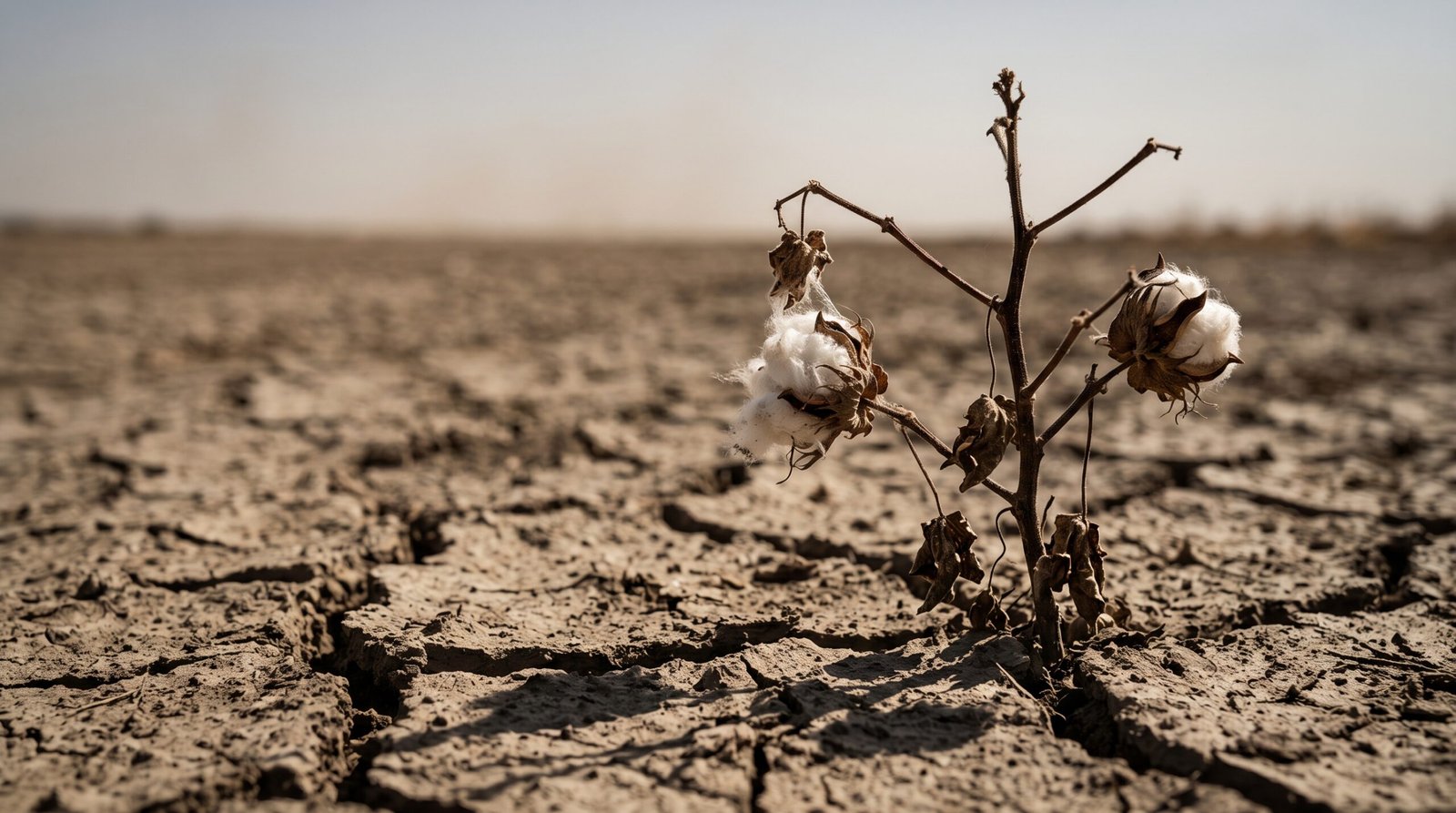
Pakistan’s cotton crisis has deepened into a major “structural economic challenge”, with production falling nearly 52 per cent below its 2014-15 level, four consecutive crop seasons recording or facing shortfalls against government targets, and farmers increasingly abandoning a crop once celebrated as the country’s “white gold”.
Despite repeated government assurances, ambitious production targets, “agricultural research initiatives” and promises of improved seed varieties, Pakistan has failed to achieve a sustained recovery in cotton production.
The consequences extend far beyond the agricultural sector.
Cotton remains a critical raw material for Pakistan’s textile industry, the country’s largest “export-oriented manufacturing sector”.
Declining domestic production increases pressure on textile manufacturers to import raw materials, exposes exporters to “international price fluctuations” and creates additional demand for “foreign exchange”.
The latest official figures present another worrying picture.
According to the Federal Committee on Agriculture’s October 2026 assessment, Pakistan’s cotton production is estimated at approximately 6.714 million bales against a target of 9.643 million bales, representing a shortfall of 2.929 million bales, or 30.4 per cent.
The estimated production is also below the approximately 7.052 million bales reported for the preceding season.
The longer-term decline is even more alarming.
Pakistan produced approximately 13.96 million bales in 2014-15.
If the latest estimate materialises, national production will have fallen by approximately 7.25 million bales, representing a decline of nearly 52 per cent from that historical benchmark.
Although cotton production has experienced occasional recoveries, the country has failed to regain its 2014-15 production level in any of the subsequent 11 completed crop seasons.
More importantly, a comparison of official production targets and reported or estimated output indicates that Pakistan has missed, or is expected to miss, its cotton production targets for four consecutive seasons, from 2023-24 through 2026-27.
The findings raise serious questions about “agricultural policymaking”, “institutional accountability”, research spending and the effectiveness of government interventions intended to revive cotton cultivation.
Four Consecutive Target Misses: The Numbers Behind Pakistan’s Cotton Crisis
A comparison of official cotton production targets with actual or estimated output reveals a persistent gap between government expectations and agricultural performance.
In 2023-24, Pakistan set a cotton production target of approximately 12.77 million bales but produced around 10.223 million, representing a shortfall of nearly 20 per cent.
The following season, the government targeted approximately 10.874 million bales, but production declined to around 7.084 million, a shortfall of approximately 34.9 per cent.
For 2025-26, the official target was approximately 10.18 million bales, while reported production stood at around 7.052 million.
The latest 2026-27 estimate suggests another substantial miss, with production expected to remain approximately 30.4 per cent below the official target.
Pakistan’s Cotton Production Targets Versus Actual Output
| Crop Year | Target (Million Bales) | Actual/Estimated Production | Shortfall |
| 2023-24 | 12.770 | 10.223 |
19.9%
|
| 2024-25 | 10.874 | 7.084 |
34.9%
|
| 2025-26 | 10.180 | 7.052 |
30.7%
|
| 2026-27* | 9.643 | 6.714 |
30.4%
|
Source: Pakistan Central Cotton Committee, Federal Committee on Agriculture and official agricultural production records. The 2026-27 figure is an October 2026 estimate.
The figures indicate that Pakistan’s cotton problem is not simply one of declining production.
Successive governments have struggled to achieve their own production objectives, even as those targets have been revised downwards.
The national target declined from 12.77 million bales in 2023-24 to 9.643 million in 2026-27, a reduction of approximately 24.5 per cent.
Yet production has continued to fall short.
This raises a fundamental question: if the government is repeatedly lowering its production ambitions, why does the country continue to miss those reduced targets?
From Nearly 14 Million To Less Than Seven Million Bales
Pakistan’s cotton production history reveals a pattern of sharp declines, temporary recoveries and persistent instability.
In 2014-15, Pakistan produced approximately 13.96 million bales.
Production subsequently declined to 9.917 million bales in 2015-16 before partially recovering to 11.946 million in 2017-18.
The recovery proved temporary.
Production fell to approximately 9.861 million bales in 2018-19, 9.148 million in 2019-20 and 7.064 million in 2020-21.
The situation deteriorated significantly in 2022-23, when cotton production collapsed to approximately 4.91 million bales, partly reflecting devastating floods and adverse growing conditions.
Although production rebounded to approximately 10.223 million bales in 2023-24, the improvement could not be sustained.
Output subsequently declined to approximately 7.084 million bales in 2024-25 and 7.052 million in 2025-26.
The latest estimate suggests a further decline in 2026-27.
Pakistan’s Cotton Production Over 13 Crop Seasons
| Crop Year | Production (Million Bales) | Annual Change |
| 2014-15 | 13.960 |
— |
| 2015-16 | 9.917 |
-29.0%
|
| 2016-17 | 10.671 |
+7.6%
|
| 2017-18 | 11.946 |
+11.9%
|
| 2018-19 | 9.861 |
-17.5%
|
| 2019-20 | 9.148 |
-7.2%
|
| 2020-21 | 7.064 |
-22.8%
|
| 2021-22 | 8.329 |
+17.9%
|
| 2022-23 | 4.910 |
-41.0%
|
| 2023-24 | 10.223 |
+108.2%
|
| 2024-25 | 7.084 |
-30.7%
|
| 2025-26 | 7.052 |
-0.5%
|
| 2026-27* | 6.714 |
-4.8%
|
Source: Pakistan Economic Survey historical production series and Federal Committee on Agriculture. The 2026-27 figure is an estimate.
The figures demonstrate that Pakistan has not experienced a continuous year-on-year decline.
Rather, production has fluctuated significantly while remaining below the level achieved in 2014-15.
The inability to sustain recoveries suggests deeper structural weaknesses in agricultural research, seed development, crop management, farmer incentives and policymaking.
Punjab And Sindh Account For 96% Of The National Shortfall
Punjab and Sindh remain the backbone of Pakistan’s cotton economy, but both provinces are facing substantial production deficits.
According to the October 2026 assessment, Punjab’s cotton production is estimated at approximately 3.694 million bales against a target of five million.
Sindh is expected to produce approximately 2.528 million bales against a target of 4.042 million.
Balochistan’s estimated production stands at approximately 492,000 bales against a target of 600,000.
Provincial Cotton Production Targets Versus Estimates
| Province | Target (Million Bales) | Estimated Production | Shortfall |
| Punjab | 5.000 | 3.694 |
26.1%
|
| Sindh | 4.042 | 2.528 |
37.5%
|
| Balochistan | 0.600 | 0.492 |
18.0%
|
| Khyber Pakhtunkhwa | 0.00093 | 0.00041 |
55.9%
|
| Pakistan | 9.643 | 6.714 |
30.4%
|
Source: Federal Committee on Agriculture, October 2026. Figures are rounded.
Punjab accounts for approximately 1.306 million bales of the estimated national production deficit.
Sindh accounts for approximately 1.514 million bales.
Together, the two provinces represent roughly 96 per cent of Pakistan’s shortfall against the national target.
Sindh’s performance is particularly concerning because its percentage shortfall is substantially greater than Punjab’s.
The figures suggest that any meaningful national cotton revival programme must focus primarily on improving productivity, cultivation incentives and farmer profitability in Punjab and Sindh.
Without a sustained recovery in these provinces, Pakistan is unlikely to restore its historical cotton production levels.
Farmers Are Abandoning Cotton As Cultivation Shrinks 12.6%
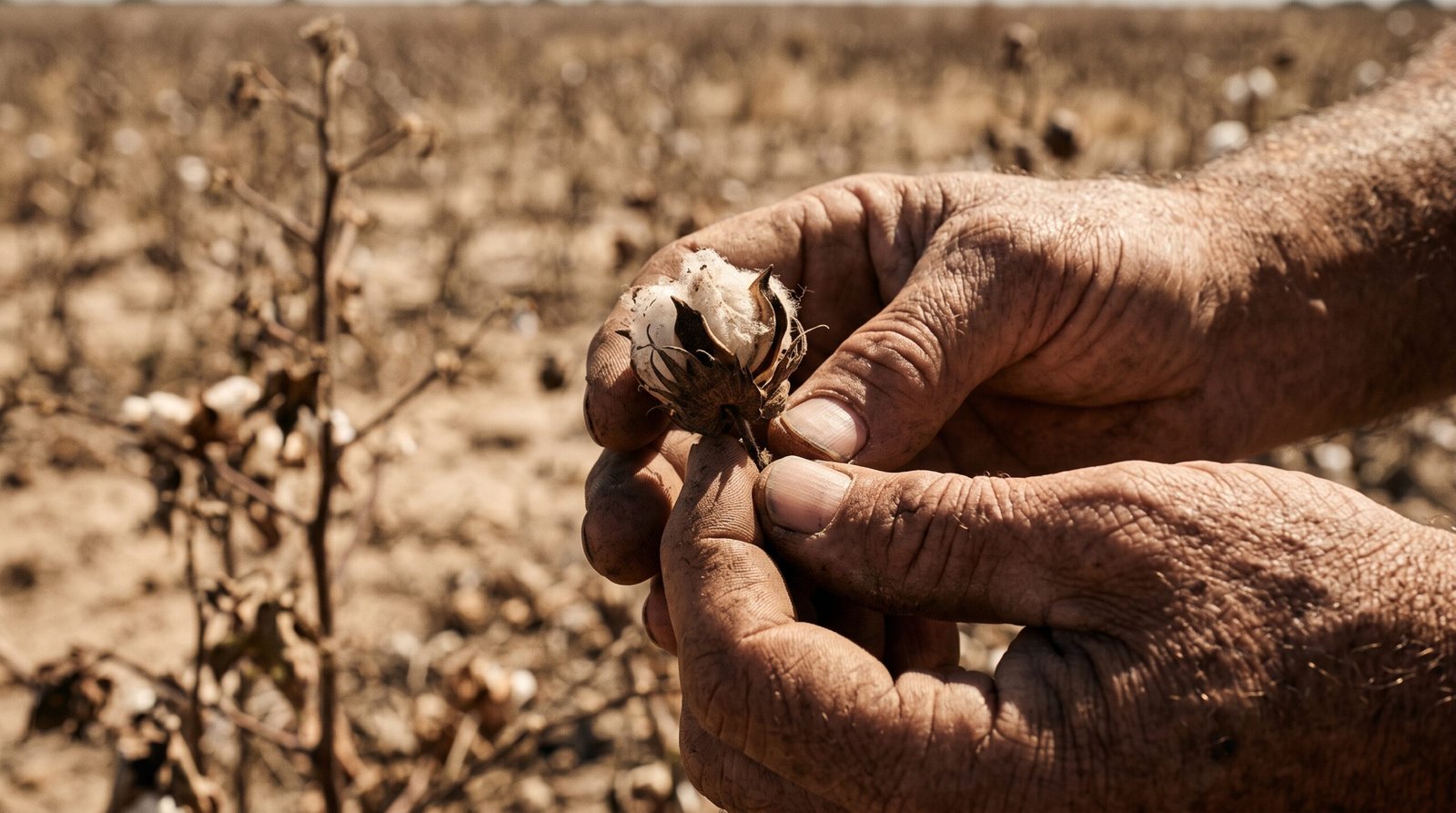
One of the most alarming developments is the contraction in the area devoted to cotton cultivation.
According to the latest official assessment, Pakistan cultivated approximately 1.759 million hectares of cotton in 2026-27, compared with 2.012 million hectares during the preceding season.
This represents a reduction of approximately 253,000 hectares, or 12.6 per cent, within a single year.
The cultivated area was also approximately 18.6 per cent below the official target of 2.160 million hectares.
Decline In Cotton Cultivation Area
| Province | 2025-26 (000 Hectares) | 2026-27 (000 Hectares) | Change |
| Punjab | 1,265.0 | 1,058.0 |
-16.4%
|
| Sindh | 563.1 | 516.9 |
-8.2%
|
| Balochistan | 184.1 | 184.1 |
0.0%
|
| Pakistan | 2,012.4 | 1,759.1 |
-12.6%
|
Source: Federal Committee on Agriculture, October 2026.
The decline indicates that Pakistan’s cotton crisis is not merely the result of lower yields.
Farmers are also allocating less land to the crop.
This is particularly significant because agricultural production decisions are ultimately driven by economics.
Growers assess expected profitability, input costs, irrigation requirements, crop risks and market access before deciding what to cultivate.
If cotton offers lower or less predictable returns than competing crops, farmers have a strong incentive to shift production.
“Unless policymakers address these commercial realities, announcements of higher production targets will have limited impact.”
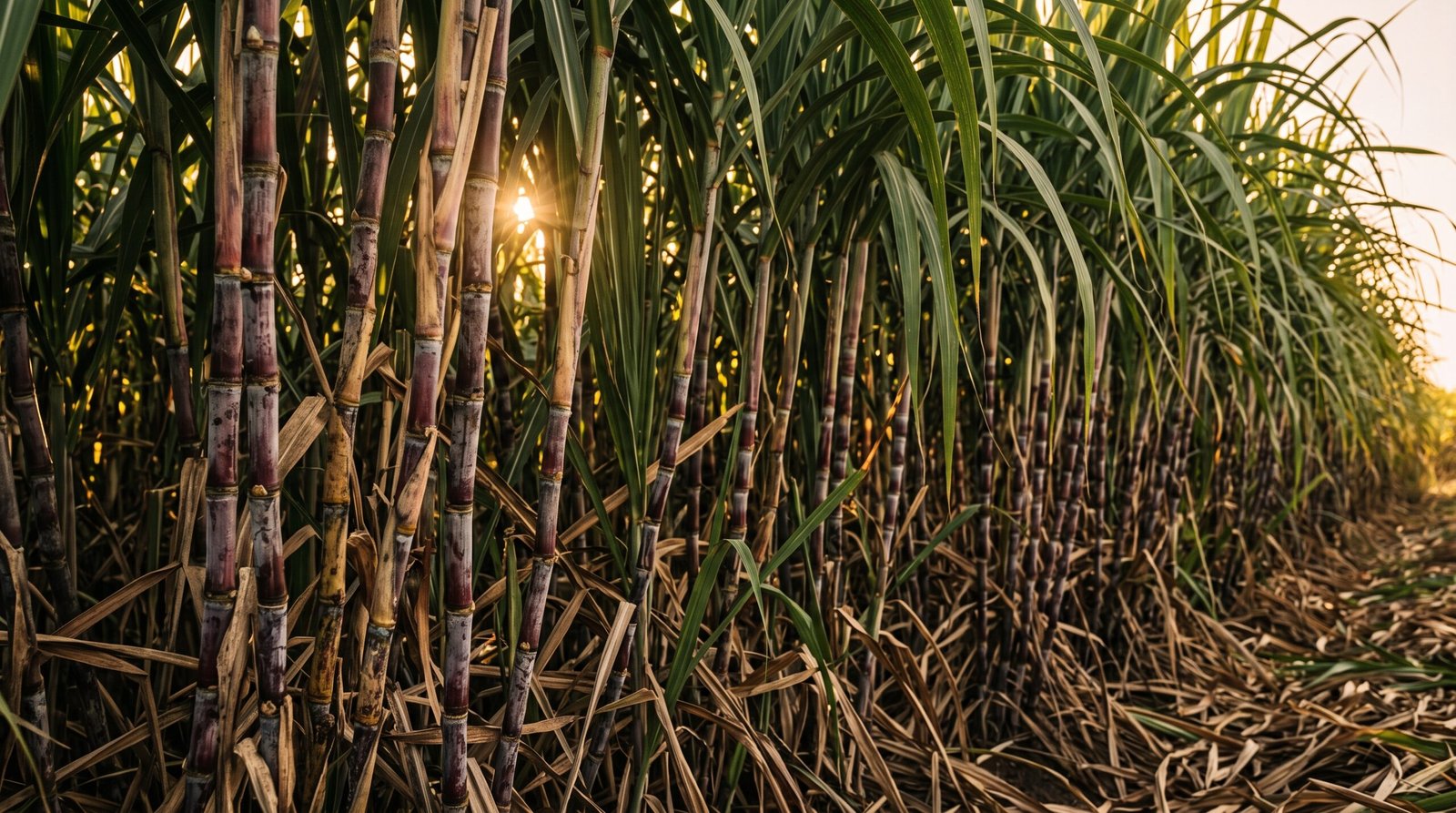
Sugarcane Expands 11% While Cotton Cultivation Contracts
The latest agricultural figures reveal a striking contrast between cotton and competing crops.
While cotton cultivation declined by approximately 12.6 per cent, sugarcane cultivation expanded by around 11.2 per cent.
Sugarcane production increased by approximately 8.8 per cent to 97.3 million tonnes.
Rice cultivation expanded by approximately 3.9 per cent, while maize cultivation increased by 11.5 per cent.
Changes In Cultivated Area Of Major Crops
| Crop | Change In Cultivated Area |
| Cotton |
-12.6%
|
| Sugarcane |
+11.2%
|
| Rice |
+3.9%
|
| Maize |
+11.5%
|
Source: Federal Committee on Agriculture, October 2026.
The contrast raises an important policy question.
Why is Pakistan losing land devoted to a crop that supplies its largest “export-oriented manufacturing sector” while cultivation of several competing crops continues to expand?
Part of the explanation lies in differences in profitability, procurement arrangements and perceived risk.
Cotton growers face uncertainty associated with pest attacks, unpredictable weather, seed quality, rising input costs and fluctuating market prices.
Sugarcane growers, particularly those operating near established sugar mills, may benefit from more predictable procurement arrangements, although payment delays and pricing disputes remain significant concerns in that sector.
The expansion of sugarcane does not necessarily mean that every additional hectare has been diverted from cotton.
Such conclusions require district-level land-use analysis.
Nevertheless, the broader pattern indicates that cotton is struggling to compete for agricultural land.
Pakistan therefore needs a credible “crop-zoning strategy” that considers water availability, soil suitability, farmer profitability and the economic importance of export-oriented crops.
Poor Seeds, Pest Attacks And Weak Research: Why Cotton Keeps Failing
Pakistan’s cotton decline cannot be attributed to a single problem.
The crisis reflects a combination of weak research capacity, inconsistent seed quality, pest pressure, climatic disruptions, declining farmer confidence and fragmented agricultural governance.
Seed quality and research failures
Cotton production depends heavily on the availability of certified, high-yielding and “climate-resilient varieties”.
Farmers require varieties capable of resisting major pests and diseases while delivering commercially viable yields under changing weather conditions.
Weak seed certification, inconsistent varietal performance and insufficient commercialisation of agricultural research have limited progress.
The effectiveness of institutions responsible for cotton research and seed development therefore deserves closer scrutiny.
Pest attacks and pesticide resistance
Whitefly, pink bollworm and other pests remain major threats to cotton cultivation.
Inappropriate pesticide use can increase production costs without delivering effective crop protection.
The sector needs better pest surveillance, farmer training and “integrated pest-management programmes” rather than continued dependence on reactive pesticide spraying.
Climate change and unpredictable weather
Extreme heat, excessive rainfall, flooding and shifting seasonal patterns have increased the risks associated with cotton cultivation.
The collapse in production during 2022-23 demonstrated how severely climatic shocks can affect the crop.
“Climate-resilient varieties”, improved drainage, “precision irrigation” and more effective “weather advisory systems” must become central elements of agricultural policy.
Declining farmer profitability
Cotton cannot recover unless farmers have a compelling economic reason to cultivate it.
Rising costs of fertiliser, pesticides, irrigation, fuel and labour reduce profitability.
When growers believe competing crops offer better risk-adjusted returns, they naturally shift cultivation.
A revival programme that ignores farmer profitability is unlikely to succeed.
Fragmented policymaking
Agricultural responsibilities are divided between federal and provincial institutions.
While national production targets are announced centrally, “agricultural extension”, irrigation management and several implementation functions fall under provincial authorities.
Without clear accountability and coordinated implementation, ambitious national targets risk becoming little more than annual announcements.
Cotton Imports: The Foreign Exchange Cost Of Agricultural Failure
Pakistan’s textile industry remains the country’s largest “export-oriented manufacturing sector”, making domestic cotton availability strategically important.
When local production is insufficient or fails to meet manufacturers’ quality requirements, textile mills must source raw materials from international markets.
This exposes manufacturers to global price volatility, exchange-rate fluctuations, freight costs and supply-chain disruptions.
It also increases demand for “foreign exchange”.
Imports are not inherently undesirable.
Textile manufacturers may require specialised cotton varieties that cannot be produced domestically in sufficient quantities or at the required quality.
The problem arises when Pakistan becomes increasingly dependent on imports because domestic production is commercially inadequate.
For a country seeking to expand exports and reduce “external-account vulnerabilities”, this represents a significant economic weakness.
Pakistan’s cotton strategy must therefore focus not merely on producing more bales but on supplying the quality, consistency and varieties required by domestic manufacturers.
Could Pakistan Save $1 Billion By Producing Three Million More Bales?
The economic significance of restoring cotton production can be illustrated through a simple scenario.
A standard cotton bale in Pakistan’s official production series weighs approximately 170 kilogrammes.
If Pakistan increased domestic cotton production by three million standard bales, the additional output would amount to approximately 510,000 tonnes.
Assuming an illustrative international cotton price of $1.50 to $2 per kilogramme, the “gross commodity value” of that additional production would range from approximately $765 million to $1.02 billion.
Illustrative Value Of Additional Domestic Cotton Production
| Additional Production | Value At $1.50/kg | Value At $2/kg |
| 1 million bales | $255 million |
$340 million
|
| 2 million bales | $510 million |
$680 million
|
| 3 million bales | $765 million |
$1.02 billion
|
| 5 million bales | $1.275 billion |
$1.70 billion
|
Calculations assume 170 kilogrammes per bale. These are illustrative commodity values, not forecasts of actual foreign exchange savings.
The figures highlight the substantial economic opportunity associated with restoring domestic production.
However, higher local output would not automatically generate equivalent import savings.
Actual savings would depend on cotton quality, domestic consumption, substitution for imported varieties and international prices.
Nevertheless, a sustained increase in competitive domestic production could reduce import dependence, improve “supply security” and strengthen the “textile value chain”.
Can Pakistan Return To 10 Million Or 14 Million Bales?
Pakistan’s historical production figures demonstrate that the country has previously achieved output approaching 14 million bales.
A return to 10 million bales is therefore not beyond its demonstrated historical capacity.
However, the latest estimated production of 6.714 million bales indicates that a substantial recovery would be required.
To reach 10 million bales, Pakistan would need to increase production by approximately 49 per cent.
Reaching 14 million bales would require output to more than double.
What Pakistan Must Produce To Recover Its Cotton Industry
| Production Goal | Additional Bales Required | Increase Needed |
| 8 million bales | 1.286 million |
19%
|
| 10 million bales | 3.286 million |
49%
|
| 12 million bales | 5.286 million |
79%
|
| 14 million bales | 7.286 million |
109%
|
Calculations based on the October 2026 production estimate.
These figures demonstrate the scale of the challenge.
A meaningful recovery would require both expansion of suitable cotton-growing acreage and improvements in productivity.
Simply increasing cultivated area without addressing low yields, poor seed quality and farmer profitability would expose growers to additional risks.
Similarly, focusing exclusively on productivity without addressing the economic reasons farmers are abandoning cotton would leave the sector vulnerable.
Pakistan needs to pursue both objectives simultaneously.
What Needs To Be Done: A Five-Year Cotton Revival Strategy
Pakistan requires a comprehensive national cotton revival programme supported by measurable annual targets, independent monitoring and clear “institutional accountability”.
The programme should focus on five priorities.
First, restore farmer confidence.
Growers must have access to certified seed, affordable inputs, reliable crop-protection advice and transparent market arrangements.
The government should work with farmer organisations and textile manufacturers to improve the predictability of cotton marketing and reduce avoidable transaction costs.
Second, improve productivity.
Pakistan should prioritise research into high-yielding, pest-resistant and “climate-resilient varieties”.
Demonstration farms, modern “agricultural extension” services and district-level yield monitoring should be expanded.
Third, strengthen agricultural research institutions.
The Pakistan Central Cotton Committee, Pakistan Agricultural Research Council, provincial research institutes and agricultural universities should operate under a coordinated research framework.
Funding should be linked to measurable outputs, including commercially successful varieties, improved yields and documented reductions in crop losses.
Fourth, modernise production forecasting.
Satellite-based acreage monitoring, independent field surveys and transparent reporting could improve the reliability of cotton estimates.
Government crop-production data and ginning-factory arrivals should be reported with clear explanations of their different methodologies and bale-weight conventions.
Fifth, create a commercially viable cotton market.
Farmers need reliable buyers, transparent “quality-based pricing”, affordable “agricultural finance” and effective mechanisms for resolving payment disputes.
Without improving the commercial attractiveness of cotton cultivation, technical interventions alone will be insufficient.
Proposed Five-Year Cotton Recovery Roadmap
| Timeline | Priority | Expected Outcome |
| First 6 months | Audit cotton acreage, seed quality and production estimates |
Reliable national baseline |
| Year 1 | Improve certified seed supply and pest-management services |
Reduced preventable crop losses |
| Year 2 | Expand farmer training and demonstration farms |
Higher yields among participating growers |
| Year 3 | Restore cultivation in suitable cotton-growing districts |
Sustained acreage recovery |
| Year 4 | Expand climate-resilient varieties and efficient irrigation |
Improved productivity |
| Year 5 | Consolidate research, marketing and production reforms |
Sustained national production recovery |
The government should publish independently verified progress reports against each milestone.
Success should not be measured simply by whether production increases in a favourable weather year.
It should be assessed through sustained improvements in acreage, yield, farmer profitability, seed quality, crop resilience and domestic cotton availability.
Who Should Be Held Accountable For Pakistan’s Cotton Collapse?
The scale and duration of Pakistan’s cotton decline raise serious questions about institutional performance.
The Ministry of National Food Security and Research, provincial agriculture departments, Pakistan Central Cotton Committee, agricultural research institutions and seed certification authorities all have responsibilities within the “textile value chain”.
Yet the country continues to struggle with problems that have been discussed for years.
The critical issue is whether these institutions have been given realistic objectives, adequate resources and measurable performance standards.
How much public funding has been spent on cotton research over the past decade?
How many commercially successful cotton varieties have been developed and adopted?
What improvements have been achieved in average yields?
How effectively have farmers been protected against counterfeit or substandard agricultural inputs?
And why have repeated warnings about declining cultivation failed to produce a sustained policy response?
These are questions that deserve detailed answers from the authorities concerned.
“Institutional accountability” should include “independent assessments” of research spending, seed certification, crop forecasting and “agricultural extension” programmes.
Without such scrutiny, Pakistan risks repeating the same cycle of ambitious announcements and disappointing outcomes.
The Bigger Question: Can Pakistan Afford Another Decade Of Cotton Decline?
Pakistan’s cotton crisis is not simply a problem for farmers.
It has implications for the country’s entire “textile value chain”, from ginning and spinning to weaving, processing, garments and exports.
Weak domestic cotton production can increase raw-material costs, undermine supply predictability and weaken the connection between agriculture and the “export-oriented manufacturing sector”.
The consequences also extend to rural employment, agricultural incomes and the economic activity generated by cotton harvesting, transportation and ginning.
At a time when Pakistan is seeking to improve “export competitiveness”, strengthen “foreign exchange” earnings and reduce “external-account vulnerabilities”, allowing a strategically important crop to decline further would be economically damaging.
The country has already demonstrated that it possesses the agricultural capacity to produce substantially more cotton than it currently does.
What remains missing is a durable framework that makes cotton cultivation profitable, scientifically supported, climate-resilient and commercially competitive.
The latest figures should serve as a warning.
With estimated production of 6.714 million bales against a target of 9.643 million, Pakistan faces another substantial shortfall.
More importantly, the contraction in cotton acreage suggests that growers themselves are losing confidence in the crop.
Unless policymakers address that underlying problem, higher production targets will remain difficult to achieve.
Pakistan must decide whether it intends to continue announcing ambitious targets or undertake the institutional, scientific and market reforms necessary to deliver them.
After more than a decade of declining production and four consecutive seasons of missed or projected-to-be-missed targets, the cotton sector needs measurable results rather than another round of promises.
“Pakistan’s cotton problem is not a shortage of targets. It is a shortage of sustained delivery.”