


KARACHI: Despite generating the highest inflation-adjusted average household income in the country, the province of Sindh has suffered a catastrophic two-decade stagnation across critical social indicators, rapidly losing ground to Punjab and Khyber Pakhtunkhwa in health, education, and basic sanitation.
This stark developmental paradox was revealed in the newly compiled Pakistan Welfare Atlas by Gallup Pakistan Digital Analytics. By aggregating extensive data from the PSLM, LFS, and PDHS spanning from 2004 to 2025, researchers have painted a troubling picture of regional inequality. While Sindh matched or even led other provinces in several key welfare metrics in 2004, it has since regressed into a clear national laggard.
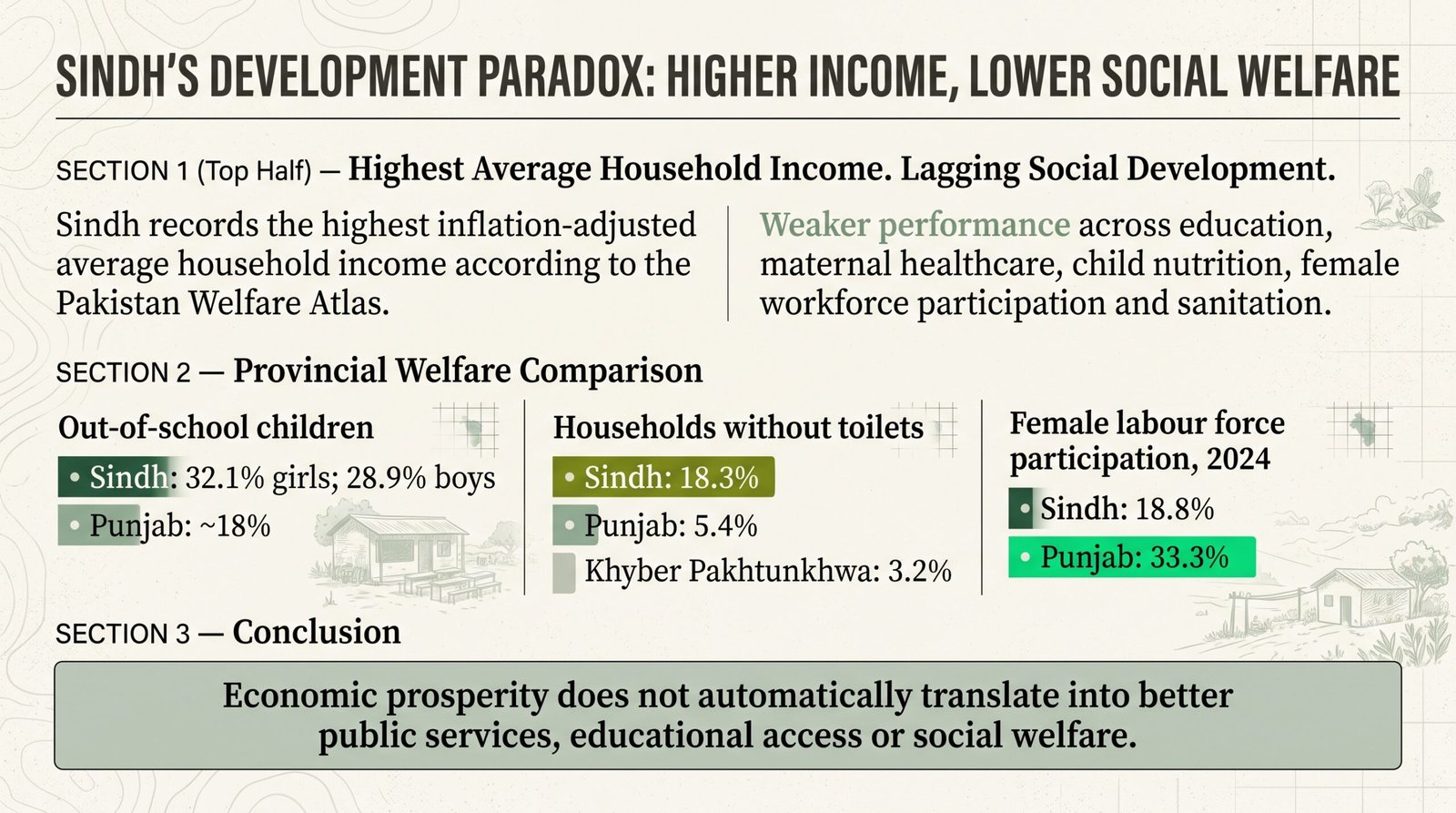
The province’s educational infrastructure is experiencing a severe crisis. According to the data, nearly a third of all school-aged children in Sindh are completely excluded from the education system, with 32.1 percent of girls and 28.9 percent of boys aged five to sixteen currently out of school. In stark contrast, Punjab has managed to bring its out-of-school population down to approximately 18 percent. Furthermore, youth literacy rates for those aged fifteen to nineteen have stagnated violently. Over the last two decades, Sindh managed a mere 11-point gain in youth literacy, the absolute lowest growth of any province, allowing Khyber Pakhtunkhwa—which historically started far behind—to easily overtake it. This regional failure aligns with a broader national trend that has seen government school enrollment plummet as private and Deeni Madrasa enrollments surge across the country.
The deterioration extends deeply into maternal and child healthcare. While national averages for facility births surged from a dismal 25.9 percent in 2004 to over 80 percent by 2025, Sindh’s individual trajectory has been deeply flawed. In 2004, Sindh proudly led the nation with 32.6 percent of all births occurring in health facilities. By 2025, however, it had slipped to third place at 81.7 percent, falling noticeably behind Punjab and Khyber Pakhtunkhwa. The gap in antenatal care access between Sindh and Punjab has also widened drastically, growing from a negligible three points to a severe eleven-point deficit.
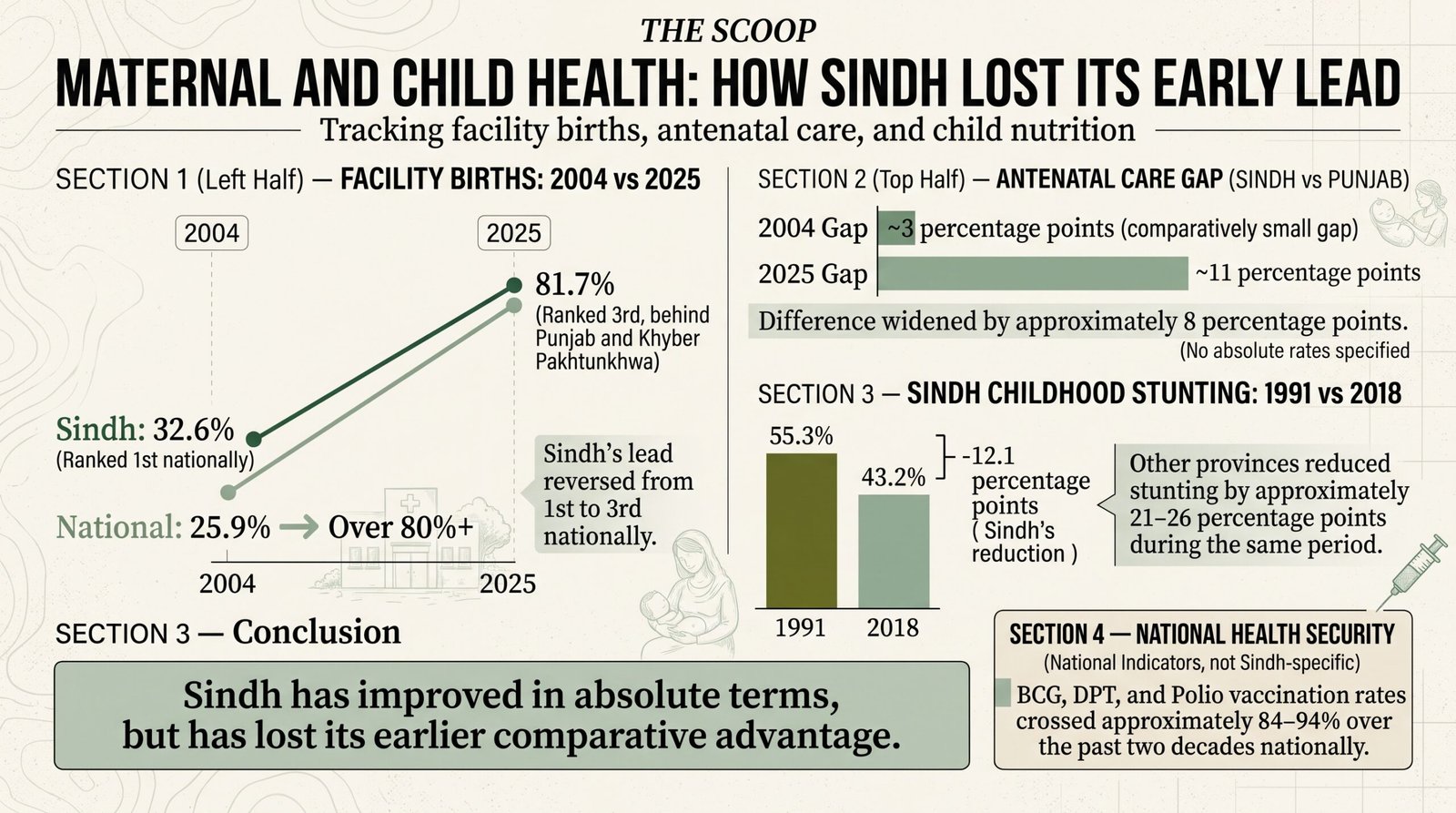
Child development metrics show Sindh severely trailing its provincial peers. Between 1991 and 2018, the province reduced child stunting by only 12 percentage points, dropping from 55.3 percent to 43.2 percent. During that same window, every other province in Pakistan successfully slashed stunting rates by 21 to 26 points. While national childhood vaccination rates for BCG, DPT, and Polio have successfully crossed the 84 to 94 percent thresholds over the past two decades, local execution in lagging provinces remains a persistent drag on absolute national health security.
Economic exclusion and plunging living standards further compound the province’s woes. Sindh holds the alarming distinction of being the only province in Pakistan to witness a shrinking female workforce in recent years. Between 2018 and 2024, female labor force participation in Sindh actually contracted, falling from 20.5 percent to 18.8 percent. Over the exact same period, female workforce participation in Punjab surged aggressively from 26.3 percent to 33.3 percent.
Basic sanitation metrics present an equally grim reality, with 18.3 percent of all households in Sindh currently lacking access to a toilet. This is astronomically higher than in Punjab, where only 5.4 percent of households lack basic sanitation, and Khyber Pakhtunkhwa, where the figure sits at an impressive 3.2 percent.
Ultimately, the Gallup Pakistan data presents a highly contradictory and deeply concerning socio-economic landscape for the province. The statistics expose a fundamental governance failure: the ability of Sindh to generate the highest average household income in Pakistan has completely failed to translate into basic social welfare, leaving millions of its residents trapped in a cycle of poor health, widespread illiteracy, and systemic economic exclusion.