


ISLAMABAD, November 14, 2026: For years, Pakistan’s battle against cybercrime has been complicated by rising online financial fraud, digital blackmail, identity theft, organised international scam networks and complaints about the slow pace of investigations.
Now, a fresh set of enforcement figures from the National Cyber Crime Investigation Agency (NCCIA) is drawing attention to the country’s evolving approach to tackling digital crime.
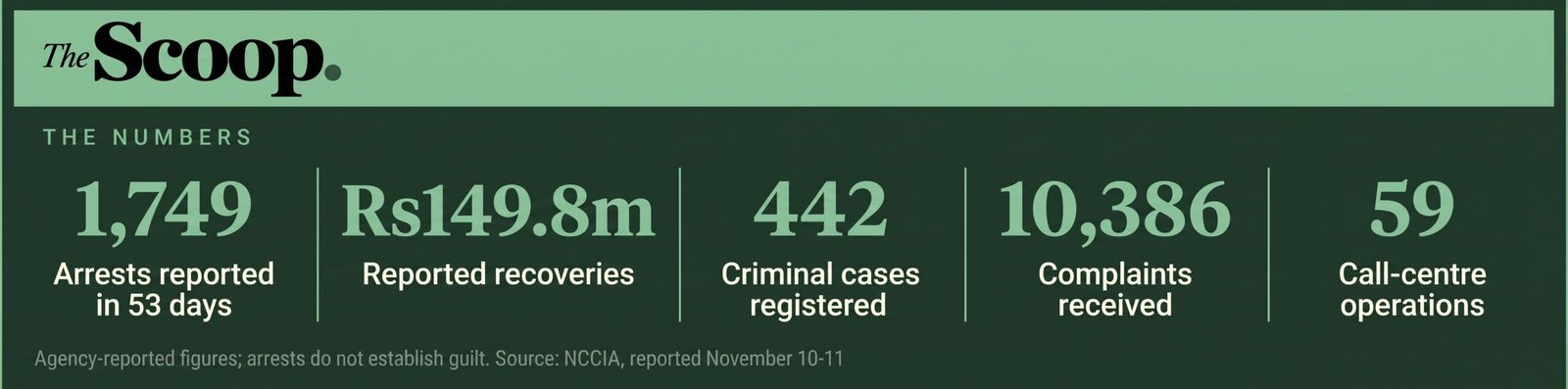
In just 53 days, the federal cybercrime investigation agency has reported arresting 1,749 suspects, recovering Rs149.8 million, registering 442 criminal cases and conducting dozens of operations against suspected illegal call centres.
The figures emerged during the tenure of Syed Ali Nasir Rizvi, the former Inspector General of Islamabad Police who assumed responsibility as Director General of NCCIA in September 2026.
Yet the significance of these developments extends beyond the performance of one senior police officer.
Pakistan is confronting an increasingly sophisticated cybercrime industry, where fraudsters can operate across international borders, exploit vulnerable citizens, misuse digital financial services and damage the reputation of the country’s legitimate technology sector.
Against this backdrop, the operational direction being pursued by NCCIA raises an important question: Is Pakistan finally developing the enforcement capacity required to confront organised cybercrime?
The answer will depend not only on the number of arrests but also on the quality of investigations, financial recoveries, convictions, institutional transparency and the protection of citizens’ fundamental rights.
The Numbers Behind NCCIA’s Nationwide Crackdown
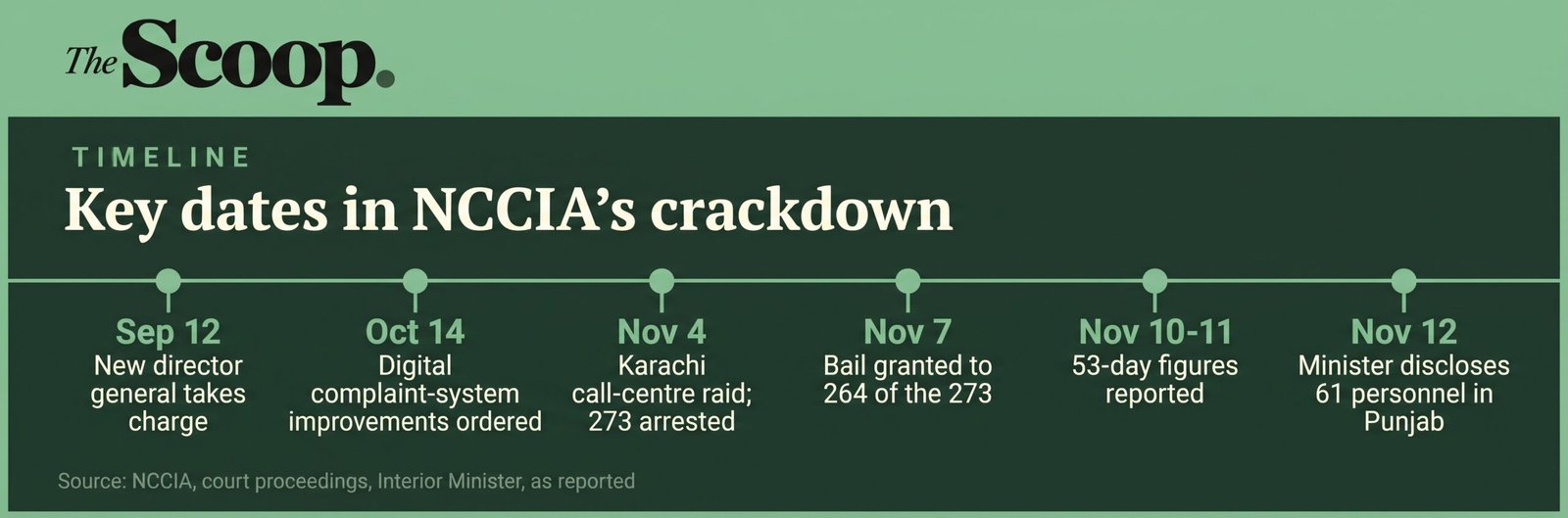
According to performance figures reported on November 10 and 11, NCCIA recorded substantial investigative activity during a 53-day period.
The agency reported receiving 10,386 cybercrime complaints from across Pakistan.
These resulted in the registration of 6,672 inquiries and 442 criminal cases.
During the same reporting period, nationwide enforcement operations led to 1,749 arrests, while investigators reported recovering more than Rs149.8 million.
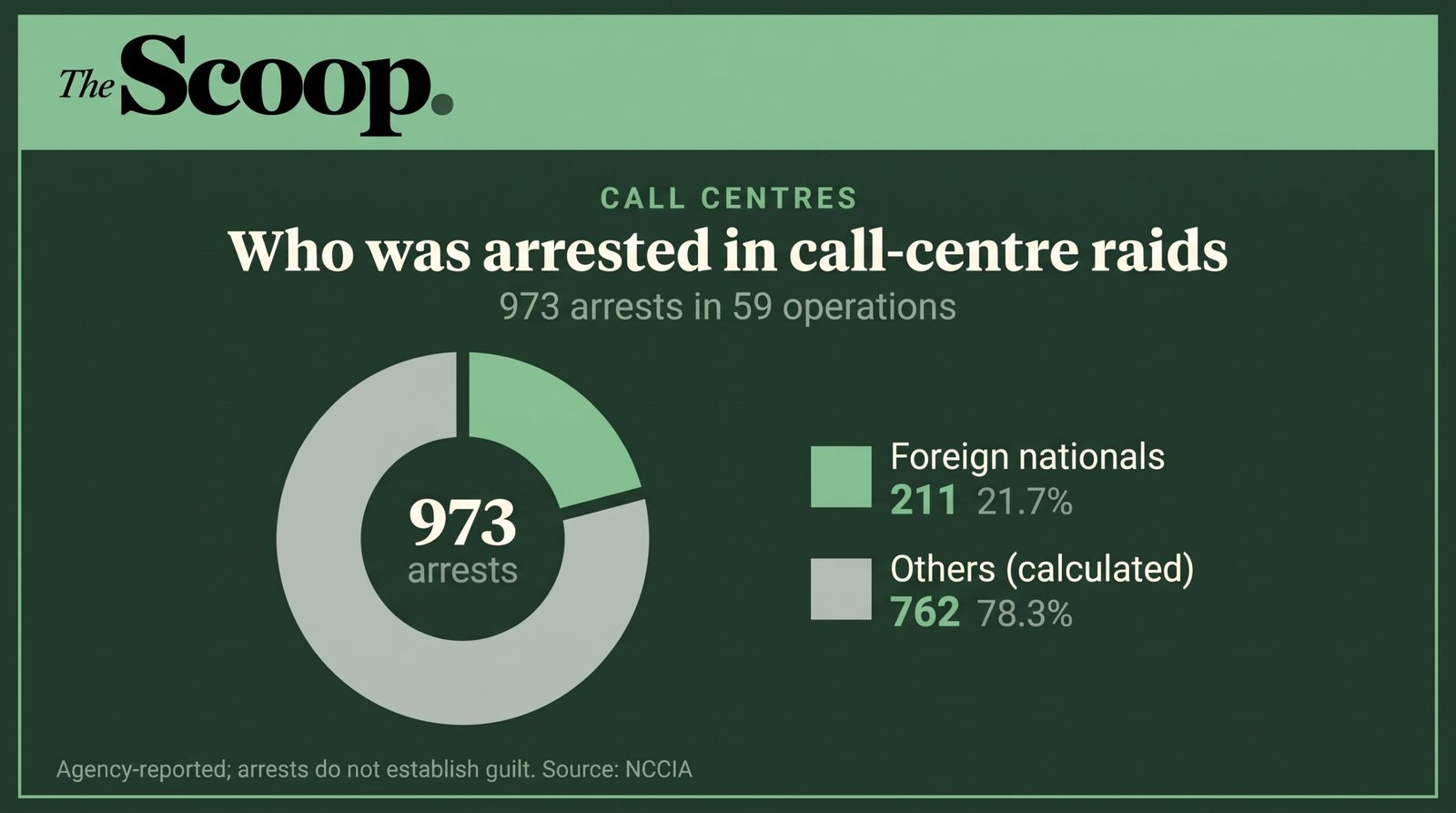
The agency also conducted 59 operations against suspected illegal call centres, registering 43 cases and arresting 973 individuals.
Of those detained in the call-centre operations, 211 were foreign nationals, according to the agency’s figures.
Investigators also reported seizing 15,502 items during the raids, including electronic devices and other material intended for forensic examination.
Meanwhile, NCCIA’s Cyber Patrolling Unit analysed 4,530 internet addresses and referred 1,186 links to the Pakistan Telecommunication Authority for possible blocking.
These figures illustrate the scale of the agency’s recent enforcement activity.
However, they should be understood as agency-reported operational statistics rather than independently verified judicial outcomes. Arrests do not establish guilt, and the figures do not disclose how many cases have resulted in convictions.
Similarly, the Rs149.8 million figure represents reported recoveries. The agency has not published a complete public reconciliation establishing how much of that total has already been returned to victims.
Nevertheless, the breadth of the operations suggests that NCCIA is directing considerable attention towards organised fraud, financial crime and technologically enabled criminal networks.
Ali Nasir Rizvi’s Shift From Conventional Policing to Cybercrime
Rizvi’s appointment as NCCIA Director General on September 12, 2026, marked a significant transition in his law-enforcement career.
Before assuming his current position, he served as Inspector General of Islamabad Police, having previously held policing responsibilities in Punjab.
His background is rooted in conventional policing, operational command, investigation and law-enforcement administration.
Cybercrime investigation, however, presents an entirely different set of operational and institutional challenges.
Unlike traditional criminal cases, digital offences often involve encrypted communication systems, concealed identities, electronic financial trails, cross-border transactions and sophisticated methods of manipulating victims.
Investigators must preserve electronic evidence, establish financial links between suspects, coordinate with financial institutions and, frequently, seek assistance from foreign jurisdictions.
A senior officer’s experience in conventional policing can contribute to organisational discipline, accountability and operational coordination. Yet cybercrime enforcement additionally requires specialised technological expertise.
For Rizvi, the challenge is therefore not merely to increase the number of enforcement operations.
It is to combine conventional investigative discipline with the technical capabilities necessary to pursue increasingly complex digital crimes.
His early priorities, including complaint-management reforms, field inspections and targeted operations against organised fraud networks, suggest an emphasis on both enforcement and administrative restructuring.
Whether these measures represent a lasting institutional transformation will become clearer over time.
Illegal Call Centres: A Growing Threat to Pakistan’s Reputation
One of the most consequential areas of NCCIA’s recent enforcement campaign involves suspected illegal call centres.
Pakistan has developed a legitimate and expanding business process outsourcing industry, employing young professionals who provide customer support, information technology, medical billing and other services to international clients.
However, investigators have identified suspected criminal enterprises operating under the appearance of legitimate outsourcing businesses.
Such networks allegedly impersonate financial institutions, insurance companies and customer-support representatives to obtain sensitive personal information and conduct fraudulent financial transactions.
In September, NCCIA reported arresting 212 individuals during operations against three suspected fraudulent call centres in Islamabad’s E-11 and G-10 sectors.
According to the agency, the operations resulted in the recovery of hundreds of computers, mobile phones and associated electronic equipment.
In October, NCCIA officers conducted additional operations in Lahore, including action against a suspected fraudulent medical billing operation and schemes allegedly targeting overseas customers.
Further investigations involved accusations of online investment fraud, impersonation and unauthorised collection of financial data.
These operations are significant because suspected international scam networks can harm both foreign victims and Pakistan’s reputation as a destination for legitimate outsourcing services.
The challenge for investigators is to distinguish genuine technology businesses from criminal enterprises while ensuring that enforcement actions do not unnecessarily disrupt lawful commercial activity.
Effective regulation and enforcement should strengthen legitimate businesses rather than create uncertainty for an entire industry.

The Karachi Operation That Put NCCIA Under the Spotlight
One of the largest operations of the recent campaign took place in Karachi on November 4.
NCCIA raided a suspected fraudulent call centre operating under the name Voxtron Solutions near Sharea Faisal.
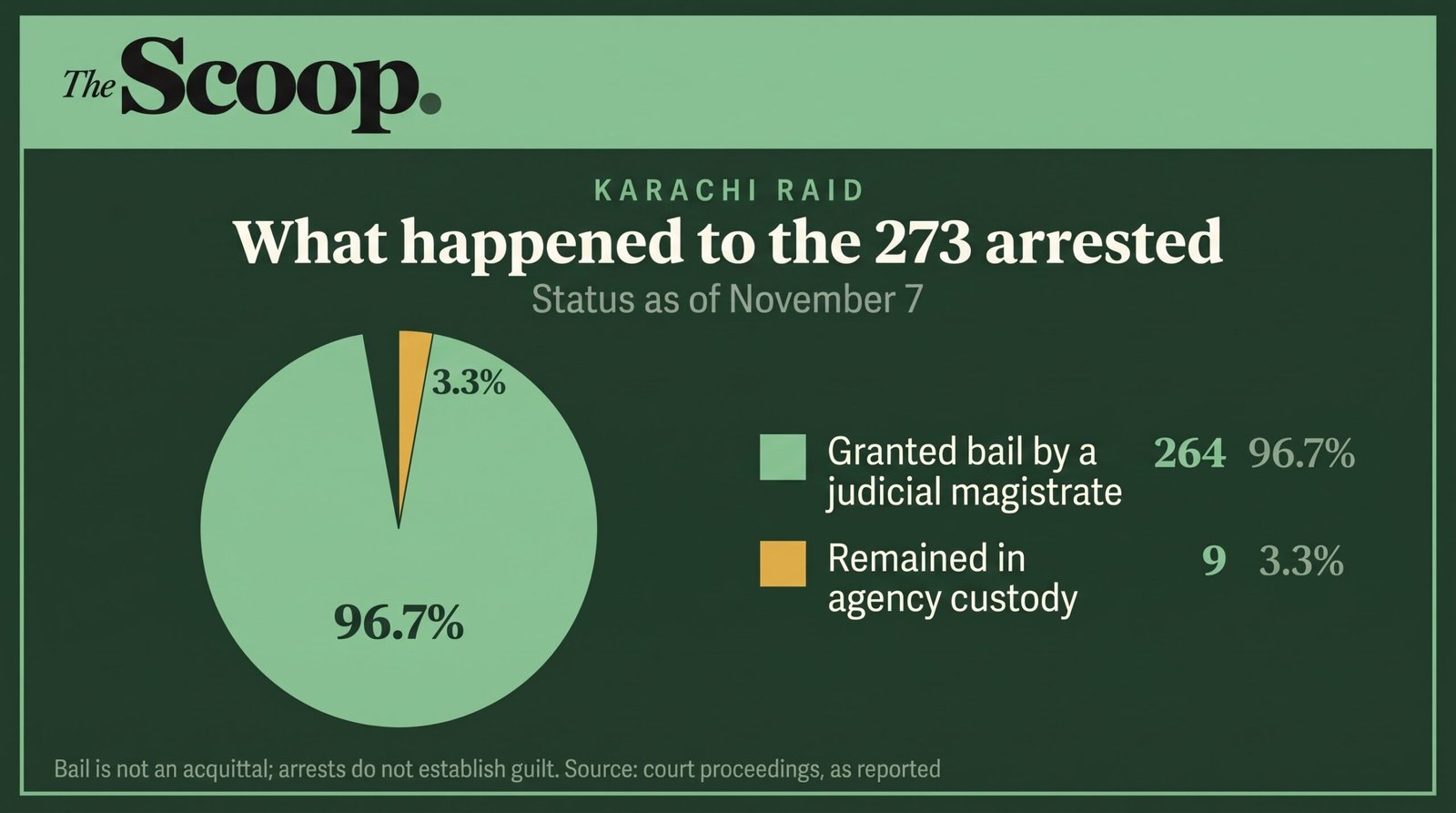
Officials reported arresting 273 individuals and seizing 339 laptops, 152 mobile phones and four computers.
According to NCCIA Additional Director Shahzad Akbar, preliminary investigations indicated that the operation allegedly targeted foreign nationals through impersonation, identity misuse and caller-ID spoofing.
The case attracted considerable attention because of the number of people detained and the scale of equipment recovered.
However, subsequent court proceedings also highlighted the distinction between conducting an operation and establishing individual criminal responsibility.
By November 7, a judicial magistrate had granted bail to 264 of the 273 people arrested, including women and juveniles. Nine suspects remained in agency custody for further investigation at that stage.
Defence lawyers also questioned whether the required search and seizure warrants had been obtained.
The proceedings illustrate an important reality: large-scale raids may disrupt suspected criminal activity, but successful prosecution requires legally obtained evidence and proof of each accused person’s involvement.
For NCCIA, the lesson is clear.
The effectiveness of such operations will ultimately be determined by the strength of forensic evidence, lawful investigative procedures and the prosecution’s ability to establish guilt in court.
Why Recovering Victims’ Money Matters More Than Headlines
Arrests and raids naturally attract public attention, but the financial consequences of cybercrime are often devastating for victims.
Digital fraud can destroy personal savings, compromise bank accounts and leave individuals facing considerable financial hardship.
For elderly citizens, small business owners and families with limited savings, recovering stolen money may be the most meaningful measure of law-enforcement effectiveness.
In October, NCCIA released its first-month performance report after Rizvi assumed charge.
The report documented 5,176 complaints, 4,491 inquiries, 272 registered cases and 1,129 arrests.
It also reported that Rs105.3 million had been recovered and returned to victims.
The subsequent 53-day performance figures recorded Rs149.8 million in recoveries, although they did not establish how much of this larger amount had been disbursed.
These are important distinctions.
An effective cybercrime agency should be assessed not simply by how much money it traces or freezes, but by how much is legally recovered and actually restored to victims.
The government and NCCIA could strengthen public confidence by publishing regular, independently auditable figures on financial losses reported, amounts recovered, funds returned and unresolved claims.
Such transparency would provide a more complete picture of the agency’s effectiveness.
Taking Complaints Beyond the Traditional Police Desk
Another notable development under Rizvi has been the renewed emphasis on citizen complaints and administrative accountability.
For many Pakistanis, approaching a federal investigative agency can be intimidating.
Victims frequently need clear instructions, timely responses and reliable updates on the progress of their cases.
During a five-day inspection of NCCIA offices across Punjab in October, Rizvi reviewed reporting centres, pending inquiries, investigations and record-management procedures.
According to the agency, he also interacted directly with more than 500 complainants.
The introduction and continuation of open complaint hearings, commonly known as khuli kachehris, has provided citizens with opportunities to raise grievances before senior management.
The concerns raised have included online financial fraud, social media harassment, blackmail, account hacking and identity misuse.
On October 14, Rizvi directed officials to improve the agency’s digital complaint-management system, including registration, case tracking and disposal procedures.
The directions called for greater use of technology to allow citizens to monitor their complaints and improve accountability among investigating officers.
Further instructions were issued during meetings on November 10, when the NCCIA leadership reviewed coordination between operational units, complaint-management personnel, the helpline and the agency’s information technology staff.
These developments indicate an attempt to address an administrative problem that extends beyond cybercrime: the gap between filing a complaint and receiving a meaningful institutional response.
The proposed reforms will require measurable implementation.
A complaint-management system becomes effective when citizens can track their cases, receive timely explanations for delays and challenge administrative inaction.
A Serious Shortage of Personnel
Despite the recent enforcement activity, NCCIA continues to face substantial resource constraints.
During a press conference at the agency’s Lahore office on November 12, Interior Minister Mohsin Naqvi acknowledged the shortage of personnel and announced that the federal government was working to provide additional resources.
According to the minister, NCCIA had only 61 personnel serving a Punjab population of approximately 140 million.
That figure reportedly included employees ranging from drivers and constables to senior officials.
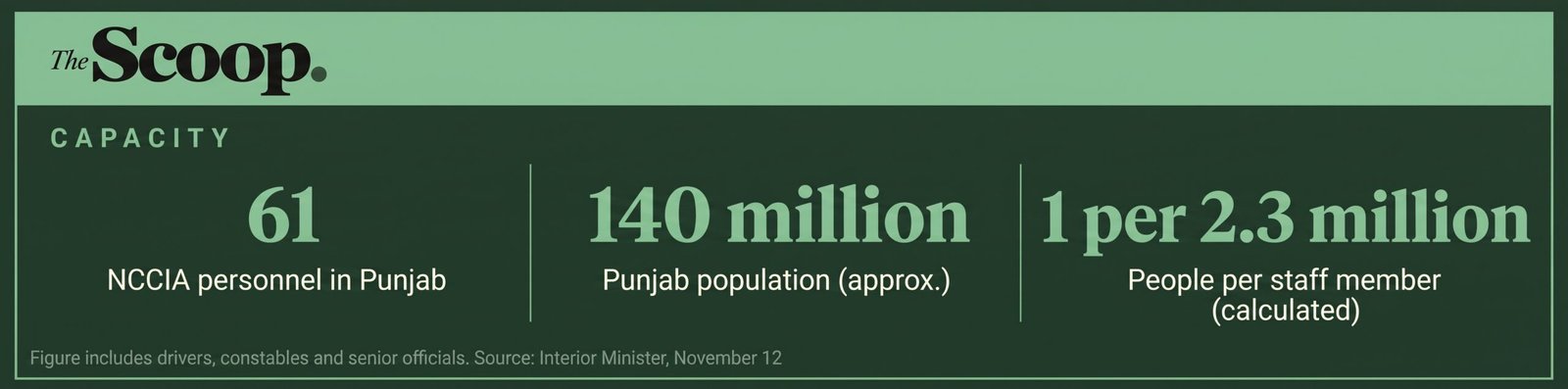
The staffing constraint offers important context for understanding the agency’s workload.
An institution responsible for investigating sophisticated technological crimes cannot depend indefinitely on limited personnel and resources.
It requires forensic laboratories, trained investigators, specialist prosecutors, modern software, secure evidence-management systems and dedicated financial investigation capabilities.
Naqvi also announced that the government intended to introduce cybercrime complaint registration through NADRA’s Pak ID platform, providing another channel through which citizens could submit and track complaints.
The proposed initiative, if implemented effectively, could help reduce procedural difficulties for complainants.
However, improving access without expanding investigative capacity risks producing larger backlogs.
The government will therefore need to ensure that technological reforms are matched by staffing, training and adequate funding.
A Cybercrime Agency Cannot Succeed Through Arrests Alone
The challenge facing NCCIA is broader than its recent operational achievements.
Pakistan’s cybercrime framework has undergone significant changes, particularly following the 2025 amendments to the Prevention of Electronic Crimes Act (PECA).
The agency now carries responsibilities previously associated with the Federal Investigation Agency’s Cyber Crime Wing.
Its mandate includes investigating offences involving electronic fraud, identity theft, unauthorised access to information systems, online harassment and other crimes covered under the law.
Yet enforcement takes place within a legal environment that has attracted criticism from journalists, civil society organisations and digital-rights advocates.
The International Federation of Journalists and Pakistani press-freedom organisations have raised concerns about the use of cybercrime laws against journalists and online commentators.
These concerns cannot be ignored when assessing the future of the agency.
There is a fundamental difference between investigating financial fraud, blackmail and the exploitation of children, and using criminal procedures against lawful journalistic expression or legitimate criticism.
For NCCIA to become a trusted institution, its investigative powers must operate within constitutional protections and judicial oversight.
The agency’s credibility will depend on whether it can pursue genuine criminal conduct without allowing enforcement mechanisms to become instruments of intimidation.
Strong enforcement and respect for fundamental rights should reinforce one another.
Protecting Women and Children in the Digital Space
Another important dimension of NCCIA’s mandate concerns offences involving women and children.
Online blackmail, harassment, identity misuse and the unauthorised distribution of private material can cause significant psychological, reputational and financial harm.
Victims often hesitate to report such crimes because of social stigma, privacy concerns and fear of further exposure.
On November 12, Interior Minister Mohsin Naqvi publicly discussed a case involving six young girls who had reportedly suffered serious distress after being subjected to blackmail.
He said NCCIA investigators had moved quickly to arrest suspects identified in connection with the complaints.
The reported response highlights the importance of treating digital exploitation as a serious criminal justice issue rather than dismissing it as a private dispute or social media controversy.
However, victim protection requires more than arrests.
Confidential complaint procedures, sensitive interviewing practices, protection of private material and access to appropriate support services must become standard features of cybercrime investigations.
For an institution such as NCCIA, the treatment of vulnerable complainants will be an essential measure of its effectiveness.
The International Dimension of Pakistan’s Cybercrime Challenge
Cybercrime rarely respects national borders.
A fraudulent call centre operating in Pakistan may target victims in North America or Europe, while stolen financial information can move through digital networks spanning several countries.
Investigators may need foreign evidence, international banking records and cooperation with overseas law-enforcement agencies.
This requires close coordination with international partners and strict adherence to evidentiary and legal procedures.
The presence of foreign nationals among those arrested in recent NCCIA operations underlines the cross-border nature of some suspected criminal networks.
At the same time, Pakistan must avoid allowing illegal enterprises to damage confidence in its legitimate information technology and outsourcing industries.
A credible cybercrime investigation system could support Pakistan’s economic interests by helping demonstrate that the country is prepared to investigate international fraud and protect legitimate businesses.
But such confidence will emerge from lawful prosecutions, effective cooperation and transparent enforcement, not arrests alone.
The Real Test for Ali Nasir Rizvi
Rizvi’s early months at NCCIA have been marked by substantial reported enforcement activity, increased attention to organised cyber fraud and repeated directives concerning public complaints.
The agency has conducted major raids, reported significant recoveries and announced measures to modernise complaint handling.
These activities deserve examination on their merits.
Yet a definitive assessment of his leadership would be premature without comparable historical figures, independent evaluations and comprehensive judicial statistics.
Several questions remain unanswered.
How many of the registered cases will result in convictions?
What proportion of stolen money will ultimately be returned to victims?
How quickly will NCCIA resolve pending complaints?
Will the agency develop the forensic and prosecutorial expertise needed to handle complex international financial crimes?
And can it establish sufficient safeguards to maintain public confidence in the impartiality of its investigations?
The answers will determine whether the recent enforcement campaign develops into sustainable institutional reform.
Beyond the Crackdown: Pakistan Needs a Stronger Cybercrime Institution
The creation of a specialised federal cybercrime investigation agency reflected an acknowledgement that the nature of criminal activity was changing.
Financial transactions, communications, businesses and personal information are increasingly dependent on digital systems.
As a result, citizens require a law-enforcement institution capable of protecting them against criminal exploitation in cyberspace.
The latest figures released during Rizvi’s tenure indicate considerable operational activity, particularly against suspected organised fraud networks and illegal call centres.
The focus on complaint tracking, administrative oversight and financial recovery also addresses weaknesses that have long affected public confidence in investigative institutions.
However, lasting improvement will require resources, professional training, technological capability, judicial accountability and transparency.
For Ali Nasir Rizvi, the opportunity is to move NCCIA beyond periodic crackdowns and towards becoming a dependable institution capable of responding to the digital threats facing Pakistan.
That transformation cannot be measured in weeks or through arrest figures alone.
It will be measured by victims receiving justice, criminal networks being successfully prosecuted, legitimate businesses operating without fear of fraudulent competition and citizens having confidence that the law protects their rights.
Pakistan does not merely need a cybercrime agency that can make arrests. It needs one that can investigate effectively, recover stolen money, secure convictions and earn public trust.
Whether NCCIA can meet that standard will define the significance of its current enforcement drive — and the lasting impact of Rizvi’s leadership.