

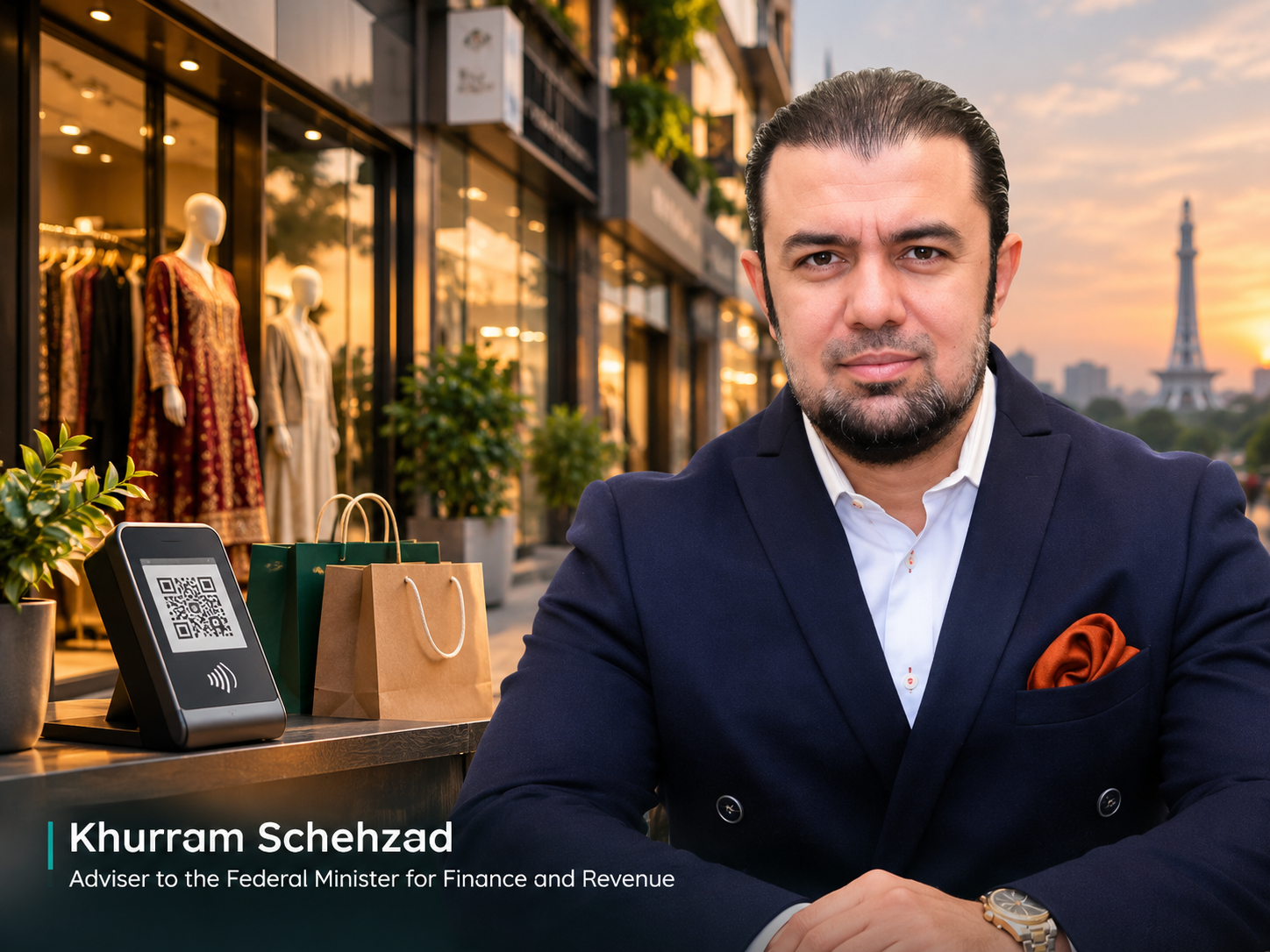
LAHORE, November 17, 2026: Pakistan’s wholesale and retail industry, accounting for approximately 18 per cent of the country’s gross domestic product (GDP) and representing an economic footprint exceeding $80 billion, is emerging as a critical testing ground for the government’s claims of economic recovery, as policymakers increasingly acknowledge that macroeconomic stability alone cannot generate sustainable business expansion, stronger household purchasing power or employment.
Delivering a keynote presentation titled Retail, Rebuilt: From Macro Stability to Shop-Floor Growth at the 6th Pakistan Future of Retail Business Summit & Expo 2026, held at the Pearl-Continental Hotel in Lahore on Tuesday, Khurram Schehzad, Adviser to the Federal Minister for Finance and Revenue, outlined an economic roadmap linking fiscal consolidation, digital transformation, access to finance, formalisation and export-oriented manufacturing.
The summit, organised by the Chainstore Association of Pakistan (CAP) and TerraBiz under the theme Retail, Rebuilt, brought together policymakers, retailers, manufacturers, financial institutions and technology providers to examine the industry’s changing business environment.
Schehzad’s central argument was that Pakistan had made substantial progress in restoring macroeconomic stability, but the next phase of reform must translate those improvements into stronger businesses, greater consumer spending, additional investment and jobs.
“Stability must reach the shop floor,” his presentation declared.
The message marks an important shift in the country’s economic debate: from avoiding financial crisis to determining whether stabilisation can deliver commercially meaningful growth.
From Economic Crisis to Stability: The Government’s Recovery Narrative
Schehzad presented a series of fiscal, monetary and external-sector indicators intended to demonstrate the extent of Pakistan’s economic turnaround since the crisis period of 2022–23.
According to the figures presented, Pakistan’s fiscal deficit narrowed to 2.6 per cent of GDP during FY2025–26, its lowest level in 22 years, while the primary balance recorded a surplus equivalent to 2.9 per cent of GDP, described as the strongest performance in 26 years.
The presentation contrasted these figures with FY2022, when the fiscal deficit stood at approximately 8 per cent of GDP, and FY2022–23, when the primary balance had been negative.
Inflation, which averaged 29.2 per cent during FY2022–23, moderated to an average of 7.1 per cent in FY2025–26.
Pakistan’s debt-to-GDP ratio also declined from 75.2 per cent during the earlier crisis period to approximately 68 per cent in FY2026, while the current account recorded a comparatively modest deficit of $304 million, against a deficit of $17.4 billion in FY2022.
Foreign exchange reserves held by the State Bank of Pakistan were reported at approximately $21.6 billion in November 2026, substantially above the levels recorded during the acute external financing crisis of early 2023.
The adviser also highlighted sovereign credit ratings of B from Standard & Poor’s, B3 from Moody’s and B- from Fitch, all carrying stable outlooks.
Collectively, these indicators support the government’s argument that Pakistan has moved away from immediate financial instability.
However, the implications for the retail economy require a more nuanced assessment.
A reduction in inflation does not mean consumer prices have returned to earlier levels. Similarly, stronger fiscal balances do not necessarily translate into increased disposable incomes, lower operating expenses or improved profitability for retailers.
For businesses dealing with electricity expenses, taxation, financing costs, rent, logistics and inventory management, the recovery will ultimately be measured through sales volumes and sustainable margins rather than headline economic indicators.
Economic Growth Returns, But Can Businesses Capitalise?
Schehzad’s presentation reported real GDP growth of 3.7 per cent during FY2025–26, compared with an economic contraction of 0.2 per cent in FY2022–23.
The outlook presented for FY2026–27 pointed towards growth of approximately 4 per cent.
Large-scale manufacturing expanded by 5 per cent, marking its strongest performance in four years, while the keynote highlighted private-sector credit expansion of Rs1.463 trillion during FY2026.
Provisional figures presented for the first quarter of FY2026–27 indicated net foreign direct investment of approximately $720 million, representing a 20 per cent year-on-year increase.
Corporate profitability was reported to have increased by 25 per cent year-on-year during the first quarter of FY2026–27, following 18 per cent growth during FY2026.
These developments suggest that business confidence and investment activity are improving.
But an important distinction remains between higher corporate earnings and a broad-based recovery across the economy.
Pakistan’s retail sector includes major national chains, shopping malls and established brands, but it also encompasses thousands of smaller enterprises whose access to finance, technology and organised supply chains remains limited.
For the recovery to reach these businesses, stronger macroeconomic indicators must be accompanied by affordable commercial financing, predictable taxation, reliable energy and a sustained increase in consumer demand.
The $80 Billion Question: Do Pakistani Consumers Have More Money to Spend?
One of the most significant elements of Schehzad’s presentation focused on the purchasing power of Pakistani households.
Retail growth ultimately depends on the ability and willingness of consumers to spend.
The adviser highlighted workers’ remittances of $41.6 billion during FY2025–26, an increase of approximately 9 per cent from the preceding year and substantially higher than the $27 billion recorded in FY2022–23.
Pakistan’s per capita income was reported at approximately $1,900, reflecting an 8.3 per cent year-on-year increase.
Agricultural credit disbursements reached approximately Rs3.2 trillion during FY2026, increasing by around 25 per cent, indicating an expansion of financing available to the agricultural sector.
These developments potentially support consumer markets through remittance-funded household expenditure, agricultural activity and rising nominal incomes.
However, the relationship between higher income indicators and actual purchasing power is not straightforward.
Per capita income represents a national average and does not establish how evenly economic gains are distributed among households.
Similarly, agricultural credit disbursements represent financing extended to borrowers rather than a direct measure of farmers’ profits or disposable income.
Pakistan’s retailers must therefore contend with a fundamental commercial challenge: whether household spending has recovered sufficiently to sustain higher sales volumes without increasingly relying on price discounting and promotions.
For fashion chains, supermarkets, restaurants, electronics retailers and smaller neighbourhood businesses, this may prove a more meaningful measure of economic recovery than aggregate GDP growth.
Cashless Pakistan: Digital Payments Could Transform Retail Finance
A major component of the keynote was devoted to Pakistan’s expanding digital payments ecosystem and its potential to reshape the relationship between retailers, consumers and financial institutions.
Drawing on the Cashless Pakistan Dashboard, Schehzad highlighted significant growth in digital banking participation between June 2025 and September 2026.
The presentation reported that digital banking users increased from 95 million to 140.2 million, representing growth of approximately 48 per cent.
Annual digital transaction volumes rose from 6.9 billion to 15.9 billion, an increase of more than twofold.
The proportion of the financially included population expanded from 67 per cent to 71 per cent, while the reported gender gap in financial inclusion narrowed from 33 to 27 percentage points.
Active merchants accepting digital payments were reported at 1.68 million in the September dashboard, compared with approximately 500,000 in June 2025.
Separately, a government briefing issued on November 12 reported that active digital-payment merchants had reached 2.03 million. The different reported figures underline the importance of consistent measurement and reporting as the government expands its cashless economy initiative.
Schehzad’s presentation also acknowledged continuing connectivity challenges, with smartphone penetration at 72 per cent and internet penetration at 64.5 per cent in September, below the targets of 73 per cent and 70 per cent respectively.
For the retail industry, the expansion of digital payments offers opportunities beyond convenience.
Electronic transactions can help businesses establish documented sales histories, improve cash-flow visibility, reduce certain cash-handling risks and potentially strengthen their eligibility for institutional financing.
A retailer with verifiable digital sales and financial records may be better positioned to demonstrate business performance to a bank than one relying entirely on cash transactions and informal records.
However, increasing digital payment acceptance is only the first stage of the transformation.
The commercial value of digitisation will depend on transaction charges, connectivity, payment reliability, consumer adoption and whether financial institutions actually use transaction histories to improve access to credit.
Without these supporting developments, digital payments could expand significantly without delivering equivalent improvements in business profitability or financial inclusion.
SMEConnect and Rs300 Billion Export Financing: A New Opportunity for Businesses?
Among the most commercially significant policy measures discussed during the keynote was the expansion of financing access for small and medium-sized enterprises.
Schehzad highlighted the launch of SMEConnect, the State Bank of Pakistan’s centralised digital financing portal, which became operational for SME loan applications on November 1, 2026.
Under the framework, businesses seeking financing submit applications through the platform, which forwards them to relevant banks and development finance institutions after the required verification processes.
The initiative seeks to simplify financing applications and establish a more transparent connection between smaller businesses and formal lenders.
The keynote reported outstanding SME financing of approximately Rs1.14 trillion, reflecting an increase of around 66 per cent year-on-year.
This expansion suggests growing institutional lending to smaller enterprises, although financing remains subject to lenders’ credit assessments and eligibility requirements.
A second major initiative involves the allocation of Rs300 billion for eligible SME exporters under the Export Finance Scheme administered through the Export-Import Bank of Pakistan.
The allocation is part of the broader export financing framework rather than a newly announced general-purpose retail subsidy.
It is intended to support eligible exporters, including smaller businesses seeking working capital to develop and expand their international operations.
For Pakistan’s retail and manufacturing ecosystem, the initiative could become particularly relevant to businesses seeking to move beyond domestic markets.
Clothing brands, textile manufacturers, home furnishing businesses and other product-oriented enterprises with export potential may benefit from improved financing access, provided they satisfy the scheme’s requirements.
Nevertheless, the availability of an earmarked financing envelope does not automatically guarantee disbursements to smaller businesses.
Its impact will depend on how efficiently eligible applicants can secure funding, whether lending terms are commercially workable and how successfully financing reaches businesses that have historically struggled to access bank credit.
From Retail Chains to Capital Markets: Financing Expansion Differently
Schehzad also presented a broader financing strategy linking different business requirements with appropriate capital instruments.
For inventory purchases and day-to-day operations, the presentation emphasised bank financing and supplier credit.
For business expansion, it identified private equity, public share offerings, corporate debt and Sukuk as potential financing channels.
Retail property development was linked to real estate investment trust structures, subject to eligibility and regulatory requirements.
The presentation highlighted a renewed level of capital-market activity.
During FY2025–26, 11 initial public offerings raised approximately Rs18.4 billion, while five IPOs were reported during the first four months of FY2026–27.
The keynote also referred to the Pakistan Stock Exchange’s expanding investor base, which reached approximately 682,000 investors in October 2026, an increase of 56 per cent year-on-year.
Around 85 per cent of new investors were reported to belong to Generation Z and Millennial age groups.
These developments could become increasingly relevant to Pakistan’s larger retail businesses as they seek alternatives to conventional bank borrowing.
However, equity and debt markets generally require stronger financial disclosures, corporate governance and compliance than many family-owned businesses traditionally maintain.
The challenge for Pakistan’s retail ecosystem will therefore include helping commercially successful businesses develop the structures necessary to attract institutional capital.
FBR’s Faceless Tax System: Will Formalisation Become Less Burdensome?
Tax administration and the formalisation of retail businesses represented another important part of the presentation.
Schehzad highlighted the Federal Board of Revenue’s National Faceless Centre, established in September 2026, as a reform intended to reduce direct interaction between taxpayers and tax officers.
The system introduces computerised, risk-based case selection and electronic handling of tax audits and assessments.
Its intended objectives include reducing official discretion, improving transparency and creating greater predictability in tax administration.
For the retail sector, the effectiveness of such reforms could have significant implications.
Businesses operating within the formal economy incur documentation, taxation and compliance costs that may differ substantially from those faced by informal competitors.
A modern retail sector therefore requires not only stronger tax enforcement but also fairer competition and administratively manageable compliance.
The central policy challenge is to ensure that formalisation becomes commercially viable rather than simply increasing the cost of operating legally.
The introduction of digital tax administration is a structural step, but its success will ultimately depend on implementation, consistency and the experience of businesses interacting with the new system.
Beyond Lahore and Karachi: The Next Retail Growth Frontier
A particularly important aspect of Schehzad’s roadmap was the emphasis on expanding retail development beyond Pakistan’s largest metropolitan centres.
The presentation identified Faisalabad and other regional hubs as potential areas of growth where manufacturing, consumer demand and commercial activity intersect.
The underlying argument was that Pakistan’s future retail expansion cannot depend exclusively on large shopping malls and premium commercial districts in Lahore, Karachi and Islamabad.
Regional cities offer opportunities for organised retailers, manufacturers, logistics providers and emerging consumer brands.
However, this expansion requires investment in warehousing, cold-chain infrastructure, dependable last-mile delivery services and reliable energy supplies.
For food retailers, for example, inadequate temperature-controlled logistics can increase waste and operating costs.
For fashion and consumer goods businesses, delayed deliveries, inconsistent supplier arrangements and weak distribution infrastructure can undermine the commercial benefits of entering new markets.
Schehzad consequently linked lower business costs with predictable approvals, improved infrastructure and stronger coordination between retailers and manufacturers.
The presentation also emphasised demand-led sourcing, joint product development, quality standards and timely payments to suppliers.
These considerations suggest a shift from treating retail as an isolated commercial activity towards recognising its wider role in manufacturing, agriculture, logistics, technology and financial services.
From Selling Imported Products to Exporting Pakistani Brands
One of the keynote’s most ambitious proposals concerned the transformation of Pakistan’s retail economy from a predominantly domestic commercial market into a platform for internationally competitive Pakistani brands.
“Our ambition: move from selling more products in Pakistan to selling more Pakistani brands to the world,” the presentation stated.
The proposition has important implications for Pakistan’s economic development.
Pakistan possesses an established manufacturing base in textiles, apparel and several other consumer-product industries, yet domestic manufacturing capacity alone does not guarantee the development of internationally recognisable brands.
Global brand-building requires sustained investment in product quality, marketing, design, distribution, customer experience, intellectual property and market development.
The distinction is economically significant.
Manufacturing products for third-party labels and selling internationally recognised Pakistani-owned brands are different business models, with potentially different margins, commercial risks and opportunities for long-term value creation.
For Pakistan to capture greater value from its manufacturing capabilities, stronger coordination will be required between producers, retailers, investors and export promotion institutions.
The Rs300 billion SME export financing allocation may support part of that transition, but financing alone cannot substitute for product competitiveness, reliable production or international market access.
The Real Challenge: Turning Economic Stability Into Business Growth
Perhaps the most consequential message of Schehzad’s keynote emerged in its concluding call for practical implementation.
Rather than allowing the summit to remain solely a discussion platform, the adviser called for its outcomes to become a pipeline of investable projects.
The framework assigned interconnected responsibilities to government, financial institutions, retailers and manufacturers.
Government would need to make investment easier through predictable regulation, efficient approvals and improved infrastructure.
Financial institutions would need to make commercially viable businesses easier to finance.
Retailers and manufacturers would need to translate those improvements into stronger brands, exports and employment.
The presentation did not announce a separate universal retail financing programme or a new across-the-board subsidy. Instead, it brought together existing and recently introduced policy instruments into a wider strategy for private-sector growth.
That distinction matters.
Pakistan’s economic stabilisation has created an opportunity to pursue longer-term structural reforms, but translating that opportunity into sustained growth remains a considerably more demanding exercise.
The country will need to address the gap between improving financial indicators and the commercial realities faced by businesses and households.
In a sector representing approximately one-fifth of the economy, even modest improvements in productivity, purchasing power, access to finance and formalisation could have substantial implications for employment, manufacturing demand and economic activity.
Equally, persistent constraints could prevent the retail economy from realising the potential suggested by headline economic figures.
For Pakistan’s $80 billion wholesale and retail industry, the defining question is no longer simply whether the economy has stabilised. It is whether that stability can produce more customers, stronger businesses, better-paying jobs and Pakistani brands capable of competing internationally.
As Schehzad’s presentation concluded: “Stability is the foundation. Execution is the difference.”
For Pakistan’s retailers, that difference will determine whether the current recovery becomes a sustained period of commercial expansion or remains largely visible in economic statistics.
The Scoop was the Official Media Partner of the 6th Pakistan Future of Retail Business Summit & Expo 2026, held in Lahore on November 17.