

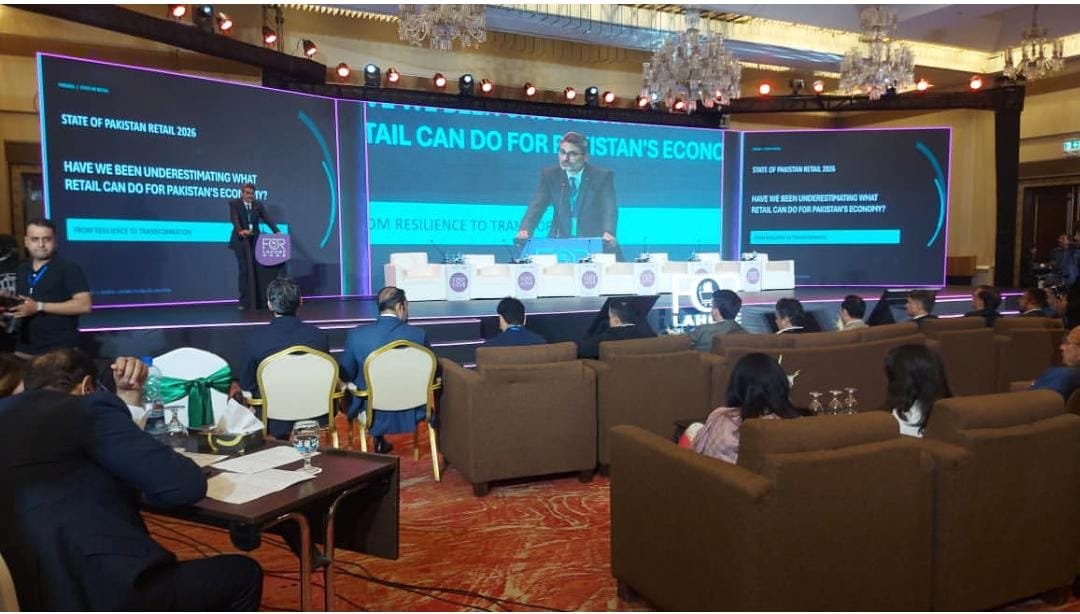
LAHORE, November 17, 2026: Pakistan’s retail industry has the potential to become one of the country’s most powerful engines of economic transformation, with an ambitious proposal to establish 50 internationally active Pakistani consumer brands and generate $1 billion in annual branded exports by 2030.
However, achieving this vision will require far more than opening additional shopping malls, expanding store networks or introducing new digital payment systems. It will demand fundamental changes in taxation, industrial collaboration, investment, formalisation and the country’s approach to building internationally competitive businesses.
These were the central messages of the State of Pakistan Retail 2026 presentation delivered by Asfandyar Farrukh, Co-Founder and Immediate Past Chairman of the Chainstore Association of Pakistan (CAP), at the 6th Pakistan Future of Retail Business Summit & Expo 2026, held in Lahore on Tuesday.
The event, organised by CAP in collaboration with TerraBiz under the theme Retail, Rebuilt, brought together policymakers, business leaders, retailers, manufacturers, investors and technology companies to examine the future of Pakistan’s retail economy. The Scoop served as the summit’s Official Media Partner.
Farrukh’s presentation challenged the conventional understanding of retail as merely a network of shops and commercial outlets, arguing instead that the industry should be recognised as a critical link between manufacturing, logistics, employment, financial services, tourism and international trade.
The presentation’s most significant proposal was a Retail 2030 ambition: 50 internationally active Pakistani consumer brands, including at least 20 with a substantial retail presence across multiple countries, and $1 billion in collective annual branded exports.
Importantly, these figures were presented as proposed industry ambitions rather than approved targets, government commitments or economic forecasts.

Retail Accounts for Nearly 18% of Pakistan’s Economy
The scale of Pakistan’s retail economy is considerably larger than the industry is often given credit for.
According to the Pakistan Economic Survey 2025–26, wholesale and retail trade jointly accounted for 17.8% of GDP, making the sector one of the largest contributors to national economic activity.
The sector represented approximately 30.47% of total services-sector value added, demonstrating its importance to the broader economy. These figures cover wholesale and retail trade together, not organised retail exclusively.
The presentation estimated organised retail’s share of wholesale and retail trade at approximately 12%, but did not provide a detailed methodology for that estimate.

Farrukh argued that the true economic importance of retail extends well beyond sales transactions.
A successful retail brand generates demand for textile mills, manufacturers, logistics companies, commercial property developers, software providers, financial institutions and skilled workers.
Its expansion can stimulate domestic production, encourage innovation, strengthen supply chains and create opportunities for investment.
However, the economic figures also reveal a concern.
The latest national accounts revision reduced estimated wholesale and retail trade growth for FY2026 from 3.71% to 2.37%, reflecting weaker manufacturing and import-related activity. This reinforces the need for productivity-led growth rather than relying exclusively on expanding consumer spending.
The Biggest Contradiction: Pakistan Penalises Businesses That Pay Taxes
Perhaps the strongest part of Farrukh’s presentation concerned the unequal conditions facing documented and undocumented businesses.
Pakistan has repeatedly emphasised the need to broaden its tax base, increase documentation and integrate retail transactions with the Federal Board of Revenue’s digital systems.
Yet formal retail businesses continue to face significant compliance costs while competing with operators that may remain outside the documented economy.
Organised retailers invest in point-of-sale systems, formal payrolls, tax documentation, financial reporting and regulatory compliance.
These investments improve transparency, but they also create additional operating costs.
By comparison, businesses operating through undocumented supply chains, under-invoiced imports or inconsistent tax compliance may enjoy cost advantages.
Farrukh’s argument was that documentation should improve a business’s competitiveness rather than undermine it.
The distinction is particularly important because the problem extends beyond the shop counter.
Undocumented products entering supply chains, inconsistent taxation across distribution networks and unequal enforcement can distort competition long before merchandise reaches the consumer.
Farrukh called for simpler compliance requirements, fair taxation and predictable enforcement rather than granting special exemptions to organised retailers.
The controversy surrounding the FBR’s point-of-sale integration framework demonstrates the challenge.
In June 2025, the Federal Tax Ombudsman intervened following complaints from CAP about technical failures, invoice synchronisation problems and enforcement measures affecting Tier-1 retailers.
The Ombudsman directed the FBR to suspend shop sealing linked to unresolved POS technical problems and improve coordination and dispute-resolution mechanisms.
The broader question remains whether Pakistan can successfully expand the documented economy without first reducing the commercial disadvantages associated with compliance.
From Manufacturing for Others to Owning Pakistani Brands
Another major theme of the presentation concerned Pakistan’s limited ability to capture the full commercial value of products manufactured domestically.
The country possesses substantial textile manufacturing capacity and a growing network of consumer brands, particularly in fashion, footwear and lifestyle retail.
However, manufacturing capability alone does not guarantee maximum export earnings.
Higher commercial value can be generated through product development, design, marketing, brand ownership, international distribution and direct relationships with consumers.
Farrukh identified the emerging collaboration between CAP and the All Pakistan Textile Mills Association (APTMA) as a significant opportunity to bridge this gap.
The two organisations have initiated discussions and working sessions designed to connect manufacturers with organised retail brands, encourage domestic sourcing and identify opportunities for international expansion.
The collaboration gained momentum during meetings in September and October 2026, when textile manufacturers and retail businesses explored replacing imported merchandise with locally developed alternatives and expanding Pakistani brands abroad.
The proposed model emphasises producing goods that meet actual customer demand rather than manufacturing without adequate market intelligence.
It would also encourage manufacturers to work directly with retail brands on pricing, product quality, delivery schedules and technical innovation.
For Pakistan, the significance could extend well beyond reducing imports.
If locally manufactured goods are developed, branded and distributed by Pakistani companies internationally, a larger proportion of the commercial value could potentially remain within the national economy.
Farrukh captured this ambition with the message:
“We should not be satisfied with ‘Made in Pakistan’ alone. We should aspire to ‘Branded in Pakistan, wanted around the world.’”
The challenge, however, lies in execution.
Global expansion requires investment in retail infrastructure, warehousing, consumer research, distribution networks, marketing and international regulatory compliance.
Without commercially viable products and competitive supply chains, ambitious export targets risk remaining aspirational.
The $1 Billion Question: Can Pakistan Build 50 International Brands by 2030?
The most forward-looking element of the presentation was the proposal for a measurable Retail 2030 programme.
Farrukh suggested that the industry consider three major internationalisation objectives: developing 50 internationally active Pakistani consumer brands, ensuring at least 20 establish a significant physical retail presence in multiple countries, and generating $1 billion in combined annual branded exports.
The presentation also proposed increasing organised retail’s share of wholesale and retail trade to 15%.
These ambitions would require cooperation among manufacturers, retailers, financial institutions, investors and government bodies.
They are not yet an adopted national export strategy, and the presentation acknowledged the need to establish reliable baseline figures and a credible implementation roadmap.
The distinction between ordinary exports and branded exports is particularly important.
A Pakistani textile manufacturer exporting merchandise to an international retailer participates in global trade, but the overseas brand may capture considerable additional value through distribution, marketing and retail sales.
By contrast, a Pakistani company developing its own international consumer brand can potentially earn from several stages of the value chain.

The success of the proposed strategy would therefore depend not simply on how much Pakistan produces, but on how effectively Pakistani businesses can access and retain customers internationally.
Digital Payments, Logistics and Skills: CAP’s Next Priorities
The presentation also outlined several initiatives aimed at expanding CAP’s role beyond traditional policy advocacy.
These include exploring e-commerce logistics solutions with TCS, promoting Raast QR payment adoption through engagement with Bank Alfalah, and developing retail vocational training through the Punjab Vocational Training Council (PVTC) and the College of Tourism and Hotel Management (COTHM).
The emphasis was on building practical commercial capabilities.
Better logistics could make online retail fulfilment more efficient, while wider digital payment adoption could improve transaction convenience and transparency.
The State Bank of Pakistan has established Raast person-to-merchant payment infrastructure, allowing businesses to accept interoperable digital payments through QR technology.
Training initiatives could address skills gaps in retail operations, customer service, management and technology.
However, the presentation described these initiatives as areas of collaboration and development, rather than providing evidence that all had already been implemented at scale.
Farrukh also proposed strengthening retail intelligence through industry surveys, research conducted with Ipsos and the possible introduction of a CAP Retail Performance Index.
Such an index could eventually help measure sector performance more systematically, providing investors and policymakers with better visibility into business conditions.
Also Read: Discounts Are Not Enough: TerraBiz CEO Tells Pakistan’s Retailers What Customers Really Want
Retail and Tourism: An Overlooked Economic Opportunity
Farrukh also challenged the separation of retail from tourism policy.
Tourism development is generally associated with hotels, attractions, transport infrastructure and cultural destinations.
However, visitors also generate economic activity through shopping, restaurants, entertainment and local services.
Modern retail centres can help transform tourism destinations into broader commercial ecosystems.
The presentation suggested that federal tourism initiatives and Punjab’s emphasis on heritage and destination development could create opportunities for greater cooperation with retailers.
This could include integrating shopping districts, local consumer brands, food businesses and commercial spaces into tourism planning.
Importantly, Farrukh did not announce a formal CAP tourism programme. Instead, he identified the area as a potential opportunity requiring collaboration.
For cities such as Lahore, the argument is especially relevant.
A destination that attracts visitors but fails to generate commercial opportunities for local businesses may capture only a limited proportion of the economic benefits of tourism.
Connecting shopping, dining, heritage and entertainment could encourage longer visits and greater local spending.
Policy Victories Are Not Enough Without Structural Reform
Farrukh also highlighted CAP’s policy engagement in Punjab and at the federal level.
According to the presentation, the association’s interventions contributed to relaxation of smog-related operating restrictions, withdrawal of a proposed uniform signboard policy and reversal of a proposed sales tax on commercial rent.
CAP also cited its involvement in the Federal Tax Ombudsman’s POS-related decision and engagement with authorities concerning footwear taxation under the Third Schedule.
The precise scope and implementation of these outcomes remain subject to the relevant official orders.
The broader message was that trade associations should not have to repeatedly intervene to resolve regulatory problems that could have been avoided through consultation and better policy design.
Retailers require predictable rules, commercially reasonable operating conditions and consistent enforcement to make long-term investment decisions.
Frequent changes in taxation, business hours and compliance procedures can increase uncertainty, particularly for companies planning new stores, production facilities and employment.
Why the Next Four Years Matter
The presentation divided Pakistan’s organised retail development into distinct phases.
Between 2012 and 2016, the industry established stronger foundations through branded retail formats, shopping malls and modern commercial infrastructure.
The period from 2017 to 2021 saw network expansion and the disruption caused by COVID-19.
From 2022 to 2026, the sector faced inflation, increased operating costs, regulatory pressures and the need for digital adaptation.
Farrukh suggested that the period from 2027 to 2030 should represent a transition towards productivity, investment and international competitiveness.

This would mark a shift in how retail success is evaluated.
Instead of measuring progress primarily through the number of new stores, the industry would need to assess the productivity of individual outlets, financial sustainability, domestic procurement, employment generation and international market expansion.
The presentation proposed measuring the tangible results of industry collaboration, including products successfully commercialised, new local sourcing arrangements, branded exports, digital payments adoption, workforce training and additional tourism-related spending.
That approach would also introduce greater accountability into industry development initiatives.
The Real Test: From Promises to Commercial Results
Farrukh’s presentation ultimately raised a larger question about Pakistan’s economic priorities.
Can the country transform its substantial manufacturing capabilities, domestic consumer base and entrepreneurial talent into globally competitive Pakistani businesses?
For decades, debates about retail have focused heavily on taxation, shop timings, imports and consumer spending.
The Retail 2030 vision attempts to shift that conversation towards industrial productivity, local value addition, international brand ownership and sustainable economic expansion.
But the proposed ambitions cannot be delivered by CAP or retail brands alone.
They would require investors willing to finance expansion, manufacturers capable of meeting international standards, technology partners offering efficient systems and policymakers providing a stable commercial environment.
Farrukh’s concluding argument was that industry development should be judged by outcomes rather than meetings, agreements or announcements.
The real measure of success would be stronger businesses, increased employment, higher productivity, new investment and Pakistani brands competing successfully in international markets.
For an economy seeking sustainable export growth and a broader documented tax base, the retail industry’s proposed transformation presents an opportunity worth serious consideration.
The question now is whether Pakistan can move from celebrating the resilience of its retailers to creating the conditions in which they can grow, compete and build global brands.