

I have spent my working life among switchboards, and I have learned that a utility’s history is never the one in the ceremonies. The ribbon-cutting gets the photograph. The history is in the logbooks, the fuel invoices, the burnt-out bearings and the men who fixed them at two in the morning. On the eve of a new country, let me set down how this plateau came to be lit.
In the 1840s the Potohar was a crossroads of armies and caravans, with no thought of lamps. But the science was already moving. Faraday had shown in 1831 that a magnet moved past a coil would coax a current from copper, and Dr. O’Shaughnessy was proving in Bengal that telegraph wires would work in tropical heat. A few engineers and officers posted to this plateau saw no reason the Margalla foothills should wait on Calcutta.
Their first line ran from the Rawalpindi cantonment toward the hills. It was crude, and monkeys, monsoon and mischief broke it often. But it ticked. For the first time, word of a landslide on the Murree road travelled faster than a horse. As the hill station grew through the 1850s and 60s, the telegraph office at Murree became the most important room in the hills. Electricity meant messages, not light. Yet it gave the region a habit that mattered more than any machine: expecting the distant to become near.
Light came in the 1880s. Small hydroelectric dynamos, driven by water wheels on the streams above Murree, fed a few arc lamps on the Mall and at the church. Crowds gathered at dusk to watch them come on. Any engineer will tell you why that first hydro was fragile: a stream that runs full in August freezes in January, exactly when the dark falls at four in the afternoon and light matters most. Down in Rawalpindi the cantonment followed with gas and then a steam-driven set for the parade ground and the officers’ mess. These were islands of light, expensive and unreliable, owned by the few and watched by the many.
Also Read: The Story—II: The Unholy Alliance—How Clergy & Crown Recaptured Enlightenment
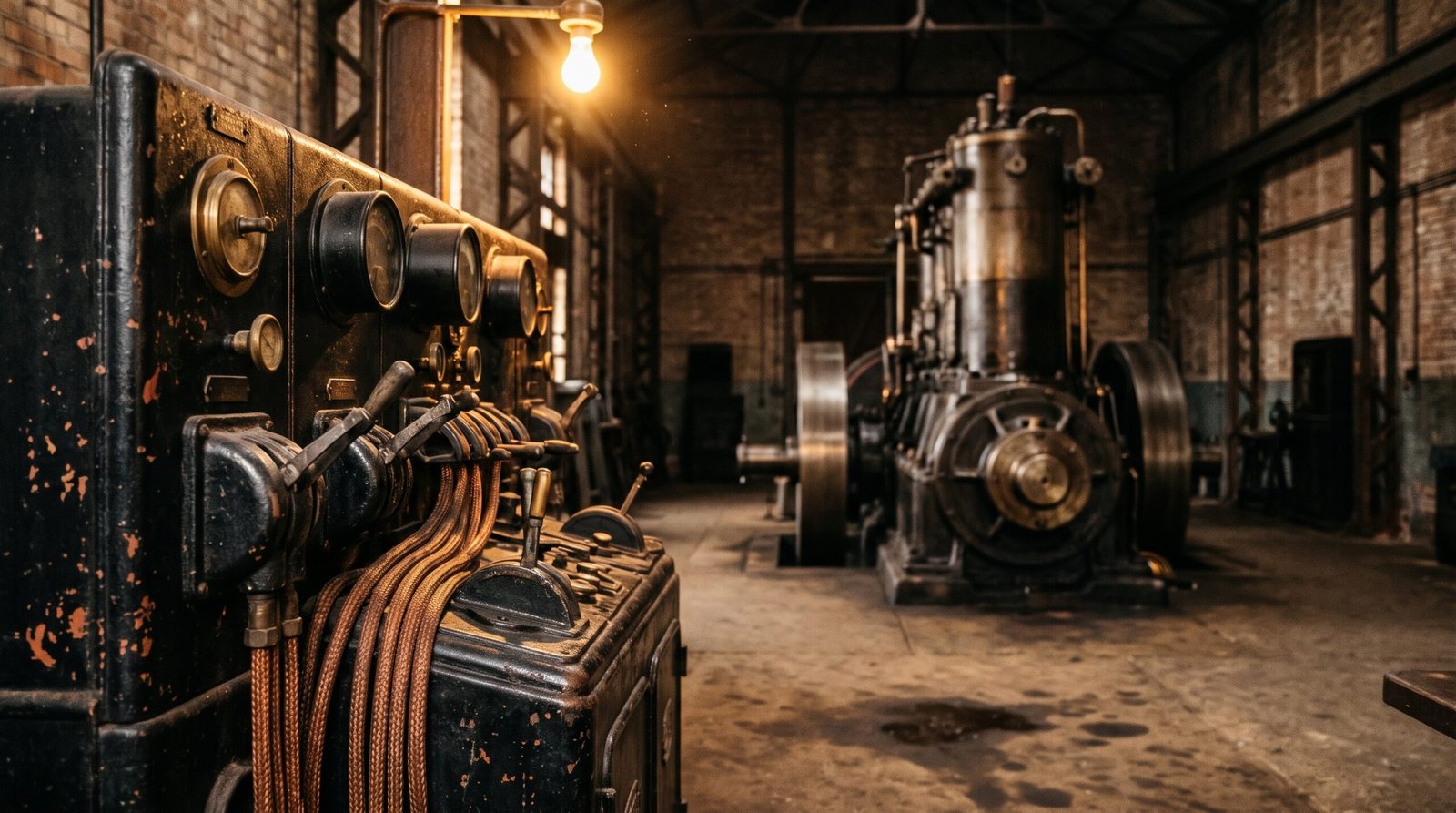
The turning point was 1893, when Rudolf Diesel patented his compression-ignition engine. To a power man, the appeal was obvious. A diesel set needs no boiler, no mountain of coal hauled up by rail and camel, and no river in spate. A drum of oil and a competent mechanic can run a station anywhere. The first diesel set in our twin districts went in around the turn of the century behind the Rawalpindi cantonment. It was the ugliest machine in town and the most useful. When the streams froze, it kept running.
I will not romanticise it. Those plants thumped, smoked and ate fuel that arrived by rail from the coast at prices that rose and fell with the empire’s wars. But they were predictable, and predictability is what an industry needs. By 1910 the railway workshops, the larger hotels and the cantonment had learned to treat the diesel hall as the heart of the station. Ice factories followed, then flour mills and printing presses, and a young man from Raja Bazaar could apprentice himself to a fitter and earn more than his father ever had.
Still, power in Rawalpindi remained a patchwork: a cantonment set here, a hotel’s private engine there, a mill that lit its own sheds and nobody else’s. The city needed an institution, and in 1923 it got one. The Rawalpindi Electric Power Company was founded that year, in the British India era. Its promoters, so the story goes, were a mix of local merchants, retired officers and railway men who agreed on one thing: electricity sold to the public was a better business than electricity hoarded by the garrison. The company gathered the best of the old sets, added new diesel generators in a hall near the cantonment, and strung distribution lines along the Mall, through Saddar and, after much argument, into the lanes of Raja Bazaar.
The early tariffs were steep and the connection fees steeper, and a shopkeeper in the old city thought twice before swapping a kerosene lamp for a bulb he could not afford to leave on. A household was billed several annas for every unit its lamps burned, while the mills and workshops buying power in bulk paid a fraction of that, so that those who could least afford light paid the most for it. But REPCO did what no cantonment engineer had done: it treated the ordinary person as a customer. It sent a meter reader to your door. It kept an office where you could complain. In a town used to being served last, that was new.
The company grew with the town. It added capacity for the railway workshops and flour mills in the 1930s, and its system reached beyond Rawalpindi. The Campbellpur Electric Supply Company was part of the Rawalpindi company’s network at the time of independence. A lineman posted in Rawalpindi might find himself walking poles toward Campbellpur within a year, and the habit of thinking of the Potohar as one system took root.
This is where the official histories fall silent. Who actually ran REPCO’s machines? Not the sahibs on the board, who signed the orders and took their leave. The engine drivers, oilers, linemen, switchboard attendants and wiremen who climbed poles in January sleet were overwhelmingly men of this region. They were trained on the job, promoted rarely and paid a fraction of what their British counterparts earned. When the telegraph failed in a blizzard, a local lineman walked the ridge to find the break. When a diesel seized at midnight, a local fitter stripped it by lamplight.
The inequality was built into the wires. Electric light reached the Mall, the cantonment bungalows and the civil lines decades before it reached the walled lanes of the old city. Murree’s bazaar lived by kerosene long after the European quarter blazed, and Mall Road itself was closed to Indians. Tariffs were set in offices where no local Muslim, Kashmiri or hill dweller had a voice. The grid followed the geography of privilege: first the barracks, then the railway, then the rich, and last the ordinary household.
Also Read: Punjab’s Past Beyond The Palace And The Empire
Yet electricity escapes its owners. Once the mill had power, the workers learned to read the gauges. In the 1920s and 30s, as REPCO’s capacity doubled and small hydel schemes appeared in the northern hills, a new class of electricians, mechanics and engineers came up through the technical schools, impatient with the old order. They knew what the Residency did not: whoever understands the power plant understands how the country actually works.
The Second World War tested everything. Diesel was rationed, spare parts vanished, and the Murree lamps dimmed to half strength. The plants kept running because the people running them knew every bolt. An old engine-room foreman told me the war taught him one lesson: a machine is only as reliable as the hands that love it, and those hands never received the medals.
What we inherit is modest. Across the whole of what is now Pakistan, total generation at independence stands at only 61 MW, spread among a handful of private companies, of which ours is one. It is a small foundation for a new country, but a working one, built by hands that are not leaving.
What would I ask of the years ahead? First, that we treat diesel as a bridge, not a destination. Its smoke, imported fuel and running costs are a poor basis for a free country. The streams above Murree and the great rivers to the north are our true inheritance, and a free state should build on them with dams, hydel stations and a grid that reaches the village before it reaches the club.
Second, that we credit the skill of this region to the people who built it. It was not a gift of the Raj. It grew in spite of the Raj, and it deserves proper schools, proper wages and proper authority over the plants these men have kept alive.
Third, that we keep REPCO’s founding idea, that electricity is something provided to the public, not something the garrison keeps for itself. Let the next hundred years finish what the first hundred began, with wires laid for everyone.
The lamps of the Potohar were lit by many hands. Let us make sure that, in the century to come, they shine on all of them.
Note from today’s vantage point, not part of the 1947 text: the story continued after independence. REPCO was nationalised in 1972 and taken over by the Government of Pakistan, was de-listed from the stock exchange in 1985, and was reincorporated in 1998 as the Islamabad Electric Supply Company (IESCO).