

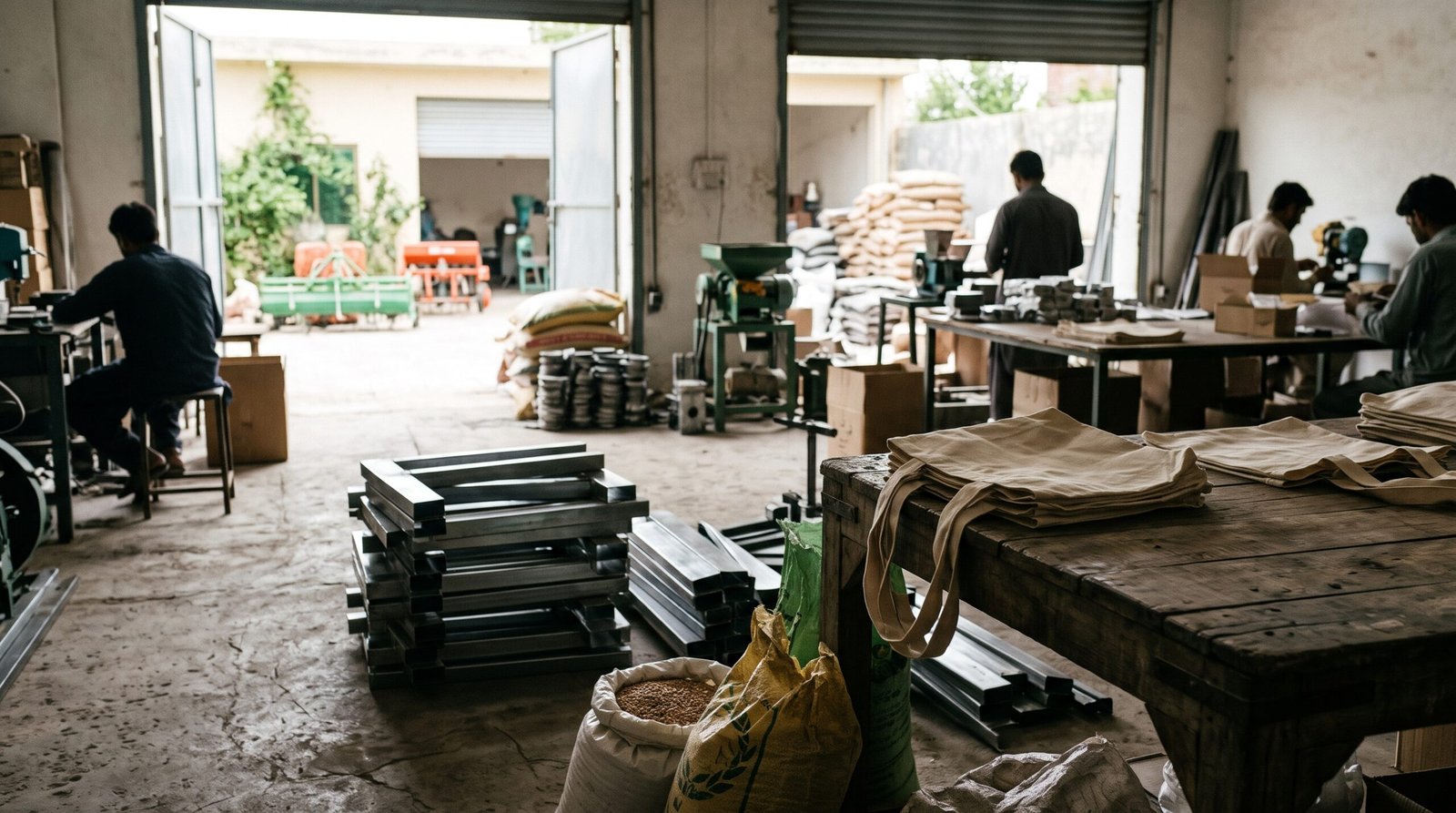
The government’s decision to increase the maximum financing limit under the Prime Minister’s Youth Business and Agriculture Loan Schemes from Rs7.5 million to Rs25 million is an important development in Pakistan’s financial inclusion and entrepreneurship agenda.
Prime Minister Shehbaz Sharif has also reduced the minimum eligibility age from 21 to 18 years and directed that 30% of loans be allocated to women. For FY2026-27, Rs292 billion has been allocated, with approximately 266,700 beneficiaries expected.
According to the government briefing, 581,341 young people have received financing worth Rs313.9 billion since January 2023, reportedly ten times the number of beneficiaries during the preceding decade.
These are encouraging numbers. However, the real economic question is not how much financing is announced, but how effectively this financing translates into productive businesses, employment, agricultural productivity and export earnings.
1. Pakistan’s SME sector: A significant economic opportunity
Pakistan’s National SME Policy 2021 estimated that the country had more than 5.2 million SMEs, contributing approximately 40% to GDP and 25% to exports.
These figures remain an important historical policy baseline, although Pakistan needs a more recent and comprehensive enterprise census to measure the sector accurately.
Despite this economic contribution, formal SME financing has remained relatively limited.
According to the Ministry of Finance, outstanding SME financing reached Rs1.148 trillion as of October 23, 2026, including Rs538 billion for small enterprises.
Earlier, SME financing represented approximately 9.9% of domestic private-sector advances.
This reflects a fundamental structural imbalance: SMEs contribute substantially to economic activity, but their access to formal banking credit remains disproportionately low.
The challenge is not simply a shortage of liquidity. It also involves inadequate financial documentation, limited collateral, informal business structures, weak credit histories and the high cost of assessing smaller borrowers.
The revised youth financing initiative should therefore be viewed as an opportunity to expand the bankable SME population rather than merely distribute subsidised loans.
2. SBP is building a more enabling SME financing architecture
An important development is that the State Bank of Pakistan has already undertaken several regulatory initiatives.
The revised SME Prudential Regulations became applicable from January 1, 2026. Subsequently, on July 16, 2026, SBP further revised the regulatory definition of SMEs:
- Micro enterprises: Annual sales up to Rs30 million.
- Small enterprises: Above Rs30 million up to Rs400 million.
- Medium enterprises: Above Rs400 million up to Rs2 billion.
- Start-ups: Micro, small or medium enterprises up to five years old.
This broader classification provides banks with a more relevant framework for identifying and financing businesses at different stages of development.
Another significant initiative is SMEConnect, launched by SBP on October 29, with applications being routed through the centralized financing portal from November 1, 2026.
Instead of approaching multiple banks independently, SME applicants can submit their financing applications through one digital platform, which forwards verified applications to the relevant bank or DFI.
Interestingly, the Finance Ministry reported on November 5 that the portal had already attracted more than 10,000 applications.
This demonstrates considerable demand for formal credit, although applications must ultimately translate into approved, disbursed and performing financing.
Furthermore, SBP’s October 28 framework for wholesale and agency financing enables banks to extend finance to small enterprises and small farmers through intermediary financial institutions, with government risk coverage.
This is particularly important for rural areas, smaller commercial centres and businesses that cannot be efficiently served through conventional branch-based banking alone.
The direction is clear: Pakistan needs to move from traditional collateral-dependent lending towards cash-flow-based, technology-enabled and risk-sharing financing.
Also Read: Cherat Cement Pivots To Chemicals With Rs24 Billion Nimir Acquisition After Previous Bids Fail
3. Agricultural financing: Beyond seasonal crop loans
Agriculture remains one of the most important areas where financial inclusion can generate a direct economic impact.
According to the Ministry of Finance, outstanding agricultural financing reached Rs1.329 trillion by October 23, 2026, serving approximately 3.5 million borrowers.
Under the Zarkhez-e: Asaan Zarai Qarza initiative, 20,176 applications involving Rs8.674 billion had been approved, while 6,132 collateral-free loans worth approximately Rs2.34 billion had been disbursed.
The gap between approvals and actual disbursements deserves attention. Converting approved facilities into timely financing is essential, particularly when agricultural seasons cannot wait for lengthy banking procedures.
SBP has also introduced a Risk Coverage Scheme for Small Farmers covering eligible crop production, dairy, livestock and fisheries financing from July 2025 to June 2028.
It provides 10% first-loss government coverage on qualifying agricultural loan portfolios, with eligible individual financing of up to Rs3 million.
Under the National Subsistence Farmers Support Initiative, digital verification through the Land Information Management System facilitates access to collateral-free financing. At least 75% of the financing is provided in kind through agricultural inputs, while the balance can be disbursed in cash.
These initiatives provide a foundation for improving agricultural credit penetration.
However, the next stage must be more ambitious.
Pakistan should increasingly finance the entire agricultural value chain, including:
- Farm mechanisation and modern irrigation.
- Dairy, livestock and fisheries.
- Cold storage, warehousing and agricultural logistics.
- Food processing and packaging.
- Seed production, fertiliser efficiency and technology.
- Agricultural exports and value-added products.
The Rs25 million youth financing ceiling can help young agricultural entrepreneurs move beyond traditional farming towards commercially viable agribusinesses.
One important distinction should be maintained: the Rs3 million small-farmer risk coverage arrangement is a separate financing instrument and should not be confused with the newly announced Rs25 million youth-loan ceiling.
4. Start-ups require a different financing philosophy
Pakistan’s start-up ecosystem requires a combination of banking finance, venture capital, incubation, mentorship and institutional support.
SBP’s revised SME classification now recognises eligible businesses up to five years old as start-ups.
This is a positive regulatory development because a newly established business should not automatically be excluded from the SME financing ecosystem simply because of its operating history.
The government has also established the Pakistan Startup Fund through the Ministry of IT and Telecommunication and Ignite.
The fund offers non-equity grants of up to 30% of an investment round, ranging from US$50,000 to US$1 million, subject to eligibility and private-investment requirements.
This is important because start-ups do not all have the same financing requirements.
A technology business developing a new product without established revenues may require venture capital rather than conventional bank debt. Conversely, a manufacturing, logistics, food-processing or technology-enabled business with identifiable cash flows may be suitable for structured banking facilities.
The youth-loan programme can therefore complement the start-up ecosystem, but it should not be treated as a replacement for venture capital.
Banks should develop differentiated financing models for early-stage entrepreneurs, growing SMEs and established businesses.

5. Pak EXIM: Linking SME financing with export-led growth
This is perhaps the most important connection between youth entrepreneurship, SME financing and Pakistan’s external-sector sustainability.
In our earlier research on SME financing and Pak EXIM’s enhanced Export Finance Scheme, we examined how smaller businesses could be integrated into export-oriented supply chains.
The latest developments make this opportunity even more relevant.
The government’s FY2026-27 Export Finance Scheme envelope has been enhanced to Rs1.5 trillion.
A dedicated Rs300 billion allocation was initially announced for SME exporters, agricultural SMEs and new-to-scheme borrowers.
However, an important subsequent development emerged on November 8: the Adviser to the Finance Minister announced that the entire Rs300 billion allocation had been ring-fenced exclusively for eligible SME exporters.
This is a significant targeting change. Agricultural businesses will need to meet the applicable SME exporter eligibility requirements rather than assume that the earlier separate agricultural allocation remains available.
Under the EXIM-administered E-EFS structure, participating banks finance exporters using their own liquidity, while Pak EXIM administers the government’s rate subsidy, paid quarterly.
The short-term facility supports working-capital requirements, with financing tenors of up to 180 days.
This distinction is important for the banking industry: the facility is not simply a direct loan disbursement by EXIM. Commercial banks remain central to origination, credit assessment, financing and portfolio monitoring.
Furthermore, Pakistan is developing long-term export financing through machinery, capacity expansion and balancing, modernisation and replacement facilities.
A further encouraging development is the government’s approximately Rs3 billion SME Risk Pool through Pak EXIM and the Export Development Fund, alongside its reinsurance partnership with the Islamic Corporation for the Insurance of Investment and Export Credit.
The Prime Minister also directed on November 5 that the 80% export-revenue condition for SME long-term financing be removed. Its practical impact will depend on the relevant operational amendments.
The opportunity is to connect smaller domestic businesses with the larger export ecosystem.
For example, an SME manufacturing packaging material, engineering components, textile accessories, food ingredients or other industrial inputs should be able to develop a financing relationship around verified purchase orders and the cash flows of its supply chain, subject to applicable scheme eligibility.
This is where commercial banks and Pak EXIM can collectively create a much stronger export-financing ecosystem.
6. What should Pakistan’s banking industry do differently?
From a banking and credit-risk perspective, the success of these initiatives will depend on execution.
First, banks should establish specialised youth and SME financing programmes rather than process every applicant through conventional corporate credit assessment models.
Second, financing should be based on business viability, transaction history, projected cash flows and repayment capacity, supported by appropriate collateral and risk mitigation.
Third, SMEDA should work closely with banks to provide business-plan development, financial literacy, accounting support, market research and technical consultancy.
Fourth, government risk coverage should be integrated with disciplined credit underwriting rather than treated as a substitute for sound credit appraisal.
Fifth, banks should develop sector-based financing models for agriculture, manufacturing, technology, services and export-oriented SMEs.
Sixth, the new Rs25 million ceiling requires transparent operational instructions covering revised financing tiers, end-user pricing, bank compensation, security requirements, repayment periods and grace periods. The Finance Ministry confirmed that the ECC had approved revised scheme tiers and bank rates on November 4, but the detailed structure needs to be communicated clearly to participating banks and applicants.
Finally, performance should be measured through actual economic outcomes.
The relevant indicators should include business survival, employment generation, women’s participation, agricultural productivity, export proceeds, repayment performance and the number of businesses graduating into sustainable bank relationships.
7. The bigger economic picture
Pakistan has historically struggled to convert its entrepreneurial potential into sustainable productive investment.
A combination of limited SME financing, a fragmented agricultural value chain, insufficient start-up capital and a relatively narrow export base has constrained the economy’s ability to create employment and generate foreign exchange.
The current developments provide an opportunity to address these interconnected challenges.
The Prime Minister’s Youth Loan initiative can create new entrepreneurs. SBP can provide the regulatory and digital infrastructure. Commercial banks can mobilise their balance sheets and credit expertise. SMEDA can improve business readiness. Pak EXIM can connect eligible enterprises with international markets and export financing.
But these institutions must operate as parts of one coordinated economic financing strategy.
My perspective is that Pakistan does not need another credit-disbursement programme alone. It needs a sustainable enterprise-financing ecosystem in which a young entrepreneur can establish a business, obtain working capital, acquire machinery, access domestic supply chains, become an exporter and eventually graduate into a mainstream banking relationship.
That is how financial inclusion becomes economic development.
And that is how a Rs25 million financing ceiling can become much more than a government announcement.