

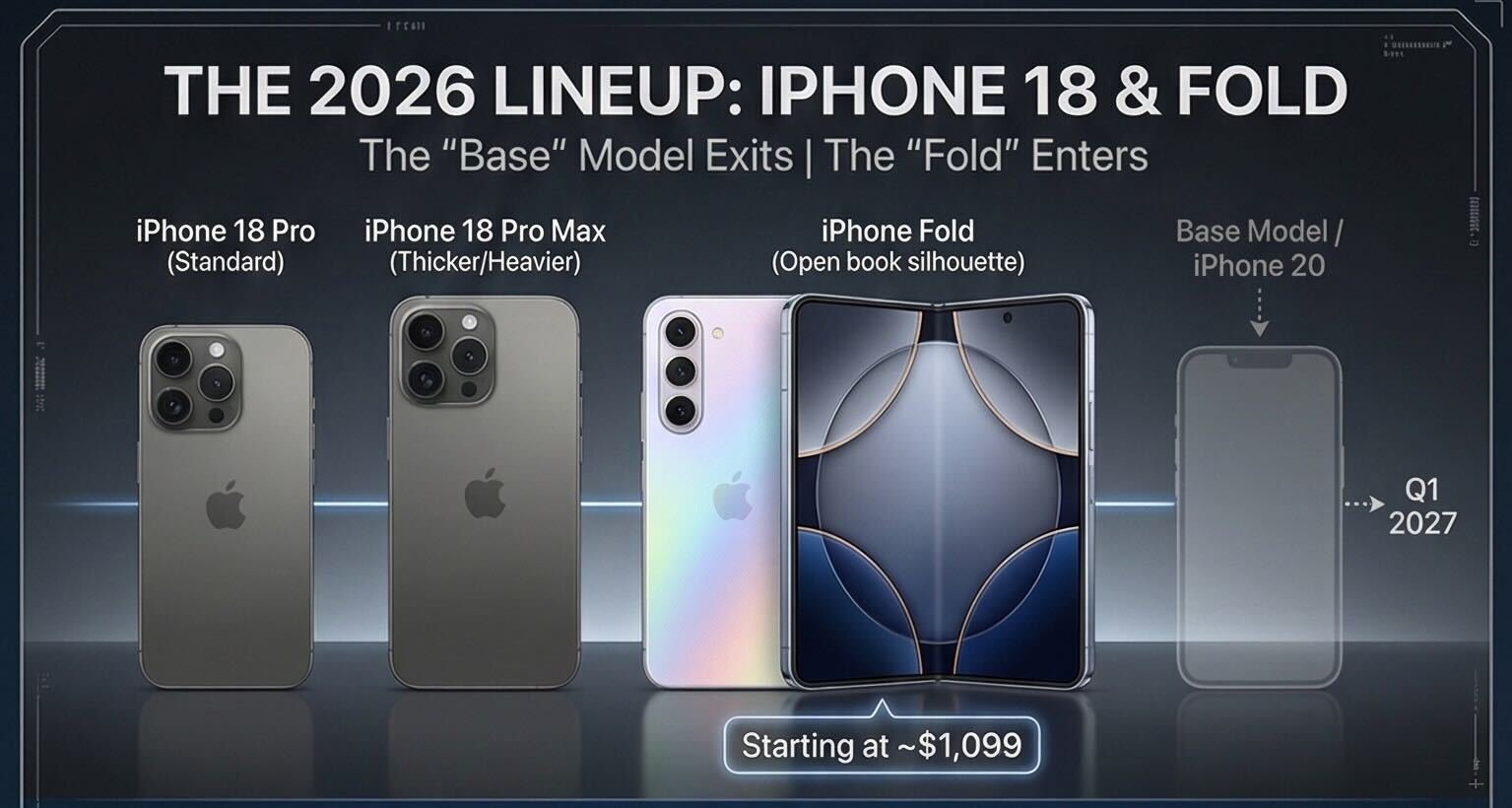
Apple’s latest iPhone launch is more than another annual smartphone upgrade. The company is simultaneously strengthening its established premium iPhone franchise with the iPhone 18 Pro and iPhone 18 Pro Max while opening an entirely new category with its first foldable, the iPhone Duo.
For Apple, the move comes at an important point in the premium smartphone market. Flagship phones have become increasingly expensive, replacement cycles have lengthened and manufacturers are looking for new hardware categories capable of persuading consumers to upgrade.
The iPhone 18 Pro models represent evolution. The iPhone Duo represents experimentation with a new business opportunity.
And for Pakistani consumers, there is another consideration: taxes.
iPhone 18 Pro: Apple pushes further into the premium segment
Apple’s iPhone 18 Pro starts at $1,199 for 256GB, while the iPhone 18 Pro Max starts at $1,299, with both models available in 256GB, 512GB, 1TB and 2TB configurations. Apple began global availability on September 18 after opening pre-orders on September 12.
The increase is significant because the previous generation started at a lower price point. The higher entry price also reflects a broader trend in which manufacturers are pushing premium smartphones further up the pricing ladder.
The hardware improvements are substantial even though the overall design remains familiar.
Both Pro models use Apple’s new A20 Pro processor and introduce improved thermal management. Apple has also redesigned the main camera around a 48MP Fusion sensor with variable aperture, giving users greater control over exposure and depth of field than previous iPhones.
For professional users, creators and businesses relying on mobile photography and video, this could be more meaningful than a simple processor upgrade.
The Pro Max remains Apple’s large-screen flagship, while the smaller Pro is aimed at customers who want flagship specifications without the larger physical footprint.
Then Apple changed the equation
The biggest announcement, however, was not another Pro model.
It was the iPhone Duo.
Apple’s first foldable iPhone opens into a 7.6-inch display, while the external screen measures 5.4 inches. Apple says the internal screen is 50 per cent larger than the iPhone 18 Pro Max display. Both screens support ProMotion, Always-On functionality and up to 3,000 nits of outdoor brightness.
The Duo uses Apple’s A20 Pro chip and has a dual 48MP Fusion camera system. Apple has also designed iOS experiences specifically around the foldable format, including different ways of using the device in open, folded and partially folded positions.
That makes the Duo commercially interesting.
Apple isn’t simply selling a phone that folds.
It is attempting to sell consumers a phone that can function as a smartphone and, when opened, provide a much larger workspace for documents, video, gaming, browsing and multitasking.
For business users, this could be particularly relevant.
A consultant travelling between meetings, an executive reviewing presentations, a journalist working on documents or a professional managing multiple applications could potentially use the larger display without carrying a second tablet.
But Apple is charging for the experiment
The iPhone Duo starts at $1,999 for 256GB and goes up to $3,199 for 2TB in the US. Apple will begin pre-orders on October 16, with availability starting October 23 in its initial markets.
That makes the entry-level Duo roughly $800 more expensive than the iPhone 18 Pro and $700 more than the iPhone 18 Pro Max.
The price is therefore not simply a premium for additional storage.
It is effectively a price for an entirely different form factor.
The business question for Apple is whether consumers will regard that form factor as sufficiently useful to justify the premium.
What does this mean for Pakistan?
This is where Apple’s latest launch becomes particularly interesting.
Pakistan is not among the countries listed by Apple for the first iPhone Duo launch. Apple lists more than 70 initial markets for the October 23 launch, including the UAE, India, Malaysia, Singapore, the UK and the US, while Pakistan is not on that initial list.
The implication is straightforward: Pakistani consumers wanting the Duo immediately are likely to depend initially on imported stock rather than an official Apple Pakistan launch.
The Pro models, meanwhile, have already entered the international market and Pakistani importers are beginning to quote prices.
Local reports currently put the iPhone 18 Pro 256GB at around Rs582,000 after estimated PTA-related charges, while the iPhone 18 Pro Max 256GB is being quoted around Rs610,000. These should be treated as market estimates rather than fixed official Pakistani retail prices.
The underlying US prices translate to roughly Rs332,000 for the Pro and Rs360,000 for the Pro Max before Pakistani duties, taxes, importer margins and other costs, based on the exchange-rate assumptions used in current local reports.
PTA tax: the number Pakistani buyers need to watch
There is an important distinction between the price of the phone and the cost of making an imported phone compliant with Pakistan’s mobile-device registration system.
Pakistan’s DIRBS system is used to identify compliant and non-compliant mobile devices operating on local networks. FBR directs international passengers and importers to the applicable mobile-device duty and registration procedures.
The exact amount payable for a newly launched iPhone cannot safely be presented as a permanent fixed figure before the applicable valuation and assessment are finalised.
Current Pakistani media estimates put the registration burden for the new Pro models at roughly Rs250,000, producing estimated total prices of around Rs582,000 for the 18 Pro and Rs610,000 for the 18 Pro Max.
However, buyers should not interpret these figures as an official fixed PTA tariff for every storage variant.
Pakistan’s mobile-phone taxation involves multiple components, and the applicable amount can depend on the assessed value, registration route and other factors. FBR’s own DIRBS information directs users to the official duty-and-tax information for the applicable calculation.
That distinction becomes even more important with the Duo.
The Duo could cross the million-rupee threshold in Pakistan
At a US starting price of $1,999, the Duo is already dramatically more expensive than the conventional Pro models before Pakistani taxes and commercial margins.
Using a simple exchange-rate conversion, the US starting price alone represents a value of roughly Rs550,000–Rs560,000, depending on the dollar rate used.
Add Pakistani taxes, registration costs, freight, importer margins and the premium normally attached to scarce early stock, and the first units could potentially enter Pakistan’s market at well above Rs700,000.
Some higher-storage versions could move substantially closer to — or potentially beyond — the Rs1 million mark.
These are market estimates, not official Pakistani prices or confirmed PTA assessments.
That distinction should remain clear because the Duo’s final Pakistani price will depend heavily on the valuation applied by the authorities and the premiums demanded by early importers.
A new opportunity for Apple’s supply chain
The Duo also matters beyond the consumer.
Foldable smartphones require specialised displays, hinges, protective layers, batteries, structural components and manufacturing processes that differ from conventional smartphones.
Apple’s entry could therefore have implications throughout the premium smartphone supply chain.
If the Duo gains traction, component suppliers could see additional demand for foldable-display and hinge technologies. It could also accelerate competition between Apple, Samsung and Chinese manufacturers in a segment that has so far remained relatively small compared with conventional smartphones.
Apple’s strategy is consequently not just about selling another iPhone.
It is about determining whether foldables can become another high-value category inside its hardware ecosystem.
What should Pakistani consumers expect?
For Pakistan, the immediate picture is relatively straightforward.
The iPhone 18 Pro and Pro Max are already available internationally, with local importers beginning to quote prices.
The iPhone Duo will begin international pre-orders on October 16 and sales on October 23, but Pakistan is not included in Apple’s initial launch list.
Consequently, Pakistani buyers seeking the Duo immediately are likely to face limited availability and a significant importer premium.
The Pro models will be easier to source, but PTA registration can add a substantial amount to the final bill.
For consumers, therefore, the headline US price tells only part of the story.
In Pakistan, the real price of an iPhone is the combination of Apple’s international price + exchange rate + duties and taxes + PTA registration + logistics + importer margin.
That equation can turn a $1,199 smartphone into a device costing well over half a million rupees.
The bigger business story
Apple’s 2026 strategy effectively creates three levels of premiumisation.
The iPhone 18 Pro strengthens the conventional flagship.
The Pro Max pushes the traditional smartphone further into the premium segment.
The Duo creates a completely new price tier.
For Apple, this could increase the amount consumers are willing to spend within the iPhone ecosystem. For competitors, it raises the pressure to differentiate their own premium devices.
For Pakistan, however, the story is more complicated.
A weakening rupee, import taxation and PTA registration costs can make global flagship launches dramatically more expensive for local consumers. The gap between Apple’s international retail price and the final Pakistani cost is therefore likely to remain one of the most important factors determining demand.
The iPhone 18 generation is consequently not merely a technology story.
It is a story about premiumisation, consumer purchasing power, taxation, imports, supply chains and the economics of the global smartphone industry.
And the iPhone Duo may ultimately prove to be the more important product — not because it has the largest screen, but because it tests whether Apple can persuade consumers to pay nearly $2,000 for a new definition of what an iPhone can be.