

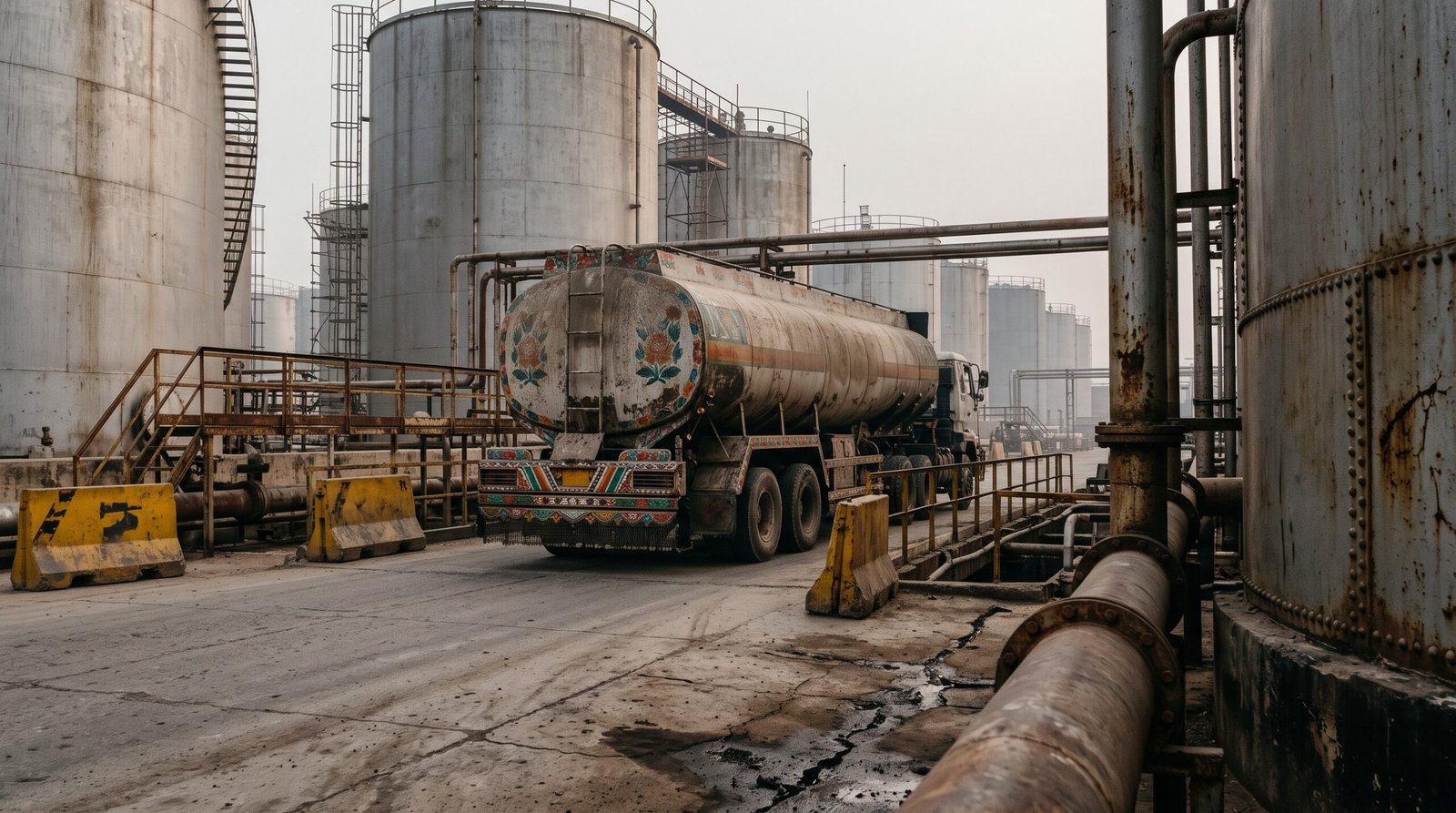
The federal government has collected Rs4.4 trillion in “petroleum levy” over four fiscal years, exceeding its revenue targets by Rs227 billion, but Planning Minister Ahsan Iqbal on Thursday ruled out an immediate reduction in the levy despite protests by Jamaat-e-Islami (JI), saying any phased relief would be considered in the next budget.
Iqbal’s remarks came the same day Petroleum Minister Ali Pervaiz informed the National Assembly that “petroleum levy” collections were part of the fiscal targets agreed with the International Monetary Fund (IMF) under its “Extended Fund Facility” and the government collected Rs4.4 trillion from 2022-23 to 2025-26.
Speaking to the media, Iqbal said a committee had been constituted to examine feasible proposals and measures for gradually reducing the “petroleum levy” in the next budget.
The government will be represented by Deputy Prime Minister Ishaq Dar, Planning Minister Ahsan Iqbal and Rana Sanaullah, while Jamaat-e-Islami will nominate three representatives.
He said both sides would discuss possible measures to provide relief to the public within the government’s limited financial resources.
The development follows protests by Jamaat-e-Islami against the government’s “petroleum levy” at a time when international oil prices have increased due to the ongoing Middle East conflict.
A delegation of the party also met the prime minister earlier this week.
The government currently charges a “petroleum levy” of Rs80 per litre, a “climate levy” of Rs5 per litre and customs duty of Rs20.56 per litre, bringing the combined amount to approximately Rs106 per litre.
Iqbal cautioned that Pakistan’s economic position remained vulnerable to external shocks and that decisions taken for immediate public relief could create fiscal difficulties later.
“Pakistan’s current macroeconomic situation, which we have managed with great difficulty, cannot afford a repetition of the mistakes of the past,” he said.
He noted that rising international oil prices and uncertainty surrounding the Middle East conflict had prompted countries to take precautionary measures to protect their economies.
Also Read: Fazlur Rehman Versus Mohsin Naqvi: When Political Convenience Collides With The State
“No one knows what situation may arise tomorrow, how global conditions will unfold, where a drone might fall, and where oil prices might reach as a result,” the minister said.
He maintained that the government needed to avoid decisions that could provide temporary relief but expose the economy to greater risks if global energy prices increased further.
Iqbal also said the government had introduced a relief scheme for low-income groups, under which approximately 12.7 million individuals had registered.
Meanwhile, in a written response submitted to the National Assembly, Petroleum Minister Ali Pervaiz provided details of “petroleum levy” collections and the government’s fiscal targets.
According to the reply, “petroleum levy” collections totalled Rs4.4 trillion during the four fiscal years from 2022-23 to 2025-26, against a cumulative target of approximately Rs4.2 trillion.
In FY2025-26 alone, provisional collections reached Rs1.567 trillion, exceeding the annual target of Rs1.468 trillion.
The government has set a “petroleum levy” collection target of Rs1.676 trillion for the current fiscal year.
“The petroleum levy collection is also part of the fiscal targets agreed under the IMF Extended Fund Facility,” the petroleum minister stated.
In May, Ali Pervaiz had written to the finance minister recommending that the annual “petroleum levy” target be fixed at Rs1 trillion and the rate reduced to Rs50 per litre in view of elevated international oil prices. However, the government did not adopt the proposal.
Responding to a separate question from MNA Sharmila Faruqi regarding fuel availability, the petroleum minister said the national oil supply chain was being continuously monitored by the Oil and Gas Regulatory Authority (OGRA), in coordination with refineries, oil marketing companies, the Petroleum Division and the Executive Committee of the National Coordination and Management Council.
For September 2026, projected petrol demand stood at approximately 692,000 tonnes, while domestic refineries were expected to supply 262,000 tonnes.
To meet demand, oil marketing companies had planned imports of approximately 511,000 tonnes of petrol.
No high-speed diesel imports were planned for the month because of sufficient opening inventories and anticipated domestic refinery production of around 555,000 tonnes.
As of September 22, petrol stocks stood at approximately 395,000 tonnes, with an additional cargo of 56,000 tonnes at berth and another 55,000 tonnes at outer anchorage in Pakistani waters.
This brought total petrol availability to approximately 506,000 tonnes, sufficient to cover around 22 days of demand at average daily sales of 22,500 tonnes.
High-speed diesel stocks stood at approximately 568,000 tonnes, providing around 30 days of supply at average daily consumption of 19,000 tonnes.
The petroleum minister said petrol and diesel consumption remained broadly consistent with official estimates, with only marginal variations.
Oil marketing companies had been directed to monitor abnormal sales patterns at retail outlets to prevent hoarding, diversion and misuse while maintaining uninterrupted supplies to consumers.
The National Assembly was also informed that Rs66.5 billion in “Price Differential Claims” (PDCs) submitted by oil marketing companies remained outstanding.
According to the petroleum minister, the government had disbursed Rs53.8 billion out of total claims of Rs120.3 billion.
He said the release of a further 25% of claims would depend on confirmation that the required documentation had been submitted.
The claims are being reviewed by OGRA, while an additional 25% of the PDC amount will be disbursed following an audit and verification by an OGRA-appointed auditor.
The minister said the auditor had already been selected for the verification process.