

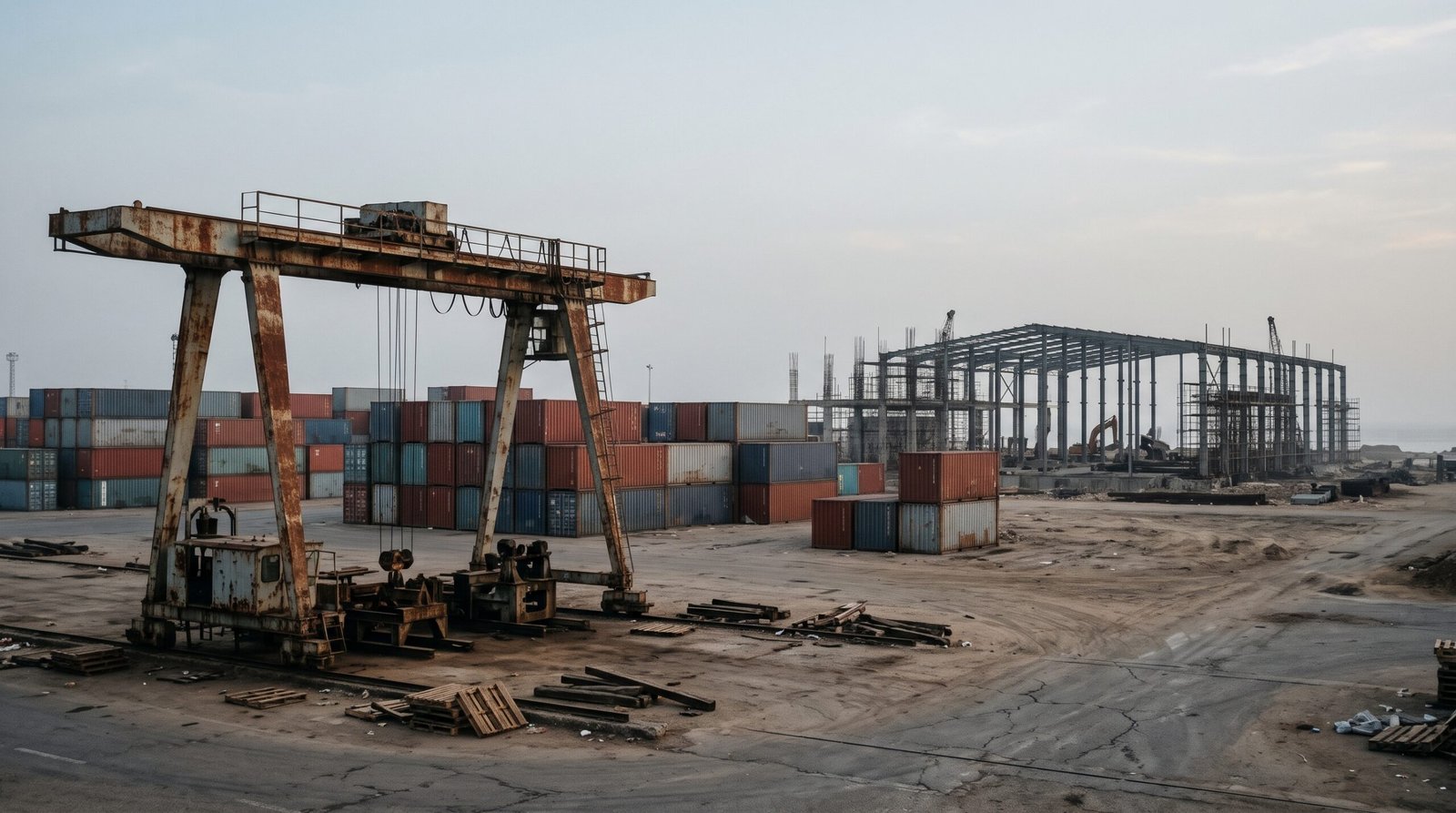
LAHORE: Pakistan’s struggle to attract and retain foreign investors has emerged as one of the most consequential challenges confronting its economy, raising questions about whether recent improvements in macroeconomic stability can translate into the sustained industrial expansion, export growth and job creation that the country urgently needs.
Foreign direct investment (FDI), generally regarded as a longer-term commitment by international businesses, fell sharply during the financial year ending June 30, 2026. At the same time, several internationally recognised companies either discontinued local manufacturing, transferred their Pakistani operations to new owners or reorganised their presence in the country.
These developments have intensified a wider debate about the investment climate.
For the government, Pakistan remains a market of considerable untapped potential, supported by a large population, strategic geography, natural resources, improving foreign-exchange liquidity and opportunities in mining, technology, energy, agriculture and manufacturing.
For investors, however, the calculation is more complicated.
A profitable business must not only find customers. It must also navigate taxes, import restrictions, energy costs, exchange-rate exposure, regulatory approvals, contract enforcement, political uncertainty and the practical ability to recover or repatriate its investment.
The central question is no longer simply why some foreign businesses are leaving Pakistan.
It is why the country has repeatedly struggled to persuade international investors to make the next major investment after the first one.
The $1.64 Billion Warning: What the Investment Data Actually Reveals
According to State Bank of Pakistan data for FY2025–26, net foreign direct investment declined to approximately $1.637 billion from $2.490 billion in FY2024–25.
That represents a reduction of $852.91 million, or 34.3 per cent.
However, the figures reveal more than a fall in the headline number.
Gross FDI inflows declined from $4.280 billion to $3.568 billion, a reduction of 16.6 per cent.
At the same time, FDI outflows increased from $1.791 billion to $1.931 billion, or 7.8 per cent.
In other words, Pakistan was receiving less new foreign direct investment while recording larger investment-related outward flows.
| Indicator | FY2024–25 | FY2025–26 |
| Gross FDI inflows | $4.280bn | $3.568bn |
| FDI outflows | $1.791bn | $1.931bn |
| Net FDI | $2.490bn | $1.637bn |
| Annual change in net FDI | — | -34.3% |
The distinction matters because gross inflows indicate the amount entering through direct-investment transactions, while net FDI accounts for relevant investment outflows.
An economy may continue to attract sizeable foreign investment while simultaneously experiencing substantial divestment, repayment of intercompany financing or other direct-investment outflows.
Pakistan’s six-year record also demonstrates the absence of a sustained upward trajectory.
Net FDI stood at approximately $1.821 billion in FY2020–21, $1.936 billion in FY2021–22 and $1.627 billion in FY2022–23.
It recovered to $2.347 billion in FY2023–24 and $2.490 billion in FY2024–25 before falling back to $1.637 billion in FY2025–26.
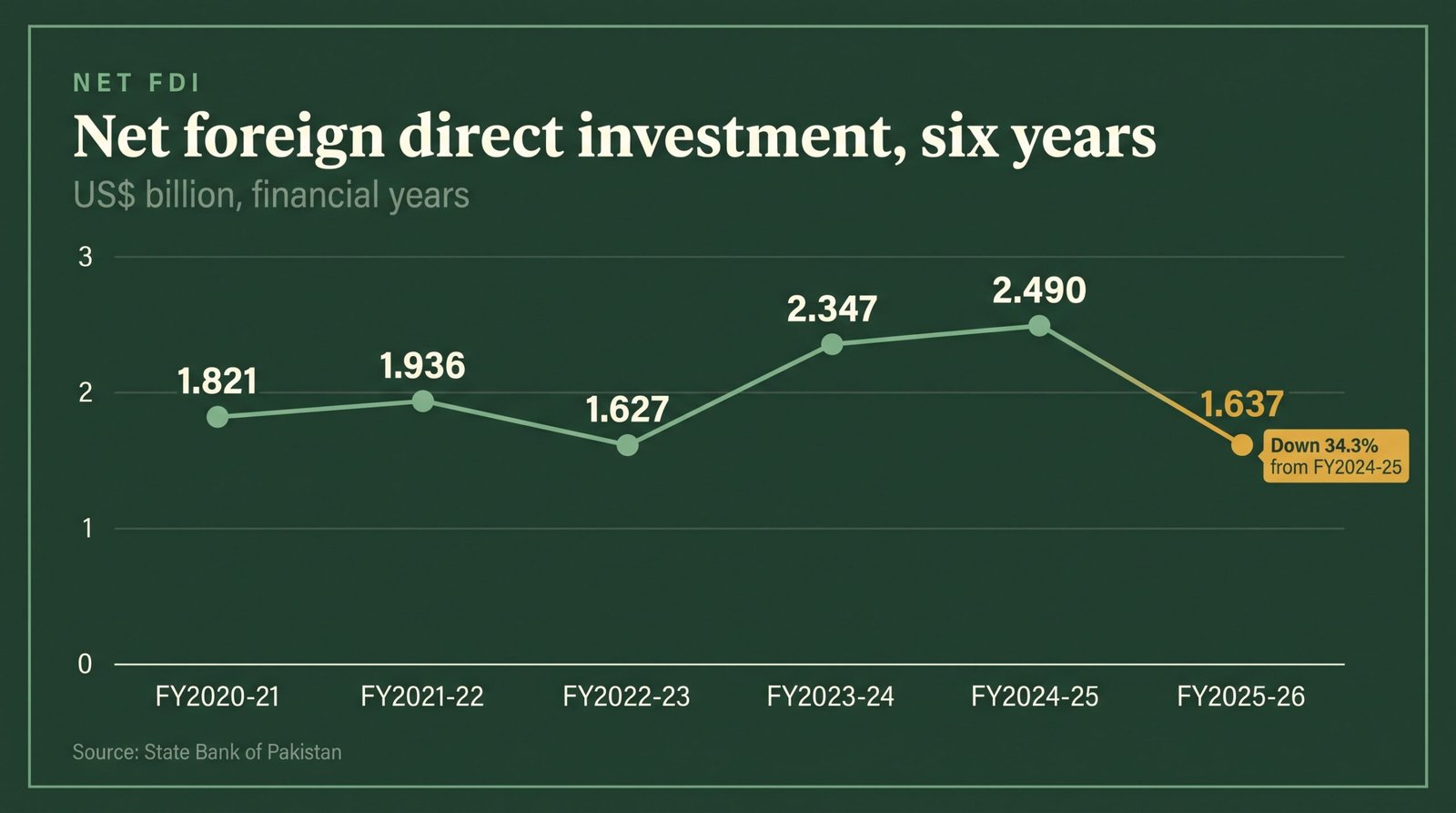
The pattern suggests a country capable of attracting capital during particular periods but struggling to sustain the investment momentum necessary for long-term industrial transformation.
The $465.5 Million Factor: A Crucial Detail Behind the Decline
A closer examination of the government’s own Pakistan Economic Survey 2025–26 reveals an important qualification to the investment crisis narrative.
The survey, discussing the July–March period of FY2025–26, attributed a significant part of the decline in FDI to a one-off consolidation and divestment transaction in the telecommunications sector.
The transaction resulted in a net outflow of approximately $465.5 million around December 2025.
That amount was equivalent to more than half of the $852.91 million year-on-year reduction subsequently recorded for the full financial year. The comparison illustrates the transaction’s scale, although the figures relate to different reporting periods and cannot be treated as an exact decomposition of the annual decline.
The timing coincides with the completion of Telenor Group’s sale of Telenor Pakistan to Pakistan Telecommunication Company Limited on December 31, 2025.
The Norwegian telecommunications company had announced the transaction in December 2023, valuing the Pakistani business at approximately NOK 5.3 billion on a cash-and-debt-free basis.
The sale represented the withdrawal of Telenor as a direct shareholder in Pakistan.
It did not mean that the telecommunications network, its customers, infrastructure or business operations simply disappeared.
The company became part of the PTCL group, with the transaction also raising questions about market concentration and competition within Pakistan’s telecommunications industry.
The Competition Commission of Pakistan approved the acquisition subject to conditions intended to safeguard competition and consumer interests.
This distinction is fundamental to understanding Pakistan’s investment figures.
When a multinational sells an existing Pakistani business, foreign ownership may decline and an investment outflow may be recorded, even though the underlying assets and economic activity continue.
The departure of a foreign shareholder may still be significant, particularly if it reflects diminished confidence or a decision to redirect capital elsewhere.
But it is not economically identical to a factory shutting down, thousands of jobs disappearing or an entire productive sector collapsing.
For policymakers, the two problems require different responses.
Multinational Exits: Which Companies Actually Left Pakistan?
Pakistan’s investment debate has increasingly been shaped by reports of international companies closing, selling or restructuring their local operations.
Among the frequently cited names are Yamaha, Procter & Gamble, Microsoft, Pfizer, Sanofi, Shell and Telenor.
However, treating all these cases as identical would produce a misleading picture.
Their circumstances, timing and economic consequences differ substantially.
Yamaha: A Genuine Manufacturing Withdrawal
In September 2025, Yamaha Motor Pakistan announced that it would discontinue motorcycle manufacturing in the country.
The Japanese company’s manufacturing operations had begun in Karachi in 2015.
The decision marked the end of a decade-long local manufacturing presence and represented a tangible loss for Pakistan’s industrial sector.
Yamaha said it would continue after-sales services, spare-parts supply and warranty support.
Nevertheless, the discontinuation of assembly and production carried implications for employees, domestic vendors, technological capability and competition in the motorcycle market.
The company referred to a change in business policy.
Pakistan’s wider motorcycle industry has faced fluctuating demand, import-related constraints, currency depreciation and rising production costs, although those broader conditions should not be presented as Yamaha’s individually verified reasons without further company confirmation.
Yamaha’s case deserves particular attention because the loss of manufacturing capacity is fundamentally different from the sale of an existing business to another investor.
Also Read: From Cement To Kia And GAC: Inside Yunus Brothers Group’s Multibillion-Rupee Business Empire
Procter & Gamble: A Shift Away From Direct Operations
In October 2025, US consumer goods giant Procter & Gamble announced plans to wind down its manufacturing and commercial operations in Pakistan as part of a wider global restructuring.
The company indicated that its products would continue to reach the Pakistani market through a third-party distributor model.
This meant the company was not necessarily abandoning Pakistani consumers.
Instead, it was moving away from maintaining the same direct operational structure.
For Pakistan, the economic concern is that such a transition can reduce direct multinational employment, local corporate expenditure, production activity and the scope for future capital investment.
For the company, an indirect distribution model may offer a way to serve demand while reducing fixed operating costs and local business exposure.
P&G’s restructuring was part of an international programme, making it inaccurate to attribute the entire decision solely to Pakistan’s economic conditions.
Even so, the loss of direct operations raises questions about the commercial attractiveness of sustaining a multinational corporate infrastructure in the country.
Microsoft: Office Closure, Not Market Abandonment
Microsoft’s decision to close its local office in Pakistan in July 2025 also generated considerable debate.
However, the US technology company continued serving customers through its regional and partner-based operating structure.
The closure affected a small local team and represented a change in Microsoft’s organisational footprint rather than the complete withdrawal of Microsoft products and services from Pakistan.
The distinction is especially important in the technology sector, where international businesses can serve customers remotely or through authorised partners without maintaining a large subsidiary.
Nevertheless, a reduced local presence may limit opportunities for direct engagement, institutional partnerships and locally based employment.
The broader question is whether Pakistan can develop an environment in which global technology companies see commercial value in expanding their physical presence, rather than serving the market primarily from abroad.
Pfizer: Manufacturing Assets Transferred to a Local Buyer
Pfizer’s restructuring in Pakistan also requires careful interpretation.
In 2024, Pakistan’s Competition Commission approved Lucky Core Industries’ acquisition of certain Pfizer assets, including a pharmaceutical manufacturing facility in Karachi and selected products and trademarks.
The transfer represented a change in ownership of business assets.
It should not automatically be described as the disappearance of pharmaceutical manufacturing capacity.
The crucial questions are whether production continued, whether employment and product availability were preserved, and whether the new ownership structure generated further investment.
These outcomes are more meaningful than merely recording that an international brand disposed of local assets.
Sanofi: Foreign Ownership Changed, Production Continued
French pharmaceutical company Sanofi’s divestment in Pakistan was associated with a transaction completed in 2023, after which the business was renamed Hoechst Pakistan.
The local company continued operating in the pharmaceutical industry under its changed ownership structure.
The transaction reflected the withdrawal of a foreign shareholder rather than an immediate closure of the entire enterprise.
Foreign corporate divestments of this kind deserve examination, but their consequences cannot be equated automatically with a manufacturing shutdown.
Shell: From International Ownership to Saudi Investment
Shell Pakistan provides another example of why the word exit must be used carefully.
Shell plc disposed of its controlling shareholding in the Pakistani business, with Saudi Arabia’s Wafi Energy becoming the new controlling investor in 2024.
The Pakistani company subsequently adopted the name Wafi Energy Pakistan.
The Shell brand continued to be used in Pakistan under the new arrangement.
Consequently, the transaction represented a shift in international ownership, not simply the disappearance of foreign investment or the closure of the fuel retail network.
Indeed, it introduced another foreign investor into the business.
Telenor: A Strategic Withdrawal Through Acquisition
Telenor’s departure similarly represented a significant change in shareholder ownership and strategic priorities.
The company’s decision to sell its Pakistani operations followed a broader assessment of its Asian business portfolio.
PTCL’s acquisition preserved the telecommunications business while concentrating ownership within another corporate group.
The deal raises legitimate questions about competition, consumer choice and future network investment.
But describing the transaction solely as the collapse of foreign business activity would overlook its nature as an acquisition.
ExxonMobil: A Project Withdrawal Is Not a Total Corporate Exit
ExxonMobil’s withdrawal from a proposed LNG terminal development in 2020 has also appeared in discussions of international investor departures.
The company indicated at the time that its decision regarding the LNG project did not affect its other relevant business interests in Pakistan.
A decision not to proceed with an individual project should not be reported as evidence that every operation associated with the company has ceased.
Taken together, these cases establish a more nuanced pattern.
Pakistan has experienced genuine manufacturing closures, strategic shareholder divestments, local-office closures, asset sales and changes in distribution models.
All may have implications for confidence.
But the scale and nature of the economic impact must be examined separately.
A Historical Problem: Pakistan’s Repeated Investment Boom-and-Bust Cycles
Pakistan’s difficulty attracting sustained foreign investment is not a new phenomenon.
Economic liberalisation and privatisation programmes during the 1990s created opportunities for international investors in banking, energy, telecommunications and other industries.
The expansion of telecommunications during the 2000s demonstrated Pakistan’s ability to attract substantial foreign capital when market demand, regulatory incentives and commercial opportunities aligned.
Similarly, the development of the China–Pakistan Economic Corridor from the middle of the following decade helped channel investment towards electricity generation and infrastructure.
Yet successive periods of investment optimism have frequently been interrupted by external financing crises, political instability, currency pressures, restrictive imports or changes in economic policy.
The country has repeatedly relied on external financial assistance to stabilise its balance of payments, while struggling to build the export earnings and domestic productivity necessary to reduce future dependence on emergency financing.
This recurring pattern creates a particular problem for foreign investors.
A factory or power plant may require decades to recover its investment.
An investor therefore evaluates not just the current exchange rate or tax rate but the probability that the rules governing the business will remain commercially viable over the life of the project.
Pakistan’s repeated policy reversals and economic disruptions have made that calculation difficult.
The World Bank’s Warning: Easy to Register, Difficult to Operate
One of the most revealing assessments of Pakistan’s business environment comes from the World Bank’s Business Ready, or B-READY, 2025 report.
Pakistan received a business-entry score of 86.64 out of 100, indicating relatively stronger performance in the framework’s measures of establishing a business.
However, performance deteriorated substantially in areas that become critical after the company starts operating.
The country’s scores included:
| Business environment indicator | Pakistan’s score |
| Business entry | 86.64 |
| Business location | 67.38 |
| Utility services | 69.02 |
| Labour | 63.92 |
| Financial services | 66.79 |
| International trade | 43.04 |
| Taxation | 50.07 |
| Dispute resolution | 39.69 |
| Market competition | 49.47 |
| Business insolvency | 52.40 |
Source: World Bank B-READY 2025. These are indicator scores, not positions in an international league table.
The figures reveal a central contradiction.
Pakistan may have made progress in facilitating the formal establishment of businesses, but it continues to perform substantially worse in resolving disputes, facilitating trade, administering taxation and supporting competitive markets.
For a multinational investor, business registration may take days or weeks.
An unresolved commercial dispute, however, can tie up capital for years.
Similarly, a company may obtain approval to establish a manufacturing facility but subsequently encounter difficulty importing inputs, paying overseas suppliers, securing reliable utilities or navigating inconsistent tax requirements.
The World Bank’s assessment suggests that the investment challenge increasingly lies in the experience of operating a business rather than simply registering one.
The IMF’s Diagnosis: A State-Dominated Economy With Structural Governance Weaknesses
The International Monetary Fund’s November 2025 Governance and Corruption Diagnostic provides a deeper explanation for these weaknesses.
The assessment, undertaken at the request and with the support of Pakistan’s government, examined fiscal governance, market regulation, financial supervision, anti-money laundering arrangements, the rule of law and anti-corruption institutions.
Its findings identified extensive governance vulnerabilities associated with a heavily state-dominated economy, complex regulation, weak institutional capacity, fragmented oversight and inconsistent accountability.
The IMF highlighted problems involving opaque taxation, discretionary regulation, insufficient transparency, weaknesses in public procurement, market distortions and difficulties enforcing commercial rights.
The report also identified risks arising from regulatory arrangements that can favour politically connected interests over more competitive businesses.
These findings are important because foreign investment does not depend exclusively on government assurances or high-level meetings.
Investors require a functioning institutional environment in which legal obligations can be enforced, disputes resolved, regulatory decisions challenged and commercial rules applied consistently.
A multinational company considering a $100 million investment must evaluate whether its contractual rights will remain protected if a policy changes, a local partner defaults or a regulator issues an adverse decision.
If that confidence is missing, even attractive consumer demand and favourable geography may prove insufficient.
The IMF’s recommendations included improving tax transparency, simplifying regulation, strengthening the independence and capacity of oversight bodies, reducing judicial backlogs and improving accountability.
For Pakistan, these reforms represent a fundamental economic requirement rather than merely an administrative exercise.
Rule of Law, Corruption Perceptions and Investor Confidence
Several international assessments reinforce concerns about the predictability of Pakistan’s institutional environment.
The World Justice Project’s 2025 Rule of Law Index ranked Pakistan 130th among 143 countries.
Transparency International’s 2025 Corruption Perceptions Index placed Pakistan 136th among 182 countries, with a score of 28 out of 100.
The Heritage Foundation’s 2026 Index of Economic Freedom ranked Pakistan 152nd, with a score of 48.9.
These indices measure different things and use distinct methodologies.
The corruption index reflects perceptions of public-sector corruption rather than proven criminal conduct in individual cases.
The economic freedom index reflects a particular assessment framework and should not be treated as the sole measure of investment attractiveness.
Nevertheless, their combined findings point towards recurring institutional concerns.
For investors, the consequences can be practical.
Weak contract enforcement increases legal uncertainty.
Regulatory discretion raises compliance risks.
Opaque procurement systems can discourage competitive participation.
And inconsistent treatment between established businesses and new entrants can reduce the incentive to invest in productive capacity.
An economy cannot build sustained investment confidence solely through tax exemptions if investors remain uncertain about the enforcement of the rules underlying those exemptions.
Security: The Reko Diq Warning
Security is another critical factor affecting Pakistan’s investment prospects, particularly in resource-rich and strategically important regions.
The Global Terrorism Index 2026 placed Pakistan first among countries most affected by terrorism.
The report recorded 1,139 deaths, 1,595 injuries and 1,045 terrorist incidents in Pakistan during 2025.
The consequences extend beyond the immediate human tragedy.
Security challenges can increase insurance costs, disrupt transport routes, complicate logistics, require additional protection expenditure and affect the willingness of lenders to finance projects.
Perhaps the clearest illustration comes from Reko Diq, the major copper and gold development in Balochistan.
In April 2026, Barrick Mining Corporation announced that escalating security risks and incidents had made it necessary to slow development activity and continue a comprehensive project review until mid-2027.
The company said the review would examine security, capital requirements, financing, project scope and timelines.
Barrick did not announce that it was abandoning Reko Diq.
It reaffirmed its belief in the project’s long-term value and said the project would remain under active management, albeit with reduced capital spending.
The distinction is crucial.
However, when the development of a globally significant mineral project is slowed because of security concerns, the implications extend far beyond a single mine.
Major resource projects require roads, power, water infrastructure, contractors, international engineering support, equipment imports and substantial financing.
Any material change in the risk assessment can influence costs, timelines and investment decisions across the supply chain.
For Pakistan, Reko Diq represents both enormous economic potential and a warning that natural resources alone cannot guarantee investment.
Energy Costs and Industrial Competitiveness
Pakistan’s electricity and gas sector has long been a source of difficulty for industrial businesses.
High energy costs, payment pressures, inefficiencies in electricity distribution and the accumulated burden of circular debt have affected the country’s competitiveness.
Manufacturing businesses compete against international rivals on price, quality, reliability and delivery time.
When electricity is expensive or unreliable, production costs rise.
When natural gas availability fluctuates, manufacturers must seek alternatives or reduce output.
And when tariffs and related charges change frequently, long-term financial planning becomes more difficult.
These issues are particularly relevant to textiles, chemicals, pharmaceuticals, fertilisers, automotive assembly and export-oriented manufacturing.
Investors assessing Pakistan do not simply compare local electricity tariffs with those in neighbouring countries.
They also consider the reliability of supply, the probability of future tariff revisions, the cost of backup generation and whether local competitors receive preferential treatment.
A country seeking export-led industrialisation must offer a predictable and commercially sustainable energy environment.
Without it, incentives offered elsewhere in an investment package may lose much of their value.
Government Borrowing and the Crowding-Out of Private Investment
Another structural concern is the dominance of government borrowing within Pakistan’s financial system.
According to figures reported from State Bank data, the government borrowed approximately Rs3.5 trillion from commercial banks during July–May FY2025–26.
Private-sector borrowing during the same period was approximately Rs986 billion.
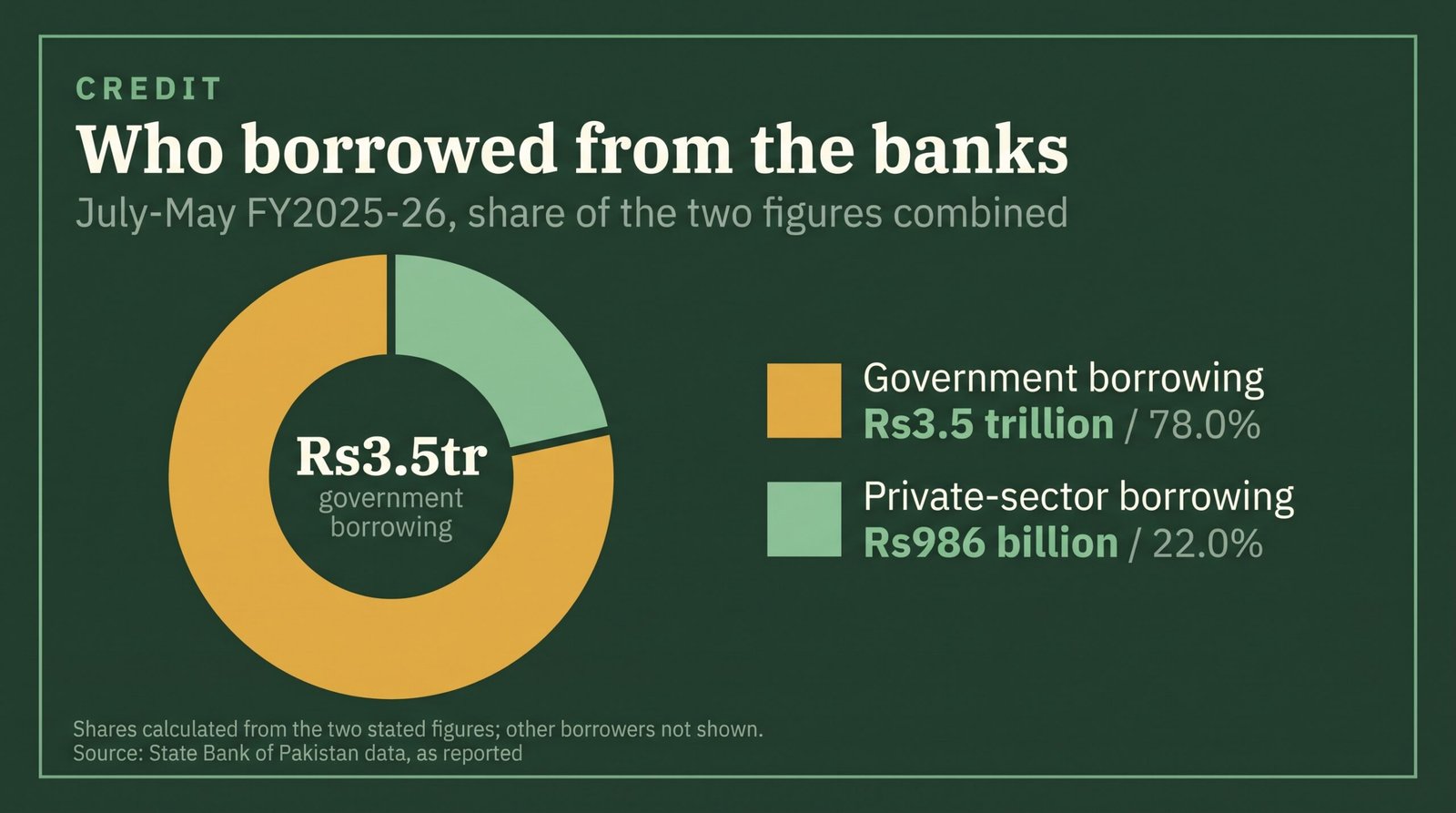
The comparison is striking.
When banks can deploy large amounts of capital into government securities, the incentive to take commercial lending risks may weaken, particularly during periods of high interest rates and economic uncertainty.
This can limit access to credit for entrepreneurs, exporters, manufacturers and small and medium-sized enterprises.
The result is a financial system in which funding government expenditure may be more attractive than financing new factories, technology investment or business expansion.
However, the figures do not establish that every rupee borrowed by the government would otherwise have been lent to the private sector.
Bank lending decisions also depend on business demand, creditworthiness, regulations and prevailing interest rates.
Nevertheless, the persistent concentration of lending in public-sector financing highlights a major obstacle to private-sector-led growth.
Foreign investors considering local production also examine the financial strength of potential Pakistani suppliers and distributors.
If those businesses cannot obtain affordable credit, it becomes harder to build the domestic supply chains that large international projects require.
Profit Repatriation: More Money Going Out Than Net FDI Coming In?
In October 2026, information presented to Pakistan’s National Assembly revealed another important aspect of foreign investment.
Foreign investors repatriated approximately $2.305 billion in profits and dividends during FY2025–26.
Of this amount, approximately $2.202 billion related to direct investment, while $103.7 million related to portfolio investment.
The combined payments exceeded the $1.637 billion net FDI figure for the year.
At first glance, the comparison might appear alarming.
However, these figures measure different transactions.
FDI represents investment flows and associated adjustments.
Profit and dividend repatriation represents returns earned on investments made during the current year or earlier periods.
Consequently, the fact that foreign-owned companies remitted more profits than Pakistan received in net FDI does not, by itself, prove that capital investment was negative or that investors were fleeing the country.
Indeed, the ability to repatriate legitimate profits is an important element of investor confidence.
The government has argued that improving foreign-exchange liquidity allowed previously delayed payments to be cleared.
That is a relevant positive development.
The more useful question is whether existing foreign businesses are reinvesting a sufficient proportion of their earnings to expand operations, production, employment and exports.
A healthy investment environment should allow foreign companies to remit profits while giving them strong commercial reasons to invest additional capital.
How Pakistan Compares With Regional Competitors
Pakistan’s investment challenge becomes more visible when placed against the performance of other Asian economies.
India attracted approximately $39 billion in inward FDI during calendar year 2025, according to international investment data.
Vietnam’s official statistics reported approximately $27.62 billion in disbursed foreign investment during 2025.
Pakistan’s $1.637 billion net FDI figure relates to the financial year ending June 2026.
These figures are not perfectly comparable because of differences in reporting periods, accounting definitions and the distinction between disbursed and net investment.
Nevertheless, the difference in overall investment scale remains considerable.
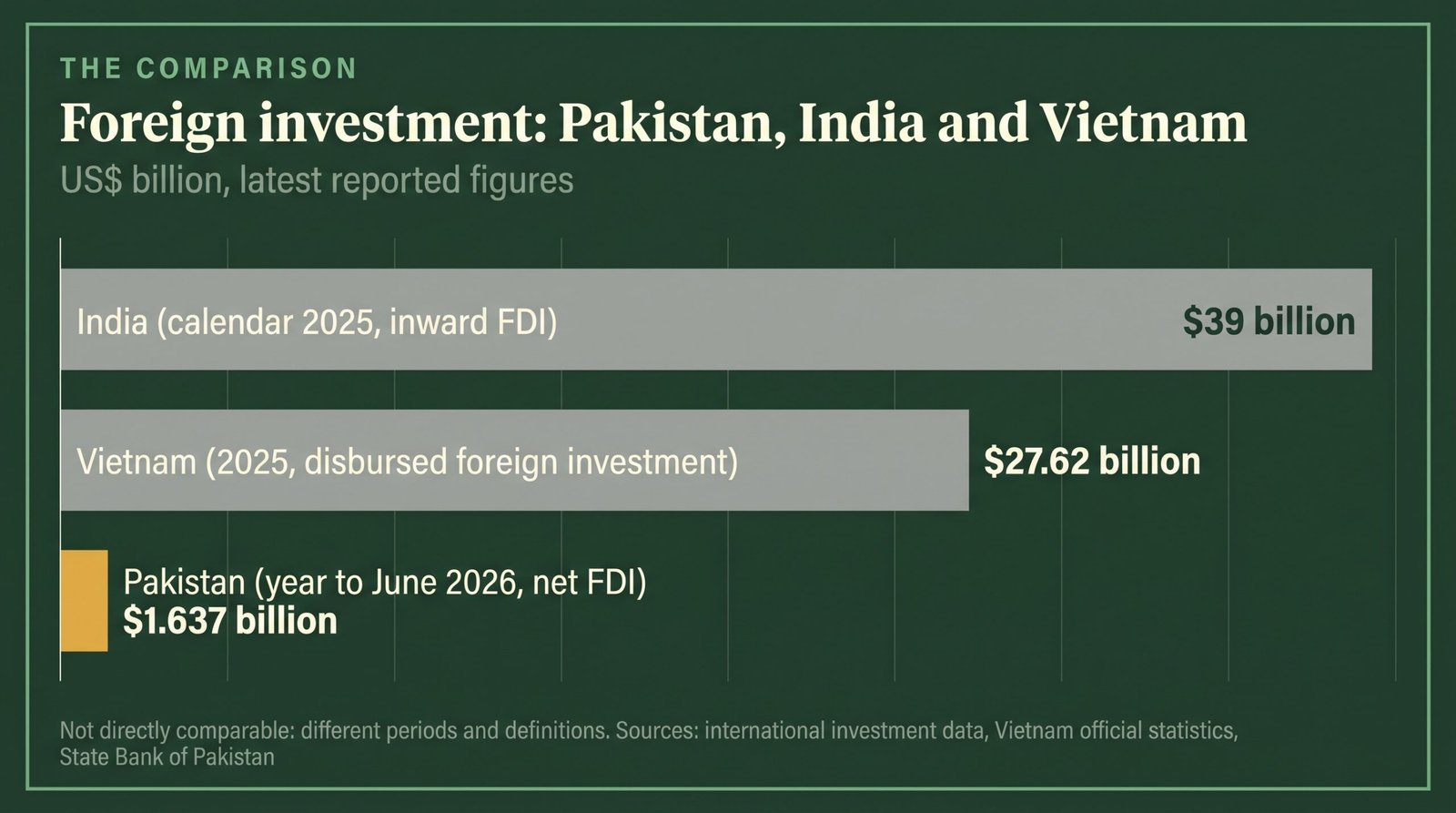
India benefits from a substantially larger domestic market, diversified industry, established technology services and extensive manufacturing networks.
Vietnam has developed export-oriented manufacturing clusters supported by global supply-chain integration, trade agreements and sustained participation by international electronics and industrial companies.
Pakistan possesses its own advantages, including a large consumer market, proximity to major regional economies, a substantial overseas diaspora, agricultural resources and significant mineral deposits.
But potential does not translate automatically into investment.
An international manufacturer deciding between locations evaluates the entire operating environment: tariffs, shipping times, port efficiency, customs procedures, tax exposure, infrastructure, workforce capability, market access and legal reliability.
Pakistan’s challenge is to make these factors competitive in combination, not merely to offer an isolated exemption or concession.
Foreign Investment Concentrated in Too Few Sectors
The composition of Pakistan’s foreign investment also deserves scrutiny.
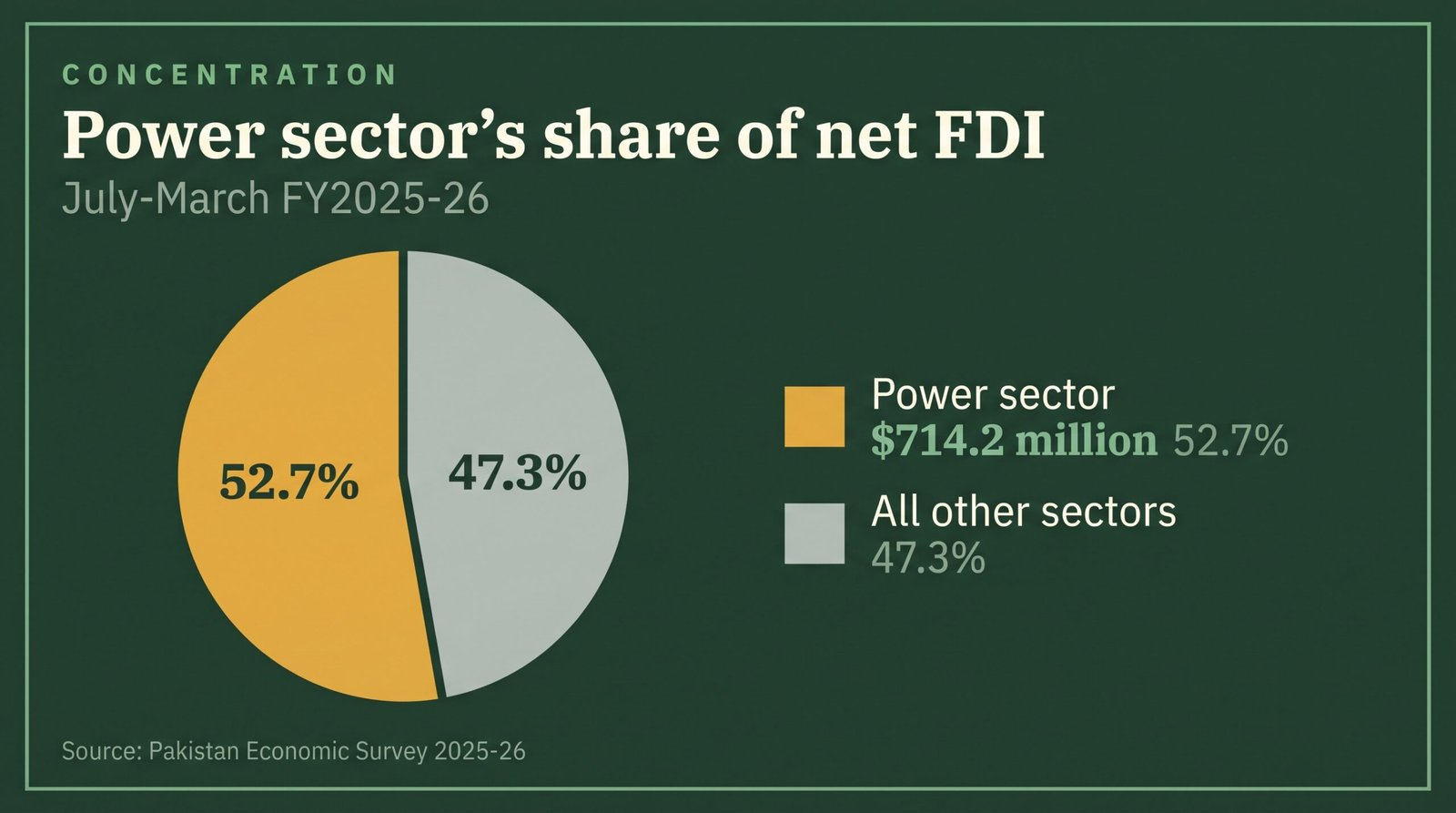
During July–March FY2025–26, the government’s Economic Survey identified the power sector as the largest recipient of net FDI, attracting approximately $714.2 million, equivalent to 52.7 per cent of total net investment during that nine-month period.
Investment in large infrastructure and energy projects remains valuable.
However, a country cannot rely indefinitely on power generation and a limited number of large projects to meet its broader economic needs.
Sustainable growth requires foreign participation in export manufacturing, agricultural processing, technology, logistics, pharmaceuticals, value-added textiles, engineering and other industries capable of producing internationally competitive goods and services.
The quality of investment matters alongside its monetary value.
A project that creates substantial exports, jobs, technical expertise and domestic supplier opportunities may generate wider economic benefits than a similar-sized investment producing primarily for a protected domestic market.
Similarly, acquisition of an existing business may change ownership without creating an equivalent amount of new productive capacity.
Pakistan therefore needs a more detailed public investment scorecard distinguishing new factories, expansion of existing operations, mergers and acquisitions, shareholder divestments and new export-generating projects.
Such transparency would allow policymakers and the public to judge actual economic progress more accurately.
What Has the Government Done?
The federal government has attempted to improve Pakistan’s investment environment through the Special Investment Facilitation Council, the Board of Investment, investment-policy reforms and efforts to reduce administrative obstacles.
The SIFC, established in 2023, was designed to facilitate investment in priority sectors and improve coordination between government institutions.
Its focus has included sectors such as agriculture, information technology, mining, energy and infrastructure.
The government’s argument is that Pakistan requires faster decisions, improved coordination and a more effective mechanism for resolving investors’ problems.
There is merit in that objective.
Large international projects often require approvals from several federal and provincial departments, regulators and public authorities.
Reducing administrative delays can make a meaningful difference.
However, investment facilitation and investment reform are not interchangeable.
High-level intervention may help resolve an individual investor’s difficulties.
A genuinely competitive investment environment requires rules that work predictably for all businesses, including those without political influence or access to senior decision-makers.
The government’s challenge is to translate exceptional facilitation into ordinary institutional efficiency.
The strongest evidence of success would be a sustained increase in new productive investment, reinvestment by existing foreign companies, diversified sources of FDI and improvements in the country’s export capacity.
Is the Situation Improving? The Latest Figures Offer a Qualification
Despite the disappointing performance in FY2025–26, the first quarter of the new financial year offers a more encouraging picture.
According to State Bank data released in October 2026, Pakistan received approximately $719.7 million in net FDI during July–September FY2026–27.
That compares with approximately $600.4 million during the corresponding period a year earlier.
The increase was approximately 19.9 per cent.
FDI in September alone stood at approximately $219.5 million.
Financial services, energy and other investment activity contributed to the improvement.
These figures matter because they demonstrate that the previous year’s decline should not be presented as an uninterrupted collapse continuing through November 2026.
However, three months of stronger inflows do not establish a durable turnaround.
Investment flows can be volatile, particularly when individual transactions are large relative to the country’s overall FDI receipts.
A meaningful recovery would require sustained improvements across several quarters, accompanied by evidence of new production, employment, exports and foreign investor reinvestment.
The early FY2026–27 figures provide grounds for cautious optimism, not a definitive verdict that the structural problems have been resolved.
What Pakistan Must Change to Win Back Investor Confidence
Pakistan’s investment challenge cannot be addressed through a single policy announcement.
It requires a credible, coordinated economic reform programme that survives changes of government and is implemented consistently.
The first priority is regulatory predictability.
Investors must be able to plan over a period of years without the constant threat of unexpected changes to taxation, import requirements, payment procedures or sector-specific regulations.
Second, commercial dispute resolution must improve.
Businesses need confidence that contracts can be enforced and that disagreements will be resolved within a reasonable and predictable period.
Third, Pakistan must establish a competitive and reliable energy framework.
Industrial tariffs, payment systems, supply reliability and distribution efficiency must be addressed together.
Fourth, the tax system needs simplification.
A transparent tax regime with fewer discretionary interventions would reduce compliance costs and improve perceptions of fairness.
Fifth, the government must strengthen competition and reduce distortions that favour selected enterprises or sectors.
Sixth, access to finance must improve, particularly for productive private-sector activity and exporters.
Seventh, security risks around strategic investment projects and transport infrastructure must be addressed through credible long-term arrangements.
Finally, Pakistan must measure investment success by economic outcomes rather than the number of memoranda of understanding signed or investment announcements made.
A commitment announced at a conference is not the same as money invested.
A proposed factory is not equivalent to an operating production line.
And the sale of an existing company is not necessarily the creation of new industrial capacity.
These distinctions are essential for an honest national investment strategy.
The Bigger Question: Why Would a Multinational Reinvest?
Perhaps the strongest test of Pakistan’s investment climate is not whether a foreign company is willing to enter the market once.
It is whether that company is willing to expand after gaining first-hand experience of operating in the country.
A business may initially invest because of Pakistan’s population, demand potential or a particular commercial opportunity.
Its next investment, however, will be influenced by what it has experienced.
Were taxes administered consistently?
Could its suppliers import raw materials without unexpected disruption?
Were payments processed within predictable timelines?
Did regulatory approvals arrive without excessive delay?
Could disputes be resolved fairly?
Was the cost of energy commercially sustainable?
And could management justify allocating additional capital to Pakistan rather than competing markets?
These are the questions that ultimately determine whether foreign investment becomes a permanent source of growth or remains an occasional inflow interrupted by periods of withdrawal and uncertainty.
Conclusion: Pakistan Is Losing More Than Investment Dollars
Pakistan’s investment problem is not adequately explained by the departure of a few multinational brands.
Some companies have closed factories.
Others have sold businesses to new owners.
Some have shifted to distributor-based operations, while others have restructured their local presence.
A major telecom divestment also influenced the FY2025–26 investment statistics.
The distinctions matter.
Yet they do not eliminate the wider problem revealed by the evidence.
Pakistan continues to confront weaknesses in contract enforcement, regulatory consistency, taxation, market competition, financing, industrial competitiveness and security.
The IMF’s governance assessment, the World Bank’s business environment scores and the decisions of international businesses collectively show that the challenge runs deeper than short-term economic instability.
The early recovery in FDI during FY2026–27 demonstrates that foreign capital has not stopped entering Pakistan.
Nor has the country exhausted its economic potential.
But restoring confidence requires more than declarations that Pakistan is open for business.
The real test is whether foreign investors can operate profitably, compete fairly, resolve disputes efficiently, repatriate legitimate returns and make long-term decisions with reasonable certainty.
For decades, Pakistan has promoted itself as a country of exceptional investment potential.
Its next economic transformation will depend on whether that potential can finally be converted into a predictable and competitive business environment.
The question is not simply why investors leave Pakistan. It is why, after investing here, too many remain uncertain about investing again.