

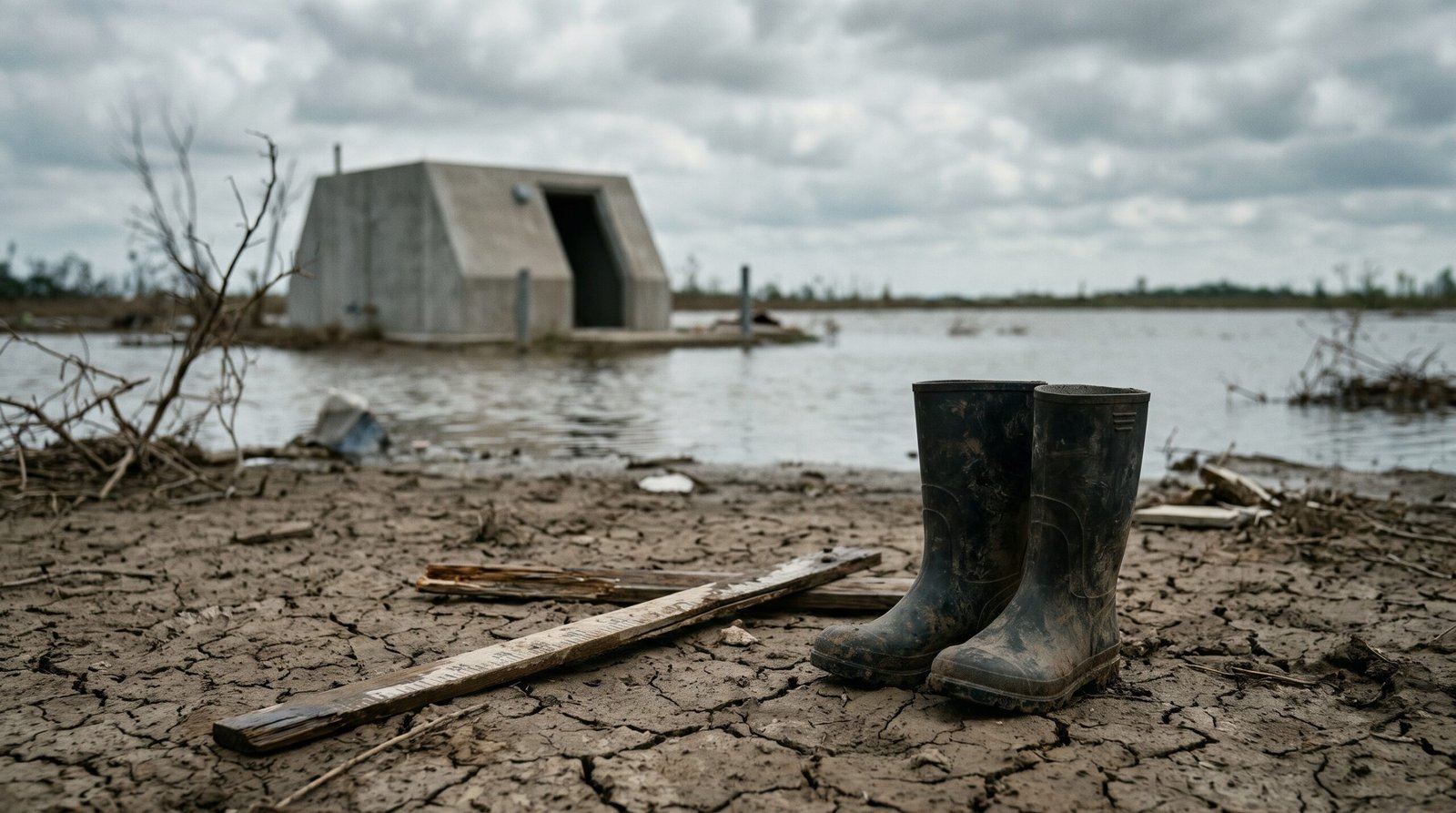
Of five cyclone shelters examined after the storm that struck Bangladesh in April 1991, only two were usable. Floodwater had put the others out of reach. Among the people in the study who had reached safe shelter by the time the cyclone struck, none died. A public authority counting buildings would have recorded five. A parent trying to get a child to safety had a different measure of what the country had built.[1]
This series began with the question of why civilisations collapse. By its conclusion, the hardest word in that question is “why”. A change in a river can explain why cultivation became precarious. It takes a different inquiry to establish why a community could move upstream while its neighbours had to remain on failing land. The first explanation belongs to the history of a river. The second requires an account of who owned land elsewhere, who could extend credit and whose claims the receiving village would recognise. Both belong to the history of a civilisation.
Earlier instalments followed grain from a Chinese farming district into the state’s accounts, and British forces to Suez while their government watched its reserves of foreign exchange. In one case, the cultivator knew what remained in the house after collection. In the other, officials could see the pressure on sterling. The difficulty was getting that knowledge to alter a commitment already made. A village could go hungry while fulfilling its quota. A government could send ships to a canal it lacked the financial freedom to hold.[2][3]
What recurs across these histories is a separation between the power to persist in an error and the obligation to live with its consequences. Where those powers are widely separated, damage can accumulate for years before it registers as failure at the centre. Meanwhile the household that absorbs the loss sells an animal, takes a child out of school or leaves the district. Each decision buys time for the household. It also buys time for the arrangement that injured it.
This proposition can be tested. If a grain authority adjusts collection promptly when cultivators report a short harvest, one would expect less harm than where the old demand remains enforceable. If two flood-prone districts receive the same warning, one would expect differences in survival according to who can reach high ground.
Evidence of equal losses under substantially different arrangements would oblige a writer to look again at the strength of the flood, the timing of the warning or some other explanation. History owes the dead at least that much care before turning their experience into a general law.
Bangladesh is instructive because its experience supplies the other half of the argument. In advance of Cyclone Sidr in 2007, forecasts were relayed to coastal communities and residents evacuated. A review published in the Bulletin of the World Health Organization describes years of work on warning systems, shelters and evacuation, including a network of volunteers.
Different storms strike different places with different force. Comparisons of death tolls alone cannot establish how many lives any single measure saved. The record does, however, identify what people could do with a forecast that an earlier household might have received in vain.[4]
One detail in that review deserves a place in any account of institutional learning. A volunteer carrying a megaphone could find that the wind took the sound away from the houses. Batteries might be unavailable locally.
Such observations look trivial beside a national investment in meteorology. To a person living in the last house on the route, the battery and the satellite are parts of the same public service. It matters greatly whether the volunteer has the standing to report which part failed and whether anyone has a small sum available to put it right.[4]
It would be easy to conclude that societies survive by listening. Much depends on what follows the hearing. A minister can receive a delegation, acknowledge every grievance and leave the allocation of resources exactly where it was.
Also Read: Why civilisations collapse—VII
The better question concerns the ordinary distribution of authority between disasters. Can residents ask for a shelter to be moved? Can a district officer commission a repair before the monsoon? Must the official who declines the request give reasons while there is still time to reconsider? These are questions about government which can be answered by examining an actual decision.
Pakistan’s post-disaster assessment estimated that the floods of 2022 affected some 33 million people and displaced nearly eight million. Housing, agriculture and livestock were among the sectors most heavily damaged. Those figures describe different injuries even where they concern the same family. A grant to replace a roof may leave a tenant cultivator unable to finance the next sowing. A loan offered after the sowing season may be impeccable in the lender’s accounts and a year late in the borrower’s life.[5]
For a parliamentary committee examining reconstruction, the telling witness might be a tenant who missed that season. On what date did the district receive the claim? Could a tenant prove the loss of a crop without holding title to the land? Which authority could reconsider a refusal, and how long did it take?
A public record of a few such cases, including claims that succeeded in time, would allow legislators to distinguish a shortage of money from a rule that sent the money to the wrong person. The remedies are quite different.
At Harappa, as the preceding instalment observed, artisans continued to make seals after the inscriptions disappeared. A form of urban life receded while some of the knowledge acquired within it remained in human hands. Descendants of the ancient Maya likewise have something to say about an account of collapse that ends with the last royal inscription.
A society can lose its rulers, its territorial reach or its familiar means of exchange. Whether its people can carry knowledge, livelihoods and mutual obligations into a changed world is a further question. It belongs to them as much as to the historian.[6]
There is no honest way to promise that every society can avert catastrophe. There is a great deal a society can decide about who faces it alone. Return to the five shelters in Bangladesh. Long before the wind rose, someone living nearby could have walked the approach with an engineer and pointed out where the water would cut the road.
Whether that conversation could secure a different route, a repair budget and a date for the work is a practical measure of the civilisation those two people shared. The next storm would disclose the answer. They ought to have been able to obtain it sooner.
Endnotes
- C. Bern et al., “Risk factors for mortality in the Bangladesh cyclone of 1991”, Bulletin of the World Health Organization (1993).
- Xin Meng, Nancy Qian and Pierre Yared, “The Institutional Causes of China’s Great Famine, 1959–1961”, Review of Economic Studies (2015).
- James M. Boughton, “Northwest of Suez”, IMF Working Paper (2000).
- Ubydul Haque et al., “Reduced death rates from cyclones in Bangladesh: what more needs to be done?”, Bulletin of the World Health Organization (2012).
- Government of Pakistan and partners, Pakistan Floods 2022: Post-Disaster Needs Assessment, main report (2022).
- J. Mark Kenoyer, “Changing Perspectives of the Indus Civilization”, p. 12. See also Smithsonian National Museum of the American Indian, Living Maya Time.
[Concluded]