

LAHORE: In Pakistan’s industrial landscape, few business families have established a footprint as extensive and diversified as the Tabba family, whose Yunus Brothers Group (YBG), widely recognised through its Lucky brand, has developed into a formidable presence across manufacturing, exports, energy, automobiles, technology, chemicals, real estate and financial services.
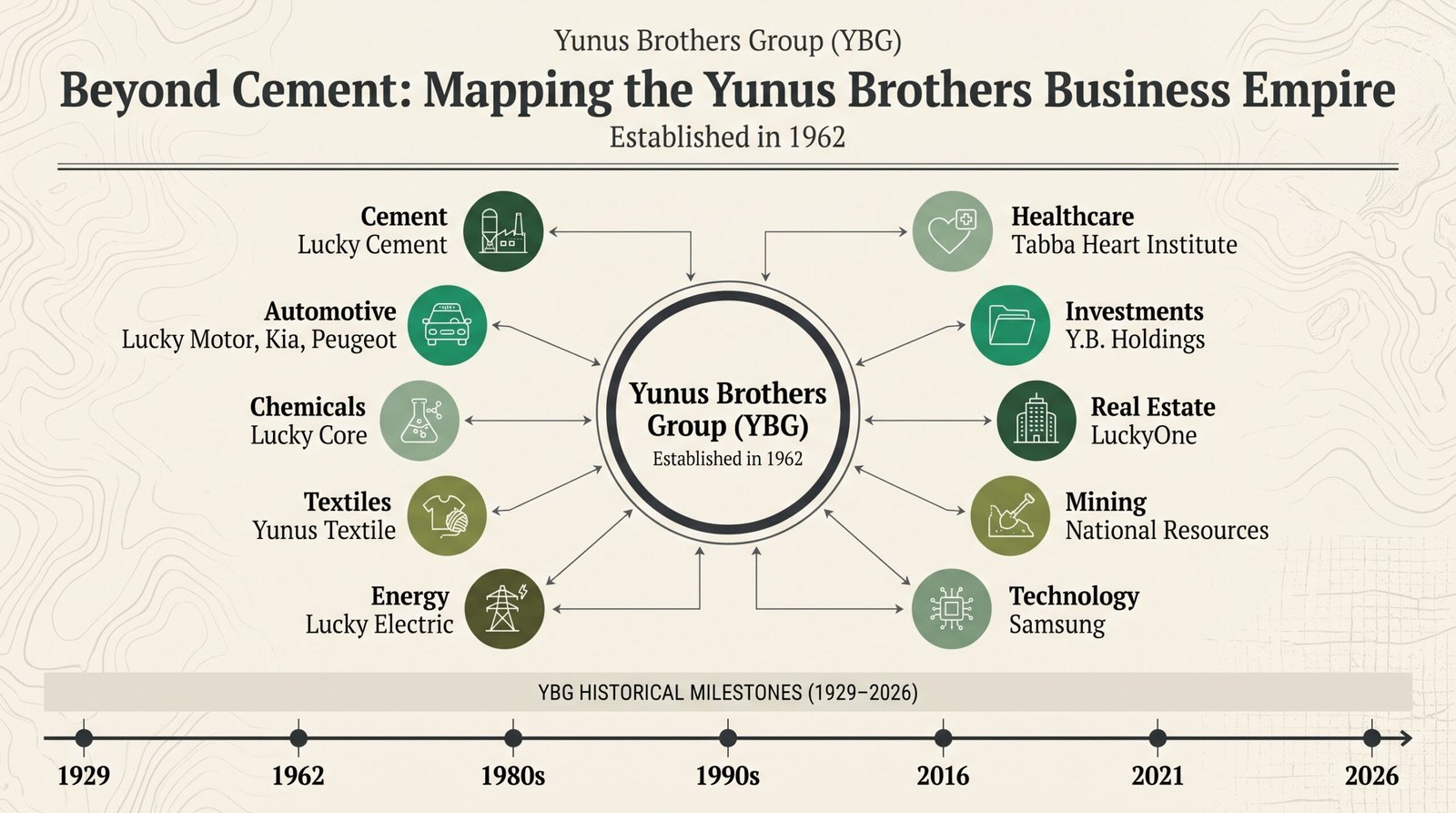
What began as a trading enterprise in 1962 has evolved into a network of listed companies, private businesses, subsidiaries, joint ventures and international investments.
From Lucky Cement’s manufacturing facilities in Pakistan and overseas to Kia vehicles on Pakistani roads, Peugeot’s European automotive presence and the introduction of GAC’s Aion and Hyptec electric vehicles, the group has gradually positioned itself across several industries central to Pakistan’s economy.
Its reach extends far beyond cement.
The conglomerate has interests in textile exports, pharmaceutical manufacturing, industrial chemicals, power generation, mobile-phone assembly, retail property, minerals exploration and investment management.
The financial scale of its flagship company offers a glimpse into the industrial empire.
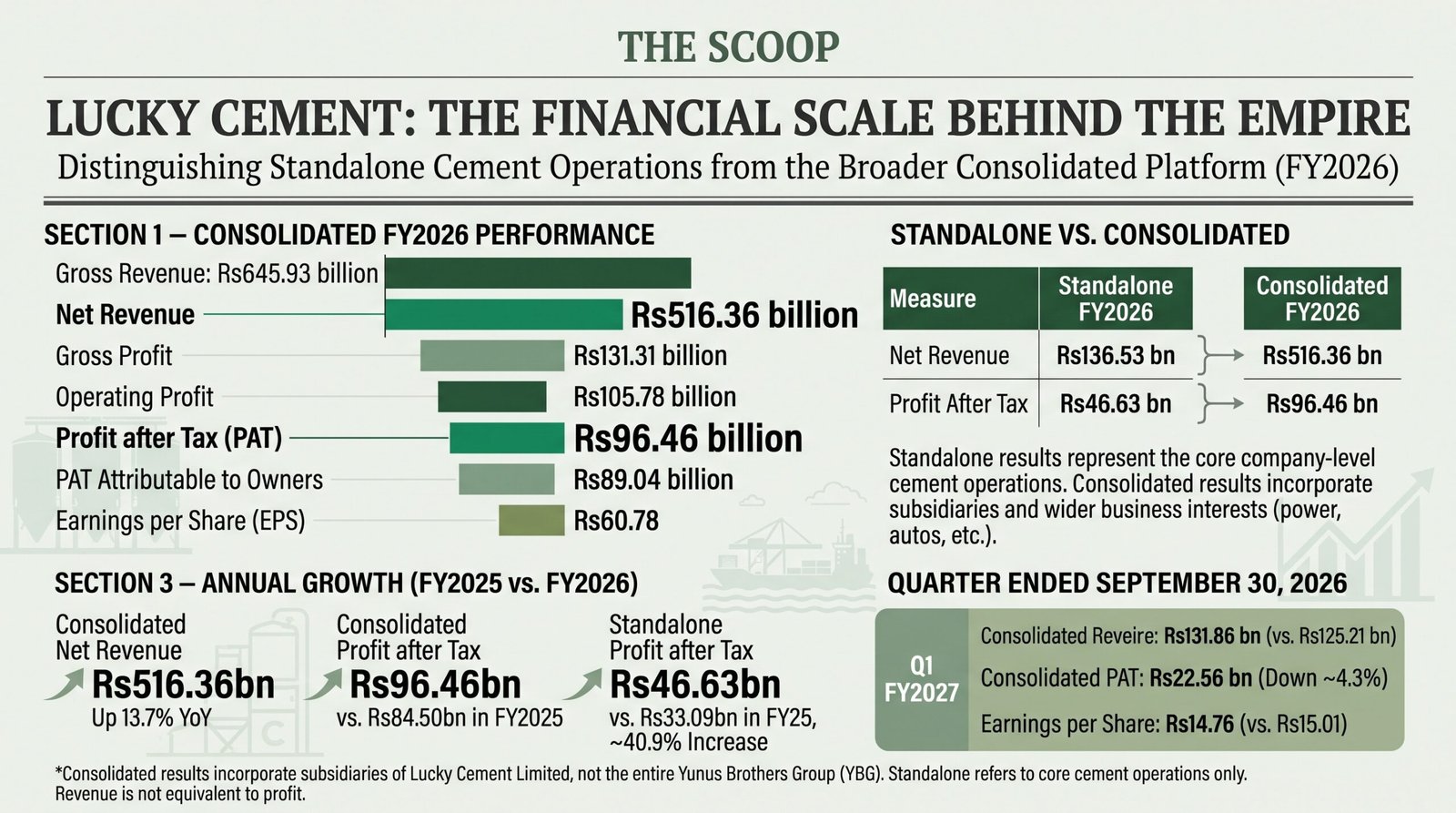
For the financial year ended June 30, 2026, Lucky Cement Limited reported consolidated net revenue of approximately Rs516.36 billion, representing an increase of 13.7 per cent over the previous year.
Consolidated profit after tax reached Rs96.46 billion, compared with Rs84.50 billion in FY2025.
However, these figures represent Lucky Cement and its consolidated subsidiaries, rather than the combined turnover or profitability of the entire Yunus Brothers Group, which includes separately controlled and associated businesses.
The distinction is important in understanding the actual size and structure of the family’s business interests.
From A Trading House To An Industrial Powerhouse
The origins of Yunus Brothers Group extend to the commercial activities of the Tabba family before the creation of Pakistan.
Haji Abdul Aziz Hashim Tabba began his entrepreneurial journey in international trade in 1929, establishing the commercial foundations upon which later generations would build.
The modern Yunus Brothers enterprise emerged in 1962 under Abdul Razzak Tabba and Muhammad Yunus Tabba.
Initially involved in trading textiles, cotton yarn and commodities, the business gradually expanded its export operations across international markets.
The transition from trading to manufacturing marked a decisive shift.
The establishment of Lucky Textile Mills in the early 1980s provided the group with an industrial base, while subsequent investments in spinning, weaving and other textile operations strengthened its involvement in Pakistan’s export economy.
The group later ventured into cement manufacturing, power generation, chemicals and other industries.
Lucky Cement, established in the 1990s, would eventually become one of the most recognisable names in Pakistani manufacturing and a principal platform for the group’s subsequent diversification.
Over the decades, the business evolved from a family-controlled trading operation into a complex industrial structure involving multiple corporate entities and strategic partnerships.
The Tabba Family: Leadership Behind The Empire
The growth of Yunus Brothers Group is closely associated with successive generations of the Tabba family.
The late Muhammad Yunus Tabba was among the principal figures responsible for transforming the family’s commercial interests into a major industrial enterprise.
His leadership spanned manufacturing, trading and corporate management, helping establish the organisational foundation for the group’s later expansion.
Today, Muhammad Ali Tabba and Muhammad Sohail Tabba occupy prominent leadership positions across the group’s businesses.
Muhammad Ali Tabba joined the group in 1991 and has held senior leadership responsibilities at Lucky Cement since 2005.
He is closely associated with the group’s expansion into cement, automobiles and international manufacturing, and chairs Lucky Motor Corporation and Y.B. Holdings.
Muhammad Sohail Tabba, meanwhile, serves as Chairman of Lucky Cement and Lucky Core Industries, alongside his longstanding involvement in the textile and industrial businesses.
Other family members also hold significant corporate responsibilities.
Jawed Yunus Tabba leads Lucky Textile Mills, while Imran Yunus Tabba is associated with group administration, procurement and strategic business interests.
The leadership structure reflects a model in which family members maintain strategic oversight while individual businesses operate under separate management teams and corporate governance arrangements.
This combination of family ownership, professional management and partnerships with international companies has been central to the group’s expansion.
Lucky Cement: The Financial Backbone
Lucky Cement remains one of the most important businesses associated with Yunus Brothers Group.
Listed on the Pakistan Stock Exchange under the symbol LUCK, the company is a major producer and exporter of cement, with operations extending into several international markets.
Its manufacturing infrastructure includes facilities at Pezu in Khyber Pakhtunkhwa and Karachi.
For FY2026, Lucky Cement’s standalone net revenue reached approximately Rs136.53 billion, compared with Rs124.51 billion a year earlier.
Standalone profit after tax increased substantially to Rs46.63 billion from Rs33.09 billion, representing growth of approximately 40.9 per cent.
Consolidated performance was considerably larger because it incorporated businesses operating beyond cement manufacturing.
The company’s consolidated figures for FY2026 included:
- Gross revenue of Rs645.93 billion.
- Net revenue of Rs516.36 billion.
- Gross profit of Rs131.31 billion.
- Operating profit of Rs105.78 billion.
- Profit after tax of Rs96.46 billion.
- Profit attributable to owners of Rs89.04 billion.
- Earnings per share of Rs60.78.
The difference between standalone and consolidated financial results illustrates how Lucky Cement has evolved beyond its original industrial activity.
It has become an investment and operational platform through which the group participates in automobiles, chemicals, energy and international ventures.
Latest Quarterly Results Show Growth And Pressure
For the quarter ended September 30, 2026, Lucky Cement reported consolidated net revenue of Rs131.86 billion, up from Rs125.21 billion in the corresponding quarter of the previous year.
However, consolidated profit after tax declined by approximately 4.3 per cent to Rs22.56 billion.
Earnings per share slipped to Rs14.76 from Rs15.01.
The results highlight a central feature of the group’s diversified operations: stronger performance in one industry does not necessarily translate into equivalent growth across the entire portfolio.
Higher cement sales and improved power generation can be offset by weaker performance in automobiles, chemicals or international markets.
Nevertheless, diversification provides multiple sources of income and reduces dependence on any single industry.
Kia, Peugeot And GAC: Lucky Motor’s Automotive Transformation
One of the most significant developments in Yunus Brothers Group’s diversification has been its entry into Pakistan’s automobile industry.
Lucky Motor Corporation, formerly associated with the name Kia Lucky Motors, has emerged as a multi-brand automotive manufacturer and distributor.
Established in December 2016, Lucky Motor Corporation is a subsidiary of Lucky Cement.
Its automotive operations have expanded through partnerships with international manufacturers, enabling the company to participate in different vehicle segments and technologies.
Kia: Establishing A Presence In Pakistan’s Automobile Market
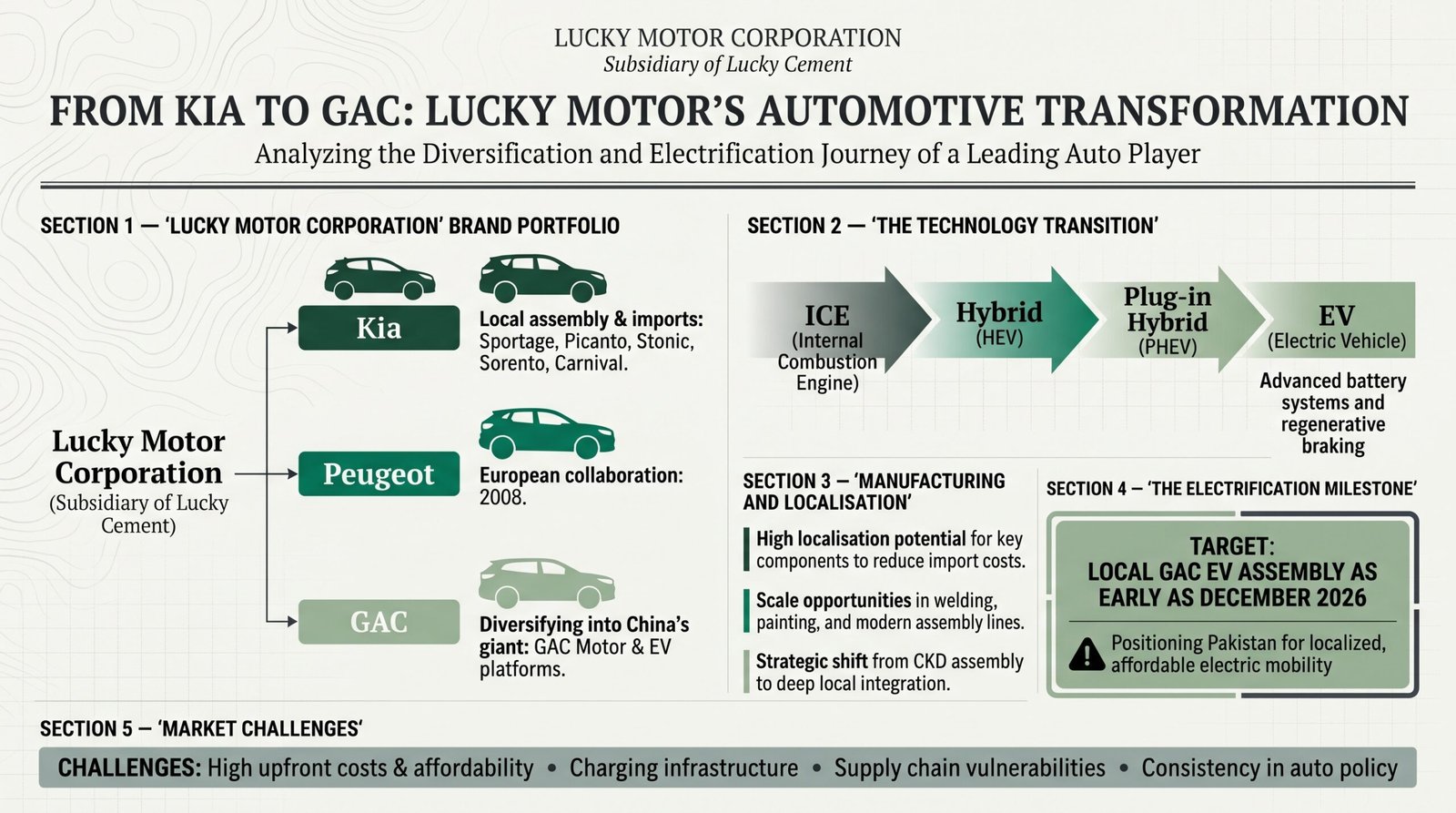
The partnership with South Korea’s Kia Corporation provided Lucky Motor with its initial major platform in passenger-vehicle manufacturing.
Through local assembly, marketing and distribution, Kia established a presence in Pakistan’s competitive automobile market.
Vehicles including the Sportage, Stonic, Sorento and Carnival have helped develop the brand’s portfolio.
The company has also introduced electric vehicles, including the Kia EV5 and EV9, broadening its exposure to premium electric mobility.
Kia’s significance extends beyond vehicle sales.
Through Lucky Motor, the partnership has created opportunities in local assembly, dealership development, after-sales operations, automotive components and technology transfer.
The company has invested in component manufacturing and localisation activities, including vehicle seats, wiring harnesses, air-conditioning components and selected plastic parts.
These investments are important in a market where dependence on imported automotive components exposes manufacturers to currency fluctuations, import restrictions and changes in government policy.
The continued development of local manufacturing capabilities could strengthen Lucky Motor’s competitive position while supporting Pakistan’s wider automotive supply chain.
Peugeot: Bringing A European Brand Into The Portfolio
Lucky Motor subsequently diversified its automotive interests through its partnership with Peugeot, part of the Stellantis automotive group.
The introduction of Peugeot gave the company access to a European automotive brand alongside Kia’s South Korean engineering and product portfolio.
The Peugeot 2008 has been a prominent product in the company’s Pakistani offering.
From a commercial perspective, the partnership represents a broader strategy of operating multiple automotive brands under a common industrial and distribution platform.
Such an arrangement may allow shared manufacturing infrastructure, supplier relationships and administrative resources, although each brand faces distinct competitive pressures.
With the Pakistani automotive market becoming increasingly crowded, the long-term success of these partnerships will depend on product pricing, after-sales support, availability of spare parts, localisation and consumer confidence.
GAC: The Group’s Next Major Bet On Electric Vehicles
The partnership with China’s Guangzhou Automobile Group (GAC) represents another important chapter in Lucky Motor Corporation’s evolution.
Announced in March 2026, the agreement introduced GAC’s new-energy-vehicle brands into Pakistan through Lucky Motor.
The move positions the group to compete in an emerging electric-vehicle market increasingly attracting Chinese manufacturers.
Unlike its earlier reliance primarily on conventional petrol-powered vehicles, Lucky Motor is now pursuing a portfolio that includes internal-combustion engines, hybrids, plug-in hybrids and fully electric vehicles.
The GAC partnership covers the Aion and Hyptec brands, giving the company access to an expanding range of electric-vehicle technologies.
Aion UT, Aion V And Hyptec HT
GAC’s Pakistani portfolio includes the Aion UT, Aion V and Hyptec HT, with the Aion ES sedan also forming part of its announced expansion.
The Aion UT targets the compact electric-car segment, where relatively accessible pricing, practicality and lower running costs are central selling points.
The Aion V competes in the electric SUV category, targeting buyers seeking greater space, technology and range.
The Hyptec HT, meanwhile, positions the brand in the premium electric SUV market.
These products give Lucky Motor exposure to several price segments rather than relying on one category of EV buyer.
The company showcased its expanding GAC portfolio at the Pakistan Auto Show 2026, strengthening its visibility among consumers and automotive industry stakeholders.
The GAC relationship is particularly important because Pakistan’s EV market is still developing, with consumer demand dependent on vehicle affordability, charging infrastructure, financing options and long-term confidence in battery performance.
Local Assembly Plans Could Change The Market
Lucky Motor CEO Muhammad Faisal indicated in May 2026 that the company was targeting local assembly of GAC electric vehicles as early as December 2026.
The stated ambitions also included exploring the possibility of exports to other right-hand-drive markets and evaluating opportunities involving batteries and charging technologies.
However, these plans should be distinguished from completed investments.
As of November 12, 2026, the December assembly target remains prospective, and commercial production milestones will require confirmation.
If successfully implemented, local assembly could potentially reduce dependence on fully imported vehicles and create opportunities for domestic component manufacturers.
It could also support the development of technical skills, specialist maintenance services and the broader EV supply chain.
Yet significant challenges remain.
Electric vehicles continue to face substantial upfront costs, while access to public charging infrastructure is uneven.
Uncertainty surrounding taxation, import duties and long-term automotive policy also complicates investment planning.
The success of Lucky Motor’s EV strategy will therefore depend not only on GAC’s products but also on Pakistan’s ability to establish a commercially sustainable electric-mobility ecosystem.
A Major Player In Mobile-Phone Manufacturing
Lucky Motor Corporation’s activities are not limited to cars.
The company entered electronics manufacturing in 2021 and began locally assembling mobile phones, including Samsung devices.
This expansion marked the group’s entry into another industry historically dependent on imports.
The company’s manufacturing activities have included Samsung smartphones, with earlier production encompassing models from the Galaxy S series.
According to its corporate profile, Lucky Motor crossed the milestone of one million locally manufactured mobile phones.
The expansion illustrates the group’s preference for building manufacturing platforms around established international brands.
However, electronics manufacturing also presents challenges.
Global component prices, changes in consumer demand, import regulations and technological shifts can have immediate consequences for profitability.
Lucky Cement’s latest quarterly report noted significant pressure in Pakistan’s smartphone market following higher international memory-chip prices.
The company has consequently placed greater emphasis on affordable smartphone categories.
The long-term opportunity lies in moving beyond basic assembly towards a more developed local electronics supply chain.
Lucky Core Industries: Chemicals, Pharmaceuticals And Industrial Manufacturing
Another major component of the business empire is Lucky Core Industries Limited, formerly ICI Pakistan Limited.
The company operates across several important industrial sectors, including soda ash, polyester staple fibre, chemicals, pharmaceuticals, animal health and agricultural sciences.
These businesses serve a wide range of industries, including textiles, glass manufacturing, healthcare, consumer products and agriculture.
For FY2026, Lucky Core Industries reported standalone net turnover of approximately Rs113.21 billion, compared with Rs120.01 billion in FY2025.
Profit after tax declined to around Rs9.69 billion from Rs11.64 billion.
The weaker financial performance reflected pressure on industrial demand, energy costs and competition from imported products.
Polyester and soda ash were among the businesses facing particularly difficult conditions.
However, pharmaceuticals and animal health offered some diversification benefits.
The company’s exposure to healthcare and industrial products demonstrates why Yunus Brothers Group cannot be evaluated solely through its cement and automobile operations.
Lucky Core also maintains an associated interest in NutriCo Morinaga, providing exposure to specialised nutrition products.
The group’s involvement in this segment reflects its broader strategy of participating in businesses supplying both industrial and consumer markets.
Textiles: The Foundation Of The Family’s Industrial Wealth
Long before Lucky Cement became widely recognised, textiles were central to the Tabba family’s industrial development.
The group maintains major interests through companies including Yunus Textile Mills, Lucky Textile Mills, Gadoon Textile Mills, Lucky Knits and other associated operations.
Yunus Textile Mills is an important home-textile exporter supplying international markets, particularly the United States and Europe.
Its vertically integrated operations allow it to participate in different stages of textile manufacturing, from raw materials and fabric processing to finished products.
Lucky Textile Mills also represents a longstanding part of the family’s manufacturing heritage.
The textile portfolio provides the group with foreign-exchange earnings, international customer relationships and manufacturing experience accumulated over several decades.
Gadoon Textile’s Rs76 Billion Revenue
Gadoon Textile Mills Limited, listed on the Pakistan Stock Exchange, provides another indication of the scale of the group’s textile interests.
For FY2026, Gadoon Textile reported net sales of approximately Rs76 billion, compared with Rs70.98 billion in the preceding year.
Profit after tax increased to approximately Rs2.63 billion from Rs2.39 billion.
The company invested around Rs5.6 billion in advanced machinery and renewable-energy initiatives during the financial year, according to its annual report.
These investments underline the growing importance of efficiency and energy management in Pakistan’s textile sector.
Despite its export potential, the industry remains vulnerable to high electricity tariffs, cotton availability, financing costs, currency volatility and competition from regional manufacturers.
Yunus Brothers Group’s longstanding exposure to textiles therefore provides valuable export earnings but also carries significant operating risks.
Energy And Power Generation: An Industrial Necessity And Investment Opportunity
Energy represents another important area of investment for the conglomerate.
The group’s involvement extends across power generation, renewable-energy projects and industrial energy infrastructure.
Among its most significant investments is Lucky Electric Power Company Limited, which operates a 660-megawatt coal-fired power plant at Port Qasim, Karachi.
The project achieved commercial operations in March 2022.
Designed to utilise indigenous Thar coal, the plant is an important component of the country’s electricity-generation infrastructure.
The latest quarterly disclosures show that the facility delivered approximately 807.5 gigawatt-hours of electricity during the quarter ended September 30, 2026.
The expansion of the Sindh Engro Coal Mining Company’s mining operations is expected to support increased utilisation of domestic Thar coal at the facility.
Beyond conventional power generation, group companies are also associated with wind and other renewable-energy investments.
Lucky Cement itself has been investing in solar generation, wind energy and waste-heat recovery technologies to reduce dependence on purchased electricity and improve production efficiency.
In October 2026, its board approved additional renewable-energy and waste-heat recovery projects.
Following completion, the company expects its relevant renewable and waste-heat recovery capacity to reach approximately 221.6 MW, enough to meet around 60 per cent of its cement operations’ energy requirements.
Nevertheless, the group’s exposure to coal-based generation creates long-term questions relating to carbon emissions, environmental regulation and Pakistan’s changing electricity-demand patterns.
Industrial competitiveness and environmental sustainability will increasingly need to be managed together.
International Expansion: Iraq And The Democratic Republic Of Congo
Yunus Brothers Group’s ambitions have extended beyond Pakistan through Lucky Cement’s international manufacturing investments.
The company operates cement businesses in Iraq and the Democratic Republic of Congo through joint-venture structures.
These investments provide exposure to construction markets outside Pakistan and opportunities to earn returns in foreign currencies.
The Democratic Republic of Congo has become a particularly important market.
Lucky Cement’s joint venture with the Rawji Group, through Nyumba Ya Akiba, is undertaking an expansion of its cement manufacturing operations.
The project envisages adding 1.6 million tonnes of annual production capacity, raising the facility’s total installed capacity to approximately 2.91 million tonnes.
In Iraq, the group’s cement operations provide further exposure to regional construction demand.
However, overseas expansion is not without risks.
Geopolitical tensions, currency movements, regulatory uncertainty, logistics costs and political developments can affect profitability.
Lucky Cement’s FY2026 disclosures indicated that operations in Congo continued to contribute positively, while cement sales in Iraq experienced pressure from regional circumstances.
International diversification therefore offers opportunities for growth while introducing additional complexity into the group’s operations.
Mining And Minerals: The Next Frontier
The group has also moved into mineral exploration through National Resources (Private) Limited.
The company is a joint venture involving Lucky Cement, Fatima Fertilizer and Liberty Mills.
Lucky Cement holds an approximately 33.33 per cent equity interest in the venture.
Its activities focus on mineral exploration in Balochistan.
According to Lucky Cement’s September 2026 quarterly report, National Resources had acquired five mineral exploration leases, including prospects associated with copper, gold, lead, zinc and antimony.
The company is progressing towards a mineral-resource estimate for one of its exploration areas, while other leases remain at earlier stages.
The move is strategically significant because mineral development could become an important contributor to Pakistan’s industrial investment and export potential.
However, exploration licences and preliminary discoveries should not be confused with commercially viable mining projects.
Actual investment returns will depend on confirmed resources, feasibility studies, financing, infrastructure, regulatory approvals and successful commercial development.
For Yunus Brothers Group, mining represents a longer-term opportunity rather than an established earnings source comparable with cement or textiles.
LuckyOne, Real Estate And Consumer Businesses
The conglomerate has also established a presence in commercial real estate and consumer-facing businesses.
LuckyOne Mall in Karachi is among the group’s most visible real-estate investments.
Developed through Lucky Landmark, the complex combines retail outlets, entertainment facilities, restaurants and other commercial activities.
Its entertainment offering includes Onederland, a family entertainment destination located within the mall.
Beyond the mall, group-linked entities include LuckyOne, Lucky Foods, Lucky Entertainment and other real-estate and commercial businesses.
This diversification exposes the group to domestic consumer spending, retail activity and commercial property demand.
Unlike manufacturing operations, where export earnings and industrial production dominate, these businesses are more closely connected to the purchasing power of Pakistan’s urban population.
The real-estate segment also provides opportunities to develop and manage long-term commercial assets.
Financial Investments And The Holding Structure
An important feature of the Yunus Brothers business empire is its network of holding and investment companies.
Entities associated with the group include Y.B. Holdings, Y.B. Pakistan, Lucky Holdings, Lucky Investments and other investment vehicles.
Their roles range from holding strategic shareholdings to managing financial investments and supporting corporate expansion.
Lucky Investments has expanded the group’s presence into Shariah-compliant asset management and investment advisory services.
Such activities provide exposure to capital markets and financial products beyond the group’s established industrial businesses.
However, the wider corporate structure requires careful interpretation.
Not every company associated with Yunus Brothers Group is wholly owned by the same holding company.
Some businesses are listed subsidiaries, others are privately held enterprises, while several operate through joint ventures or associated-company arrangements.
Consequently, the financial performance of individual entities cannot simply be added together to calculate the group’s total revenue, assets or profitability.
Doing so would risk double-counting subsidiaries already included in consolidated financial statements.
The complexity of the ownership structure also makes corporate transparency and clear disclosure particularly important for investors, creditors and other stakeholders.
Healthcare And Philanthropy: The Aziz Tabba Legacy
Beyond commercial operations, the Tabba family has maintained a significant presence in healthcare and philanthropy.
The Aziz Tabba Foundation is associated with two prominent healthcare institutions: Tabba Heart Institute and Tabba Kidney Institute.
These institutions provide specialised medical services in areas where demand for high-quality healthcare remains substantial.
The philanthropic activities also extend into education, community welfare and social development.
For the group, these initiatives represent an important part of its family and institutional legacy.
They also underline the broader role that major business groups can play in supporting public services and social infrastructure.
Challenges Facing Pakistan’s Industrial Giant
Despite the scale of its operations, Yunus Brothers Group faces challenges common to Pakistan’s major industrial conglomerates.
High energy costs continue to affect manufacturing competitiveness.
Automotive taxation and regulatory uncertainty influence vehicle prices and investment decisions.
The textile sector faces intense international competition and persistent pressure on margins.
Chemical manufacturers contend with weaker industrial demand, imported products and volatile raw-material prices.
International operations must navigate foreign-exchange exposure and political risks.
Meanwhile, emerging investments in electric vehicles and mineral exploration require substantial capital and long development periods before their full commercial potential can be realised.
A particularly important challenge is the changing structure of the automobile market.
Chinese manufacturers are entering Pakistan with increasingly competitive electric and hybrid products.
For Lucky Motor, the addition of GAC alongside Kia and Peugeot offers diversification but also requires the company to manage competing technologies, pricing strategies and consumer expectations.
Similarly, the transition towards renewable energy creates opportunities for industrial efficiency while placing greater scrutiny on coal-based power generation.
The group’s long-term performance will depend on how effectively it manages these competing pressures.
Beyond Cement: What Comes Next?
Yunus Brothers Group’s development demonstrates how a trading enterprise can evolve into a diversified industrial network through manufacturing investment, international partnerships and successive generations of family leadership.
Its future, however, is unlikely to be determined by cement alone.
The automotive business is entering a new phase through Kia’s evolving model portfolio and GAC’s electric vehicles.
Lucky Core Industries offers exposure to pharmaceuticals, chemicals and industrial manufacturing.
Textile companies continue to connect the group with global export markets.
Power investments provide exposure to Pakistan’s energy infrastructure.
International cement operations extend the group’s manufacturing presence beyond national borders.
Mineral exploration and investment management represent additional avenues for expansion.
The October 2026 approval of Lucky Cement’s planned 3.2-million-tonne annual Karachi capacity expansion further demonstrates that conventional industrial manufacturing remains central to the group’s strategy even as it pursues emerging technologies.
Taken together, these activities reveal a business empire built around multiple industries rather than a single flagship product.
Yet diversification alone does not guarantee sustained success.
Corporate governance, financial discipline, technology adoption, export competitiveness, environmental responsibility and the ability to respond to changing market conditions will ultimately determine whether the conglomerate can sustain its position.
For Muhammad Ali Tabba, Muhammad Sohail Tabba and the wider family leadership, the challenge is to ensure that the next generation of investments produces enduring commercial value rather than simply expanding the number of businesses under the group’s umbrella.
From cotton yarn and cement factories to electric vehicles, batteries, industrial chemicals and mineral exploration, Yunus Brothers Group has undergone a remarkable transformation.
The bigger question is no longer how large the Lucky business empire has become, but how effectively it can translate that industrial scale into sustainable growth in an increasingly competitive global economy.