
Pakistan’s government has finalized the comprehensive “Automotive and Auto Parts Manufacturing Policy 2026-31,” preparing to aggressively compress the consumer prices of Battery Electric Vehicles (BEVs) by nearly a third while forcing domestic automakers into a strict $6.01 billion mandatory export regime.
However, implementation of the sweeping sector overhaul remains entirely stalled pending final sign-offs from the Prime Minister’s office and subsequent consent from the International Monetary Fund (IMF), leaving the domestic consumer market and corporate supply chains in a state of speculative paralysis.
The regulatory framework, built upon the dual pillars of export enhancement and local value addition, engineers a massive fiscal shift toward New Energy Vehicles (NEVs). Under the finalized draft, the standard 18% sales tax will plummet to 1% for BEVs, 6% for range-extended EVs (REEVs), and 9% for plug-in hybrid electric vehicles (PHEVs). Concurrently, import tariffs on completely built-up (CBU) vehicles are slated for rapid reduction, converging at a uniform 15% baseline by FY2031.
The policy architecture has navigated an extensive bureaucratic vetting process, passing through four distinct high-level administrative committees since the initial draft reached the Prime Minister on June 2, 2026.
After the Deputy Prime Minister endorsed preliminary revisions, a subsequent committee spearheaded by the Minister for Power executed 14 separate recalibration sessions with macroeconomic analysts to align the framework with the National Tariff Policy. The final legal review was consolidated by a committee convened by the Minister for Law and Justice, encompassing the Ministers for Climate Change and the Economic Affairs Division (EAD), the Adviser to the Prime Minister on Industries, the Secretaries of Finance, Commerce, and Industries, and the Chairman of the Federal Board of Revenue (FBR).
This executive body has successfully drafted the underlying legislative instruments, including the “Automotive Development Levy (ADL)” Bill, the “Duty Drawback on Local Taxes and Levies (DLTL)” framework, and standardized, legally binding operating agreements for original equipment manufacturers (OEMs).
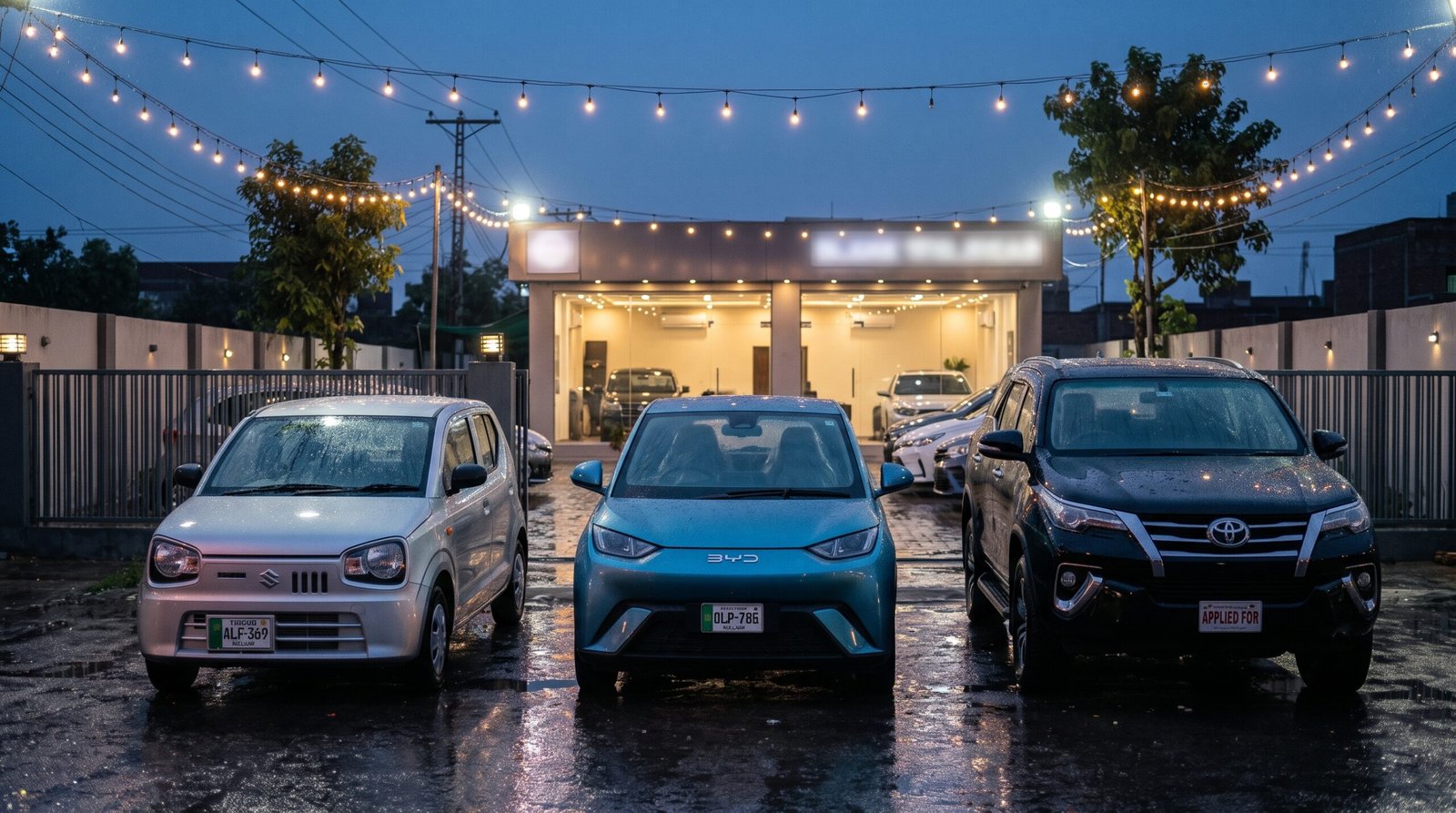
If ratified, the tax and tariff recalibrations will drastically alter showroom economics. Official committee projections indicate that imported electric hatchbacks, such as the BYD Seagull, will experience a retail price collapse of 32.2%.
| Model | Powertrain Type | Current Price (PKR m) | FY27 Est. Price (PKR m) | Price Change |
| Wuling Bingo (imported) | BEV | 3.95 | 2.68 | -32.2% |
| BYD Seagull (imported) | BEV | 5.34 | 3.62 | -32.2% |
| Toyota RAV4 2.4 (imported) | PHEV | 23.33 | 18.34 | -21.4% |
| Baojun Yep Plus (imported) | BEV | 6.27 | 5.06 | -19.3% |
| Haval AWD (local) | PHEV | 12.85 | 11.14 | -13.3% |
| MG HS (local) | PHEV | 10.31 | 8.99 | -12.9% |
| Toyota Yaris 1496cc | ICE | 6.06 | 5.33 | -12.1% |
| Suzuki Alto 658cc | ICE | 3.22 | 2.85 | -11.7% |
| Suzuki Cultus 998cc | ICE | 4.27 | 3.84 | -10.2% |
| Kia Sportage L FWD | HEV | 12.17 | 11.15 | -8.4% |
| MG HS 1498cc | ICE | 9.45 | 9.16 | -3.0% |
| Deepal S05 Premium | REEV | 9.99 | 9.71 | -2.8% |
| Toyota Fortuner 2755cc | ICE | 20.45 | 21.72 | +6.2% |
The Toyota Fortuner remains the sole vehicle projected to face a price increase, triggering the policy’s punitive taxation measures against high-displacement internal combustion engines.
To bridge the capital cost gap between internal combustion and electrification, the State Bank of Pakistan is positioned to drastically expand the NEV consumer financing limit from PKR 3 million to PKR 10 million, extending the permissible repayment tenor from three to five years.
Simultaneously, the policy forces domestic assemblers to abandon their historic reliance on import-heavy, domestic-focused retail models. The state has mandated a cumulative five-year sectoral export target of $6.01 billion. Under the “Mandatory Export Targets (MET)”, OEMs must deliver $2.72 billion in outbound shipments, while the component manufacturing base is tasked with securing $3.29 billion. Sector-wide exports are projected to scale aggressively from $256.6 million in FY2027 to $2.19 billion by FY2031.
For traditional passenger cars, SUVs, and commercial double-cabins, the export quota activates at 0% in FY2027, escalating to 5% of total factory-gate production value by FY2028, and capping at 15% for FY2030 and FY2031.
To stimulate compliance, the framework leverages both robust fiscal incentives and existential commercial threats. Compliant exporters will secure a baseline rebate of 5% on net Free-on-Board (FOB) value through the “DLTL” mechanism. Corporations expanding their export volumes by more than 5% year-over-year will capture an additional 10% bonus rebate on their incremental growth.
Conversely, OEMs failing to fulfill their export quotas face institutional penalties ranging from 1% to 3% of their total annual production value. Any manufacturer missing its target for two consecutive fiscal cycles will face mandatory cancellation of its manufacturing certificate, effectively terminating its legal right to operate within the country.
To underwrite these lucrative export subsidies without breaching IMF fiscal deficit constraints, the government is instituting a targeted “Automotive Development Levy (ADL)” aimed directly at traditional Internal Combustion Engine (ICE) vehicles.
While cars displacing up to 1000cc, commercial tractors, and two- and three-wheelers will face a 0% ADL rate, vehicles between 1001cc and 2000cc will be hit with a 2% surcharge. Luxury ICE vehicles exceeding 2000cc will suffer a massive 10% penalty levy. Commercial assets, including prime movers, trucks, and buses, will be subjected to a flat 2% rate.
Internal committee financial modeling projects total ADL tax collection at PKR 232.77 billion over the five-year policy lifespan, measured against total anticipated state expenditures of PKR 168.34 billion (dominated by PKR 131.7 billion in DLTL payouts to exporters). Official documents classify the mechanism as “fiscally positive with a large margin,” generating a projected net treasury savings of PKR 64.42 billion. However, the financial surplus will invert into negative territory by FY2030 as exponential export rebate payouts outpace internal combustion levy collections.
The state is also moving to aggressively dismantle the completely knocked-down (CKD) assembly model that relies heavily on foreign components. Under the “Minimum Domestic Value Addition Requirement (MDVAR)”, new ICE and SUV manufacturing entrants (operating since 2016) must scale their localized production value from 20% in FY2027 to 40% by FY2031. Legacy OEMs must enforce an annualized localization growth rate of 2%, securing a total 10% increase by the policy’s conclusion. Manufacturers failing the MDVAR audits will forfeit all export incentives and suffer an immediate 3% reduction in tariff concessions on imported non-localized parts.
“Sazgar is importing almost 100%,”
Despite these localization mandates, the immediate tariff restructuring heavily favors existing CKD operators and PHEV manufacturers. Customs duties on non-localized CKD components will collapse from 30% down to 10% in FY2027, and further to 5% by FY2031. Localized CKD parts will see tariffs drop from 46% to a 30-40% bracket in FY2027, bottoming out at 15% by FY2031. Crucially, specialized NEV manufacturing inputs will face a negligible 1% tariff burden and secure total sales tax exemption under the Sixth Schedule of the Sales Tax Act.
A senior industry executive confirmed that assemblers commanding PHEV portfolios—such as Sazgar, Hyundai, Changan, and Kia—are structurally positioned to monopolize the immediate fiscal benefits.
“Now PHEV sales will rise further and hybrid sales will start to drop.”
Legacy market leaders Toyota, Honda, and Suzuki will capture wider profit margins strictly through the reduced duties on imported raw materials, but their ICE-heavy product lineups will fail to qualify for the transformative sales tax collapse granted to NEVs.
Corporate accountability and baseline consumer protection will be institutionalized through FBR oversight. The FBR’s Post Clearance Audit (PCA) directorate is mandated to conduct bi-annual forensic audits of DVA targets and DLTL rebate claims, supplemented by mandatory third-party independent evaluations. Furthermore, the domestic market will be forced to align with international engineering benchmarks, adopting 62 existing and 45 new WP-29 vehicular safety regulations for all local and imported units.
Following IMF sign-off, the government is operating against a tightening legislative clock. The National Action Plan dictates the establishment of a dedicated Export Facilitation Council by November 2026. By December 2026, the ADL and DLTL legislation, the binding export framework, and the NEV credit restructuring must be enacted into law, culminating in the passage of the overarching Motor Vehicle Industry Development Bill by February 2027.