

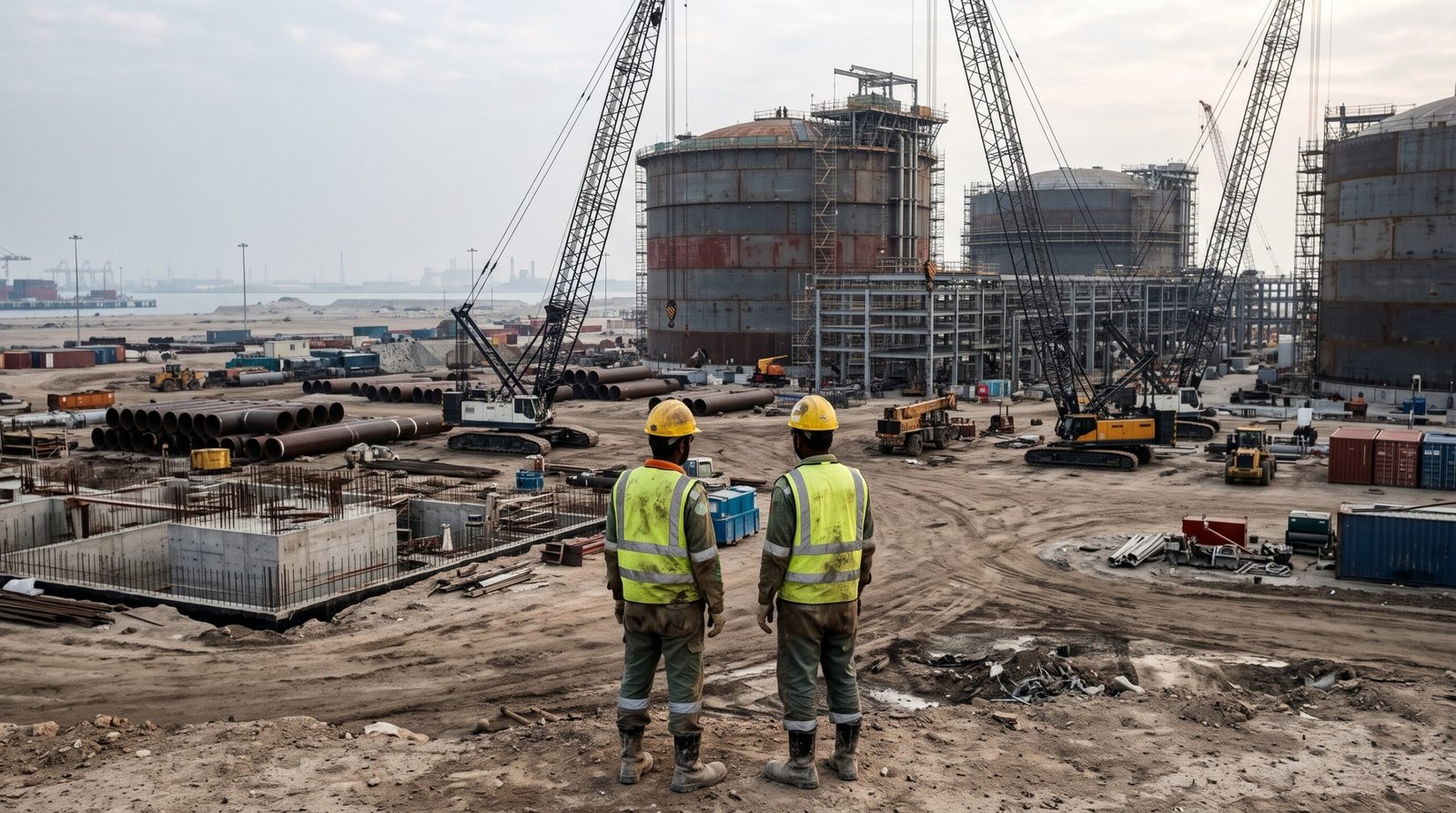
A multinational consortium backed by the Trump administration has proposed a massive $4.4 billion investment to overhaul Pakistan’s liquefied natural gas (LNG) infrastructure, aiming to fundamentally resolve the country’s severe energy supply constraints and its heavy reliance on vulnerable international supply chains.
Spearheaded by US-based Global Vision Energy Partners (GVEP) and Khanjee Holdings, alongside Luxembourg’s General Mediterranean Holding, the proposal seeks to establish an integrated LNG import, storage, regasification, and transmission network at Port Qasim.
The project fills a critical void left after Energas—a joint venture between the Lucky Group and QatarEnergy—abandoned a similar initiative due to shifting domestic energy policies and unresolved regulatory bottlenecks.
“Unlike conventional LNG infrastructure arrangements dependent on government-backed purchase commitments, the proposed venture will operate on a merchant basis.”
Operating on a “merchant basis”, the infrastructure will eliminate the need for sovereign guarantees or state-backed purchase agreements. Instead, it will offer “tolling” and “transshipment” services to multiple private and international clients at market-driven rates.
The initiative has already secured provisional consent from the Port Qasim Authority. Facilitation efforts are currently being coordinated by the Ministry of Maritime Affairs and the Petroleum Division, while the Oil and Gas Regulatory Authority (Ogra) reviews the consortium’s application for a provisional operating license.
Also Read: Bestway Cement Reports Rs6.84 Billion Quarterly Profit As Industry Faces Demand And Cost Challenges
International financial backing remains a cornerstone of the proposal. The US Trade and Development Agency has approved the initiative for its project preparation program. Furthermore, the consortium is pursuing partial financing from the US Development Finance Corporation, bolstered by export credit guarantees from the US Export-Import Bank for equipment and technology.
The capital deployment is structured across two distinct phases. Phase one requires an estimated $1.7 billion to construct a state-of-the-art import, storage, and regasification terminal.
This facility will feature four massive storage tanks, each capable of holding 140,000 cubic metres, yielding a combined static storage capacity of 560,000 cubic metres. Operating with three inventory turnover cycles annually, the terminal is engineered to process approximately 35.6 billion cubic feet (BCF) of LNG per year, translating to roughly 11.9 BCF per cycle.
Phase two encompasses a 1,100-kilometre gas transmission pipeline stretching upcountry. With a diameter ranging from 42 to 48 inches, the pipeline will possess a transportation capacity of 1.2 billion cubic feet per day, pushing the total estimated project expenditure to $4.4 billion. This domestic network mirrors the scale of the previously stalled North-South gas pipeline historically negotiated with Russia.
Strategically positioned at Port Qasim, the hub sits outside the Strait of Hormuz, shielding operators from the geopolitical friction and shipping disruptions inherent to that “strategic waterway”.
While domestic regasification tariffs remain subject to Ogra’s strict regulatory approval, the consortium has outlined a clear preliminary pricing structure for its first ten years of operation, followed by steep reductions.
| Service Category | Initial Tariff (Years 1-10) | Subsequent Tariff (Post-Year 10) |
| Terminal and Storage Tolling | $4.93 per mmBtu | $2.20 per mmBtu |
| Gas Transmission | $1.91 per mmBtu | $0.92 per mmBtu |
The consortium plans to finance the $4.4 billion undertaking through a standard 70% debt and 30% equity split.
“The sponsors intend to establish Port Qasim as a regional LNG storage and trading hub serving domestic consumers and international suppliers.”
The proposed equity structure allocates a 26% stake to GVEP and 24% to General Mediterranean Holding. Khanjee Holdings and a bloc of strategic co-investors will control 20%, leaving the final 10% available for Pakistani domestic investors, with minimum indicative commitments targeted at $50 million.
To fill out the equity requirements, the sponsors have identified high-profile potential backers, including Grey Rock Investment Partners, Kohlberg Kravis Roberts & Co., Blackstone, Saudi Arabia’s Public Investment Fund, and the Kuwait Investment Authority. However, participation by these institutions remains strictly indicative and is entirely contingent upon comprehensive due diligence, internal board approvals, and definitive agreements.