

The government of Punjab has costed a sweeping three-year economic transformation plan at Rs1,995 billion for fiscal years 2026-27 through 2028-29, aggressively aiming to transition the province’s economy from raw output generation to value-added, export-led industrial production.
Branded as Punjab’s Innovation for Value, Opportunity and Transformation (PIVOT), the macroeconomic blueprint is backed by Rs1,089 billion in direct provincial government investment and relies heavily on unlocking an additional Rs906 billion in anticipated private-sector capital leverage.
The policy framework directly targets a $6.8 billion increase in incremental export potential, alongside the creation of 162,000 new jobs and the development of a highly skilled workforce exceeding 850,000 personnel.
Under the PIVOT trajectory, provincial Gross Domestic Product (GDP) growth is officially projected to hit 5.5% in FY27, 5.6% in FY28, and 5.9% in FY29. These metrics represent a significant acceleration against baseline projections of 4.1%, 4.6%, and 5.0%, effectively injecting an additional 100 basis points into the province’s three-year growth average.
“Cumulative provincial GDP uplift is calculated at Rs1,792 billion in real terms and approximately Rs3,947 billion in nominal terms against the baseline scenario.”
This macroeconomic pivot is critical for Pakistan’s wider fiscal stability, as Punjab currently contributes 55.7% of the national GDP and houses a population of 127.7 million people.
To manage the massive capital deployment, the provincial government has structured the PIVOT initiative across eight primary investment components.
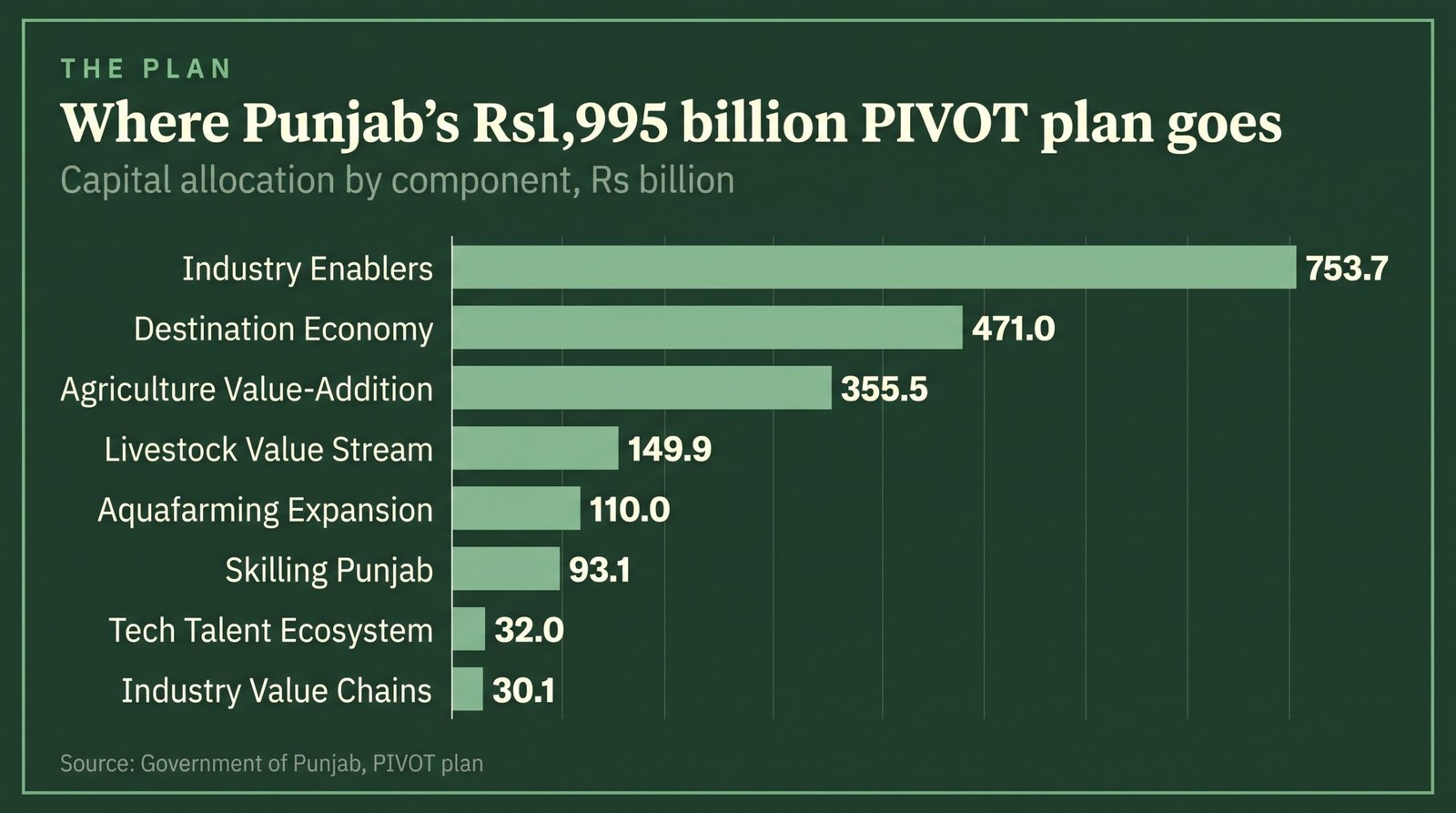
Industrial infrastructure absorbs the heaviest capital concentration. Under the “Industry Enablers” umbrella, Rs25 billion is explicitly earmarked for “common effluent treatment plants” across four primary industrial clusters. These facilities will add 70 million gallons per day of wastewater treatment capacity, specifically engineered to ensure local manufacturers meet stringent European Union and United States environmental standards.
Also Read: US-Backed Consortium Proposes $4.4 Billion LNG Hub And Pipeline In Pakistan
Furthermore, Rs35 billion will fund the development of five major industrial estates, including a massive 2,000-acre facility located near the M-4 Motorway, developed under a public-private partnership model.
Financial engineering remains a core mechanism of the strategy. The government is deploying the “Sanati Taraqqi and Export Promotion” financing facility, anchored by a massive Rs193 billion interest subsidy. This tiered structure offers highly concessional loans at 0%, 3%, and 5% rates across 463 targeted projects, intending to crowd-in Rs300 billion in private enterprise investment. Additionally, two dedicated Rs50 billion accelerators will directly fund duty reimbursements and the installation of on-site solar power for investors operating within selected industrial and agro-processing parks.
Within the distinct “Industry Value Chains” component, eight specific export sectors will receive Rs30.1 billion in targeted support. The textiles and apparel sector dominates this allocation with Rs13.3 billion, funding the creation of specialized “plug-and-play garment parks” that are projected to independently generate 20,000 jobs. Additional funding will bolster leather, pharmaceuticals, sports goods, cutlery, ceramics, fans, and floriculture, primarily executed through the establishment of testing laboratories and international certification support.
“In agriculture, Rs135 billion is heavily set aside for mechanization, alongside Rs60 billion to construct four agro-processing parks across Sargodha, Khanewal, Okara, and Bhakkar.”
To address chronic supply chain inefficiencies, the state has allocated Rs20 billion for specialized wheat silos intended to close an estimated 20-25 million metric ton (MMT) storage deficit. Livestock development features specialized financing pegged at the 6-month KIBOR plus 1%, alongside the establishment of a Foot-and-Mouth Disease (FMD) free zone in Bahawalnagar. This is intended to drive meat exports up by 200%. Aquafarming expansion captures Rs50.3 billion for three modern shrimp estates located in Muzaffargarh and Sargodha.
Aligned with the vision of Chief Minister Punjab Maryam Nawaz Sharif, the “Destination Economy” component allocates Rs471 billion to develop eight comprehensive tourism circuits via public-private partnerships, targeting an influx of 18 to 30 million annual tourists.
Labor and technology development are treated as distinct economic multipliers. The “Skilling Punjab” initiative aims to aggressively train 162,060 domestic and 240,000 international trainees, projecting a subsequent $468 million annual lift in foreign remittances. Concurrently, the “Tech Talent Ecosystem” is programmed to produce 1.5 million frontier-tech graduates annually while incubating 1,200 new technology startups.
To ensure execution, the provincial government will enforce severe bureaucratic rationalization. A single, unified coordinating body will systematically replace more than 15 disparate inspection agencies. This structural reform will slash the current burden of 40 to 50 regulatory visits per factory down to a single, consolidated “risk-based quarterly inspection”. The legislative framework of the PIVOT plan also formally mandates comprehensive reviews of existing labor laws, reductions in stamp duties on bills of exchange, and the implementation of a streamlined land lease policy specifically for Special Economic Zones.