

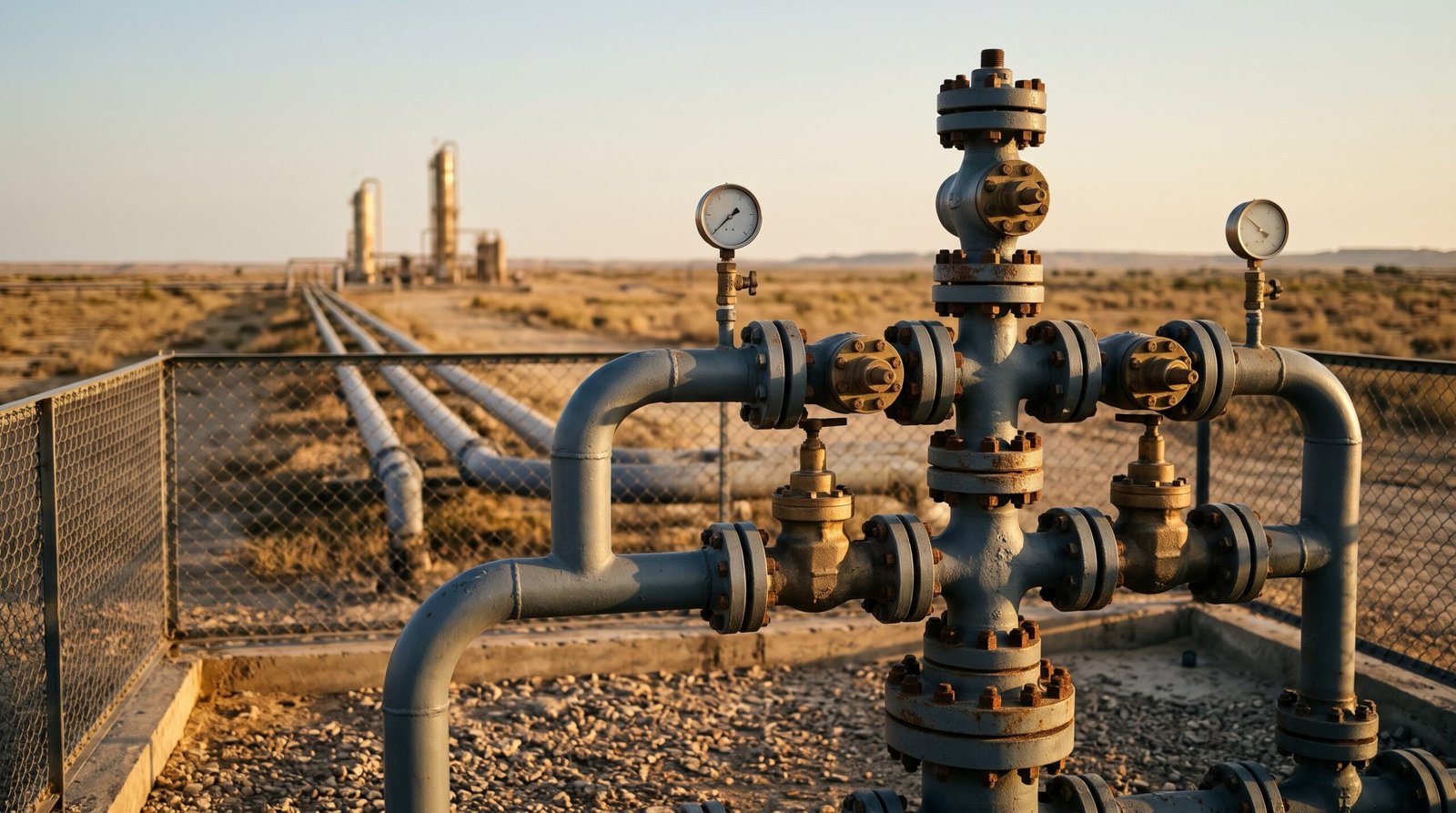
When a proposal to redraw provincial boundaries is discussed in Islamabad, people in a producing district can reasonably ask who will sign the next gas agreement and who will receive the proceeds. The previous article in The Scoop proposed a practical way to answer them. Open the resource agreements to scrutiny by elected assemblies, publish what each government receives, and give producing districts a voice in how the money is spent. The Senate’s devolution subcommittee has now put a figure on the dispute. It should put the accounts on the table as well.[1]
On 23 November, Senator Zamir Hussain Ghumro told the subcommittee that four petroleum companies had earned about Rs. 3.6 trillion in profits since 2011 and that an estimated Rs. 1.8 trillion should have gone to the provinces. The Express Tribune reported the proposed provincial shares as Rs. 978 billion from Oil and Gas Development Company Limited (OGDCL), Rs. 462 billion from Pakistan Petroleum Limited, Rs. 225 billion from Mari Energies and Rs. 144 billion from Pakistan Oilfields Limited.
Senator Ghumro said the provinces had received none of the share he claimed. The four amounts add up to Rs. 1.809 trillion. The Senate’s account records that the Petroleum Division had been asked to supply profits for 2011–2026 alongside province-wise figures for wellheads and production. The published account gives the aggregate claim. The underlying schedules are needed to determine what fell due under each arrangement, what was paid and whether any arrears remain.[2]
The Constitution (Eighteenth Amendment) Act, 2010, did something more consequential than assign a revenue head. Under Article 172(3), mineral oil and natural gas within a province or its adjacent territorial waters vest jointly and equally in that province and the Federal Government, subject to existing commitments and obligations.
The counterpart to the Federation is the province where the resource lies. Equal ownership therefore has to be made effective where decisions are taken about granting a concession, renewing it or changing its terms. The relevant instruments must show whose consent was obtained and what each government secured. Where Islamabad relies on an existing commitment, it should identify the instrument, its date and the precise obligation it says continues to bind the parties.[3]
The Rs. 1.8 trillion claim starts from the profits of companies. Article 172(3) starts from ownership of the resource. An explorer’s accounts reflect its contractual interest in several fields, its costs and taxes, and potentially earnings from investments. A company’s profit after tax may be retained or distributed to shareholders.
The federal treasury’s dividend receipts show what it was actually paid as a shareholder. A proposed provincial entitlement must identify the relevant production or receipt, its legal basis and the amount allocable to the producing province.
The Constitution states a net-profit rule expressly for bulk hydroelectric generation in Article 161(2). The oil and gas provision leaves the machinery for giving financial effect to equal ownership to be worked out.[3]
Company filings show what can go wrong in a simple addition. Mari Energies identifies the Government of Pakistan as a 20 percent shareholder and OGDCL as another 20 percent shareholder. OGDCL’s financial statements recognise a share of Mari’s profit as earnings from an associate. If the profit series used for OGDCL includes those earnings, adding Mari’s full profit would count a portion twice. The schedules should identify the accounting basis for every year, remove any overlap and distinguish the value realised from Pakistani oil and gas fields from other earnings. The same care is needed before extending the calculation to gas transmission and distribution businesses.[2][4]
Article 161(1) already gives producing provinces specific claims. It directs the relevant net proceeds of federal wellhead excise on natural gas and the gas royalty collected by the Federation to the province where the gas wellhead is situated. It also directs net federal wellhead excise on oil to the producing province.
The Seventh National Finance Commission Award separately provides for crude oil royalty and the distribution of the natural gas development surcharge. The Federal Budget in Brief for 2026–27 shows a revised estimate of Rs. 190.5 billion for straight transfers in 2025–26, comprising gas and crude oil royalties, gas excise and the gas development surcharge. The amounts and dates credited to individual provincial treasuries belong in the reconciliation. Each payment should be matched to the obligation it discharges.[3][5]
Also Read: Big Bird Foods Eyes Global Halal Market As Revenue Surges To Rs14.76 Billion
The petroleum policy already offers a concrete question for the audit. The 2012 policy envisages equal division of the benefit of the windfall levy on crude oil and condensate between the Federation and the province concerned. Where that provision applies, the Petroleum Division should disclose the levy assessed, the amount collected and the basis on which it was shared. Those figures would show where equal sharing has practical financial consequences.[6]
The Senate has been here before. After the devolution committee referred the issue to the chair in 2017, Raza Rabbani’s ruling called for joint exercise of authority over petroleum and proposed a legal framework for joint control. It took the view that the protection for existing commitments covered agreements on their original terms and that subsequent changes required provincial approval.
The Petroleum Division can now show, concession by concession, how provincial participation has worked since that ruling. Article 153 and Article 154 offer the forum. The Council of Common Interests, chaired by the prime minister and including all four chief ministers, is charged with policy and supervision in matters listed in Part II of the Federal Legislative List, which includes mineral oil and natural gas. The subcommittee asked for a federal cabinet decision. The compliance report and proposed mechanism should also come before the Council, with the positions of all four provinces on the record.[2][3][7]
The Auditor-General should reconcile the money as it moves from company to government and from Islamabad to the provincial treasuries. The Petroleum Division should publish the production volumes, the applicable prices, the licence and lease terms, the parties’ working interests and the dates of any renewals or amendments, field by field and year by year.
The federal and provincial finance departments should then show the amounts due, the sums received, the dates of transfer and the basis for any deductions. Dividends, royalties, levies and concession receipts should each have a traceable entry. Parliament and the provincial assemblies should receive the reconciliation, along with a timetable for paying established arrears and a record of outstanding disputes. The Council can settle the policy for future receipts and identify any legislation needed to give it effect.
The books must stay open after the money reaches the provincial capital. The Petroleum Exploration and Production Policy 2012 provides for 10 percent of the royalty to be used for infrastructure in the district where oil and gas are produced.
In Abdul Wahab Khattak and others, the Peshawar High Court directed that elected district and tehsil heads be represented on the relevant committees in Khyber Pakhtunkhwa and that the committees follow the Supreme Court’s directions on transparency. Provincial governments should publish district receipts alongside project allocations, expenditures and completion dates. A resident should be able to trace an amount from the producing field to the provincial treasury and then to the scheme it financed.[6][8]
For those asked to trust that a new provincial map will bring decisions closer to them, there is a test available under the existing one. Publish a producing district’s account and let its elected representatives examine it. The Federation and the provinces can start with the four companies named at the hearing. The next debate on boundaries should begin with that account in the hands of the people whose districts are under discussion.
Notes:
- The Scoop, “Who will back a Pakistani inventor?”
- Senate of Pakistan, proceedings of the Devolution Sub-Committee, 23 November 2026 · Shahbaz Rana, “Provinces denied Rs1.8tr profits,” The Express Tribune, 24 November 2026
- Constitution of the Islamic Republic of Pakistan, Articles 153, 154, 161 and 172, and Federal Legislative List, Part II, entry 2
- Mari Energies Limited, Shareholding Structure · OGDCL, notes to the interim financial statements for the quarter ended 30 September 2026, related-party disclosures for Mari Energies
- Distribution of Revenues and Grants-in-Aid Order, 2010 (President’s Order No. 5 of 2010), Articles 5–6 · Ministry of Finance, Federal Budget in Brief 2026–27, table 6
- Petroleum Exploration and Production Policy 2012, section 4.1, items 4–5
- Senate of Pakistan, Ruling of the Chair on the Joint Ownership of Mineral Oil and Natural Gas, pp. 5–7
- Peshawar High Court, Abdul Wahab Khattak and others, W.P. No. 703-B of 2016, judgment of 15 June 2017, para. 27
Disclaimer: The views and opinions expressed in this article are solely those of the author(s) and do not necessarily reflect the editorial position, values or beliefs of The Scoop or its management.
The Scoop firmly believes in freedom of speech, intellectual diversity and the open exchange of ideas. As an independent media platform, we remain committed to providing space for differing perspectives, including those that may challenge or contradict our own views.
Publication does not constitute endorsement. Our commitment to freedom of expression and independent journalism extends beyond opinions with which we agree.