

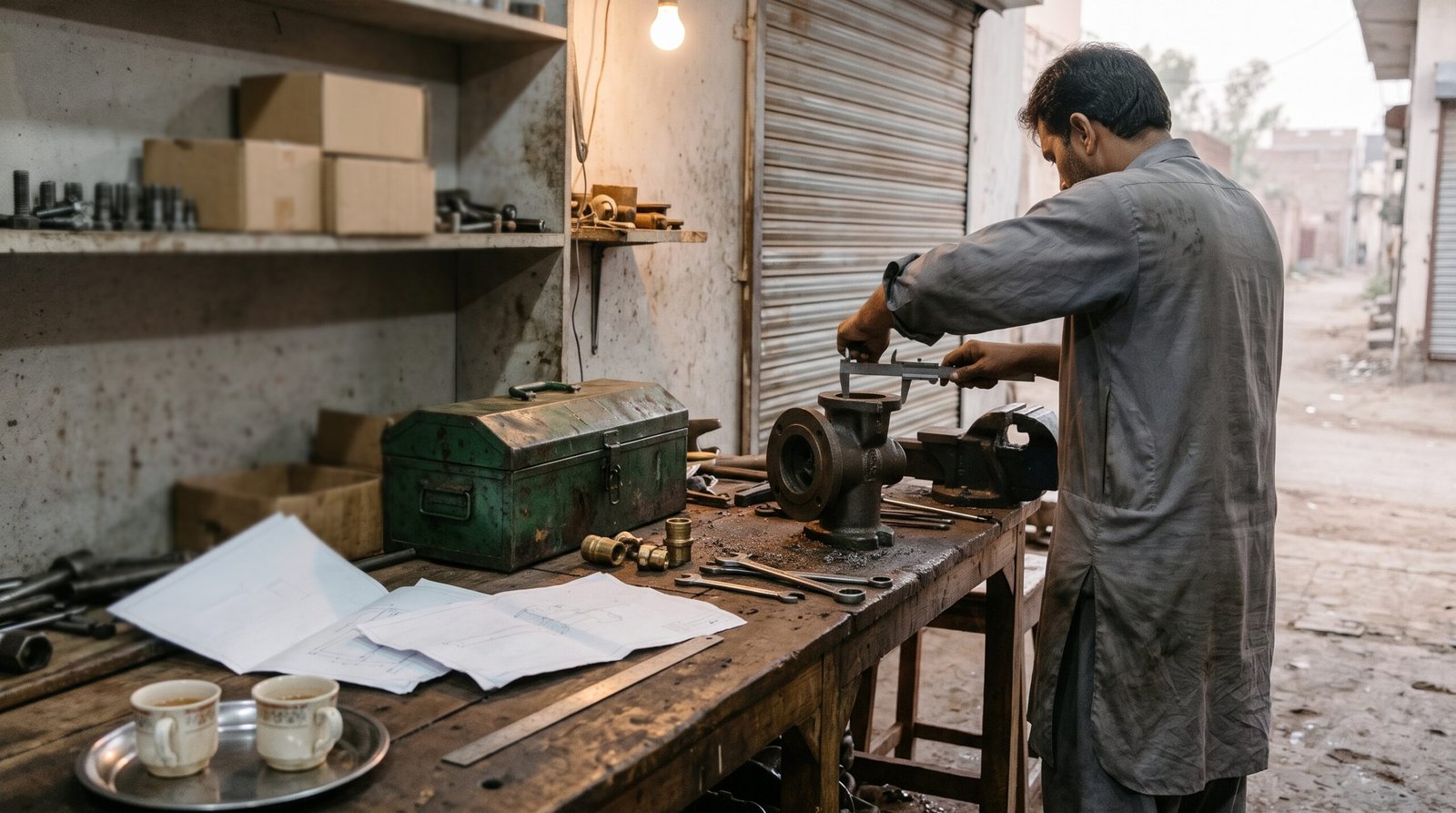
Eleven proposals have reached Haroon Khawaja. About fourteen more people have expressed interest but need help putting their ideas on paper. In December 2026, he plans to bring the applicants together over tea. There is something worth pausing over in that modest invitation. Pakistan has found a great deal of time this year to discuss where a new provincial boundary might run. How much time has it given a citizen who thinks she has invented something and wants someone to read the proposal?
Haroon Khawaja launched Mojid (Inventor) in the second quarter of 2026 with his own funds. His first approach was to universities. The summer closure slowed matters, and some institutions wanted memoranda of understanding or conditions settled before proceeding.
In an update to Mojid’s advisory board, Haroon Khawaja describes a practical response. He invited innovators to apply directly through the initiative’s website. The proposed December 2026 orientation will explain how to prepare a feasibility study. Applicants are to develop their pitches in January 2027. Mentors will assess the completed proposals, with final selection by the board envisaged for April.[i]
The most revealing figure in that account may be the fourteen still seeking guidance. A person can know precisely why a pump fails in the field and have little idea how to estimate the market for a replacement. Another can write a persuasive business plan without ever having repaired a pump. If familiarity with an application form decides who gets a hearing, Pakistan may select the second person and never meet the first. Mojid’s early promise lies in giving both a chance to show what they know. Its eventual worth will be measured by what happens after the tea.
The World Intellectual Property Organization’s Global Innovation Index 2026 offers a national perspective. Pakistan ranks 95th among 139 economies, up from 99th a year earlier. India ranks 38th, Sri Lanka 94th and Bangladesh 105th. The four-place improvement deserves a measured reading. WIPO itself gives Pakistan a statistical confidence interval extending from 85th to 100th. A more telling comparison lies within the country’s own results. Pakistan ranks 121st for the conditions and resources supporting innovation and 72nd for innovation outputs. Before passing judgement on the ingenuity of Pakistanis, those who determine the conditions under which they work might examine their own performance.[ii]
Consider patents. WIPO’s country profiles record 498 applications filed at home by Pakistan residents and another 52 filed abroad. Population makes the comparison with neighbours more instructive. Pakistan recorded two resident patent applications per million inhabitants, against 13.9 in Sri Lanka and 62 in India. Sri Lanka, so close to Pakistan in the overall innovation ranking, filed at nearly seven times Pakistan’s rate per head.
These figures count applications. They tell us little about the mechanic who improves a machine for a local factory and sees no commercial reason to patent it. They do, however, invite universities, industry and the patent office to explain what assistance an inventor can obtain, in her own language and within reach of her district, before an idea is abandoned.[iii]
Money presents a second test. On November 22, Dawn drew attention to the State Bank of Pakistan’s September banking statistics. The five largest banks held 57.3 per cent of banking assets and 53 per cent of deposits. They accounted for 62.1 per cent of the banking system’s investments. Of those five banks’ own investment portfolios, 95 per cent was in government securities. Smaller banks also invested overwhelmingly in government paper.
The State Bank calls the phenomenon concentration. Its figures establish how much financial power rests with a few institutions. A finding of collusion or abuse would require evidence about their conduct.[iv]
Put the applicant for Mojid alongside the largest customer of these banks. The applicant may need a modest sum to build a prototype. She has no sales history, perhaps no property to pledge, and cannot say with certainty that her design will work. The Government of Pakistan can offer a readily marketable security and return for more money at the next auction. A prudent banker can explain the choice in a few sentences. The harder explanation is owed by successive governments. What kind of economy did they expect to emerge when financing the state became such an attractive use of the nation’s savings?
There is a practical division of labour here. A modest grant can pay for a prototype. An investor prepared to share the risk can finance trials. A bank has a more conventional role once an enterprise has an order to fulfil and needs working capital.
A provincial irrigation department, for example, could publish a problem its engineers encounter, invite competing designs and pay for the best of them to be tested under field conditions. The results, including failures, could be made public. An inventor would gain something more valuable than a photograph at an awards ceremony. A prospective buyer would know whether the product worked.
Much is said about Pakistanis having ceased to read or listen. That judgement bears more heavily on citizens than the evidence warrants. Fourteen people have already indicated that they would like to learn how to present an idea. The more searching question concerns those with the authority to listen.
When a teacher, engineer or district officer submits a carefully argued proposal, who undertakes to read it? Does the author receive reasons for a refusal? Can an elected representative obtain the underlying figures, challenge the decision in committee and return to constituents with an answer? Habits of public reasoning grow when people have some experience that the effort of supplying evidence is worthwhile.
That is where innovation meets the unsettled politics of the federation. Many citizens believe that the political arrangements following the elections of February 8, 2024 frustrated the verdict they had delivered. That grievance deserves a democratic hearing. The Commonwealth Observer Group documented restrictions on electoral competition and found that the interruption of mobile services impaired transparency in the transmission of results.
On October 11, 2026, the President, acting on the prime minister’s advice, proclaimed an emergency and governor’s rule in Khyber Pakhtunkhwa under Articles 232 and 234. The federal government cited grave security concerns. Those concerns place a corresponding responsibility on the federation to explain publicly when elected provincial authority can resume its ordinary work. Citizens whose cooperation is indispensable to peace deserve a voice in the decisions taken in their name.[v]
The debate over new provinces would gain credibility if its proponents began with Punjab. There is a democratic case for redrawing Pakistan’s largest province to reduce its predominance in national politics and bring government closer to people long distant from Lahore. The people of the affected regions should be heard on boundaries, revenues, water, public employment and the location of institutions.
Article 239(4) of the Constitution gives the affected provincial assembly a decisive voice through the requirement of a two-thirds majority of its total membership. As argued earlier in Devolution before division and Provinces: To be or not to be, a new provincial capital can reproduce every failing of the old one if it keeps the money and leaves elected local councils dependent on its pleasure.[vi]
An equally constructive beginning would be to open the books on resources. In Sindh, Balochistan and Khyber Pakhtunkhwa, a proposal to redraw boundaries can readily be heard as a proposal to decide elsewhere who will control a gas field, a mine or a river. The civil and military leadership can answer that apprehension without anyone having to speculate about motives. Let elected assemblies examine resource agreements, publish the shares accruing to each government, and give producing districts a say in how the proceeds are used. Article 172(3) expressly provides for joint and equal federal and provincial ownership of mineral oil and natural gas, subject to existing commitments and obligations. Other minerals require examination under their own legal arrangements.[vii]
Article 161 offers an immediate test of good faith. The 2026–27 federal budget estimates Rs6.189 billion in straight transfers for excise duty on natural gas. It also lists crude-oil royalty, a different receipt. Parliament should ask what excise is levied and collected at oil wellheads under the arrangement contemplated by Article 161(1)(b), why the budget presents no corresponding straight-transfer line, and what each producing province actually received. At a hydroelectric station, the constitutional entitlement is to net profits from bulk generation.
The bus-bars enter the calculation because that is where bulk supply is valued at a rate determined by the Council of Common Interests. A proposal for a new excise at the bus-bars is a separate policy choice. The existing obligation can be examined today by publishing, station by station, the applicable rate, allowable deductions, net profit, payments and disputed balance. A provincial assembly could then debate an account its citizens can check.[viii]
Pakistan will be one hundred in August 2047. A child born this year will then be old enough to vote, to invent something and to ask who received the proceeds of the gas or electricity produced in her province. What answer should she receive on any of those occasions? Haroon Khawaja has offered one answer on the scale available to a private citizen. He has invited people to bring their ideas, undertaken to help them prepare, and named a month in which a decision should be made. Pakistan’s most powerful institutions have far greater means. They, too, can begin by giving people a hearing, sharing the evidence behind decisions and trusting elected Pakistanis to exercise the authority that belongs to them.
The series continues with Part II, “Who gets Pakistan’s savings?”, on bank profits, sovereign borrowing and finance for productive enterprise. Part III, “A country that reads and listens”, turns to libraries, universities and the public hearing of evidence. Part IV, “What the producing provinces are owed”, follows the money from wellheads and hydroelectric stations to provincial accounts. Part V, “Punjab and the future of the federation”, examines provincial boundaries, elected local government and democratic consent. Part VI, “A compact for 2047”, brings these strands together in commitments citizens can measure.
[i] Haroon Khawaja, “Update on Mojid”, communication to the Board of Advisors. Initiative website: Mojid.
[ii] WIPO, Global Innovation Index 2026, Pakistan profile and comparative rankings.
[iii] WIPO, Intellectual Property Statistics, country profiles for Pakistan, Sri Lanka and India.
[iv] State Bank of Pakistan, Quarterly Compendium: Banking Statistics, September 2026, Table 1.6. Shahid Iqbal, “Five banks dominate financial system”, Dawn, 22 November 2026.
[v] Commonwealth Observer Group, Pakistan General Election, 8 February 2024. Radio Pakistan, announcement of the proclamations, 11 October 2026.
[vi] Constitution of Pakistan, Article 239(4). See also “Devolution before division”, The News on Sunday, 13 September 2026, and “Provinces: To be or not to be”, Minute Mirror, 4 November 2026.
[vii] Constitution of Pakistan, Article 172(3).
[viii] Finance Division, Federal Budget 2026–27, Budget in Brief, transfers to provinces, and Constitution of Pakistan, Article 161.
Disclaimer: The views and opinions expressed in this article are solely those of the author(s) and do not necessarily reflect the editorial position, values or beliefs of The Scoop or its management.
The Scoop firmly believes in freedom of speech, intellectual diversity and the open exchange of ideas. As an independent media platform, we remain committed to providing space for differing perspectives, including those that may challenge or contradict our own views.
Publication does not constitute endorsement. Our commitment to freedom of expression and independent journalism extends beyond opinions with which we agree.