

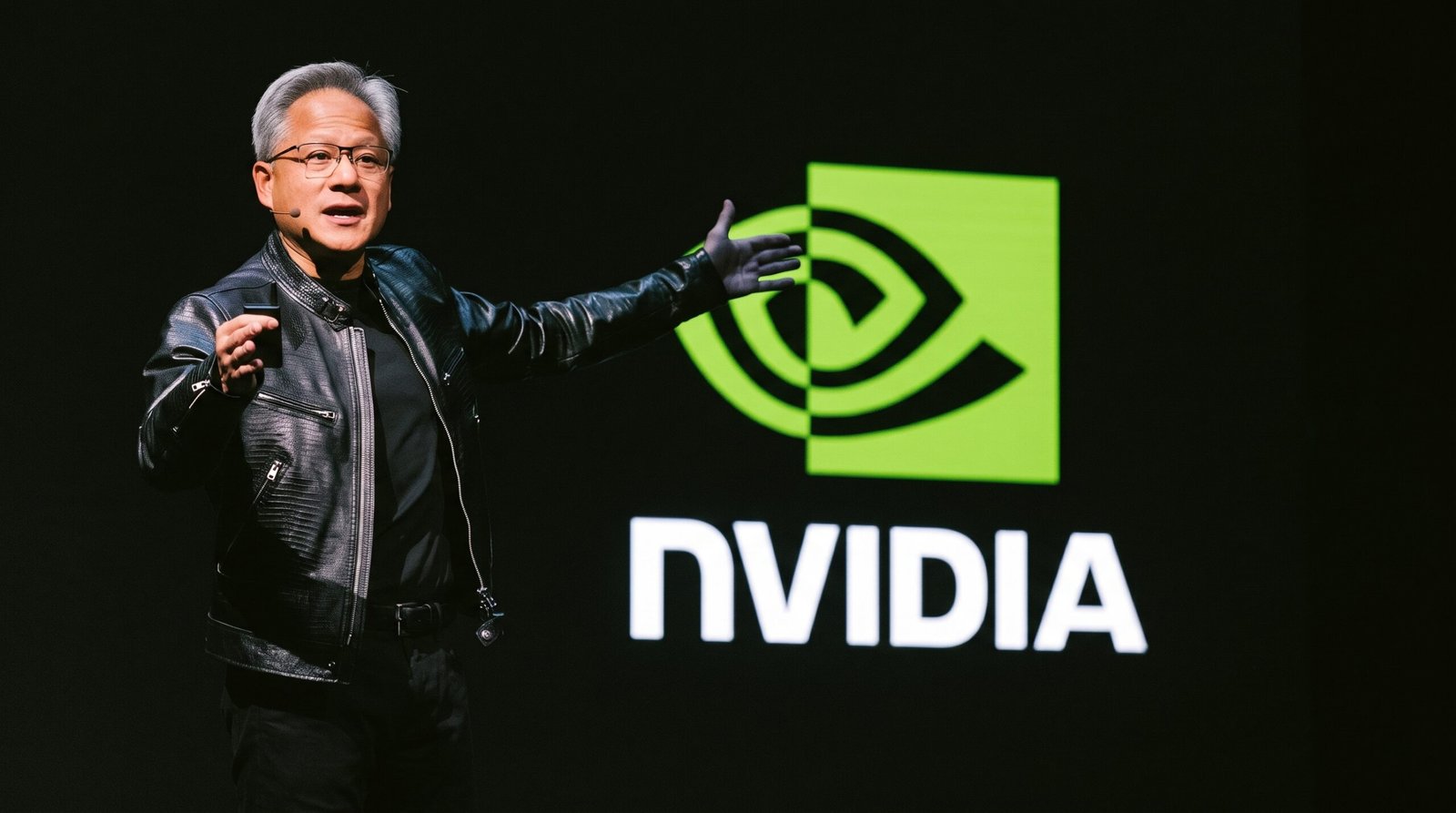
SANTA CLARA / WASHINGTON: In one of the sharpest corporate reversals in Silicon Valley history, Nvidia’s board of directors has unanimously voted to reinstate co-founder Jensen Huang as President, Chief Executive Officer, and Board Director—just 11 days after he abruptly resigned amid a scandal involving a former executive at a Singapore-based customer suspected of ties to Chinese intelligence.
Announced on Monday, November 23, 2026, and effective immediately—following a board vote formally dated November 22 in a filing with the US Securities and Exchange Commission (SEC)—the decision ends a turbulent leadership vacuum that had rattled global artificial intelligence markets. Chief Financial Officer Colette Kress, who stepped in as interim CEO during Huang’s absence, will return exclusively to her role as Executive Vice President and CFO, while Harvey C. Jones will remain Chairman of the Board.
The White House Push and Board Reversal
The unanimous vote marked a dramatic U-turn for Nvidia’s directors, coming just days after Board Chairman Harvey C. Jones had publicly ruled out bringing Huang back. According to Nvidia’s official statement, directors reversed course following “a series of discussions and meetings” with Huang and after receiving “input from senior levels of the United States government,” concluding they were satisfied with Huang’s candor and “confident that Mr. Huang’s reinstatement poses no national security risk”.
“The Board believes Jensen is the right person to lead Nvidia, and that his reinstatement is in the best interests of our stockholders, employees, partners and customers,” Jones said in Monday’s statement.
Behind the scenes, President Donald Trump played an active role in facilitating Huang’s return. In an interview with CNBC, Trump said Huang “did nothing wrong” and confirmed he had been in direct and indirect contact with Nvidia’s board—with Semafor reporting that the president dialled into a board meeting to urge Huang’s reinstatement. Writing on Truth Social on Monday, Trump praised the board’s move as “the correct and proper decision,” stating that Attorney General Todd Blanche had confirmed the US government does not possess evidence of unlawful conduct by Huang.
Pressure had also mounted across Silicon Valley and retail investor circles: an open petition demanding Huang’s return garnered more than 180,000 signatures within days of his exit, including backing from Elon Musk.
Addressing employees and investors upon his return, Huang said he was “honored” to resume leadership and accepted the responsibility “with the greatest humility and renewed commitment”. Thanking Jones, Kress, executive staff, partners, and his family, Huang concluded: “I can’t wait to get back to work”.
Wall Street Roars Back With a $1 Trillion Surge
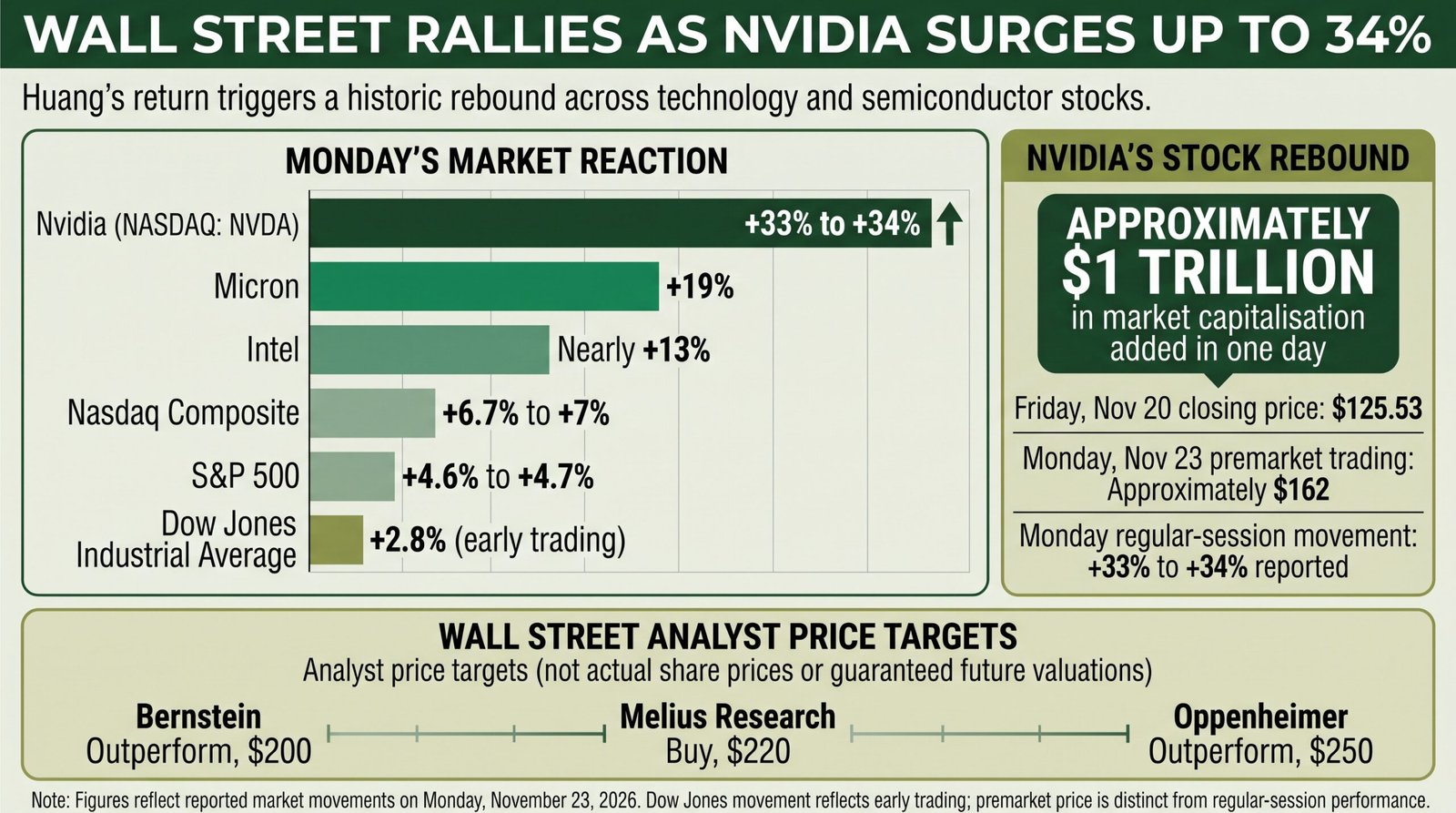
Investors greeted Huang’s return with a historic relief rally after a punishing selloff that had dragged Nvidia down sharply from its pre-crisis levels. Having closed at $125.53 on Friday, November 20, Nvidia shares jumped more than 25 per cent in premarket trading to roughly $162 before surging between 33 per cent and 34 per cent during Monday’s regular session—adding roughly $1 trillion in market capitalisation in a single day.
The rebound cascaded across global semiconductor and technology equities, lifting a broader market that had slumped amid AI-valuation jitters:
| Market / Metric | Monday, November 23 Reaction |
| Nvidia (NASDAQ: NVDA) | Surged 33%–34% (from Friday’s $125.53 close), adding roughly $1 trillion in market value |
| Nasdaq Composite | Climbed nearly 6.7%–7% |
| S&P 500 | Advanced 4.6%–4.7% |
| Dow Jones Industrial Average | Rose 2.8% in early trading |
| Semiconductor Peers | Micron jumped 19%; Intel gained nearly 13% |
| Wall Street Upgrades | Bernstein (Outperform, $200 target); Melius Research (Buy, $220 target); Oppenheimer (Outperform, $250 target) |
Morningstar senior equity analyst Brian Colello noted that shareholders had effectively “voted on Huang’s ouster with a sharp market selloff” and predicted Nvidia would return to “business as usual” with minimal C-suite disruption and reduced risk to its product roadmap and neocloud partnerships—though he cautioned the chipmaker will likely face tighter restrictions selling AI hardware across Asia.
Also Read: Nvidia Crisis Triggers Intense Scrutiny Of US Export Control Agency Over China Chip Curbs
Anatomy of the Megaspeed Scandal
Huang’s abrupt resignation on November 12 followed revelations of extramarital affairs, most notably with Alice Huang, a former executive at Megaspeed International—a Singapore-based Nvidia customer that US officials suspect of having ties to Chinese intelligence and potentially helping divert restricted AI chips to China.
Originally incorporated in Singapore in 2015 as 7Road International, the overseas arm of a Chinese video game developer, Megaspeed has insisted it operates as a legitimate and lawful business and stated that Alice Huang departed the firm in August 2025. However, Singaporean authorities confirmed that Alice Huang was barred from re-entering the city-state following a 2025 investigation into suspected breaches of domestic law, and US authorities placed Megaspeed on an export control list. Beijing has rejected the espionage allegations as unsubstantiated.
New Compliance Guardrails—and Unfinished Probes
While Nvidia’s announcement confirmed no changes to its hardware roadmap, CUDA ecosystem, or commercial product lines, the company paired Huang’s reinstatement with formal governance guardrails and acknowledged that regulatory scrutiny is far from over:
- Ongoing Foreign-Intelligence Inquiry: A special committee of independent directors will continue its investigation into allegations that Huang was targeted by foreign intelligence operations, with Huang committing his full cooperation.
- National Security and Export Control Oversight: The board’s newly established National Security and Export Control Oversight Committee—formed on November 17 and composed exclusively of independent directors—will oversee trade compliance and national security risks.
- New Chief Compliance Officer: Nvidia has launched an executive search for a Chief Compliance Officer who will oversee company-wide compliance and report directly to the board’s Nominating and Corporate Governance Committee.
- Cooperation With Federal and State Inquiries: The chipmaker pledged continued cooperation with active investigations across the Department of Justice (DOJ), the SEC—which is reportedly examining Nvidia’s accounting practices—and California state authorities examining whether restricted chips reached China.
Political Blowback and Governance Questions Even as Wall Street celebrated, Huang’s swift reinstatement drew sharp pushback in Washington and from corporate governance specialists. Bipartisan lawmakers in Congress questioned the Trump administration’s involvement in a corporate personnel decision and vowed to investigate the circumstances surrounding Huang’s return, with congressional investigators setting a December 2 deadline for briefings on Megaspeed and Nvidia’s export-control compliance. Even while championing Huang’s return, President Trump acknowledged that Nvidia’s adherence to US export controls should remain under review.
Governance analysts were quick to draw parallels to OpenAI co-founder Sam Altman’s brief 2023 ouster and reinstatement, warning that bringing back a founder-CEO days after his departure highlights the outsized dependency of modern AI giants on singular leaders. Critics cautioned that reversing course under market and political pressure exposes Nvidia to lingering legal and reputational risks—and raises uncomfortable questions over whether the board retains sufficient independence to hold its most indispensable executive accountable going forward.