

LAHORE: Pakistan’s poultry processing industry is witnessing the emergence of a potentially significant player in international halal food markets, with Big Bird Foods Limited (PSX: BBFL) positioning itself for a new phase of expansion following a substantial increase in annual revenue, growing domestic distribution and the commencement of exports to the United Arab Emirates.
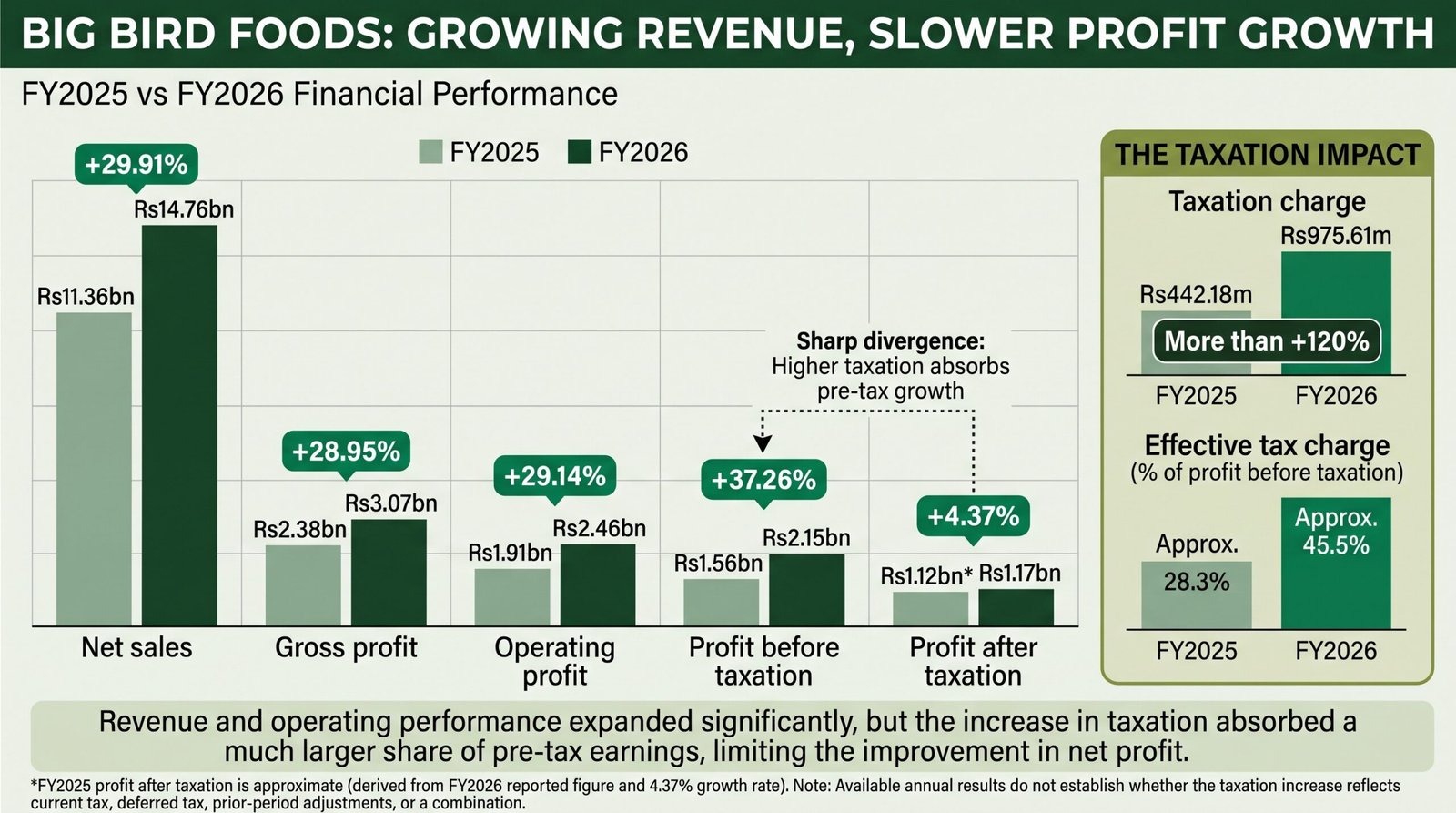
The Lahore-based food processing company reported net sales of Rs14.76 billion for the financial year ended June 30, 2026, representing an increase of 29.91 per cent from Rs11.36 billion in the preceding year.
The performance reflects the company’s expanding commercial operations and its ambition to move beyond Pakistan’s domestic poultry market into a regional food processing and export business.
However, an examination of its financial statements and latest corporate briefing submitted to the Pakistan Stock Exchange reveals a more complex picture.
While revenue increased by almost 30 per cent and operating profit grew by more than 29 per cent, profit after taxation advanced by only 4.37 per cent to Rs1.17 billion.
The difference raises an important question about the company’s next stage of growth: whether higher production volumes, export earnings and product diversification can translate into sustained improvements in net profitability.
For Big Bird Foods, the opportunity is substantial. So are the commercial and operational challenges associated with competing in international food markets.
From Poultry Farming to a Modern Food Processing Enterprise
Big Bird Foods forms part of the wider Big Bird Group, a Pakistani poultry business established by entrepreneurs and poultry industry professionals, including Abdul Basit, Dr Muhammad Mustafa Kamal and Dr Abdul Karim.
The group’s development reflects the transformation of Pakistan’s poultry business from relatively fragmented farming activities into an increasingly integrated industry involving breeding, hatcheries, animal nutrition, feed production, processing and distribution.
Big Bird Foods Limited was incorporated on September 21, 2011, converted into a public limited company in June 2023 and subsequently listed on the Pakistan Stock Exchange on August 5, 2024.
The listed company is chaired by Abdul Basit, while Dr Muhammad Mustafa Kamal serves as Chief Executive Officer.
Abdul Basit, the founder chairman of the wider group and a former president of the Lahore Chamber of Commerce and Industry, has also served as chairman of the Pakistan Poultry Association.
The company’s operational model is built around poultry processing, with manufacturing facilities in the Lahore-Kasur region, including its processing complex along Multan Road.
Its commercial activities cover fresh and processed chicken, frozen food products, ready-to-cook meals and value-added poultry products.
An investment research report published by Taurus Securities in December 2025 estimated Big Bird Foods’ annual processing capacity at approximately 38.4 million birds, suggesting significant installed infrastructure and opportunities for further capacity utilisation.
However, actual production, capacity utilisation and sales volumes will ultimately determine how effectively this infrastructure contributes to financial performance.
The company’s relationship with the wider Big Bird Group also provides access to expertise and infrastructure across different stages of the poultry value chain.
This integrated business background could prove important as food manufacturers face increasingly demanding requirements concerning raw material quality, supply reliability, traceability and product consistency.
Revenue Growth Signals Commercial Expansion
Big Bird Foods’ financial results for FY2026 demonstrate significant growth in business activity.
Gross profit increased by 28.95 per cent to Rs3.07 billion from Rs2.38 billion, while profit from operations rose by 29.14 per cent to Rs2.46 billion from Rs1.91 billion.
Profit before taxation increased even faster, climbing 37.26 per cent to Rs2.15 billion from Rs1.56 billion.
Finance costs also declined from approximately Rs343.55 million to Rs316.73 million, providing some relief to the company’s earnings.
These figures indicate that the company expanded its turnover while broadly preserving its gross and operating margins.
Its gross profit margin remained close to 20.8 per cent, compared with approximately 21 per cent in FY2025.
Nevertheless, the expansion was accompanied by higher commercial expenditure.
Distribution and selling expenses increased to approximately Rs602.92 million from Rs373.69 million, an increase of more than 61 per cent.
This reflects the financial demands associated with expanding a consumer food business, where greater geographical coverage, retail visibility, promotional activity and distribution infrastructure can require substantial expenditure.
The financial challenge is therefore not simply to increase sales, but to ensure that additional turnover generates proportionately higher profits.
Why Profit Growth Remained Modest Despite Strong Sales
One of the most significant findings in Big Bird Foods’ latest financial results concerns the difference between pre-tax and post-tax profitability.
Although profit before taxation increased by 37.26 per cent, profit after taxation rose by only 4.37 per cent.
The company’s taxation charge increased from approximately Rs442.18 million in FY2025 to Rs975.61 million in FY2026, representing an increase of more than 120 per cent.
Based on the reported figures, its effective tax charge relative to pre-tax earnings increased from approximately 28.3 per cent to 45.5 per cent.
Consequently, the net profit margin declined from approximately 9.86 per cent to 7.92 per cent.
Earnings per share increased marginally to Rs3.80 from Rs3.75, using the restated FY2025 comparative figures.
The annual results do not, by themselves, establish whether the full increase in taxation represents recurring tax expenses, deferred tax effects, previous-period adjustments or a combination of factors.
Nevertheless, the impact on reported profitability is unmistakable.
The company also did not recommend a cash dividend for FY2026.
For shareholders, these developments highlight the importance of distinguishing between rapid business expansion and the actual earnings retained after operating costs, financing expenses and taxation.
For management, improving the conversion of revenue into net profit will be particularly important as the company undertakes its international expansion strategy.
UAE Export Breakthrough Opens New Opportunities
Perhaps the most consequential development for Big Bird Foods is its growing participation in international halal food markets.
In a material information disclosure submitted to the Pakistan Stock Exchange on July 16, 2026, the company announced that it had secured a substantial export order from a Gulf-based halal food company.
The order covers raw chicken and further processed poultry products.
According to the disclosure, the contract was expected to approximately double the company’s export volumes and potentially generate an additional Rs1.2 billion in annual revenue.
The company also indicated that further opportunities could emerge through expanded production capacity and the introduction of additional product categories.
Its November 2026 corporate briefing confirms that exports have commenced in the UAE market.
At the same time, the company says discussions are in their final stages for expansion into Saudi Arabia.
These developments are potentially important for Pakistan’s wider food processing sector.
Historically, much of the country’s poultry industry has depended on domestic consumption, leaving producers exposed to fluctuations in local demand, poultry prices and raw material costs.
Access to international markets could provide additional revenue streams, foreign exchange earnings and opportunities for higher-value processed food products.
However, exporting poultry products is considerably more complex than supplying domestic markets.
International food buyers frequently require extensive documentation, reliable cold-chain management, traceability, approved processing systems and compliance with destination-country food safety and halal requirements.
For Big Bird Foods, securing overseas contracts represents an important commercial achievement, but maintaining supply consistency and meeting contractual quality standards will ultimately determine whether those relationships develop into sustainable export businesses.
A Rs2.4 Billion Export Ambition
Big Bird Foods has set out specific export revenue targets as part of its medium-term business strategy.
According to the company’s latest corporate presentation, management is targeting export revenue of Rs1.2 billion during FY2027 and Rs2.4 billion during FY2028.
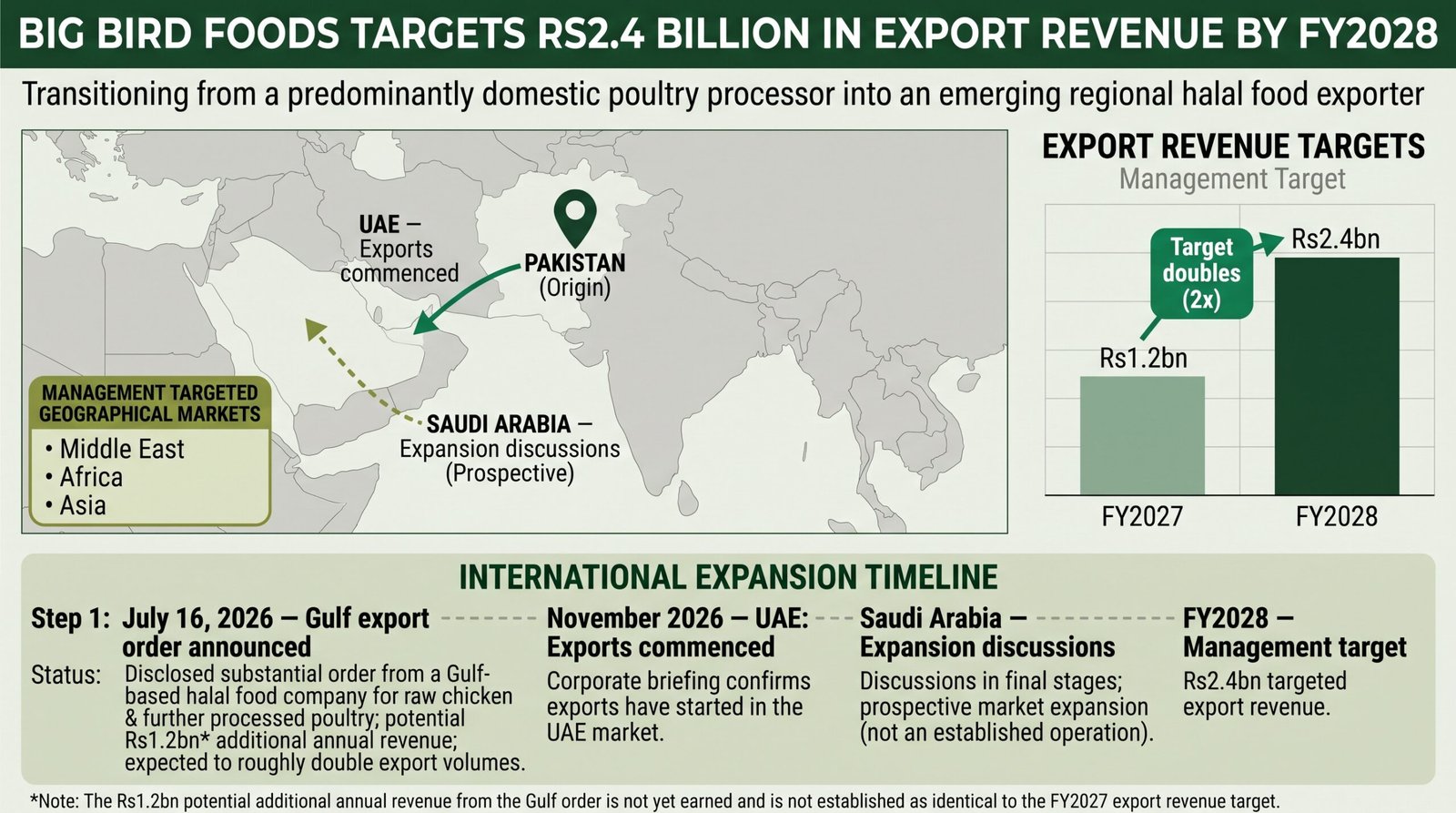
The strategy focuses on strengthening the company’s presence across the Middle East, Africa and Asia.
These remain management targets rather than realised export revenues.
Importantly, the projected Rs1.2 billion in additional annual revenue associated with the July 2026 Gulf order should not automatically be treated as identical to the FY2027 export target without further clarification of the contract’s delivery schedule and revenue recognition.
Nevertheless, the expansion strategy illustrates the company’s intention to develop a meaningful international business alongside its domestic operations.
If successfully implemented, the planned export expansion could gradually change Big Bird Foods’ revenue composition and reduce its dependence on the Pakistani market.
International customers may also create incentives for continued investment in processing technology, packaging, product standards and quality assurance.
The company’s long-term ambition, as outlined in its corporate briefing, is to establish Big Bird Foods as an internationally recognised halal food brand.
Product Innovation Strengthens Domestic Market Position
Alongside exports, Big Bird Foods is investing in product diversification to capture changing consumption patterns in Pakistan.
The company introduced several new products during FY2026, including Thyango Patty, Chunky Nuggets, Chunky Samosa, Malai Toppings, Lemon & Herb Drumstick, Spicy Juicy Tender, Chicken Qeema Paratha, Aalo Paratha and Fries.
These additions demonstrate a strategy extending beyond conventional poultry processing towards convenience food and ready-to-cook products.
This segment is particularly relevant to urban households, working professionals, supermarkets, restaurants and institutional buyers seeking standardised food products.
Prepared and further processed poultry products can potentially offer opportunities for brand differentiation and value addition.
However, their profitability depends on product pricing, consumer acceptance, production efficiency and distribution costs.
Big Bird Foods has also reported adding several retailers to its customer portfolio, including Imtiaz, Diamond, Bin Hashim, Chase Up and Punjab Cash & Carry.
The expansion of organised retail relationships provides access to wider consumer markets and could support stronger brand recognition.
According to its latest quarterly report, the company also operates outlets across several Pakistani cities, including Lahore, Karachi, Rawalpindi, Multan, Faisalabad, Gujranwala, Bahawalpur, Jhang, Sahiwal and Sargodha.
The growing distribution network is an important component of the company’s strategy to establish a stronger position in Pakistan’s branded poultry and processed food industry.
Solar Power and Technology Investment
Energy efficiency is another area in which Big Bird Foods is seeking to strengthen its competitiveness.
The company confirmed in its November corporate briefing that a 3-megawatt solar power system has been installed and is operational.
The installation supplies electricity for manufacturing operations and reduces reliance on conventional energy sources.
For a poultry processing business requiring refrigeration, freezing, food handling equipment and temperature-controlled operations, reliable electricity is a critical operational requirement.
Solar generation can potentially provide savings against conventional electricity purchases, although the company has not quantified the financial benefits of the installation in its latest briefing.
Management is also planning continued investment in modern food processing and packaging automation.
These initiatives are intended to improve production efficiency, product consistency and resource utilisation.
In addition, Big Bird Foods has identified employee welfare, training, corporate governance and environmental improvements among its strategic priorities.
An upgrade of its water treatment process is included in its longer-term environmental and governance objectives.
For an expanding food processor, such investments are relevant not only to operating efficiency but also to international market acceptance, where buyers may require detailed compliance with safety and sustainability standards.
Balance Sheet Expansion Provides Strength but Raises Working Capital Questions
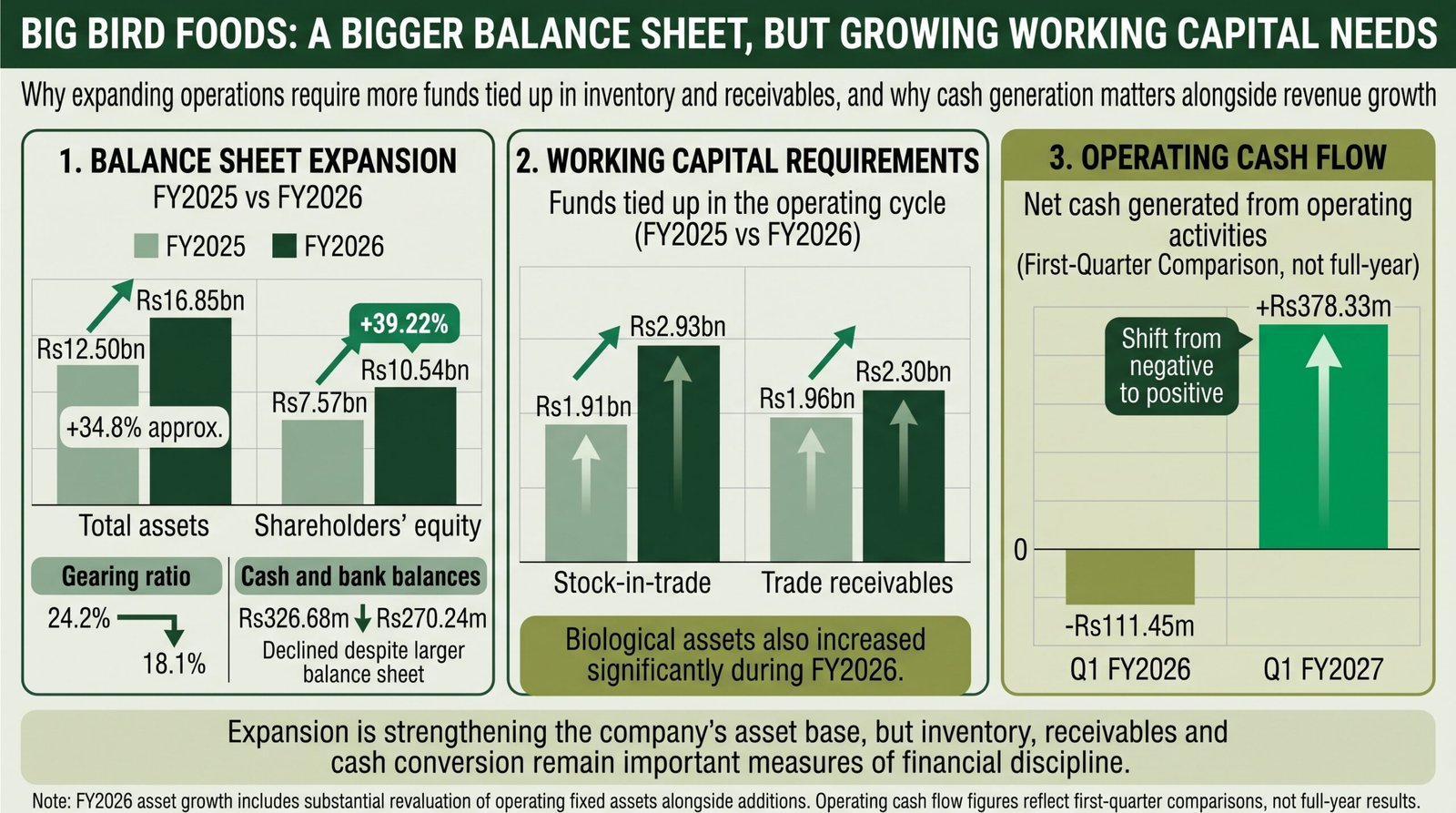
Big Bird Foods ended FY2026 with total assets of approximately Rs16.85 billion, compared with Rs12.50 billion a year earlier.
Shareholders’ equity increased by 39.22 per cent to Rs10.54 billion from Rs7.57 billion.
The company’s reported gearing ratio declined to 18.1 per cent from 24.2 per cent, indicating an improvement in its stated debt-to-equity measure.
However, the increase in property, plant and equipment should not be viewed entirely as new cash investment.
The financial statements show a substantial revaluation of operating fixed assets during FY2026, alongside additions to the company’s physical asset base.
The business also required greater working capital as its operations expanded.
Stock-in-trade increased to approximately Rs2.93 billion from Rs1.91 billion, while trade receivables rose to Rs2.30 billion from Rs1.96 billion.
Biological assets also increased significantly.
These movements are consistent with a growing poultry operation, but they demonstrate how expansion can tie up funds in inventory, livestock and customer credit.
Cash and bank balances, meanwhile, declined from approximately Rs326.68 million in June 2025 to Rs270.24 million in June 2026.
The distinction matters because a growing balance sheet does not necessarily translate into an equivalent increase in readily available cash.
For Big Bird Foods, efficient inventory management, recovery of receivables and disciplined working capital financing will remain essential as domestic and international sales expand.
First Quarter FY2027 Shows a More Measured Growth Pattern
The company’s latest quarterly financial statements, covering the three months ended September 30, 2026, provide an early indication of its performance after the strong FY2026 results.
Net sales increased by 4.77 per cent to Rs4.07 billion from Rs3.89 billion in the corresponding quarter of the previous year.
Profit after taxation rose by 3.93 per cent to approximately Rs345 million from Rs332 million.
However, profit from operations declined by 1.77 per cent to Rs598.28 million, reflecting pressure from higher operating expenses.
Distribution and selling expenses increased by 36.55 per cent to approximately Rs159.77 million.
Earnings per share declined to Rs1.05 from Rs1.11, with the company attributing the reduction to an increase in the number of outstanding shares following a previous issuance.
There were also encouraging developments.
Finance costs declined by more than 26 per cent during the quarter as the company continued to repay borrowings.
More significantly, net cash generated from operating activities improved to approximately Rs378.33 million, compared with an operating cash outflow of Rs111.45 million during the corresponding period a year earlier.
The improvement in operating cash generation represents a positive development, particularly for a company undertaking extensive commercial expansion.
However, slower sales growth and continued pressure from distribution expenditure suggest that maintaining the rapid expansion witnessed during FY2026 will require careful execution.
Pakistan’s Poultry Industry Has Significant Untapped Potential
Big Bird Foods’ expansion takes place against the wider transformation of Pakistan’s poultry industry.
Poultry is an important source of relatively affordable animal protein and plays a substantial role in the country’s livestock and food supply chains.
The industry supports businesses involved in breeding, feed manufacturing, farming, transportation, processing, wholesale trading, retail distribution and food services.
Nevertheless, Pakistan’s poultry processors face several structural challenges.
Volatility in feed prices, fluctuations in live-bird prices, energy costs, disease risks, cold-chain limitations and changing consumer purchasing power can all affect profitability.
For export-oriented businesses, additional challenges include market access, overseas competition, product certification, logistical costs and international quality requirements.
The development of large-scale branded and processed poultry businesses could help Pakistan increase value addition and capture a larger share of international food markets.
For this to happen consistently, companies must combine investment in modern manufacturing with reliable supply chains, export-oriented product development and strong food safety systems.
Big Bird Foods’ expansion offers an example of how an established domestic poultry business is attempting to make this transition.
The Road Ahead: Turning Scale Into Sustainable Profitability
The next phase of Big Bird Foods’ development will depend on how effectively it executes three interconnected priorities: international expansion, domestic product diversification and operational efficiency.
Its revenue growth demonstrates that the company has increased its commercial scale significantly.
The commencement of UAE exports, negotiations for Saudi market expansion and a target of Rs2.4 billion in export revenue by FY2028 provide identifiable opportunities for future development.
Its product launches and growing organised retail network also suggest that management recognises the importance of moving towards branded, further processed and convenience-oriented food products.
At the same time, the company’s financial results reveal issues that cannot be overlooked.
Taxation absorbed a substantially larger proportion of pre-tax earnings during FY2026. Distribution costs increased considerably, while the latest quarterly figures indicate a slower pace of revenue growth.
The company’s growing working capital requirements and the absence of a dividend also make cash generation and capital allocation important considerations.
What Big Bird Foods must now demonstrate is that its expansion can deliver more than higher turnover.
It needs to translate new export orders into recurring overseas revenue, utilise processing infrastructure efficiently and ensure that growing sales produce sustainable returns.
The larger significance extends beyond the company itself.
Pakistan has long possessed the agricultural resources, poultry expertise and domestic market necessary to support a competitive food processing industry.
What remains relatively underdeveloped is the country’s ability to consistently transform those advantages into internationally recognised, value-added food exports.
Big Bird Foods is attempting to build such a business.
Its FY2026 performance establishes meaningful commercial progress, while its international plans offer an opportunity to develop a stronger presence in regional halal food markets.
Whether the company eventually emerges as a major Pakistani food exporter will depend less on headline revenue growth and more on the quality, consistency and profitability of the business it builds.
For now, Big Bird Foods has demonstrated that it can expand. Its next challenge is to prove that expansion can generate stronger, sustainable profits while establishing a lasting position in international markets.