

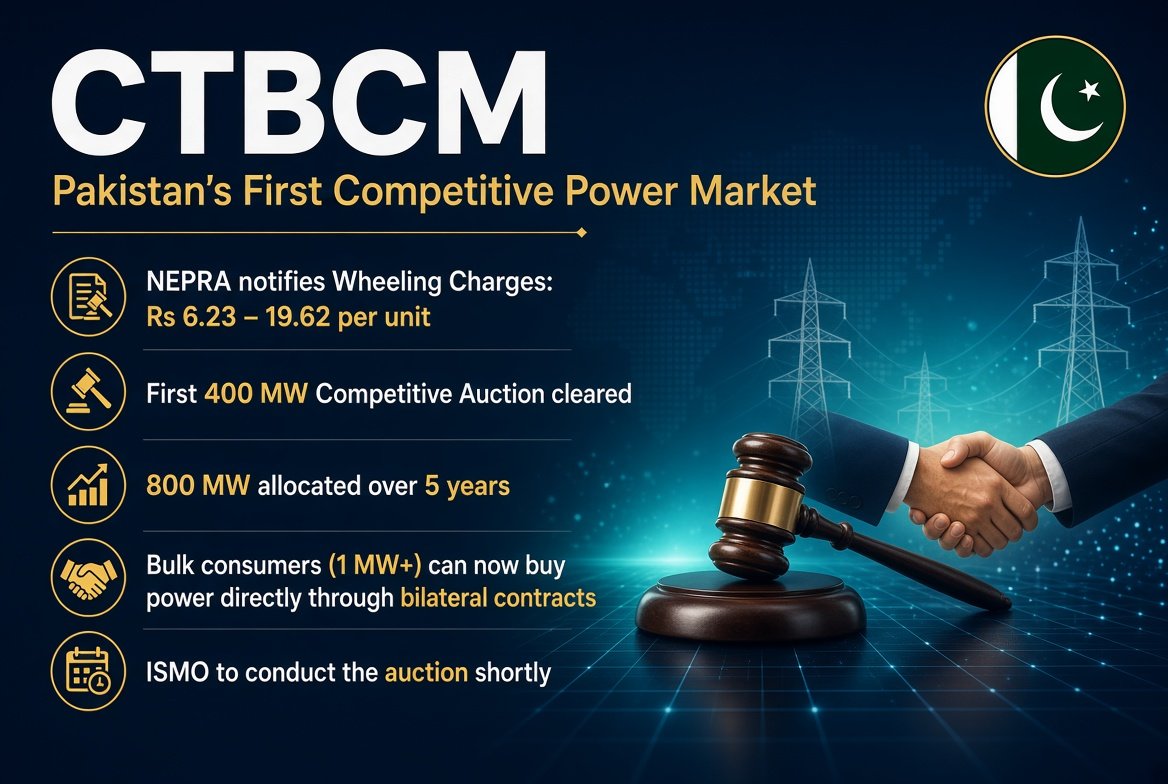
What CTBCM Means
CTBCM stands for Competitive Trading Bilateral Contract Market. It is a wholesale electricity market in which multiple buyers and sellers can enter bilateral contracts to buy and sell power at negotiated rates, rather than relying on a single central purchaser.
Under the traditional single-buyer model, the Central Power Purchasing Agency (CPPA-G) bought electricity on behalf of the distribution companies (DISCOs). In CTBCM, bulk power consumers (those with loads of 1 MW or more) can choose to buy from their DISCO or from a competitive supplier. Generators can sell directly through bilateral contracts or on a merchant basis. Power still flows over the national grid, for which users pay regulated “wheeling” or use-of-system charges (UoSC). The market is designed as a cost-based gross pool for dispatch, with firm capacity and energy as the main products.
International Examples and History
Competitive electricity markets with bilateral contracts and open access (wheeling) are well-established internationally.
United Kingdom: Moved from the old England & Wales Pool to the British Electricity Trading and Transmission Arrangements (BETTA), which relies heavily on bilateral contracts backed by a balancing mechanism.
Nord Pool (Nordic countries): Combines a power exchange with extensive bilateral trading and has long been a global benchmark for regional integration.
United States: Markets such as PJM operate hybrid systems with bilateral contracts alongside centralized markets and locational marginal pricing.
Australia & Latin America: Australia’s National Electricity Market and various Latin American markets also feature open-access transmission and bilateral contracting.
Regional Power Pools: Southern Africa (SAPP), West Africa, and Central America have used bilateral agreements and wheeling to enable cross-border trade, though full competitive markets remain a work in progress.
These models show that bilateral contracting plus regulated network access can deliver greater efficiency, investment signals, and consumer choice when supported by clear rules, independent operators, and transparent pricing.
Uses of CTBCM
CTBCM enables:
- Large industrial and commercial consumers to negotiate directly with generators for better prices and reliability.
- Generators (including merchant plants and those exiting legacy contracts) to sell capacity and energy without sole dependence on government-backed power purchase agreements.
- DISCOs to procure incremental power through competitive auctions rather than negotiated deals.
- Gradual introduction of competition that can later expand toward retail markets.
- Better utilization of the existing transmission and distribution network through wheeling.
Pros and Cons
Pros
- Introduces competition that can lower wholesale prices through bidding and bilateral negotiation.
- Gives bulk consumers real choice and encourages efficiency and innovation among suppliers.
- Reduces reliance on sovereign guarantees and “take-or-pay” contracts over time.
- Improves transparency, governance, and forecasting discipline.
- Creates a pathway toward retail competition and regional power trade.
Cons
- Wheeling charges that include cross-subsidies and stranded costs can blunt the price advantage for participants.
- Implementation complexity, institutional capacity gaps, and resistance from incumbents have caused long delays.
- Risk of market power if participation remains limited.
- Potential short-term disruption to DISCO finances and circular-debt dynamics.
- Requires robust IT systems, settlement mechanisms, and regulatory oversight to function properly.
History, Present Status, and Legislation in Pakistan
The idea of a competitive wholesale market dates to the 1992 WAPDA Strategic Plan for unbundling the power sector. The 1997 NEPRA Act created an independent regulator. In April 2015 the Economic Coordination Committee directed CPPA-G to design the CTBCM model. NEPRA approved the high-level design in December 2019 and the detailed design plus an 18-month implementation plan in November 2020.
Key supporting regulations followed in 2022 (Market Operator Licensing, Electric Power Trader, Open Access, Procurement, Consumer Eligibility, Registration, etc.). In May–June 2022 NEPRA granted CPPA-G the market operator licence and approved the Market Commercial Code; trial runs began. The Independent System and Market Operator (ISMO) was later established and operationalized. The commercial operations date for CTBCM was declared 22 January 2026.
Progress was repeatedly delayed by disputes over the calculation of use-of-system charges (especially inclusion of cross-subsidies and stranded costs). On 10 October 2026 NEPRA finally notified uniform wheeling charges, removing the last major regulatory barrier to the first auction.
Future and Uses in Pakistan
The government has allocated 800 MW for competitive wheeling auctions over five years (initially in two phases of 400 MW each). Capacity can expand later with approval. The market is expected to:
- Lower costs for industrial consumers and improve export competitiveness.
- Attract investment in new generation (especially renewables) on a more commercial basis.
- Gradually reduce the role of sovereign guarantees and move toward take-and-pay arrangements.
- Serve as the foundation for eventual retail competition once the threshold for eligible consumers is lowered.
Success will depend on timely auctions, credible settlement, fair network access, and continued regulatory independence.
Pros, Cons, and Path to Success in the Pakistani Context
The same advantages listed earlier apply strongly in Pakistan: industrial users (who account for a significant share of demand) stand to gain the most from choice and lower prices. The main risks remain high or uneven wheeling charges, limited initial liquidity, and the need to protect the residual regulated market from adverse selection.
Success factors include:
- Transparent, predictable auction rules and timely settlement.
- Realistic wheeling charges that recover legitimate network costs without excessive cross-subsidies.
- Strong institutional capacity at ISMO and the system operator.
- Gradual expansion of eligible consumer categories.
- Complementary reforms (circular-debt management, DISCO performance improvement, and hybrid contract renegotiations with existing IPPs).
The First 400 MW Auction and Likely Contestants
NEPRA’s notification of wheeling charges (Rs 6.23–19.62 per unit for auction participants, versus substantially higher rates for non-participants) has cleared the way for the first 400 MW auction. ISMO is expected to conduct it within the next couple of months. A fixed grid charge of Rs 1 per kW per month also applies. Uniform loss factors (8.04 % at 11 kV and 1.51 % at 132 kV) have been set.
The government has already issued the Request for Proposals for the 400 MW first-phase auction (part of the overall 800 MW five-year program). Bids have no upper or lower price limits and are fixed for one year. Participants face a 20 % cap per auction and a cumulative 160 MW limit over five years.
Likely contestants include existing Independent Power Producers (IPPs) seeking to sell surplus or merchant capacity, new renewable developers (solar and wind projects must meet battery-storage requirements), captive generators, and traders. Bulk industrial consumers themselves may partner with suppliers. Recent hybrid “take-and-pay” renegotiations between the government and certain IPPs (shifting part of returns from pure capacity payments toward actual generation) position those generators to participate more flexibly in the competitive market. Generators with lower marginal costs or those already connected to the grid are particularly well placed to benefit once open access becomes operational.
Conclusion
In short, CTBCM is no longer a distant policy aspiration. With wheeling charges notified and the first auction imminent, Pakistan is taking a concrete step toward a more competitive, transparent, and consumer-oriented electricity market. The ultimate success of the reform will be measured by whether it delivers lower costs, greater reliability, and genuine choice for bulk consumers while strengthening the overall health of the power sector.