


LAHORE/KARACHI: Pakistan’s Unity Foods scandal is no longer merely a story about a former chief executive accused of misappropriating company funds. It has developed into a far-reaching examination of the country’s corporate-governance system, exposing a disturbing regulatory timeline, questionable financial transactions, billions of rupees in banking exposure and a financial-reporting controversy that strikes at the credibility of Pakistan’s capital market.
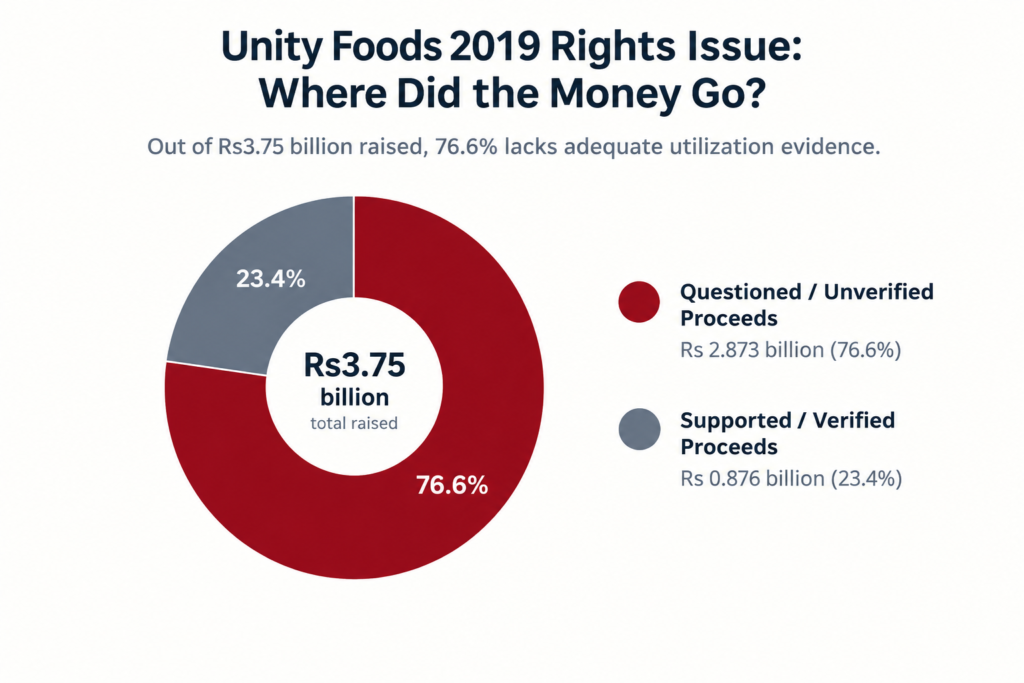
The figures are extraordinary. A Rs44.7 billion discrepancy between the company’s published accounts and internal SAP records. Rs5.318 billion in transactions allegedly benefiting the former chief executive’s mother. Rs2.87 billion in questioned rights-issue proceeds. Rs2.6 billion advanced through a subsidiary to undisclosed parties. Rs5.2 billion in inventory discrepancies. Approximately Rs5 billion in aged receivables. And Rs12.45 billion in bank deposits reportedly pledged against liabilities involving former subsidiaries.
There are also allegations involving the acquisition of shares in another listed company, Al-Shaheer Corporation, the transfer of goods without corresponding recovery, transactions involving related entities and unusual trading in Unity Foods shares.
These amounts cannot simply be added together to establish a total loss because several represent accounting discrepancies, collateral exposures or potentially overlapping transactions. Nevertheless, the scale and variety of the allegations raise serious questions about how the company’s financial affairs were managed and supervised.
The more troubling issue is the passage of time.
Regulatory proceedings involving Unity Foods date back to September 2018. The company subsequently raised billions from shareholders, expanded its industrial operations, attracted investment from Singapore-based agribusiness giant Wilmar International and maintained extensive relationships with commercial and Islamic banks.
Further regulatory action followed in 2019, 2022 and 2025. Court proceedings complicated parts of the process. Yet it was not until August 29, 2026, that the Federal Investigation Agency registered a criminal case following a referral from the Securities and Exchange Commission of Pakistan.
The criminal case does not establish that all the alleged irregularities existed when the first regulatory proceedings began. But it does establish a chronology that Pakistan’s financial watchdogs cannot dismiss.
Why did regulatory concerns remain unresolved for years, and what happened to the safeguards intended to protect shareholders, creditors and the wider financial system?
The Unity Foods affair demands more than prosecution of individuals. It requires an examination of the regulatory decisions, financial controls, lending arrangements, audit procedures and corporate-governance mechanisms that operated throughout the company’s expansion.
A regulatory trail stretching back to 2018
The first significant regulatory milestone in the publicly documented chronology was September 26, 2018, when SECP issued a show-cause notice to Unity Foods under Section 257 of the Companies Act, 2017.
The company challenged the proceedings and obtained judicial relief in December 2018.
Another SECP order followed on December 27, 2019, under Section 221 of the Companies Act. That action was also challenged, with a stay obtained at the end of December.
The proceedings concerned different statutory powers and should not be mistaken for a single uninterrupted investigation into the allegations contained in the 2026 FIR.
Nevertheless, they demonstrate that Unity Foods had attracted regulatory attention years before the present criminal proceedings.
The company disputed the earlier allegations and maintained that it had supplied the information sought by the regulator.
A subsequent judicial ruling addressed the limits of SECP’s inspection powers under Section 221, distinguishing inspection of books and records from a broader investigation into a company’s affairs.
The judgment did not eliminate the regulator’s authority to pursue other lawful investigative measures.
This distinction matters because the regulatory history cannot be explained simply by blaming the courts or declaring that SECP did nothing.
The more precise question is whether the regulator exhausted the powers available to it, pursued alternative statutory remedies where appropriate and acted quickly enough to address potential risks to investors.
If the law permitted repeated litigation to delay material regulatory scrutiny, that raises a legislative problem. If regulatory action was delayed despite available legal powers, that raises an enforcement problem.
Either way, the eight-year chronology requires a detailed institutional accounting.
Rs3.75bn raised from shareholders — and Rs2.87bn questioned
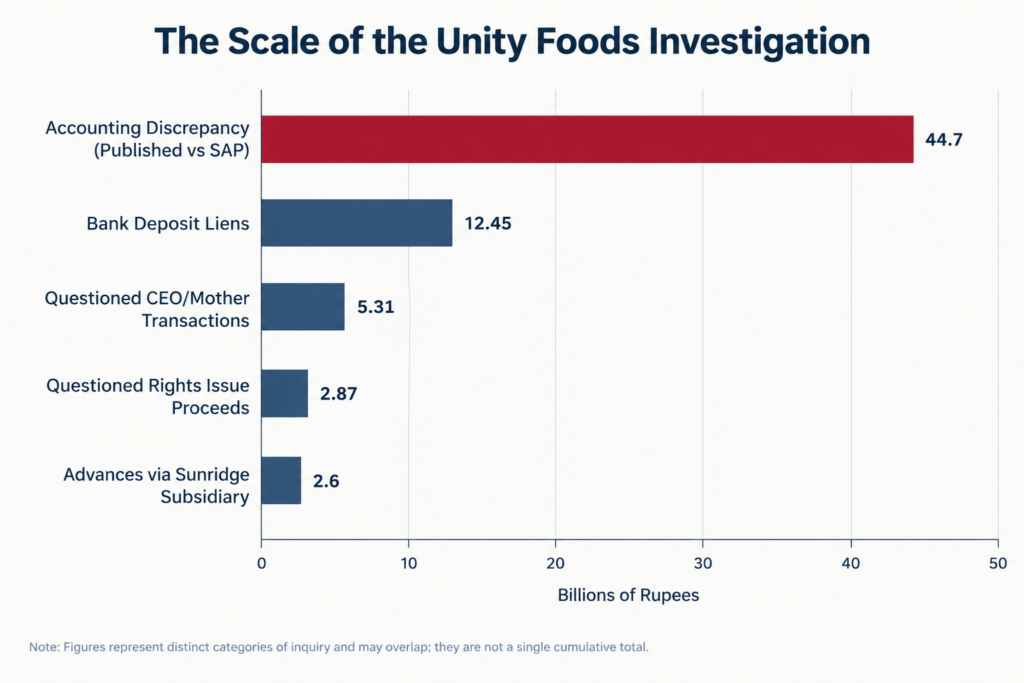
One of the most consequential elements of the investigation concerns Unity Foods’ 2019 rights issue.
The company raised Rs3.75 billion through the issuance of 375 million shares at Rs10 each.
The disclosed purposes included acquiring industrial assets, expanding the Port Qasim refinery and establishing an oil storage terminal.
Shareholders were therefore contributing capital against identifiable business plans.
According to the SECP referral underlying the FIA case, approximately Rs876.6 million of the proceeds could be supported by the utilisation evidence examined, while documentation supporting approximately Rs2.873 billion was allegedly unavailable or inadequate.
The disputed amount represented roughly 76.6 per cent of the funds raised.
The FIA case characterises the matter as an alleged diversion of proceeds from their disclosed purposes.
The importance of this allegation extends well beyond one company’s capital expenditure.
A rights issue depends on investors trusting that management will use the money for the purposes communicated to the market or properly disclose material changes.
If the utilisation of more than three-quarters of an issue becomes questionable, the effectiveness of the entire monitoring process comes under scrutiny.
What did the company’s board approve? What utilisation reports were submitted? Were payments independently verified against contracts and completed projects? What information was available to the regulator? Were deviations disclosed to shareholders?
These are questions that should have definitive documentary answers.
Pakistan’s capital market cannot build investor confidence if shareholders are expected to provide money against disclosed expansion plans without an effective mechanism to verify subsequent utilisation.
The transactions involving the former CEO’s mother
One of the investigation’s most personally significant allegations concerns Muhammad Farrukh Amin Godil, Unity Foods’ former chief executive, and his mother, Fehmida Amin.
According to the FIA case, the company’s books recorded substantial loan-related transactions involving Fehmida Amin during FY2017-18 and FY2018-19.
Reports of the regulatory referral describe loan receipts of approximately Rs705.7 million and Rs4.793 billion during the respective periods, alongside payments of approximately Rs283 million and Rs5.036 billion.
Investigators have questioned the supporting banking instruments, approvals and accounting treatment of these transactions.
Published accounts of the FIR differ on the alleged misappropriation figure, with Rs5.318 million appearing in one report and Rs5.318 billion in others. The original FIR and transaction reconciliation must establish the correct amount.
But the governance implications are already clear.
Transactions involving a chief executive’s immediate family require particularly close examination because of the potential conflict between personal interests and fiduciary responsibilities.
The investigation must determine who authorised the entries, who approved the payments, whether the transactions were disclosed, what commercial consideration existed and whether the company’s board or audit committee examined them.
Former CFO Jalees Edhi has also been named in the criminal proceedings.
The case therefore raises questions not only about the destination of funds but about the company’s treasury operations, accounting approvals, internal controls and board-level supervision.
A listed company’s money is not the personal property of its executives. It belongs to the corporate entity, whose directors and officers must account for its use.
The Rs44.7bn accounting discrepancy
The largest financial figure in the investigation is the alleged Rs44.7 billion difference between Unity Foods’ published financial statements and its internal SAP records.
The discrepancy has become the defining number of the scandal.
But its significance is not that Rs44.7 billion has already been established as stolen.
The significance is that investigators have identified a difference of extraordinary magnitude between records that should be capable of reconciliation.
SAP systems are designed to record business transactions across finance, procurement, inventory, sales and other operations. Published financial statements are prepared through accounting and consolidation processes and are subject to external audit.
Differences can arise from legitimate adjustments, consolidation entries, timing or classification. But a discrepancy of this scale demands a detailed explanation of the underlying accounts and transactions.
The FIA case identifies several areas of concern.
These include questionable receivables associated with an account described as Mujahid Broker, an approximately Rs5.2 billion difference between recorded and physical inventory, roughly Rs5 billion in aged receivables associated with Sunridge Mart for which delivery evidence was reportedly unavailable, delayed recognition of approximately Rs1.1 billion in sales and inconsistencies in trade-payable reconciliations.
The case also refers to the company’s failure to publish its half-yearly accounts for the period ended December 31, 2025.
Taken together, these issues raise fundamental questions about the reliability of financial information available to shareholders and lenders.
Who controlled the SAP records? Who approved manual adjustments? How were balances reconciled? What procedures did internal auditors perform? What information reached the audit committee? What did external auditors examine?
The answers must come from the accounting records and audit trail.
A Rs44.7 billion difference cannot be resolved through public statements alone.
The Rs12.45bn bank-deposit lien: a critical financial trail
One of the most significant aspects of the Unity Foods case concerns the disposal of two former subsidiaries, Unity Technologies (Private) Limited and Unity Plantations (Private) Limited.
According to the FIA allegations, the companies were transferred to individuals associated with the wider corporate structure under arrangements whose approvals, commercial basis and documentation have been questioned.
Reported sale consideration of approximately Rs499.9 million and Rs787 million remained outstanding.
But the larger issue concerns bank deposits.
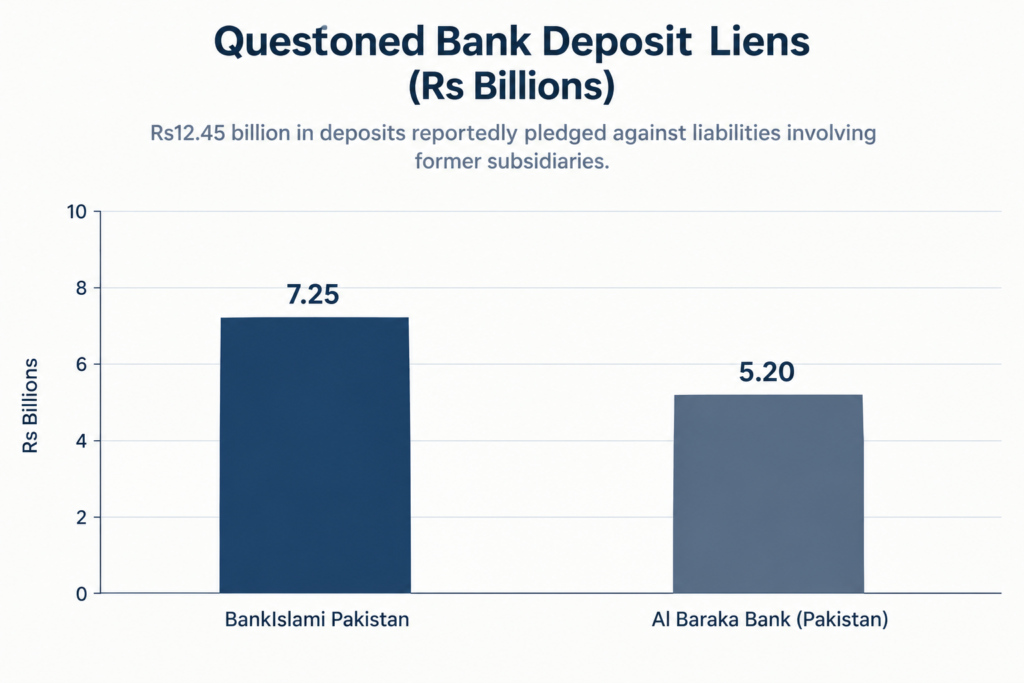
The FIA material identifies approximately Rs7.25 billion in Unity Foods deposits with BankIslami Pakistan and approximately Rs5.2 billion with Al Baraka Bank (Pakistan), reportedly subject to liens supporting financing associated with the former subsidiaries.
Together, those amounts represent approximately Rs12.45 billion.
A lien over a deposit is not equivalent to money having been stolen or permanently lost. It means the deposit is encumbered and may be available to secure or satisfy obligations under the relevant financing arrangements.
That distinction is essential to understanding the financial exposure.
The investigative question is whether Unity Foods’ deposits remained pledged against obligations of entities that had ceased to be its subsidiaries, and whether those arrangements were properly authorised, disclosed and justified.
If so, who approved the continuation of the security?
What consideration did Unity Foods receive?
Were minority shareholders informed?
Did the financing banks reassess the collateral arrangements after changes in ownership?
Were the deposits subsequently appropriated or released?
The answers could establish whether the arrangements represented legitimate corporate financing, inadequate governance or an improper transfer of financial risk.
Reporting on the investigation has also described an FIA request for detailed BankIslami records relating to a Rs15 billion financing facility extended to Unity Technologies under a diminishing Musharakah structure, including a June 2025 restructuring and subsequent treatment of Unity Foods’ deposits.
The reported inquiry extends to the roles of banking personnel involved in processing and recommending the facility.
That is an important development because it moves the banking dimension from general questions about lending controls towards examination of a specific financing transaction.
It does not establish wrongdoing by the bank or its employees. But it makes the relevant sanctioning documents, security agreements, credit approvals, restructuring records and collateral decisions central to the investigation.
Why SBP cannot treat the banking dimension as somebody else’s problem
The State Bank of Pakistan is responsible for supervising banks and their compliance with applicable prudential and risk-management requirements.
It is not responsible for auditing every corporate borrower’s financial statements.
But where a major listed company’s deposits have reportedly been used to secure financing involving former subsidiaries, the quality of the banks’ credit and collateral controls becomes a legitimate supervisory concern.
The issue is particularly important because Unity Foods’ consolidated FY2025 accounts reported approximately Rs41.23 billion in short-term borrowings and Rs2.42 billion in long-term financing.
The company therefore had a substantial financial relationship with the banking system.
A proper examination should determine whether lenders independently verified stock and receivables, assessed connected-party exposures, reviewed collateral ownership and monitored the effect of corporate restructurings on their security arrangements.
The case also raises questions about the treatment of deposit liens, the rights of lenders to appropriate collateral and the disclosure of contingent or actual financial exposures.
The State Bank’s supervisory framework is intended to ensure that banks have adequate systems for managing precisely such risks.
Whether those systems operated effectively in the relevant transactions is a question that deserves direct examination.
The public-interest issue is not simply whether banks extended credit. It is whether the financing and security arrangements were properly assessed, authorised, monitored and documented.
Rs2.6bn advanced through Sunridge Foods
Another major allegation concerns Rs2.6 billion reportedly advanced through Unity Foods’ subsidiary Sunridge Foods to two undisclosed parties.
According to the FIA material, approximately Rs2 billion remained outstanding without interest when the exposure was brought to the Unity Foods board’s attention in February 2026.
This allegation raises serious questions about the subsidiary’s financial controls.
Who received the money? What contracts governed the advances? What commercial purpose justified them? What security existed? Were the recipients related parties? What recovery measures were undertaken?
The reported timing of the board disclosure is also important.
If the board was formally informed of the exposure in February 2026, investigators must establish when the transactions originated, who knew about them earlier and whether they had previously been reflected in financial statements or management reports.
The existence of a subsidiary does not remove the parent company’s governance responsibilities.
Subsidiaries can conduct legitimate transactions independently, but consolidated reporting and group-level oversight must still provide an accurate picture of material exposures.
The Al-Shaheer connection
The Unity Foods case also reaches into another listed company, Al-Shaheer Corporation.
According to the FIA allegations, Farrukh Amin Godil entered into a Letter of Understanding dated December 4, 2023, relating to the acquisition of Al-Shaheer shares.
The arrangements reportedly involved shares acquired through several nominees, including Safdar Sajjad, Amir Shehzad, Fehmida Amin and DJM Securities.
The investigation questions whether company resources were subsequently used in connection with the transaction.
The material refers to approximately Rs1.1 billion in goods transferred from Unity Foods to Al-Shaheer without corresponding recovery, alongside additional financial dealings involving Sunridge Foods.
It also identifies payments connected to electricity bills, consultancy expenses and settlement of a recovery claim.
These allegations require examination of the commercial relationships between the entities and the individuals involved.
The central question is whether the transactions served legitimate business purposes or were used to benefit persons pursuing a separate acquisition.
That distinction must be established through contracts, invoices, delivery records, board approvals, payment instructions and the ultimate movement of funds.
The involvement of another listed company makes the matter particularly important for securities-market oversight.
The international investor and the governance question
Unity Foods’ expansion attracted investment from Singapore-headquartered Wilmar International through associated investment vehicles.
Wilmar’s involvement gave Unity Foods a connection to a major international agribusiness group with extensive experience in commodities, manufacturing and supply chains.
Wilmar-related entities acquired substantial shareholdings over several years, while further transactions were approved through Pakistan’s competition regulatory framework.
There is no established basis to attribute the alleged misconduct to Wilmar simply because it invested in Unity Foods.
Nevertheless, the investment history makes corporate due diligence an important part of the broader story.
What information was available during investment negotiations? Were outstanding regulatory proceedings disclosed? What financial warranties were obtained? What governance arrangements followed the investment?
The answers matter because sophisticated investors may have access to financial and governance information beyond that available to ordinary shareholders.
The question is whether the company’s governance structure and internal controls kept pace with its expanding ownership, financing and operational complexity.
The auditors and audit committee
The accounting allegations also place the company’s financial-reporting oversight under examination.
Unity Foods’ published records identify Grant Thornton Anjum Rahman as its external auditor.
An audit does not guarantee that every fraud or accounting irregularity will be detected. Nor does the existence of a subsequent investigation establish that an auditor failed to perform its duties.
But a case involving an alleged Rs44.7 billion discrepancy, questionable receivables, inventory differences and related-party transactions necessarily requires examination of the audit process.
Investigators should establish how the financial statements were prepared, what audit evidence was obtained, whether management representations were challenged and how significant accounting estimates and reconciliations were tested.
They should also examine whether internal-control weaknesses were identified and communicated to management or the audit committee.
The board’s audit committee has a particularly important role because it sits between management’s financial reporting and the external audit process.
If significant discrepancies existed, the chronology of their detection, escalation and resolution must be reconstructed.
Responsibility cannot be determined simply by identifying the people who signed the financial statements. It requires evidence of their authority, knowledge, actions and omissions.
But neither can responsibility be avoided merely by pointing to the complexity of a large corporate group.
The unusual-trading investigation
The SECP separately initiated an investigation into unusual trading activity in Unity Foods shares on June 2, 2026.
The regulator subsequently issued notices to Muhammad Farrukh, Safdar Sajjad, Fehmida Amin and Hina Safdar.
The investigation includes examination of trading activity and, in Farrukh’s case, records concerning the pledging of Unity Foods shares with banks.
This is distinct from the FIA investigation into alleged misuse of funds and falsification of accounts.
Unusual trading does not itself establish insider trading or market manipulation.
Nevertheless, the separate inquiry introduces another question about the relationship between corporate information, share ownership and market activity.
Investigators must establish whether the relevant transactions complied with securities laws and whether any person traded while possessing material information unavailable to other investors.
For minority shareholders, the issue is particularly important.
They depend on a market in which material information is disclosed fairly and trading rules are enforced consistently.
The former CEO and the criminal proceedings
The FIA case names former Unity Foods CEO Muhammad Farrukh Amin Godil and other individuals, including Fehmida Amin, Jalees Edhi, Amir Shehzad and Safdar Sajjad.
The allegations concern criminal breach of trust, cheating, falsification of accounts and related offences under the Pakistan Penal Code.
In September 2026, the Sindh High Court suspended a magistrate’s order that had discharged Godil from the case and allowed the FIA to pursue custody for investigation in accordance with the court’s directions.
The procedural history is important because a discharge, suspension of that discharge, remand or bail decision is not a final determination of criminal guilt.
The investigation must establish the specific role of each accused person and trace the relevant transactions.
That includes determining whether the amounts identified by SECP represent actual diversion of funds, accounting differences, recoverable advances or other financial exposures.
The outcome will depend on the evidence ultimately presented before the courts.
The Rs54bn question — and the danger of misleading arithmetic
The Unity Foods scandal has frequently been described in terms of a Rs54 billion fraud.
But the different figures circulating in connection with the case cannot responsibly be treated as independent losses and added together.
The Rs44.7 billion figure concerns an accounting discrepancy.
The Rs5.2 billion inventory difference and approximately Rs5 billion in receivables may form part of that broader discrepancy.
The loan-related allegation involving Fehmida Amin, Rs2.87 billion rights-issue utilisation question and Rs2.6 billion advances concern specific transactions that may overlap with other accounting balances.
The Rs12.45 billion bank-deposit liens represent encumbered deposits rather than an automatically established loss.
A proper forensic investigation must therefore produce a reconciled schedule showing the nature of each amount, the relevant financial period, any overlap, actual losses, recoveries and outstanding exposures.
That exercise is essential to establishing the financial impact.
It would be a serious mistake for Pakistan’s financial authorities to allow an investigation involving tens of billions of rupees to end without a clear explanation of the numbers.
The real victims may be the minority shareholders
Unity Foods was not an obscure private enterprise operating outside the formal financial system.
It was a listed company with substantial industrial operations, a recognised consumer-business presence, international investment and significant banking relationships.
Its FY2025 consolidated financial statements reported assets running into tens of billions of rupees, substantial borrowing and extensive operating activity.
Its shareholders relied on published accounts, corporate disclosures, audit reports and the regulatory framework governing listed companies.
Minority shareholders do not ordinarily have access to confidential bank records, internal SAP ledgers, audit working papers or board minutes.
They cannot independently verify every receivable, inventory balance or related-party transaction.
Their protection depends on the effectiveness of corporate governance and market regulation.
If the financial statements or disclosures on which they relied were materially inaccurate, the consequences could extend beyond the individuals named in the FIA case.
They could affect the company’s valuation, borrowing arrangements, creditor recoveries, future financing and investor confidence.
The question of financial restitution must therefore remain part of the wider investigation.
SECP’s investor-protection promise faces a difficult test
SECP Chairman Dr Kabir Ahmed Sidhu has publicly emphasised the regulator’s responsibility to protect minority shareholders and ensure that money raised from investors is used for disclosed purposes.
That principle goes directly to the heart of the Unity Foods affair.
The question is how effectively it was applied throughout the company’s regulatory history.
The Commission deserves recognition for pursuing the investigation that ultimately resulted in the FIA referral.
But that action does not eliminate the need to examine earlier proceedings.
What did SECP know in 2018? What additional information emerged in 2019? What happened during the litigation? What was established through the 2022 proceedings? What concerns led to further regulatory action in 2025? When were the accounting and transaction discrepancies now cited by investigators first identified?
These questions are essential to determining whether the system detected problems promptly and whether enforcement mechanisms were adequate.
A regulator’s responsibility is not fulfilled merely by identifying irregularities after they have become extensive.
Investor protection also requires timely detection, effective escalation and appropriate intervention.
The accountability chain must not end with the accused
The Unity Foods affair now presents several distinct questions of institutional responsibility.
SECP must account for the regulatory chronology and explain the effectiveness of its intervention.
The banking system must establish whether financing, collateral and deposit-lien arrangements complied with applicable requirements.
SBP’s supervisory framework must be assessed against the risks revealed by the financing transactions.
The company’s board and audit committee must be examined in relation to their oversight responsibilities.
The external audit process must be assessed against the financial-reporting issues identified by investigators.
PSX’s disclosure and enforcement mechanisms must be examined in light of the company’s regulatory and financial history.
And the FIA must establish the actual movement of funds, identify beneficiaries, reconcile disputed amounts and determine individual criminal responsibility.
These responsibilities are connected, but they are not interchangeable.
A criminal case against former executives does not automatically establish that a regulator or bank failed in its duties.
Equally, the existence of a criminal investigation does not absolve those institutions of the need to examine their own decisions and controls.
The distinction is fundamental.
Criminal accountability determines whether particular individuals committed offences. Institutional accountability determines whether the safeguards intended to protect investors operated effectively.
Pakistan needs answers to both.
The warning for Pakistan’s financial system
The Unity Foods case presents an opportunity to confront a recurring weakness in corporate accountability: financial irregularities can become the subject of prolonged disputes while shareholders remain dependent on disclosures whose reliability may later be challenged.
The regulatory chronology began years before the present criminal case.
During that period, the company raised shareholder capital, maintained extensive banking relationships, underwent changes in ownership and management and operated through a complex network of subsidiaries and related entities.
The allegations now being examined concern the fundamental building blocks of corporate financial integrity: cash, inventory, receivables, related-party transactions, share issuance, accounting records and collateral.
Those are precisely the areas in which effective internal controls, independent audits, board oversight, lender due diligence and regulatory supervision are supposed to provide protection.
The ultimate criminal findings remain for the courts.
But the institutional questions cannot wait for a final verdict.
The relevant authorities should establish a complete chronology of the regulatory proceedings, a reconciled account of the disputed financial amounts, the status of the bank-deposit liens, the outcome of the financing inquiries and the effectiveness of the company’s financial-reporting controls.
They should also determine whether weaknesses in law, supervision, corporate governance or enforcement allowed material risks to remain unresolved.
Pakistan’s capital market cannot afford an outcome in which the public learns the names of the accused but never receives a satisfactory explanation of how the system operated.
The Unity Foods affair must produce more than a prosecution.
It must establish whether the country’s financial safeguards worked, where they failed and what must change.
Because the central question is no longer simply who may have taken the money.
It is who was responsible for watching it — and why, after eight years of regulatory history, Pakistan’s investors are still waiting for answers.