
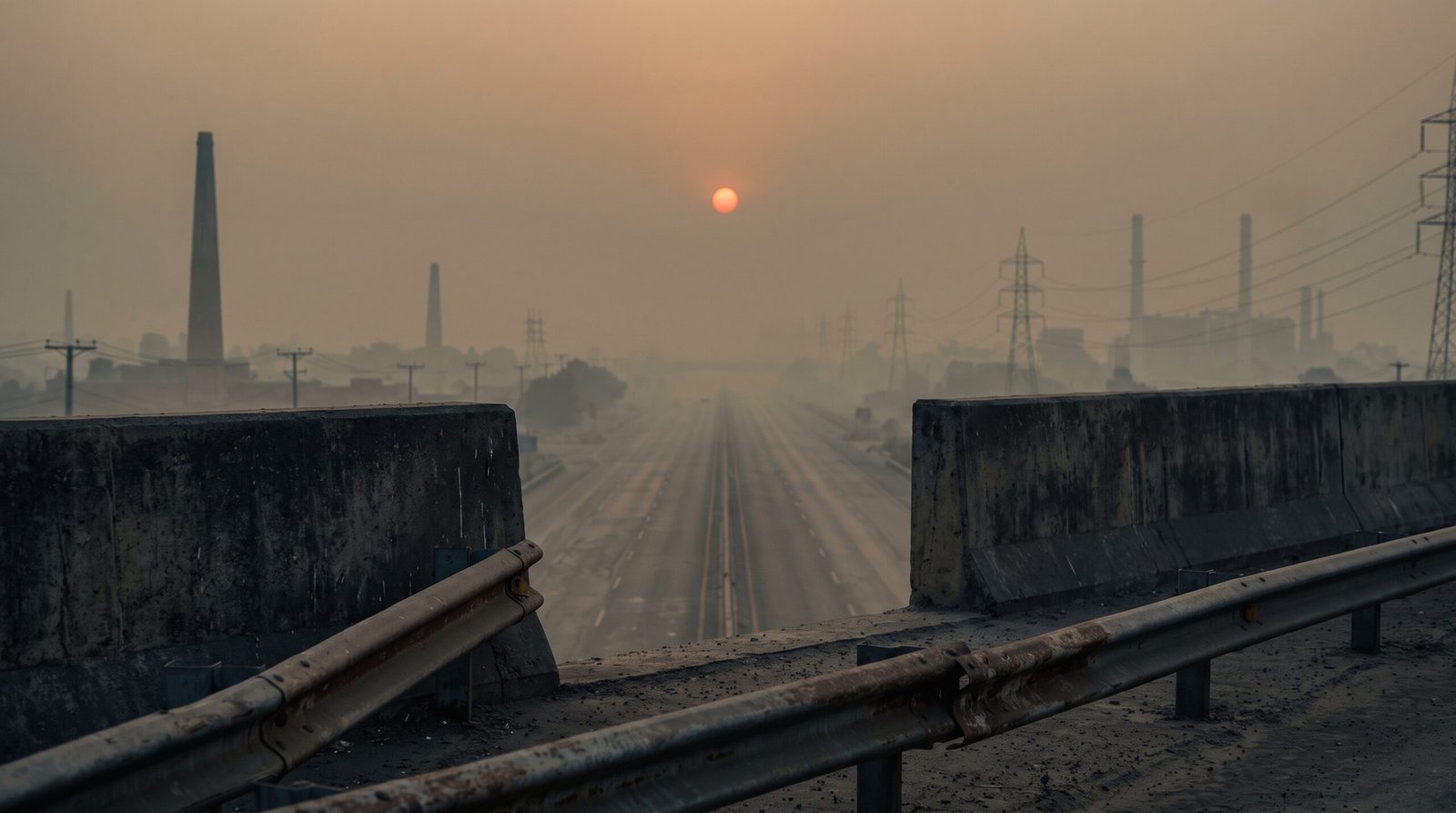
Pakistan does not have a smog season. It has a smog economy, in which billions are spent every year and the air stays exactly as it was. Each winter the world’s air-quality screens turn red over Punjab, press conferences follow, and the money goes to whatever photographs well.
The numbers are not subtle. IQAir’s 2025 city ranking placed thirteen Pakistani cities among the world’s 50 most polluted: Faisalabad (98.8 µg/m³ of PM2.5), Rahim Yar Khan (92.6), Lahore (88.9), Sukkur (88.6), Pattoki (86.7), Lodhran (85.3), Peshawar (81.7), Sialkot (78.6), Mandi Bahauddin (74.4), Multan (71.1), Bahawalpur (67.7), Jhang (63.6) and Mirpur Khas (57.7). The WHO annual guideline is 5 µg/m³. Faisalabad breathes nearly 20 times that and Lahore almost 18 times. For the year as a whole, IQAir ranked Pakistan the most polluted country on earth, with a national average of 67.3 µg/m³, down from 73.7 in 2024.
My own decade-long study of Lahore, Lahore’s air and Punjab’s environment spending, 2016 to 2026, shows that this is not a bad year. Of 129 months examined, not one met the WHO guideline. The worst month, November 2024, averaged 290 µg/m³. Every year since 2016 has run between 2.5 and 3.6 times Punjab’s own limit of 35 µg/m³. And winter is getting worse: the October-to-December mean for 2025 was 221.5 µg/m³, against 192.9 in 2016, a rise of 14.8 percent. After ten years and a great deal of money, Lahore’s air has not improved.
This month showed what that means in real time. On 12 November, Lahore stood first in the global ranking, with IQAir readings between 344 and 371, while Raiwind touched 519, Bahawalpur 515, Multan 507 and Gujranwala 411. IQAir’s live ranking showed Lahore at a US AQI of 318 (hazardous) and Karachi at 165 (unhealthy). On 18 January 2026 Lahore’s AQI crossed 500. Smog that appears at the same time in cities hundreds of kilometres apart is not explained by one city’s traffic or one district’s stubble. It is a provincial, and national, emissions problem.
Against that backdrop, consider how Punjab has chosen to spend. The province’s own Planning and Development Board lists environment and climate schemes with a cumulative estimated cost of Rs71.09 billion, of which Rs19.86 billion had been spent by June 2026. Of the Rs20.67 billion of environment schemes approved between 2021 and 2024, 48.7 %went to monitoring and laboratories, 26 %to the AirSafe smog initiative, and 20.4 %to buildings and administration. Only 4.8 %went to the green credit programme and the climate observatory combined. On 28 March 2025 the World Bank approved a $300 million concessional IDA loan for the Punjab Clean Air Program (PCAP), which promises a 35 %cut in PM2.5 over a decade for 13 million residents of Lahore Division and 35.6 million tonnes of CO2 avoided over 12 years. Yet the procurement record shows only Rs3.46 billion of PCAP-linked items, for new monitoring stations and fuel-quality laboratories, and both are still unapproved. At an illustrative Rs280 to the dollar, the loan is worth about Rs84 billion. Money has never been the missing ingredient. Method has.
The method under the Senior Minister’s leadership has been to buy what can be seen and to starve what would work. The first anti-smog guns, 15 units imported from China in winter 2025 at an estimated Rs45 million each, about Rs675 million in all, were bought under an urgency provision of the procurement rules. Each sits on a 16,000-litre tanker, mists water over roughly 100 metres, and can use up to 360,000 litres a day if run continuously. They cannot touch the airshed of a city of 15 million people. Then came a Rs3 billion project for 30 electric fog cannons in February 2026, and Rs4.74 billion for 30 anti-smog guns in the 2026-27 budget, inside a Rs5.3 billion Smog Mitigation Initiative. The climate observatory, proposed at Rs5 billion, appears in the 2026-27 budget at Rs14.6 billion, within a headline environment budget of Rs17.2 billion, to watch the crisis rather than reduce it. Meanwhile the one scheme aimed at the chemistry of what Pakistan burns, a Rs560 million programme of fixed and mobile fuel-quality testing laboratories, is still unapproved, with a provision of only Rs40 million. The root cause starved while the theatre was fully budgeted. This is not an allegation of theft; my report is explicit that it makes none. It is an indictment of method, and no serious engineer would sequence a cure this way.
The chemistry is not a mystery. My report puts transport at 43 per cent of Lahore’s PM2.5: diesel freight, two-stroke engines, over 4.5 million vehicles, and Euro-II fuel with sulphur above 500 ppm. Industry accounts for 25 %, brick kilns 15 %, and agriculture and waste burning 17 %. Air pollution is physics and chemistry before it is politics: what comes out of a tailpipe, a kiln or a generator depends on what went in. In CRSS’s work on Lahore and Karachi, we kept returning to adulterated petrol and diesel, and to CO2 illicitly mixed into LPG. On 31 October 2024, I emailed the Senior Minister a science-based roadmap, copying our Executive Director. It urged source apportionment, measurement and engineering design in place of seasonal bans, and asked for real-time fuel-quality testing, action on LPG mixing and fuel adulteration, and an honest look at the hollowed-out oversight of fuel quality at OGRA. The correspondence is on record. More than two years on, it has never been meaningfully answered. A government handed a free, expert diagnosis, and then spending billions on everything except the diagnosis, has not run out of information. It has chosen its priorities.
Let me say it as loudly as I can: the philosophy on which Punjab is treating smog is technically wrong. It treats smog as a seasonal nuisance to be sprayed, watched and announced, when it is an emissions problem that must be removed at the source. Managing the symptom while leaving the cause untouched is like prescribing paracetamol for an untreated infection. The fever goes down on the chart, the patient gets worse, and next winter the same patient is back in the same ward. The 2021 to 2024 smog emergency directives, with their green lockdowns, early closures and vehicle impoundments, brought short-term relief only, and the winter averages above are the proof.
Clipping industrial activity is the same wrong step again. Ordering units to close or throttle production during smog weeks punishes output, not pollution. A factory burning adulterated fuel in an unfiltered boiler pollutes the same per unit of output whether it runs at full load or half, so the emissions return the day it reopens. Industry is a genuine source, a quarter of the total by my report’s apportionment, and that is exactly why it must be controlled with technology and enforcement, not by switching factories off. Meanwhile, workers lose wages, exports slip, and demand drifts toward informal units that are often dirtier and invisible to any regulator. The one measure that has worked is a technology standard. The 2019 zig-zag kiln directive, which banned the old Bull’s Trench kilns, reached about 80 % compliance around Lahore by 2024. Engineering says to regulate emissions intensity, not economic activity: continuous stack monitoring, cleaner and tested fuel, efficient boilers, filters, wet scrubbers and electrostatic precipitators for mills and boilers, and penalties that are actually collected. A province can be industrial and clean. The two are not opposites, and treating them as opposites is a failure of technical imagination.
This is what happens when a technical problem is handed to the wrong kind of expert. In my professional assessment, the climate-change experts advising the Senior Minister do not know an iota of climate-change engineering. Had they known it, someone would have asked, before a single rupee was committed, what the air in Lahore is actually made of. No one did. Climate change and air pollution are physics, chemistry and engineering, and advocacy is not a substitute for them. The Senior Minister, whose own background, as I understand it, is not in engineering or atmospheric science, is leaning on an advisory structure that should be re-examined publicly, not defended reflexively. Its output is impressive titles, satellite images and colourful charts, and very little on what burns, where and why. Pakistan’s air-quality sector has no shortage of such quackery, and Punjab is paying for it in rupees and in lungs.
A sound method would have started with the source inventory, funded the fuel laboratories first, published batch-level test results at the pump, prosecuted adulterators by name, and tied every rupee of the clean-air budget and every dollar of the World Bank loan to a measured fall in PM2.5. My report therefore makes four requests: a World Bank performance audit of PCAP and of the monitoring under the Punjab Green Development Programme; every rupee tied to a measurable reduction in PM2.5; a public review of how the advice behind these projects was formed; and federal adoption of value-for-money discipline. It also sets targets that can be checked: annual PM2.5 below 90 µg/m³ in 2026-27, below 65 by 2029 with Euro-V fuel and 30 %electric public buses, and below 40 by 2030. I will be careful about what I claim. Weather and regional crop burning move the annual figure, and much of the anti-smog equipment arrived late. But a decade of spending against a decade of flat air is a question that deserves an independent audit, and it should not wait for another winter to pass.
Here is the tragedy in all of this: Punjab can become Pakistan’s model for net zero. It has sun on every roof, a large agricultural base whose residues can be turned into fuel, a manufacturing sector that can be made efficient, and the political weight of the country’s most populous province. I accept that the Chief Minister takes this ambition seriously, and she deserves advice that matches her seriousness. Clean air and net zero pull on the same levers: tested fuel, efficient kilns and boilers, solar, cleaner transport and monitored industry. Every tonne cut at the source helps both. But a net-zero vision is only as good as the engineering beneath it, and it will not be delivered by quack climate experts who confuse closure orders with climate policy. The Chief Minister’s ambition is being undermined not by any lack of will, but by wrong advice.
The Senior Minister’s long hours during smog emergencies are real. But effort aimed at the wrong target still fails the people it is meant to serve, and the people paying for this failure are children in Faisalabad, Lahore and Peshawar, who breathe 16 to 20 times what the WHO considers safe and who were never asked how the billions were spent. A leader who can say plainly that the money was misdirected, and then fund the cure rather than the cameras, would deserve credit. Until then, Lahore’s air will not clear on press conferences.
Disclaimer: The views and opinions expressed in this article are solely those of the author(s) and do not necessarily reflect the editorial position, values or beliefs of The Scoop or its management.
The Scoop firmly believes in freedom of speech, intellectual diversity and the open exchange of ideas. As an independent media platform, we remain committed to providing space for differing perspectives, including those that may challenge or contradict our own views.
Publication does not constitute endorsement. Our commitment to freedom of expression and independent journalism extends beyond opinions with which we agree.