

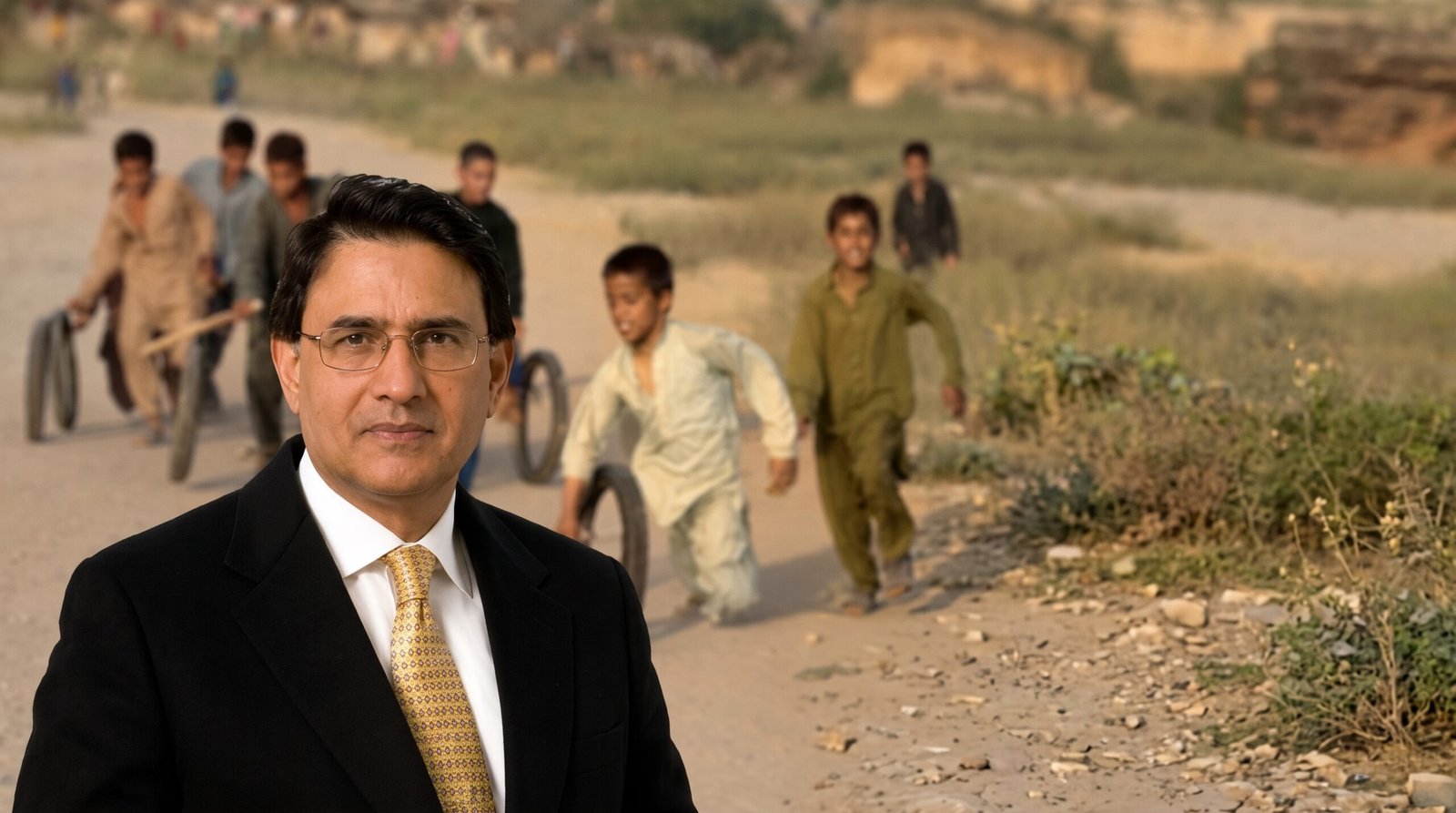
LAHORE: Pakistan could potentially eliminate its decades-old out-of-school children crisis within the next five to ten years if technology-driven learning, private-sector leadership, government cooperation and community participation are mobilised on a national scale, according to Shafiq Khan, founder and chief executive officer of Teach the World Foundation (TTWF).
In an exclusive interview with The Scoop, Khan outlined an ambitious vision for transforming Pakistan’s education system through a newly established partnership with the Federation Education Foundation (FEF), spearheaded by prominent industrialist and former federal minister Dr Gohar Ejaz.
The initiative aims to extend digital learning facilities across 170 districts, beginning with five MicroSchools in Lahore and eventually creating opportunities for hundreds of thousands, potentially millions, of children currently excluded from formal education.
Khan, a former senior executive at Marriott International who helped transform the hospitality giant’s digital operations, believes Pakistan has already developed an educational model capable of addressing one of its most persistent national challenges.
“Bottom line, we have developed the vaccine for literacy; our goal is to get it into every arm that needs it,” Khan declared.
His remarks come against the backdrop of an education emergency affecting approximately 25.15 million Pakistani children aged five to 16, according to estimates cited by UNESCO in 2026.
For Khan, the problem is no longer simply about building schools. It is about fundamentally changing how education is delivered, financed, governed and measured.
Gohar Ejaz Partnership: Combining Technology with Business Leadership
The Scoop exclusively reported on November 15 that Dr Gohar Ejaz and Shafiq Khan had entered into a partnership to establish a nationwide digital education programme, with business leaders expected to assume responsibility for local implementation.
Explaining how the collaboration emerged, Khan said the two organisations were brought together by a shared determination to address Pakistan’s enormous out-of-school children population.
“Mission alignment is the single biggest driver of this partnership,” he said.
According to Khan, FEF had recently been launched to address Pakistan’s education challenges, while Teach the World had already developed a model for reaching disadvantaged children rapidly and cost-effectively.
The connection emerged after Arshad Anis, president of Teach the World Foundation, discussed Pakistan’s education emergency in an interview with Business Recorder.
Masroor Ali Khan, a senior member of Ejaz’s team, subsequently contacted Anis, eventually bringing the two organisations together.
Khan described the partnership as an opportunity to combine an established educational model with the financial, organisational and institutional influence necessary for nationwide expansion.
“Gohar Ejaz is a tremendous force, with an outstanding track record developing marquee projects like Lake City, and before that, mobilising the textile industry,” he said.
“The acumen, capability, resources and commitment needed to do this are exactly what we need to tackle a problem as big as our out-of-school children crisis.”
Khan said he expected the Federation Education Foundation to evolve into an institution capable of mobilising the business community around a sustained national education mission.
Five Schools in Lahore: How the Digital Model Will Work
The partnership’s first practical test will be the establishment of five Digital MicroSchools in Lahore.
Unlike conventional educational institutions requiring substantial construction, extensive staffing and long development periods, the MicroSchool model is designed to operate in small rented premises within underserved communities.
Each school will typically consist of a single room, equipped with tablets, educational software and solar-powered infrastructure.
According to Khan, one school can accommodate approximately 100 children through four daily shifts of 25 students each.
Each child will attend a two-hour learning session focused on foundational literacy and numeracy.
The curriculum prioritises what Teach the World calls the critical core: reading, writing and mathematics, with the objective of developing competencies up to the fifth-grade level.
Children will use tablets loaded with interactive educational games covering English, Urdu and mathematics.
The applications are designed to encourage independent learning, allowing students to progress at their own pace rather than depending entirely on conventional classroom instruction.
Significantly, the model does not require professionally trained teachers to deliver every lesson.
Instead, each MicroSchool is supported by two women recruited from the local community, generally respected mothers who serve as learning facilitators.
Their responsibilities include supervising students, maintaining the learning environment, encouraging participation and helping children who encounter difficulties.
Khan emphasised that recruiting women from within the community helps establish trust with parents, particularly where families may be reluctant to send young girls to distant educational institutions.
“We locate our MicroSchools in communities that have large populations of out-of-school children, quite literally bringing the school to the child instead of the child to the school,” he explained.
Because the facilities are rented rather than constructed, the foundation can establish schools in weeks rather than years.
All MicroSchools are designed to operate using solar power, reducing their dependence on unreliable electricity supplies.
If each of the five Lahore schools reaches its intended operational capacity, the initial phase could accommodate approximately 500 children.
Community mobilisation will begin before the facilities open, with local teams identifying eligible children and engaging their families.
Khan said experience had demonstrated that communities generally responded enthusiastically when accessible educational opportunities were brought directly into their neighbourhoods.
The 170-District Ambition: Nationwide Expansion Within Two to Four Years?
The Federation Education Foundation intends to establish an education network spanning 170 districts of Pakistan.
Under the proposed framework, local chambers of commerce will play an important role in mobilising resources and encouraging community participation.
District-level business leaders are envisaged as local custodians of the education initiative, supported by a wider organisational structure.
Asked whether the proposed nationwide expansion was realistic, Khan expressed confidence in the ambition but cautioned against setting premature deadlines.
“Everything is possible with time, money and commitment. I think the ambition is realistic — and necessary,” he said.
Khan suggested that building a presence across the targeted districts could conceivably take two to four years, although he stressed that the actual timeline would depend on financing, implementation arrangements and lessons from the Lahore pilot.
The foundation, he said, would prioritise quality and operational readiness over rapid expansion for its own sake.
“We must move quickly, but not at the expense of quality.”
The initial rollout will help establish systems for facilitator training, community mobilisation, technology management, monitoring, financing and local leadership.
Khan expects a more detailed plan for the 170-district initiative to be developed jointly by the two organisations.
However, an important question remains: how many MicroSchools would ultimately be required in each district to reach a meaningful proportion of Pakistan’s out-of-school population?
With a typical MicroSchool serving around 100 children at a time, a nationwide network would require thousands of operational facilities to accommodate hundreds of thousands of learners simultaneously.
The number of schools, financing commitments and district-level enrolment targets have yet to be finalised.
Khan acknowledged that the ambition must ultimately be supported by demonstrable implementation capacity rather than headline targets.
Also Read: ECC Quietly Clears 416,000 Tonnes Of Sugar Exports As Punjab Crushing Stalls
Sindh’s Experience: More Than 35,000 Children Served, Claims Khan
The new partnership builds on Teach the World Foundation’s experience in Sindh, where it has worked with the Sindh Education Foundation under the provincial government’s Accelerated Digital Learning Programme.
Khan described the programme as a major example of what technology-driven education could achieve when backed by sustained political and institutional support.
He credited Sindh Chief Minister Syed Murad Ali Shah with providing the leadership required to expand the initiative through successive phases.
According to Khan, the provincial administration initially supported limited implementation before authorising larger expansion after assessing the programme’s performance.
He also praised Sindh Education Minister Syed Sardar Ali Shah, Education Secretary Zahid Abbasi and Sindh Education Foundation Managing Director Ganhwar Ali Laghari for facilitating implementation.
The foundation, he said, established 125 Digital MicroSchools during the first 14 months of its programme with the Sindh government.
Khan disclosed that the organisation expected to open its 300th school before December 31, 2026, reflecting continued expansion.
Perhaps more significantly, he said the foundation had cumulatively served more than 35,000 children, including those who had subsequently transitioned into mainstream education.
These figures represent the foundation’s reported programme performance and include children previously enrolled, rather than necessarily indicating current enrolment at one time.
Children Learning Up to Three Times Faster?
Among the most significant claims made by Khan are the educational gains reportedly achieved through the foundation’s technology-based learning approach.
He said assessments across different locations indicated that children using digital learning applications achieved learning gains approximately 1.5 to three times those seen in conventional comparison settings, depending on the evaluation.
The foundation has worked with or used assessment approaches associated with organisations including Nielsen, Idara-e-Taleem-o-Aagahi and the Centre for Economic Research in Pakistan.
In one early proof-of-concept exercise assessed by Nielsen, Khan said children using digital applications achieved scores approximately two to 2.5 times higher than those of a comparison group receiving conventional instruction.
The reported findings suggest that interactive, self-paced education could offer a potentially effective approach for children who have never attended school or have fallen substantially behind.
However, the outcomes of individual pilots should not automatically be treated as representative of every MicroSchool or of the proposed nationwide expansion.
Learning gains also need to be distinguished from long-term educational attainment, student retention and successful completion of formal schooling.
According to Khan, the foundation measures learning outcomes, attendance, retention and progression to understand whether the model produces lasting improvements.
In the first phase of the Sindh programme, approximately 60 per cent of participating children reportedly reached at least Grade 2-level competencies and subsequently transitioned into mainstream education.
He said the foundation routinely sought to mainstream its students into full-time schools whenever appropriate opportunities were available.
Beyond academic outcomes, Khan highlighted changes in parental attitudes.
When MicroSchools were initially opened in low-income settlements, many parents had to be persuaded to enrol their children.
Now, he said, some parents are requesting homework and longer school hours.
For Khan, that transformation in community attitudes is an important measure of the programme’s wider social impact.
The $130 Question: Can Pakistan Educate Millions at Lower Cost?
One of the most consequential aspects of Teach the World Foundation’s model is its proposed cost structure.
Khan disclosed that, at scale, the foundation is targeting a fully loaded cost of approximately $130 per child per year, calculated under a five-year implementation framework.
The figure includes the programme’s intended operating model but remains dependent on economies of scale and specific cost assumptions.
It should not be interpreted as a guaranteed cost for every school or compared directly with conventional schooling without accounting for differences in instructional hours, facilities and services.
Nevertheless, Khan believes digital education can fundamentally change the economics of providing foundational learning.
Traditional schools often require extensive physical infrastructure, trained teaching staff and recurring administrative expenditure.
MicroSchools instead rely on smaller rented facilities, shared technological infrastructure and locally recruited facilitators.
Operating several shifts in the same classroom allows the programme to serve more students without proportionately increasing fixed costs.
“The interesting thing about digital is that once you have developed the content, technology and operating systems, you can replicate them across many locations,” Khan explained.
“You do not have to recreate the entire model each time.”
However, financial sustainability remains an unresolved issue for the proposed national programme.
The Federation Education Foundation and Teach the World Foundation will need to determine how capital expenditure, technology replacement, facilitator remuneration, maintenance, monitoring and ongoing operational costs will be financed.
Long-term educational outcomes will also depend on whether children can continue their studies beyond the foundational competencies offered by the MicroSchools.
Khan acknowledged that successful expansion would require dependable partnerships, sustainable financing and consistent quality.
Why Pakistan’s Education System Is Failing Millions
Asked why successive governments have struggled to achieve universal education despite decades of reforms, Khan identified a fundamental weakness in the country’s approach.
Pakistan, he argued, has historically treated education primarily as an infrastructure problem rather than a learning challenge.
Government policies have typically focused on constructing schools, recruiting teachers and increasing enrolment.
Although these remain important objectives, Khan believes they have failed to address the diverse circumstances preventing millions of children from accessing meaningful education.
These include poverty, geographical isolation, the indirect costs of schooling, barriers affecting girls, and the inability of conventional classrooms to accommodate students with different learning needs.
He also highlighted the distinction between school attendance and actual educational achievement.
A child may spend several years in a classroom and still struggle with basic reading or arithmetic.
“The question should not simply be how we get more children into schools. It should be how we ensure that every child learns,” he said.
Khan argued that Pakistan must abandon routine policymaking and adopt an emergency approach to educational reform.
Among the immediate measures he suggested were introducing additional shifts in existing schools, extending the use of available infrastructure and incentivising teachers to accommodate more learners.
He also advocated greater investment in digital learning and artificial intelligence to expand access and improve instructional quality.
For Khan, the education crisis is not merely a social challenge but a major economic constraint.
A population unable to acquire foundational literacy and numeracy skills cannot participate fully in modern economic activity.
Artificial Intelligence Could Change the Future of Learning
Khan believes artificial intelligence could eventually help transform educational delivery in Pakistan, particularly by making learning more personalised.
The existing MicroSchool model already allows students to progress independently using digital educational applications.
Interactive lessons provide immediate feedback, while repeated activities help students master concepts before advancing.
AI could potentially deepen that individualisation by identifying gaps in learning, recommending appropriate content and adjusting educational pathways according to each child’s progress.
However, Khan cautioned that technological innovation should remain linked to demonstrable educational benefits.
“The priority is to ensure that the technology we use actually improves learning and is appropriate for the children and communities we serve,” he said.
He also emphasised that digital education should not be interpreted as eliminating the need for human involvement.
Local facilitators remain essential for ensuring attendance, providing encouragement, maintaining discipline and supporting children who require assistance.
Khan expects technological developments to accelerate considerably in the coming years.
He urged education policymakers and institutions to prepare for what he described as a digital learning transformation potentially more significant than previous technological changes.
Government Cooperation Essential for Nationwide Success
Despite the prominent role envisaged for the private sector, Khan believes government participation will be indispensable to the initiative’s long-term success.
He pointed to Sindh as an example of how public institutions and private educational organisations could work together.
The provincial government’s involvement provided institutional support, an implementation framework and opportunities for expansion.
Khan said the Federation Education Foundation initiative should complement existing government education efforts rather than attempt to replace them.
Government support would be especially important in developing formal pathways for children transitioning from MicroSchools into recognised educational institutions.
“The private sector can bring innovation, technology, resources and the ability to mobilise local communities,” he explained.
“Government brings the policy framework, institutional reach, regulatory support and the ability to create recognised pathways into the formal education system.”
He envisaged potential cooperation with education departments in Punjab and other provinces, including digital learning initiatives within existing public schools.
Such arrangements could allow the programme to contribute both to enrolling children who have never attended school and to improving learning outcomes among those already within the education system.
From Marriott’s Digital Revolution to Pakistan’s Education Mission
Khan’s approach to educational reform has been shaped by an international corporate career in digital transformation.
At Marriott International, he helped expand the company’s digital business from approximately $150 million to $15 billion, demonstrating how technology could reshape established industries.
Before Marriott, he worked on digital developments in the airline industry, including online booking and electronic ticketing.
His eventual transition towards education was influenced by a deeply personal experience.
Following the death of his maternal uncle, a professor at the University of Karachi and a passionate advocate of education, Khan discovered that three domestic workers had completed master’s degrees after receiving sustained encouragement from his uncle.
Their educational achievements had subsequently transformed their own lives and created opportunities for members of their families.
The experience prompted Khan and his cousins to establish a family foundation supporting the education of domestic workers’ children.
The initiative ultimately led him to examine Pakistan’s wider education emergency.
He subsequently connected with technology entrepreneur and MIT entrepreneurship educator Imran Sayeed, who shared his interest in the potential of digital technology to transform education.
Together, they explored how gamified learning applications delivered through tablets could overcome traditional barriers to literacy.
The concept eventually evolved into Teach the World Foundation’s Digital MicroSchool model.
Khan said the organisation began by testing its approach with just 23 children in a Karachi public school classroom.
That initial experiment became the foundation for a programme now operating across diverse communities and international settings.
Also Read: Over 476,000 Pakistanis Register For Overseas Jobs In 10 Months Of 2026 As Monthly Pace Slows 25.2%
A Pakistani Education Model for the World?
Khan believes Pakistan could eventually become an international example of how technological innovation and community participation can tackle educational exclusion.
The MicroSchool model, originally developed in Pakistan, has already been deployed beyond the country.
According to Khan, the foundation has implemented versions of its approach in Bangladesh, Malawi and South Sudan.
He argued that countries struggling with limited educational infrastructure and shortages of trained teachers could benefit from similar models.
For developing countries, technology-based foundational education could provide an additional route towards literacy without waiting for the construction of conventional school networks everywhere.
Khan said the organisation remained willing to share its educational model internationally while continuing to adopt improvements developed elsewhere.
He described this philosophy as placing humanity first and prioritising solutions capable of improving lives regardless of geographical boundaries.
However, he acknowledged that international expansion would require strong governance, effective partnerships, financing and reliable evidence of results.
Success Means Zero Out-of-School Children, Not Just More Schools
Asked what would constitute a successful outcome of the partnership with Dr Gohar Ejaz, Khan offered a vision extending considerably beyond establishing schools in 170 districts.
He said his ultimate ambition was to eliminate the out-of-school children problem in Pakistan within five to ten years.
“I would consider this partnership truly successful if five to ten years from now, we have zero out-of-school children in Pakistan and have built a sustainable system that can keep it that way,” he said.
Beyond expanding access, he wants the programme to help improve learning outcomes for children already attending schools.
Khan said the real measure of success would not simply be the number of educational facilities established or students enrolled.
Instead, the results should be evaluated according to whether previously excluded children acquire functional literacy, continue their education and achieve better opportunities in life.
“If, five years from now, we can look back and say that millions of children who might otherwise have remained outside the education system now have a better life trajectory because of the literacy and numeracy skills they have acquired through our work, I would consider that a very fulfilling achievement,” he said.
Yet the immediate task is much more specific.
The Federation Education Foundation and Teach the World Foundation must first demonstrate that the Lahore pilot can enrol children, deliver measurable learning gains and establish a financially and operationally sustainable model.
The subsequent challenge will be replicating those results across districts with differing economic conditions, educational needs and institutional capacities.
For a programme aspiring to address a crisis affecting more than 25 million children, expansion will require far more than ambition alone.
Khan identified five essential ingredients for success: committed leadership at both organisations, effective collaboration, strong joint governance, an adaptable implementation plan and excellent execution.
His closing message reflected both the scale of the ambition and the uncertainty of achieving it.
“The proof of the pudding will be in the life trajectories we have improved with our work.”
For Pakistan, the question is whether the partnership between Gohar Ejaz’s business-led education initiative and Khan’s technology-driven learning model can translate an ambitious national vision into lasting educational outcomes for millions of children.
The first five schools in Lahore will provide an early indication of whether that transformation can begin.