

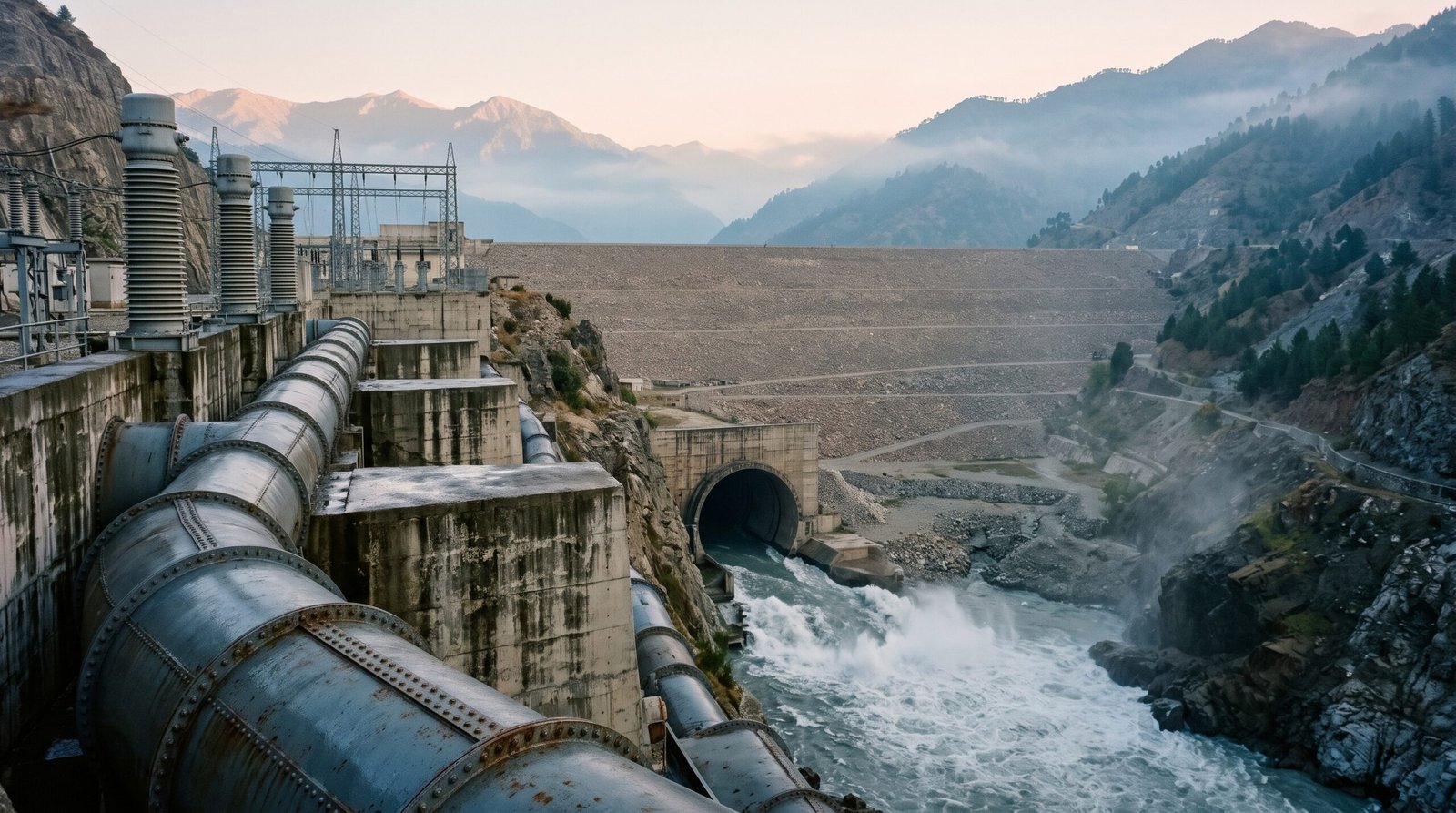
I am not the judge in this matter, and this article does not try to be one. Courts, auditors and inquiry committees will decide who is answerable. I write as someone who has been drawn to hydroelectricity since childhood, when I spent hours beside a water mill in a remote village of Murree and watched a mountain stream do honest work. I have spent my working life on the environment and climate change, and my studies of Pakistan’s worst air quality, caused by greenhouse gas emissions from burning gas and coal for power, are in the public domain. The two interests meet at Tarbela.
My message to the government is simple. Cheap electricity is the main challenge for industrial growth, for attracting foreign direct investment and for avoiding the monster of circular debt. Simple arithmetic shows that the delay in the Tarbela Fifth Extension is one of the most expensive mistakes in Pakistan’s power sector, and every month of further delay makes it worse.
The Ministry of Water Resources project page gives 16 January 2017 as the date of commencement and 16 January 2021 as the date of completion, a 48-month schedule for 1,810 million units of hydropower a year. That page is dated, since it still describes a 1,410 MW project costing Rs82.36 billion. The project is now 1,530 MW, WAPDA quotes 1.466 billion units a year, and the cost has reached Rs317 billion, more than 285 per cent above the original estimate. The completion date is now the end of June 2028.
The delay did not begin with the 2025 cofferdam collapse. The civil works contract was awarded only in May 2021, and ground was broken in August 2021, after the original completion date had already passed. A government inquiry later held the consultant responsible for the collapse, citing a rock-filled cofferdam design the contract did not permit, conditional acceptance by the consultant and approval by WAPDA without testing its validity. The Planning Minister also noted serious lapses in consultant selection, delay and design. These are findings and remarks on record. They are not findings of corruption, and I allege none. I leave judgment to those whose job it is.
Now the arithmetic. Measured from 16 January 2021, the project is 5.8 years late. At the Ministry’s design output, Pakistan has missed about 10,592 million units so far, and will have missed 12,670 million units, or 12.67 billion, by the time seven years of output are counted. Counting every day to 2 June 2028 would make it about 13,350 million units. Replacing the missing power with expensive LNG and imported coal has already cost about Rs478 billion, and by completion the bill will pass Rs580 billion, roughly $2 billion, or about Rs46 for every unit replaced. Hydropower is not free, so the fair comparison is net. WAPDA asked for an average hydel tariff of Rs5.68 per unit and Nepra approved Rs4.81. At Rs5.68 the same units would cost about Rs72 billion, leaving a net loss near Rs508 billion, or about $1.75 billion. The Planning Commission now puts the project’s 30-year levelised cost at Rs27 to 28 per unit, and against that benchmark the net loss is still close to Rs230 billion. Whichever measure is used, the delay has made power dearer and later, which is the opposite of what the project was built to do.
That is why this matters beyond one dam. A factory owner or a foreign investor looks first at the price and reliability of power. Every unit that comes from imported fuel instead of Tarbela’s tunnel pushes costs into tariffs, and expensive generation is exactly what feeds the circular debt that the government keeps promising to tame. Cheap domestic hydropower is the cure, and we have delayed it.
Also Read: From Green Lockdowns To Fog Cannons: Lessons In Climate Finance From Punjab’s Smog Economy
What, then, are the challenges to Pakistan’s economy? In my view the first is the price of electricity, because no industry competes, no investor commits and no household budget balances when power is dear and unreliable. The second is in the air we breathe. Lahore has repeatedly topped the world’s pollution rankings, with AQI readings above 500 in several Punjab cities and one Swiss monitoring index putting Lahore at 563, which is classed as hazardous, while Karachi has also featured on such lists. Smog costs lives, productivity and health budgets, and the two problems share a cure: domestic hydropower in place of imported gas and coal. Pakistan rightly presents itself as a victim of climate change, but victimhood is not a policy. The country also makes choices, including whether a hydropower project is finished on time and whether those who design, supervise and certify such projects answer for the promise of cheap and clean electricity. Consultants are paid to carry the technical risk of that promise. When a project this important runs years late, they and the institutions that hired them should share the pain that the public already feels through its bills and its lungs. My own work on climate change, as an engineer, is in the public domain, and I offer this argument in that spirit.
The carbon bill is the part I know best. Using median life-cycle values from the IPCC, as reported by the International Hydropower Association and hydro.org, hydropower emits about 24 grams of CO2-equivalent per kilowatt-hour, LNG combined-cycle plants about 490 grams, and coal about 820 grams. Generating the missing 12,670 million units would therefore emit about 0.3 million tonnes from hydropower, 6.2 million tonnes from LNG and 10.4 million tonnes from imported coal. The extra emissions from the delay are about 5.9 million tonnes if gas fills the gap and 10.1 million tonnes if coal does. These are central estimates, and the ranges are wide, but the direction is not in doubt. For the 10,592 million units already missed, the extra is about 4.9 million tonnes for gas and 8.4 million for coal.
Pakistan has just spent two weeks making its climate case at COP31 in Antalya. The conference ran from 9 to 20 November, and the Prime Minister told the leaders’ summit that Pakistan produces under one per cent of global emissions yet suffers some of the worst climate damage, reaffirming a cut of up to 50 per cent by 2035. That is the pledge in Pakistan’s third Nationally Determined Contribution, which promises a 50 per cent cut against projected levels, of which 17 per cent is unconditional and 33 per cent depends on international support. The vulnerability argument is sound. But the conditional share will be judged on delivery, the minister has put the funding need at $565 billion, and a World Bank and AIIB-financed hydropower project that sits seven years late while gas and coal fill the gap gives donors an easy reason to ask whether the money will be well spent. The emissions above are small against the global total, yet they matter as evidence, because they came from project management and not from geography.
Pakistan does not need a villain to fix this. It needs the record opened and the money followed. The full inquiry report and the Planning Commission’s review should be published, recovery should be pursued from the contractor and the consultant under the contract, and the whole delay since 2017 should be audited, not only the collapse. WAPDA should publish a unit-by-unit commissioning schedule with monthly progress, since reports point to first power between April and July 2027. Delayed clean power should also appear in the NDC reporting, so that missed hydropower shows up as the emissions it causes. The Indus flows on which hydropower depends are projected to fall by 20 to 30 per cent by 2050 under the NDC’s own projections, so the years we lose now are years of useful life we cannot recover.
A note on method. The 10,592 and 12,670 million-unit figures and the Rs478 billion and Rs580 billion costs are my own working estimates, and the per-unit cost they imply has not been independently verified. Output is assumed to start in full on 16 January 2021. If WAPDA’s current figure of 1,466 million units a year is used instead, the shortfall is about 8,570 million units to date and 10,810 million to June 2028, and phased commissioning from 2027 would trim the totals further. Emissions assume each missing unit is replaced one for one by LNG or coal, with ranges drawn from the IPCC life-cycle table. Tarbela reuses an existing reservoir and tunnel, so its own footprint is probably below the global median for hydropower. Some will argue that megaprojects everywhere run late and that the replacement mix would not have been entirely gas and coal. Those points deserve a hearing, and they do not change the conclusion that late, dearer power is costing Pakistan its competitiveness.
Disclaimer: The views and opinions expressed in this article are solely those of the author(s) and do not necessarily reflect the editorial position, values or beliefs of The Scoop or its management.
The Scoop firmly believes in freedom of speech, intellectual diversity and the open exchange of ideas. As an independent media platform, we remain committed to providing space for differing perspectives, including those that may challenge or contradict our own views.
Publication does not constitute endorsement. Our commitment to freedom of expression and independent journalism extends beyond opinions with which we agree.