

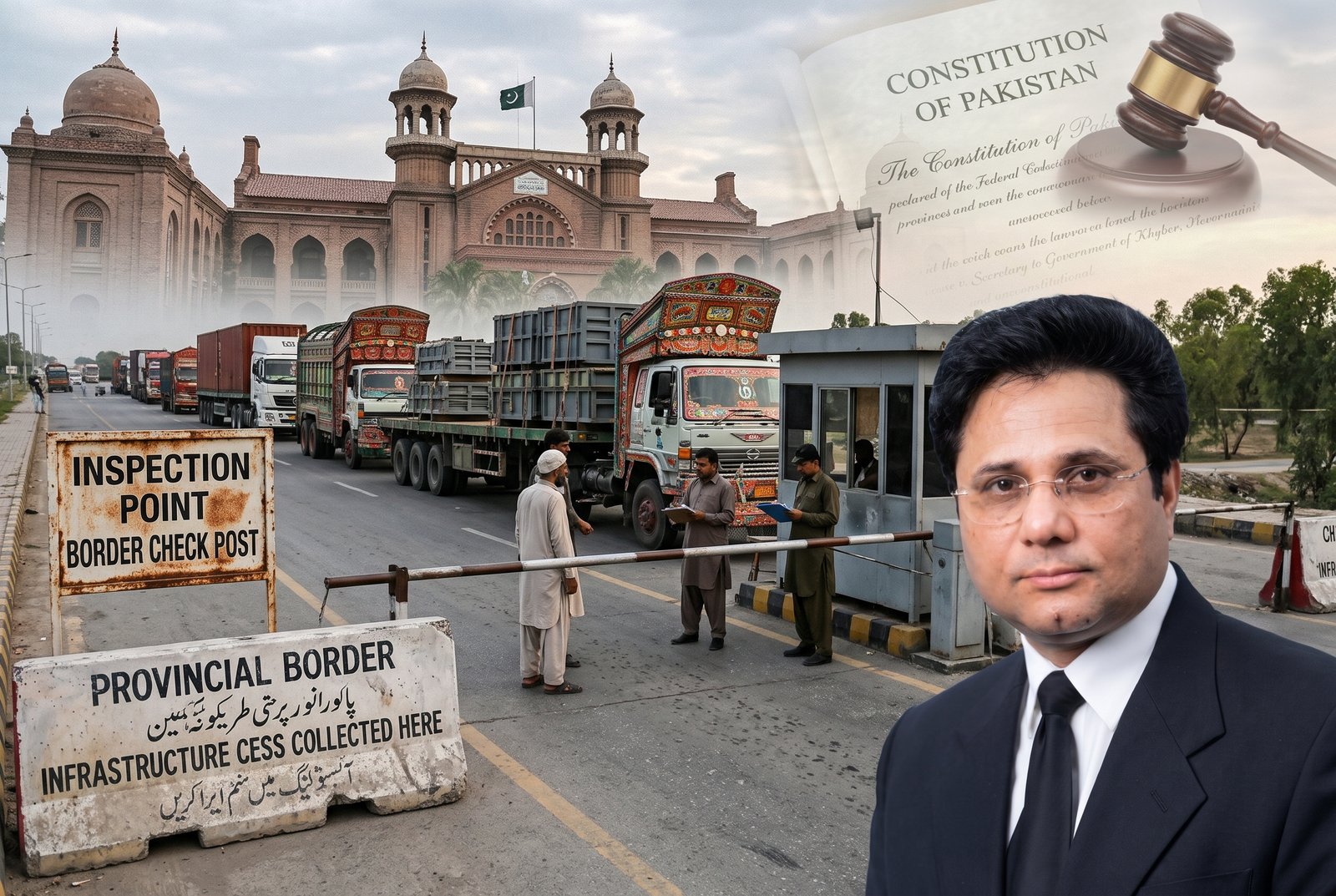
On 6 July 2026, this writer warned in an article that Pakistan was gradually constructing invisible tariff walls within its own federation. Under the seemingly innocuous description of infrastructure development cess, provincial governments were imposing fiscal burdens upon the movement of goods, undermining economic integration, increasing business costs and encroaching upon powers constitutionally assigned to Parliament. The article, titled “Pakistan’s invisible tariff walls”, questioned how a federation constitutionally committed to freedom of trade and commerce could permit its constituent units to erect fiscal barriers resembling internal customs duties.[1]
On 19 November 2026, the Federal Constitutional Court delivered a landmark judgment in M/s Chashma Ghee Mills (Pvt) Ltd v. Secretary to Government of Khyber Pakhtunkhwa & others, Civil Appeal No. 80 of 2020 and connected cases, substantially vindicating that constitutional position.
A bench comprising Chief Justice Amin-ud-Din Khan and Justice Aamer Farooq set aside the impugned High Court judgments and declared the challenged infrastructure cess provisions unconstitutional and without lawful authority, within the scope specified in the judgment. The decision represents an important reaffirmation of fiscal federalism and the constitutional boundaries of provincial taxing powers.[2]
The earlier article had identified a fundamental contradiction in Pakistan’s economic governance. While successive governments promised export-led growth, investment facilitation and regional connectivity, they simultaneously authorised taxes and charges that increased the cost of transporting goods through the country. Sindh, Khyber Pakhtunkhwa, Punjab and Balochistan had developed infrastructure cess regimes of differing scope. The July analysis examined their cumulative implications, particularly the expanding powers under provincial legislation, and argued that legislative competence could not be created merely by describing an impost as compensation for infrastructure.
The Federal Constitutional Court has now addressed that very constitutional distinction. Its reasoning is rooted in Article 142(a), read with the Fourth Schedule to the Constitution. Entry 27 of Part I of the Federal Legislative List assigns imports and exports across customs frontiers, inter-provincial trade and commerce, and trade with foreign countries to Parliament.
Entry 43 places customs duties, including export duties, within federal legislative competence. The abolition of the Concurrent Legislative List through the Eighteenth Amendment strengthened provincial autonomy, but it did not transfer subjects expressly retained in the federal domain.[3]
This distinction is indispensable. Provincial autonomy is neither administrative subordination to Islamabad nor unlimited fiscal sovereignty. It is constitutionally distributed authority. Provinces possess extensive legislative and revenue-raising powers within their assigned spheres, but no province can appropriate a federal taxing field merely because the revenue would finance a desirable provincial objective.
The FCC examined the substance rather than the nomenclature of the challenged levies. In paragraph 9, it applied the doctrine of pith and substance, requiring examination of the charging provisions, persons liable, taxable event, valuation methodology, collection arrangements and actual legal effects. An impost does not become a genuine service fee simply because legislation calls it a cess. Equally, the utilisation of its proceeds for public infrastructure cannot independently establish legislative authority.[4]
This was precisely the concern articulated in July. A genuine infrastructure charge requires an identifiable constitutional foundation and a defensible relationship with the service or regulatory activity concerned. Where liability arises because goods are imported, exported or transported across territorial boundaries, particularly where rates are linked to customs-assessed values, the levy must be examined for what it actually taxes.
The judgment’s treatment of the Sindh legislation illustrates the principle. Section 3 of the Sindh Development and Maintenance of Infrastructure Cess Act, 2017 imposed liability upon goods entering or leaving Sindh from or for destinations outside Pakistan through air or sea. Although the computation incorporated value, weight and distance, the essential charging event remained the international movement of goods. References to road carriage and infrastructure did not convert that event into an independent provincial service. The Court consequently held that the encroachment upon the federal field was substantive rather than incidental.[5]
The Khyber Pakhtunkhwa legislation required separate examination. The Infrastructure Development Cess Act, 2022, as amended in 2024, distinguished domestic goods from imported, exported or transited goods. The latter category attracted an ad valorem charge linked to the goods’ movement and status.
The Court held that a province could not construct a fiscal barrier within the national trading system merely by portraying it as infrastructure compensation. Significantly, the Court reserved separate constitutional consideration of the domestic-goods limb, including its relationship with Entry 49 of the Federal Legislative List. The judgment therefore establishes a decisive principle without indiscriminately extinguishing every conceivable provincial infrastructure charge.[6]
The distinction between a tax and a genuine compensatory fee also received careful treatment. The Court recognised that an individual payer need not receive a benefit precisely proportionate to the fee paid. Services may benefit an identifiable class collectively. Nevertheless, a real and reasonable relationship must exist between the class charged, the basis of liability and the service claimed to justify the impost. General references to roads, policing, hospitals and public facilities cannot establish that relationship merely by legislative declaration.
Indeed, the Court noted the inherent difficulty of justifying an infrastructure levy substantially determined by consignment value. Expensive but lightweight goods could attract greater charges than inexpensive, heavy consignments imposing substantially more physical wear on roads. Without evidence of a meaningful service relationship, valuation by commercial worth could not establish compensation for infrastructure usage. This reasoning directly supports the July article’s criticism of increasingly expansive ad valorem and administratively determined provincial charges.[7]
Equally important is Article 151, which protects freedom of trade, commerce and intercourse throughout Pakistan. The Court acknowledged that not every fiscal burden on trade violates that provision.
It nevertheless recognised that taxation triggered by entry, departure or transit, without independent provincial legislative authority, cannot be justified simply because the goods are eventually permitted to move after payment. Article 151 thus reinforces the constitutional vision of Pakistan as an integrated economic union, although the Court rested its decisive conclusion principally upon Article 142.[8]
Another important aspect concerns administrative collaboration between federal and provincial authorities. The collection of provincial cess through federal customs machinery cannot cure a fundamental absence of legislative competence.
Article 147 permits the entrustment of constitutionally competent provincial functions to the Federation under prescribed conditions. It does not authorise the transfer of Parliament’s exclusive legislative powers to provincial assemblies. Administrative arrangements cannot amend the Fourth Schedule.[9]
The implications extend to retrospective validation and enforcement. The Court held that retrospective provisions cannot cure a legislature’s lack of competence. In paragraph 31, it declared the corresponding invalid charging provisions and dependent rules, notifications, assessments and recovery measures unconstitutional and without lawful authority. Demands, penalties and surcharges resting solely upon those charges cannot be enforced. Securities furnished solely against them must be discharged after verification, subject to any subsisting judicial order. Individual refund and payment disputes, however, remain subject to the appropriate legal processes.[10]
For businesses that have contested these levies for years, the judgment offers an important constitutional remedy. For governments, it presents a broader institutional challenge. The absence of competence cannot be overcome by changing terminology, prescribing new rates, transferring collection responsibilities or enacting retrospective protection. Nor should the decision encourage the mistaken conclusion that provinces cannot finance infrastructure through lawful charges. They can, provided legislation remains within their constitutional authority and identifies a legally sustainable taxable event or service relationship.
The Federation must now assess the consequences for the wider architecture of provincial levies, including the scope and operation of infrastructure cess arrangements not conclusively adjudicated. Provincial legislatures should review their statutes in the light of the Court’s reasoning rather than assume that every existing charge survives merely because it was not individually named in the operative order. Equally, it would be legally inaccurate to claim that the Court has automatically invalidated every provincial charge affecting goods or transportation.
The judgment also raises a question about institutional accountability. Why were constitutionally contentious revenue instruments allowed to proliferate for decades while businesses bore litigation costs, furnished securities and faced uncertainty over commercial transactions?
Fiscal federalism demands more than collecting resources under whatever terminology may appear convenient. It requires transparent legislative competence, constitutional discipline and coordination between governments.
Pakistan’s economic problem is not simply inadequate revenue. It is also the cumulative cost of an increasingly complicated fiscal system that burdens production, transportation, trade and investment. The constitutional allocation of taxing powers is intended to prevent such fragmentation. A unified domestic market cannot function efficiently when the movement of goods becomes an opportunity for overlapping fiscal demands.
The Federal Constitutional Court has now drawn a necessary distinction between lawful provincial revenue powers and charges imposed upon constitutionally reserved federal subjects. The July warning about invisible tariff walls was therefore not merely an economic criticism; its principal constitutional concern has received authoritative judicial support.
The enduring significance of the judgment will depend upon whether governments respond by respecting the boundaries it identifies or seek to reproduce the same burdens through altered descriptions. A viable federation requires financially empowered provinces, but also an undivided national market. The Constitution provides room for both. What it does not permit is the destruction of economic unity in the name of revenue mobilisation.
Notes:
[1] Dr Ikramul Haq, “Pakistan’s invisible tariff walls”, The Express Tribune, 6 July 2026.
[2] M/s Chashma Ghee Mills (Pvt) Ltd v. Secretary to Government of Khyber Pakhtunkhwa & others, Civil Appeal No. 80 of 2020 and connected cases, Federal Constitutional Court, judgment of 19 November 2026, paragraphs 1–3 and 31. Official judgment.
[3] Constitution of Pakistan, Article 142(a) and (c), Fourth Schedule, Federal Legislative List, Part I, Entries 27 and 43; Chashma Ghee Mills, paragraphs 5–8.
[4] Chashma Ghee Mills, paragraphs 8–9; Canadian Western Bank v. Alberta, 2007 SCC 22, [2007] 2 SCR 3, paragraphs 25–31, cited in the judgment.
[5] Sindh Development and Maintenance of Infrastructure Cess Act, 2017, sections 2(f), 3, 4 and 5; Chashma Ghee Mills, paragraphs 11–12.
[6] Khyber Pakhtunkhwa Infrastructure Development Cess Act, 2022, section 3, as amended by section 14 of the Khyber Pakhtunkhwa Finance Act, 2024; Chashma Ghee Mills, paragraphs 13 and 29.
[7] Chashma Ghee Mills, paragraphs 14–16 (fee/tax distinction, connection with services and compensatory charges).
[8] Constitution, Article 151(1), (3) and (4); Chashma Ghee Mills, paragraphs 19–20 and 22.
[9] Constitution, Articles 137, 144 and 147; Chashma Ghee Mills, paragraphs 17–18.
[10] Chashma Ghee Mills, paragraphs 24–25 and 27–31 (retrospective legislation, delegated instruments, invalidity and monetary claims).
Disclaimer: The views and opinions expressed in this article are solely those of the author(s) and do not necessarily reflect the editorial position, values or beliefs of The Scoop or its management.
The Scoop firmly believes in freedom of speech, intellectual diversity and the open exchange of ideas. As an independent media platform, we remain committed to providing space for differing perspectives, including those that may challenge or contradict our own views.
Publication does not constitute endorsement. Our commitment to freedom of expression and independent journalism extends beyond opinions with which we agree.