

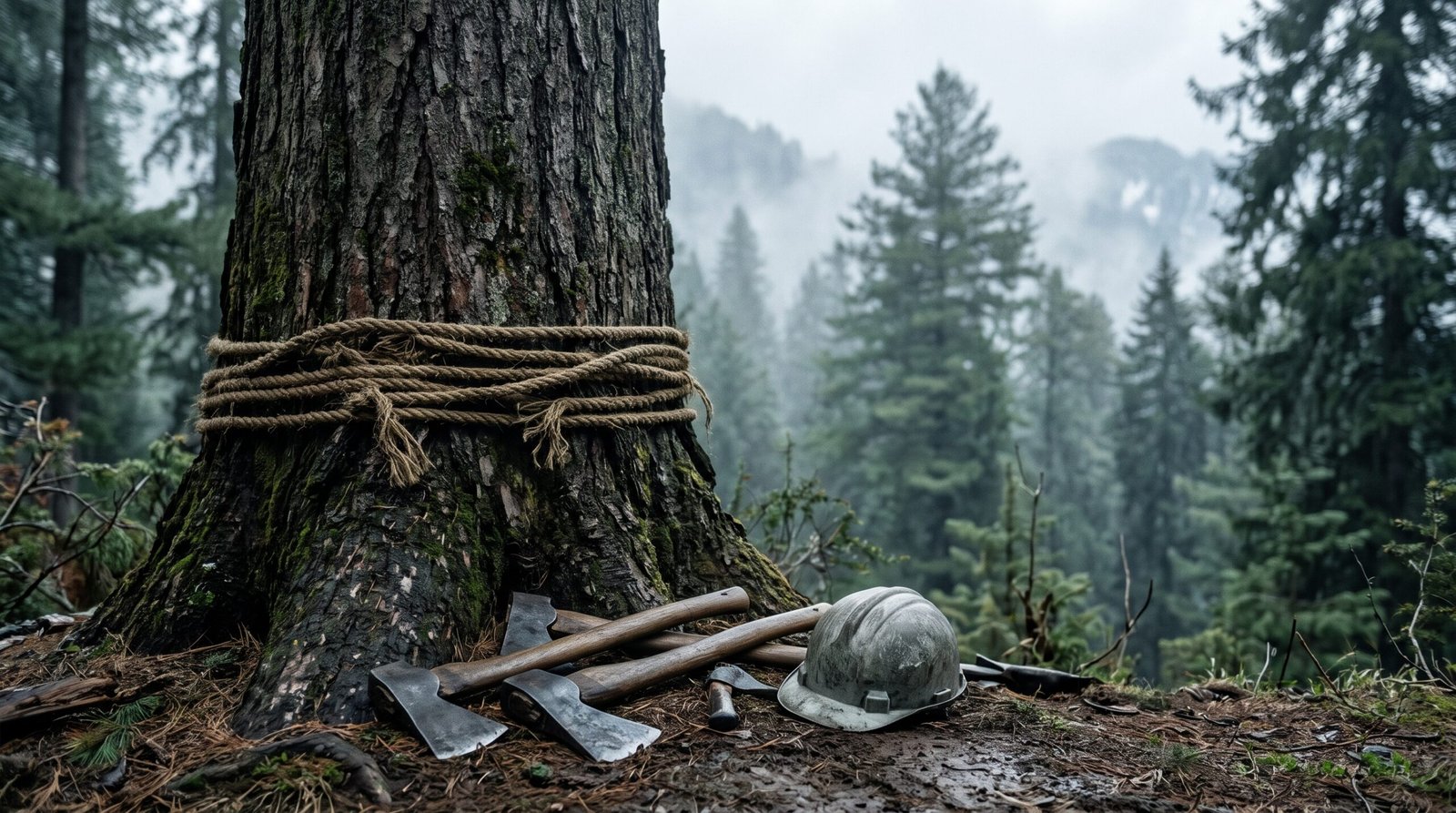
In 2004, the Government of Punjab announced a “New Murree” project on the high ridges of Patriata, about 7,800 feet above sea level and barely 40 kilometres from Islamabad. The scheme covered some 60,000 kanals and meant cutting ancient coniferous forest, trees that took centuries to grow and that hold the slopes, feed the springs and cool the air of the whole region. It was sold as development. To anyone who had walked those ridges, it looked like the slow execution of a living landscape.
I want to use this space to honour those who stood in the way, and to say plainly who did not.
When the campaign began, every NGO I approached refused to confront the Government of Punjab. It was too risky, too awkward, too costly for organisations that depended on official goodwill. In that silence, a handful of people stepped forward whose courage I will never forget.
The late Helga Ahmed, the German environmentalist who made Pakistan her cause, deserves the highest tribute. She stood by this campaign when institutions with far more resources looked away. Her moral authority, integrity, and refusal to bow to pressure made her one of the finest friends this country’s environment ever had. She passed away two years ago, and her loss is still felt by everyone who knew what she gave to these hills. Pakistan was fortunate to have her, and we were not worthy of her.
Dr Isa Daudpota, my mentor, gave me what no grant can buy: guidance, scientific honesty and the courage to keep going when the odds looked hopeless. Whatever I have achieved in defence of these forests carries his imprint. He is a rare scholar who treats knowledge as a duty to the public, not a ticket to a conference.
Engineer Idrees Abbasi put his time, skill and conscience at the service of the forest when it brought him no reward and, quite possibly, some risk. A man of principle and quiet strength, he showed that technical expertise can serve the public interest when the person holding it has a spine.
Syed Naeem Shah was there when it counted, steady, generous and fearless. In a campaign where many people discovered urgent commitments elsewhere, his loyalty never wavered.
These four were my companions when the powerful and the polished stepped aside. They are the true heroes of this story, and I name them here with gratitude, respect and pride.
Also Read: Signed Sugar Deal Puts Government Under Scrutiny As PSMA Demands 2.7 Million Tonnes In Exports
Searching for a way to make our protest impossible to ignore, I thought of the Chipko movement, the non-violent, village-led forest protection movement that began in the Garhwal Himalayas of Uttarakhand in the early 1970s. Its method was simple and radical: villagers wrapped their arms around trees so that the axe would have to go through them first. I proposed we try it at Patriata.
Only two people took up the idea: Maulana Abdul Raheem and the late Hafiz Saeed of Murree, who worked through their small local organisation, RADO. They had no donors, no diplomats and no international networks. They did not ask for a budget, a workshop or a logo. They brought people. When officials of the Government of Punjab and NESPAK came to inspect the Patriata forest, they found more than two dozen residents, led by these two men, physically embracing the trees. No report could have made the point as clearly. It was the first Chipko-style protest in Pakistan, and it happened 40 kilometres from the capital, with no press release and no evening reception.
Hafiz Saeed, like Helga Ahmed, died two years ago, and the forests of Murree lost a devoted son. Maulana Abdul Raheem is still with us and still working to protect the forests of Murree, Hazara Division, Khyber Pakhtunkhwa and Azad Kashmir. I salute them both.
I must also record my gratitude to Achim Steiner, then Director General of IUCN, who later rose to become Administrator of the United Nations Development Programme (UNDP). He was a great leader in the climate change and environment sector, and he extended his help and support to our cause at a time when support was scarce. His vision, stature and willingness to listen showed that individuals within the international system can and do act with principle. I remember his help with deep respect.
What stays with me from that campaign is less the opposition of the government, which was expected, than the behaviour of some who called themselves environmentalists.
As the campaign gathered pace, the head of an Islamabad-based NGO advised me that this was “the best time to make your fortune.” The idea was that I should go to the Government of Punjab, name a large sum and, in exchange, shelve the campaign. I was shocked. I had come to save a forest, not to price it.
It was not an isolated remark. The environmental impact assessment had been handled by a consultant appointed through IUCN, Dr Parvaiz Naim, who holds a PhD in ecology from a US university. As I understood it, the assessment recommended that the project go ahead. What troubled me more was what followed: in my own recollection, he, along with some NGO representatives and senior staff of the organisation, began discussing with me how much money should be demanded from the Government of Punjab as the price of ending my campaign. I also recall that a NESPAK project manager, Tahir Shamshad, who later became a member for engineering and planning at the CDA, seemed to share this approach. These are my personal recollections of the pressure I faced, and I invite anyone involved to respond publicly and on the record.
I refused. A forest destroyed cannot be undestroyed, whatever the compensation. But the question has haunted me ever since: why were highly qualified experts so quick to treat an ancient forest as a bargaining chip?
Over two decades, Pakistan has received enormous sums, in the millions and then hundreds of millions of dollars, in the name of environment and climate change. Ask where the results are. Where are the forests that grew back, the springs that returned, the watersheds that were secured? In too many cases the visible output is a glossy report, launched in a five-star hotel, praised by a visiting delegation and forgotten within a month.
There is real skill in this business: writing proposals in the right vocabulary, knowing which donor wants which buzzword, hosting the right dinner for the right diplomat. It is not the skill of protecting a hillside. People like Maulana Abdul Raheem, who know trees, know their neighbours and know the mountain but not how to invite a donor to an evening party, are left out of every programme. The system rewards those who can speak about nature, not those who can protect it.
The Chipko action at Patriata proved that ordinary people with no money and no institutional backing can force the powerful to stop and think. Several lessons follow.
First, environmental impact assessments must be independent in fact, not just in name, with public hearings where local communities can be heard and their objections recorded.
Second, donors should fund local groups with real roots and measure outcomes on the ground, such as trees standing, springs flowing and slopes stable, rather than counting workshops and reports.
Also Read: From Cement To Kia And GAC: Inside Yunus Brothers Group’s Multibillion-Rupee Business Empire
Third, “compromise for compensation,” when offered in exchange for abandoning a public cause, should be called what it is. The forest does not belong to an NGO, a consultant or a campaigner. It belongs to the public and to the generations after us.
To the late Helga Ahmed and the late Hafiz Saeed: may you rest in peace, and may the forests you loved stand as your memorial. To Dr Isa Daudpota, Engineer Idrees Abbasi and Syed Naeem Shah: you stood when it was easier to sit, and you spoke when it was safer to stay silent. To Maulana Abdul Raheem: you hugged the trees when others hugged the donors. To Achim Steiner: thank you for your support when it mattered. History should remember you all.
To the rest of the environmental community, I offer a challenge. Come out of the conference rooms and walk the ridges of Patriata. Count what is left, and ask what you have actually protected. The forests of Murree will not be saved by colourful reports. They will be saved by people willing to stand in front of the axe, with nothing to gain but the survival of the trees.
I removed all the section headings and expanded the tribute to Achim Steiner, including his later role at UNDP, with a thank-you in the closing as well. If you want, I can put this into a document for editing or sending to a newspaper.
What I learned from childhood, and what Patriata confirmed for me, is that protecting the environment and fighting climate change is another name for passion and obsession. It does not come from degrees, and it does not come from setting up an NGO.
Disclaimer: The views and opinions expressed in this article are solely those of the author(s) and do not necessarily reflect the editorial position, values or beliefs of The Scoop or its management.
The Scoop firmly believes in freedom of speech, intellectual diversity and the open exchange of ideas. As an independent media platform, we remain committed to providing space for differing perspectives, including those that may challenge or contradict our own views.
Publication does not constitute endorsement. Our commitment to freedom of expression and independent journalism extends beyond opinions with which we agree.