
LAHORE: Pakistan’s corporate landscape has traditionally been dominated by industrial families whose fortunes originated in textiles, manufacturing, trading and agriculture. However, the rise of Arif Habib represents a different chapter in the country’s business history — one in which the stock market became the foundation of a diversified investment empire.
From his early career as a stockbroker to the development of a corporate network with interests spanning financial services, fertiliser, steel, cement, real estate, energy and aviation, Arif Habib has emerged as one of Pakistan’s most recognisable business figures.
The evolution of the Arif Habib business network reflects decades of capital allocation, strategic investments, industrial partnerships and participation in Pakistan’s financial markets.
Its involvement in the privatisation of Pakistan International Airlines (PIA) has added another dimension to that journey, placing the group at the centre of one of the country’s most closely watched private-sector investment initiatives.
But beyond the impressive list of associated companies lies a more important question: how did a stockbroker develop such a diversified investment network, and what does its expansion reveal about the opportunities and challenges facing Pakistan’s private sector?
From Stockbroker To Corporate Powerhouse
Arif Habib’s business career began in Pakistan’s securities market, where he developed expertise in stock trading, investment analysis and capital-market operations.
Unlike conventional industrial entrepreneurs who built their businesses around factories and manufacturing facilities, Habib’s early professional experience centred on understanding financial markets, identifying investment opportunities and mobilising capital.
His growing influence in Pakistan’s capital markets eventually led to leadership roles within the country’s stock exchange institutions, including serving as chairman of the Karachi Stock Exchange.
These experiences provided exposure to listed businesses, corporate governance structures, financial reporting and the investment requirements of different industries.
Over time, his investment activities expanded beyond securities trading into strategic equity positions in companies operating across major sectors of Pakistan’s economy.
Arif Habib Corporation Limited (AHCL), incorporated in November 1994, subsequently emerged as the listed holding company at the centre of this expanding investment network.
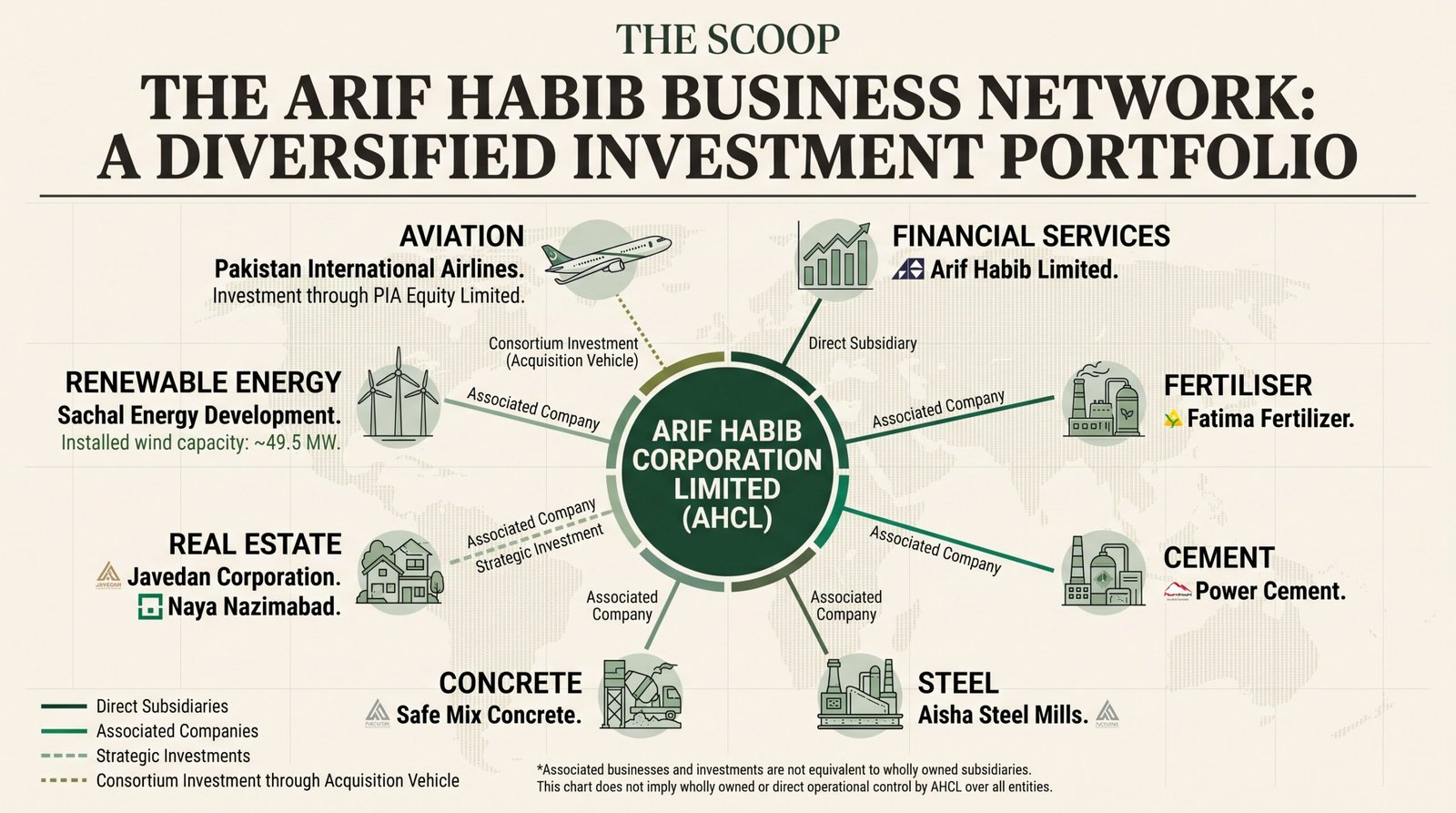
The corporation’s business model combines direct subsidiaries, associated companies and strategic investments rather than relying exclusively on wholly owned industrial operations.
This distinction is important because not every company associated with the Arif Habib name is directly controlled or wholly owned by AHCL.
Nevertheless, the breadth of the network illustrates how financial-market expertise can provide a foundation for diversified corporate investment.
The Corporate Empire: From Financial Services To Industrial Manufacturing
The Arif Habib investment network has developed exposure to several strategically important sectors of Pakistan’s economy.
Its financial-services operations include Arif Habib Limited, an established brokerage and investment-services company.
In fertiliser, the group maintains a significant investment relationship with Fatima Fertilizer, providing exposure to Pakistan’s agricultural economy.
Power Cement and Safe Mix Concrete connect the portfolio with construction materials and infrastructure development.
Aisha Steel Mills represents an investment in steel manufacturing, while Javedan Corporation provides exposure to real-estate development.
In renewable energy, Sachal Energy Development operates in wind-power generation.
The group’s international business interests also include an investment presence in Dubai.
More recently, aviation has emerged as an important new area following the Arif Habib Corporation-led consortium’s involvement in the acquisition of Pakistan International Airlines.
Taken together, these businesses demonstrate the extent of the group’s investment diversification.
However, their financial statements, revenues and assets cannot simply be added together and described as the consolidated financial strength of Arif Habib Corporation.
Different ownership percentages, accounting treatments and management arrangements determine how each investment contributes to the holding company’s financial position.
Rs118.66 Billion In Assets: The Financial Strength Behind AHCL
The financial performance of Arif Habib Corporation offers an important indication of the scale of its investment activities.
According to published financial performance figures for the year ended June 2026, AHCL reported total assets of approximately Rs118.66 billion, compared with Rs77.73 billion in the preceding financial year.
Profit after tax increased to approximately Rs44.48 billion from Rs23.67 billion in FY2025.
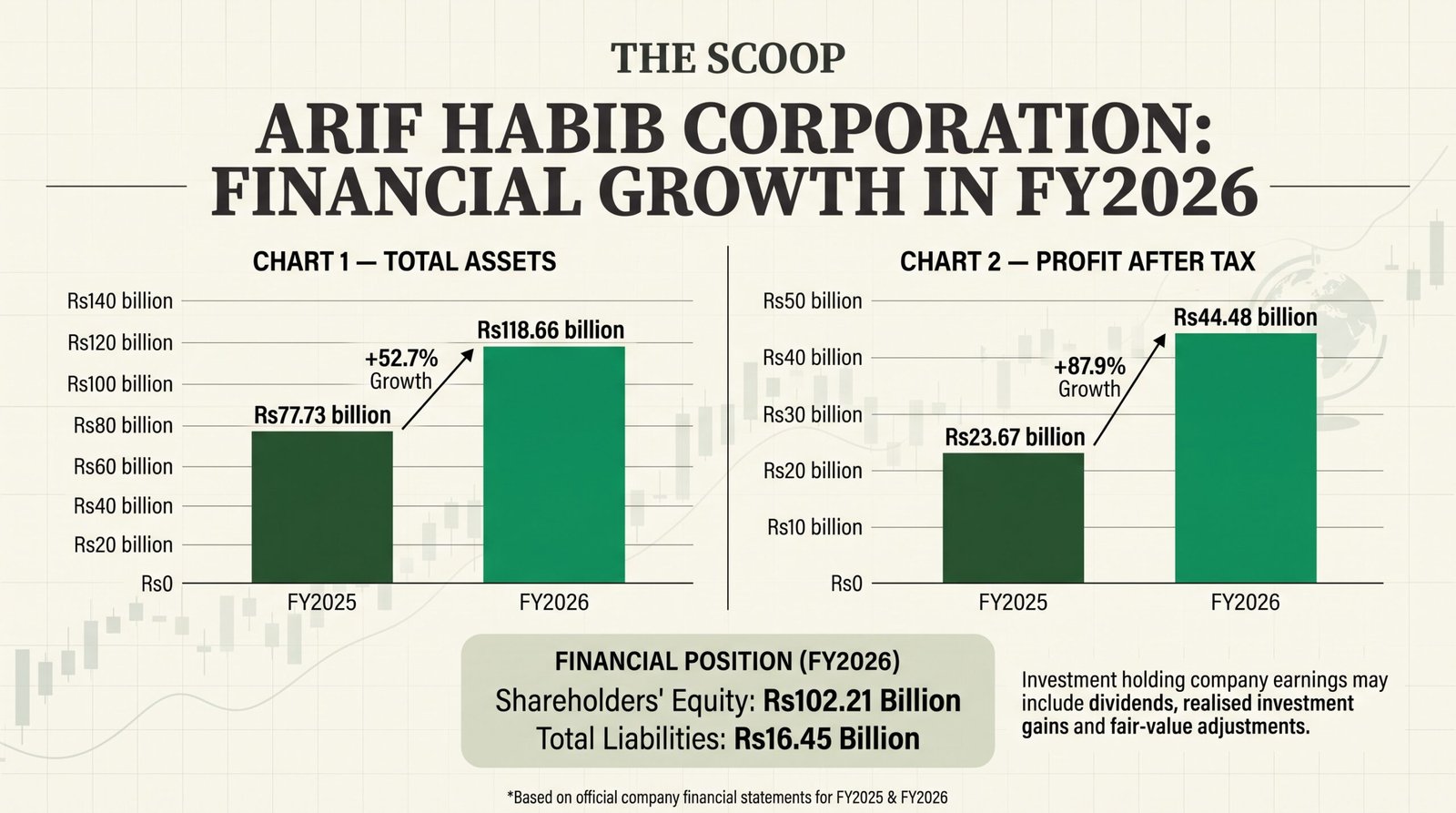
Shareholders’ equity stood at approximately Rs102.21 billion, while total liabilities were around Rs16.45 billion.
These figures indicate significant growth in the corporation’s reported financial position.
However, investment holding companies must be assessed differently from conventional operating businesses.
Their earnings can include dividend income, realised investment gains, fair-value adjustments and contributions from associated companies.
Consequently, headline profitability does not necessarily represent recurring operating cash flow.
The sustainability of earnings depends on the performance of underlying investments, market conditions, dividend distributions and the ability to realise value from portfolio holdings.
For investors, the quality of earnings and the relationship between reported profits and actual cash generation remain important considerations.
Fatima Fertilizer: A Strategic Investment In Pakistan’s Agricultural Economy
One of the most prominent industrial relationships within the Arif Habib investment network is its association with Fatima Fertilizer.
Pakistan’s agricultural sector remains a major contributor to employment, food security and economic activity.
Fertiliser manufacturers play an essential role in supporting agricultural productivity by supplying nutrients required for crop cultivation.
Through its investment relationship with Fatima Fertilizer, the Arif Habib network maintains exposure to an industry closely linked with the country’s agricultural performance.
The fertiliser sector can provide relatively resilient demand because agricultural production requires continuing access to crop nutrients.
However, profitability remains sensitive to gas availability, feedstock pricing, government regulations, agricultural purchasing power and distribution costs.
Pakistan’s fertiliser industry has also faced recurring debates over gas pricing, subsidies and the relationship between domestic production costs and market prices.
These factors make the sector strategically important but politically and economically sensitive.
For the Arif Habib investment network, the association with Fatima Fertilizer illustrates the value of investing in established industries with significant domestic demand.
Power Cement And Aisha Steel: Investing In Industrial Pakistan
Industrial manufacturing represents another important component of the group’s investment portfolio.
Power Cement provides exposure to Pakistan’s cement industry, which is closely connected with infrastructure development, housing construction and public-sector investment.
Cement demand is influenced by government development expenditure, private construction activity, interest rates and broader economic confidence.
During periods of economic expansion, infrastructure investment and residential development can support cement consumption.
Conversely, weak construction activity, expensive financing and high energy costs can place pressure on manufacturers.
Aisha Steel Mills connects the portfolio with steel manufacturing and the supply of industrial materials.
Steel-sector performance is affected by imported raw-material prices, electricity tariffs, exchange-rate movements, domestic industrial demand and competition.
Pakistan’s industrial sector has faced persistent challenges arising from high energy costs, financing constraints and fluctuations in economic activity.
These conditions highlight both the opportunities and risks associated with industrial investments.
The long-term performance of Power Cement and Aisha Steel therefore depends on operational efficiency, capacity utilisation, financial discipline and improvements in Pakistan’s broader manufacturing environment.
Javedan Corporation: Real Estate And Urban Development
Real estate represents another major area of investment associated with the Arif Habib business network.
Javedan Corporation has developed a presence in Pakistan’s property sector, most notably through its association with the Naya Nazimabad development in Karachi.
The project illustrates how investment capital can be deployed into large-scale residential and urban-development initiatives.
Real-estate projects can generate long-term value through land development, infrastructure improvements, housing construction and commercial activity.
However, such investments also involve significant risks.
Development projects require substantial capital commitments and can be affected by regulatory approvals, construction costs, infrastructure availability, market demand and the purchasing power of potential buyers.
Unlike highly liquid financial investments, property-development projects may take years to generate their expected returns.
Consequently, the success of real-estate investments depends not merely on rising land values but also on project execution, cash collections and the efficient use of capital.
Sachal Energy: Expanding Into Renewable Power
The group’s investment interests also extend into Pakistan’s energy sector.
Sachal Energy Development represents its exposure to wind-power generation.
The company’s wind-energy project in Sindh has an installed capacity of approximately 49.5 megawatts.
The investment reflects the growing importance of renewable energy in Pakistan’s electricity-generation mix.
Wind power offers an alternative to imported fossil fuels and can contribute to diversifying the country’s energy sources.
However, renewable-energy projects operate within a complex regulatory and financial environment.
Their financial performance depends on power-purchase arrangements, tariff structures, financing costs, grid availability and payment discipline within the electricity sector.
Pakistan’s longstanding circular-debt problem has also created financial challenges across the power industry.
The investment in Sachal Energy therefore demonstrates the group’s participation in renewable energy while highlighting the importance of stable energy-sector policies and financial arrangements.
PIA Privatisation: A Historic Expansion Into Aviation
Perhaps the most significant recent development in the Arif Habib investment network is its involvement in the privatisation of Pakistan International Airlines.
In December 2025, an Arif Habib Corporation-led consortium emerged as the successful bidder for a 75 per cent stake in the national airline, offering Rs135 billion.
The transaction represented a major milestone in Pakistan’s efforts to transfer management of loss-making state-owned enterprises to the private sector.
For decades, PIA had struggled with operational inefficiencies, financial pressures, governance challenges and intense competition from international airlines.
The privatisation process attracted considerable attention because of the airline’s historical significance and its potential implications for public-sector reform.
For the Arif Habib-led consortium, the acquisition represented an entry into an industry substantially different from conventional financial and industrial investments.
Aviation requires specialised operational expertise, sophisticated fleet management, route planning, maintenance systems, regulatory compliance and a sustained focus on customer service.
The investment structure is also important.
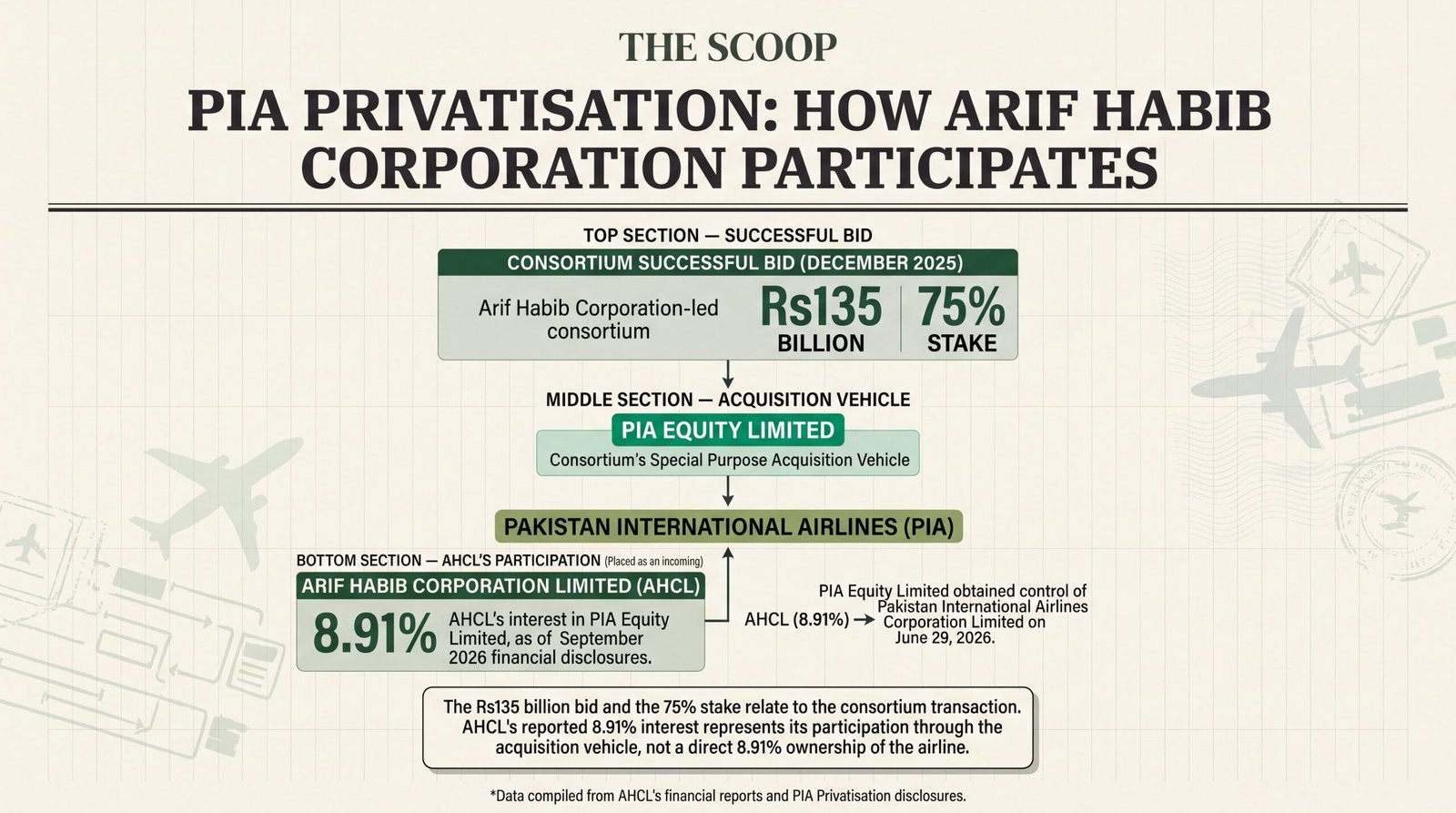
Arif Habib Corporation participates through PIA Equity Limited, the consortium’s acquisition vehicle, rather than owning the national airline outright.
According to AHCL’s September 2026 financial disclosures, the corporation held an 8.91 per cent interest in PIA Equity Limited, which obtained control of PIACL on June 29, 2026.
The distinction is essential because the consortium’s investment cannot be treated as the sole acquisition or ownership of Arif Habib Corporation.
Nevertheless, AHCL’s leadership role in the transaction has made the acquisition an important development in the wider Arif Habib corporate story.
Can The Private Sector Turn Around PIA?
The acquisition of PIA raises questions extending far beyond the purchase price.
The airline’s future depends on whether its new management can establish a sustainable commercial model while addressing longstanding operational challenges.
Fleet utilisation, aircraft maintenance, route profitability, employee productivity, fuel costs and service standards will be central to its performance.
The consortium will also need to determine how much additional capital is required to modernise operations and improve the passenger experience.
A successful turnaround could strengthen investor confidence in Pakistan’s privatisation programme and demonstrate the potential of private-sector management in previously state-owned enterprises.
Conversely, failure to deliver operational improvements could expose the investors to substantial financial and reputational risks.
The aviation investment will therefore provide an important test of whether the financial and strategic expertise associated with the Arif Habib network can translate into sustainable airline operations.
The Investment Philosophy: Diversification And Strategic Partnerships
The Arif Habib business model reflects an investment philosophy built around diversification, strategic shareholdings and participation in businesses operating across different sectors.
Rather than concentrating exclusively on a single industry, the network has developed interests in financial services, agriculture-related manufacturing, construction materials, property development and energy.
Such diversification can provide access to different sources of earnings and investment opportunities.
However, diversification does not eliminate risk.
Several industries within the portfolio remain sensitive to Pakistan’s broader economic conditions.
High interest rates can affect construction activity, industrial financing and investment valuations.
Exchange-rate depreciation can increase imported raw-material costs.
Energy tariffs can influence manufacturing profitability.
Regulatory changes can affect fertiliser pricing, power-generation arrangements and real-estate development.
Consequently, the effectiveness of diversification depends on the quality of individual investments, financial discipline and the ability to manage exposure to changing economic conditions.
Corporate Governance And The Question Of Control
One of the most important aspects of evaluating the Arif Habib investment network is understanding the distinction between ownership, management influence and corporate association.
A company in which AHCL holds a minority stake cannot automatically be described as wholly owned or controlled by the corporation.
Similarly, the combined revenues, profits or assets of associated businesses cannot simply be presented as the consolidated financial results of the holding company.
Investors and analysts must distinguish between subsidiaries, associates, joint ventures and other equity investments.
This is particularly important when evaluating the financial scale of diversified investment groups.
Corporate governance, transparent disclosures, related-party transactions and effective capital allocation are also essential considerations.
As investment networks become larger and more complex, the importance of clearly defined ownership structures and accountability increases.
Pakistan’s Economic Challenges And The Future Of The Group
Despite its diversified portfolio, the Arif Habib investment network remains exposed to the structural challenges facing Pakistan’s economy.
Industrial energy costs, taxation, exchange-rate volatility, financing constraints and policy uncertainty continue to affect business confidence.
Manufacturing companies require reliable energy supplies and competitive production costs.
Real-estate developers depend on purchasing power, infrastructure and access to financing.
Financial-services companies are influenced by stock-market activity, investor confidence and regulatory conditions.
Energy businesses operate within a sector affected by circular debt and complex payment arrangements.
The aviation investment introduces additional exposure to fuel prices, international competition, fleet availability and operational efficiency.
For the group, future growth will therefore depend not only on identifying new investment opportunities but also on improving the performance of existing businesses.
Effective capital allocation, prudent financial management and the ability to adapt to changing market conditions will remain critical.
A Business Journey That Reflects Pakistan’s Capital-Market Evolution
Arif Habib’s rise from stockbroker to prominent corporate investor is closely connected with the evolution of Pakistan’s financial markets.
His career illustrates how capital-market experience can provide a foundation for investments in industrial enterprises, infrastructure and large-scale business ventures.
The development of the Arif Habib network also demonstrates the importance of financial institutions and investment partnerships in mobilising capital for productive economic activity.
However, the ultimate measure of a diversified corporate group’s success is not simply the number of companies associated with its name.
It is the ability to generate sustainable earnings, strengthen businesses, create productive capacity, maintain sound governance and deliver long-term value.
For Arif Habib, the expansion from stockbroking into major industrial sectors represents a significant entrepreneurial journey.
For Pakistan, the group’s evolution provides a case study in how private investment capital can participate in the development of businesses across the economy.
And with PIA now part of the wider investment network’s portfolio, the next chapter may prove to be one of the most consequential.
The central question is no longer simply how Arif Habib built a diversified business empire, but whether the investment philosophy that helped create it can deliver sustainable success in one of Pakistan’s most challenging industries.