

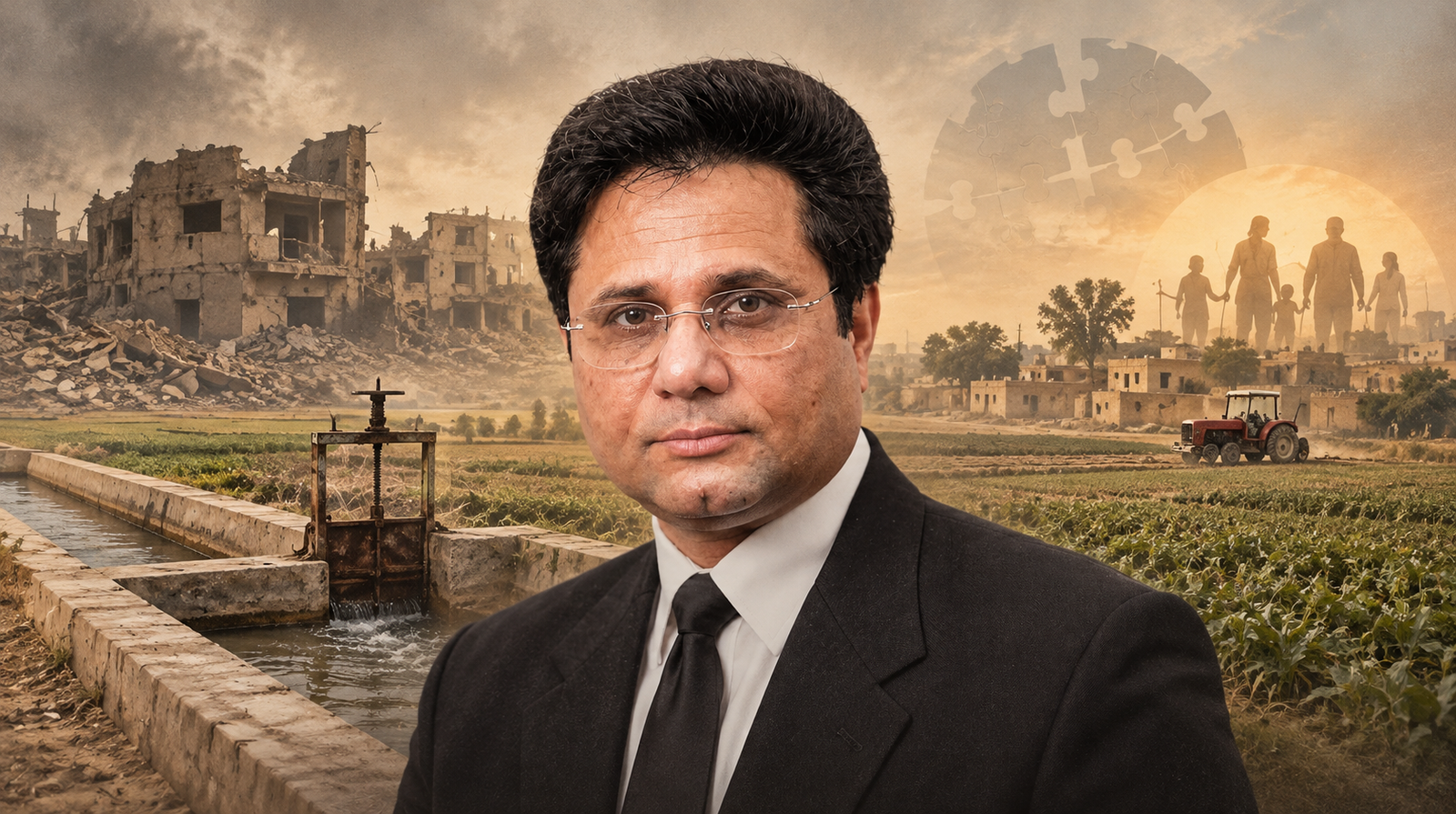
A cultivator can return to the same field after a war and find that almost everything governing his future has changed. The soil may be familiar. The boundary may stand where it stood before. But if the person who previously collected rent no longer owns the land, the cultivator faces the coming harvest with a different claim on its proceeds. Reconstruction has reached the relationship through which the family earns its living.
Japan’s agricultural land reform after the Second World War transferred ownership from landlords to many of the tenants who cultivated their fields. A World Bank study describes small tenant farmers becoming owner-cultivators without an apparent change in the size of their farms.[1] That observation poses a question for any society emerging from disaster. What must change if the people doing the rebuilding are to enjoy a more secure life afterwards?
The preceding Part VII examined what survives when cities and governing orders decline. Skills, households and communities can persist through a profound contraction of urban life. Persistence leaves a further question unanswered. Under what conditions can those survivors rebuild arrangements that give them greater protection against another crisis?
The return of production supplies only part of the answer. A harvest can recover while the cultivator remains one illness away from losing access to the field. A factory can reopen while its workers return to debts accumulated during its closure. A bridge can carry traffic again while the settlements it serves lose the schoolteacher and nurse who left during the emergency. Each recovery figure needs to be read alongside the claims people can actually exercise.
Japan’s experience also shows the importance of what accompanies redistribution. The OECD’s historical account places postwar land reform alongside investment in agricultural research, extension services and land infrastructure.[2]
Ownership gave cultivators a different position in the rural economy. Public investment helped them work within that position. A certificate of ownership cannot supply irrigation, explain a crop disease or repair a road to market. A recovery programme has to connect these tasks and assign responsibility for each.
It would take a much wider history to explain Japan’s postwar growth. The narrower lesson from its farms is sufficient here. Institutions governing access to productive assets can change, and such change can form part of reconstruction. A society need not treat every pre-disaster entitlement as an indispensable foundation for its future. It must be able to ask which entitlements supported production, which concentrated its rewards and whose consent a different arrangement requires.
The question becomes more difficult when people depend on a resource that several households must use together. A forest, pasture or irrigation channel requires continuing decisions about access and maintenance. Allocating an individual title cannot settle every dispute about a stream that passes through many holdings. Even a well-funded ministry may find that its rules bear little relation to when water reaches the last field.
Elinor Ostrom devoted much of her research to such problems. Her studies of shared resources documented communities capable of maintaining workable arrangements over long periods. In discussing this research, she stressed that no single set of detailed rules appeared in every durable system. The conditions of use differed. Users’ involvement, monitoring and their sense of a future in the resource mattered to whether formal arrangements worked.[3]
That finding makes a practical demand on an official arriving with a reconstruction plan. Before replacing an existing arrangement, the official needs to discover how it operated. Who maintained the channel before the flood? Who settled disputes during a dry season? Did the people at its far end receive their agreed share? An arrangement may preserve valuable knowledge and still exclude tenants or women. Both facts deserve investigation before public money restores it.
Participation has little substance if the invitation arrives after every consequential choice has been made. Residents asked to select the colour of a building have received a narrower authority than residents able to question its location. Equally, handing a project to a village committee does not establish that every resident can speak freely within it. A person dependent on the committee chairman for employment may require a confidential way to challenge the distribution of benefits.
Recovery involves decisions about who can make decisions. Consider a damaged irrigation channel in Pakistan. An engineer can estimate the cost of restoring its previous capacity. Cultivators can identify the points at which water was routinely diverted before the damage. A reconstruction authority that hears only the engineering account may reproduce an inequitable arrangement with stronger concrete. Hearing both accounts creates an opportunity to examine the allocation of water as well as the condition of the channel.
The resulting decision should be accessible to those who depend on it. A written schedule of water turns, records of expenditure and an affordable means of disputing a missed allocation allow residents to test whether the promised improvement occurred. These are proposals for judging a recovery project. Their value would depend on actual access, including whether a tenant could use the remedy without risking the next season’s tenancy.
Time matters as much as formal entitlement. An irrigation dispute settled after sowing may leave the successful claimant with little to celebrate. Reconstruction authorities should be judged partly by whether their decisions arrive while people can still act on them. The person seeking a remedy has a livelihood organised around seasons. An office’s calendar should take that fact seriously.
There is also a danger in allowing an emergency to supply permanent reasons for avoiding public scrutiny. Speed may require simplified procedures. The expenditure, beneficiaries and reasons for decisions should still become available for examination. Otherwise, a temporary concentration of authority can establish lasting advantages for those with access to it. Recovery then prepares the conditions of another crisis, even as the most visible damage disappears.
A society’s capacity to recover can be examined in an ordinary place, at an ordinary time. Return to the cultivator standing beside the repaired channel before sowing. Does he know when the water will arrive? Can he challenge an upstream diversion? Can he afford the seed and retain enough of the harvest to plant again? Answers to those questions reveal how much reconstruction has changed his prospects. The concluding instalment returns to the larger issue they raise, the power to correct a failing decision before its costs become irreversible.
Endnotes
- Toshihiko Kawagoe, Agricultural Land Reform in Postwar Japan: Experiences and Issues, World Bank Policy Research Working Paper 2111 (1999).
- OECD, Agricultural Policy Monitoring and Evaluation 2023, Japan, historical policy background.
- Elinor Ostrom and Oliver E. Williamson, Nobel Prize interview transcript (2009), discussion of durable common-resource institutions.
[To be continued]
Read More: Why Civilisations Collapse—IX