

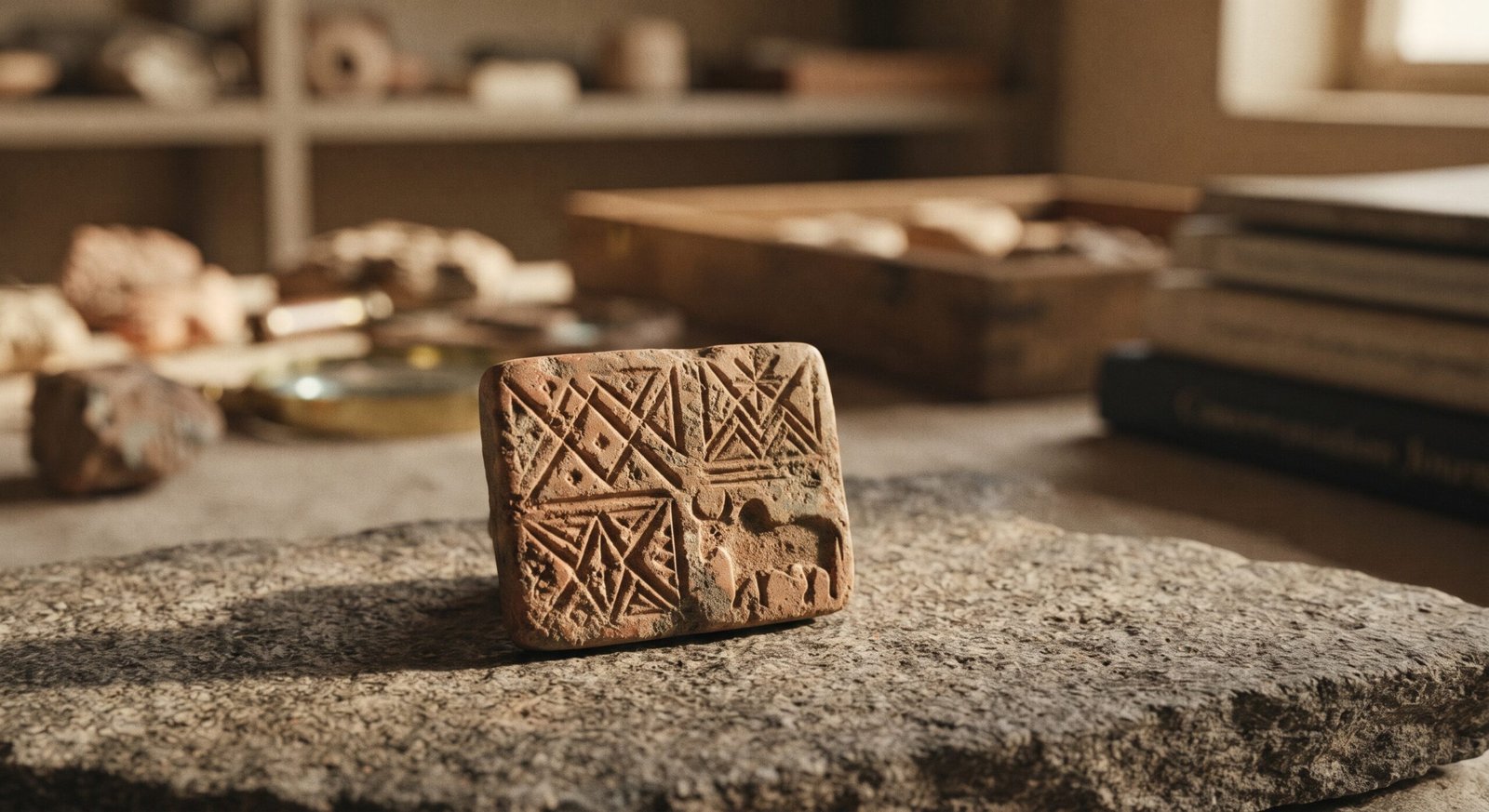
At Harappa, people went on making seals after they ceased putting inscriptions on them. The later seals carried geometric designs. In a museum case the difference might seem slight. For a historian trying to date the end of the Indus civilisation, it poses a difficulty. Which date should count as the end of a society whose craftsmen still knew how to fashion a seal but whose customers apparently had no further use for the old inscription?[1]
There is a question beyond the capacity of societies to recover. What exactly has been lost when a civilisation is said to have collapsed? A city can cease to command the produce of its hinterland. A household can lose its livelihood. A language can lose its last speaker. These are different events. A theory that supplies one date and one cause for all three asks the evidence to do more than it can.
The Indus cities flourished across an area that today falls largely within Pakistan and north-western India. After about 1900 BCE, the area under settlement contracted, many sites were abandoned and the distribution of settlements shifted eastward. In their study of the region’s rivers, Liviu Giosan and his colleagues connected these changes to the weakening monsoon and the declining reliability of the floods on which cultivation depended. Their map records both the places people left and the places where smaller settlements became more numerous.[2]
Imagine drawing that map with a pencil of only one colour, marking every abandoned site. The result would show a landscape emptying out. Add the places where people continued to settle and a different history comes into view. A contraction of urban life remains visible, with all that it implied for occupations sustained by a large city. But it becomes possible to ask where a cultivator could still raise a crop, and what became of the exchange between that cultivator and an urban craft worker.
The same move could have different consequences for the two households. A farmer might find land where a different pattern of rainfall made cultivation viable. A craft worker who depended on many customers within walking distance could move to the same village and find too little demand for a specialist’s skill. The settlement map cannot tell us which family ate better after moving. It does tell us why a single verdict about the fortunes of both would be premature.
In western Honduras, archaeologists encountered a comparable problem at the Maya city of Copán. A historian following the royal dynasty can identify a sharp political break early in the ninth century. David Webster and AnnCorinne Freter examined settlement evidence around the city itself. In their reconstruction, the decline in the valley’s population extended over centuries. Some activity among elites below royal rank also outlasted the court. The date at which one could no longer find a king proved a poor guide to the date at which one could no longer find a neighbour.[3]
Also Read: Why civilisations collapse—VI
Consider what a court leaves to an excavator. A ruler has reason to put a name and a date on stone. A family has little occasion to commemorate the twenty-third season in which it planted the same field. The ruler’s departure may therefore be easier to date than the family’s continued presence. That disparity in the record gives political authority an advantage it hardly needs. Centuries after losing the power to govern, it can still determine whose history gets told.
There is a living correction to this habit. José Huchim Herrera, a Yucatec Maya archaeologist and architect, speaks in the Smithsonian’s Living Maya Time project as both a scholar of ancient Maya building and an heir to the culture that produced it. The distinction matters. A visitor can leave a ruined city persuaded that an entire people belongs to antiquity, having spent the morning learning about its buildings from one of their descendants. More than thirty Maya languages are spoken today.[4]
Continuity deserves the same scrutiny as collapse. A family may retain its language and lose its land. A craft may survive in one settlement after the disappearance of the trading network that once supported hundreds of its practitioners. Neither survival nor loss cancels the other. In each case a precise account has to identify the ability people once possessed, the people who could still exercise it afterwards, and the price they paid to do so.
Pakistan has a practical reason to make these distinctions. Consider what a district might report after a flood. A road has reopened, a school building has been repaired and displaced households have left a relief camp. Every statement may be accurate. A tenant family now living beyond the district boundary may nevertheless have lost a season’s work and its daughter a term of schooling. On the district’s register the family disappears on the day it most needs another authority to recognise its claim.
One question would improve that account considerably. When a displaced child crosses into another district, who is responsible for finding her a place in school? The answer requires two administrations to follow the same child across a boundary. It also gives the public something definite to examine. A repaired classroom can be photographed on its opening day. Whether the girl resumed her education can be established only by following her to the place where she now lives.
The earlier instalments examined societies that could recognise a danger and still fail to act because those able to change course bore too little of the cost of delay. The evidence from Harappa and Copán adds a qualification. Even after a governing order loses that capacity, people may retain considerable powers of adaptation. The decisions open to them will depend on such ordinary matters as access to land, a neighbour willing to take them in or a skill for which there is demand elsewhere. Calling the survivors resilient is easy. Discovering who had any choice about leaving is harder.
A visitor to Harappa can see the geometric seal. Nobody has left an account of the conversation in which a customer first asked a craftsman to make one without an inscription. Somewhere between what the object establishes and what the conversation might have explained lies the historian’s obligation to exercise restraint. The old system of writing passed out of use. The hand that made the next seal still had work to do.
Endnotes
- J. Mark Kenoyer, “Changing Perspectives of the Indus Civilization”, discussion of Late Harappan seals at Harappa, p. 12.
- Liviu Giosan et al., “Fluvial Landscapes of the Harappan Civilization”, Proceedings of the National Academy of Sciences (2012).
- David Webster and AnnCorinne Freter, “Settlement History and the Classic Collapse at Copan”, Latin American Antiquity.
- Smithsonian National Museum of the American Indian, “The Maya”, Living Maya Time, including testimony by José Huchim Herrera.
[To be continued]