


LAHORE, November 5, 2026: In the heart of Lahore, surrounded by some of Punjab’s most valuable commercial and residential property, an exclusive private members’ club occupies approximately 112 acres of government-owned land under a lease that reportedly requires it to pay just Rs5,000 annually.
That institution is Lahore Gymkhana, established in 1913 and long regarded as one of the city’s most prestigious recreational and social establishments.
The land under its occupation has been valued at between Rs76 billion and Rs218 billion in assessments presented during Punjab Assembly proceedings.
Yet the annual rent under the longstanding lease amounts to approximately Rs417 per month.
The contrast raises an extraordinary question: how did a private members’ institution retain control of such a valuable public asset on terms that appear almost entirely disconnected from its contemporary economic worth?
The controversy goes considerably beyond the amount of rent being paid.
It encompasses a lease renewed decades before its expiry, questions about the legal basis of government concessions, alleged discrepancies in land possession, buildings for which official approvals have not been located, public grants, restricted membership arrangements and an unresolved dispute concerning government audit powers.
More importantly, it raises questions about the performance of successive provincial governments, the Board of Revenue and the institutions responsible for safeguarding public property.
The Rs218 Billion Question: What Is The Land Actually Worth?
According to valuation material discussed before the Punjab Assembly’s Special Committee No. 6, land comparable to the Lahore Gymkhana estate along The Mall, Jail Road and Zafar Ali Road was assessed at approximately Rs70 million to Rs200 million per kanal.
Applied to approximately 1,090 kanals, those benchmarks produce an indicative valuation ranging from roughly Rs76 billion to Rs218 billion.
These figures do not establish that the entire estate could be sold or commercially developed at those prices. Its existing recreational use, planning restrictions, leasehold status and public-purpose considerations would all affect any professional valuation.
Nevertheless, they demonstrate the substantial economic value of the underlying state asset.
The rental arithmetic is equally striking.
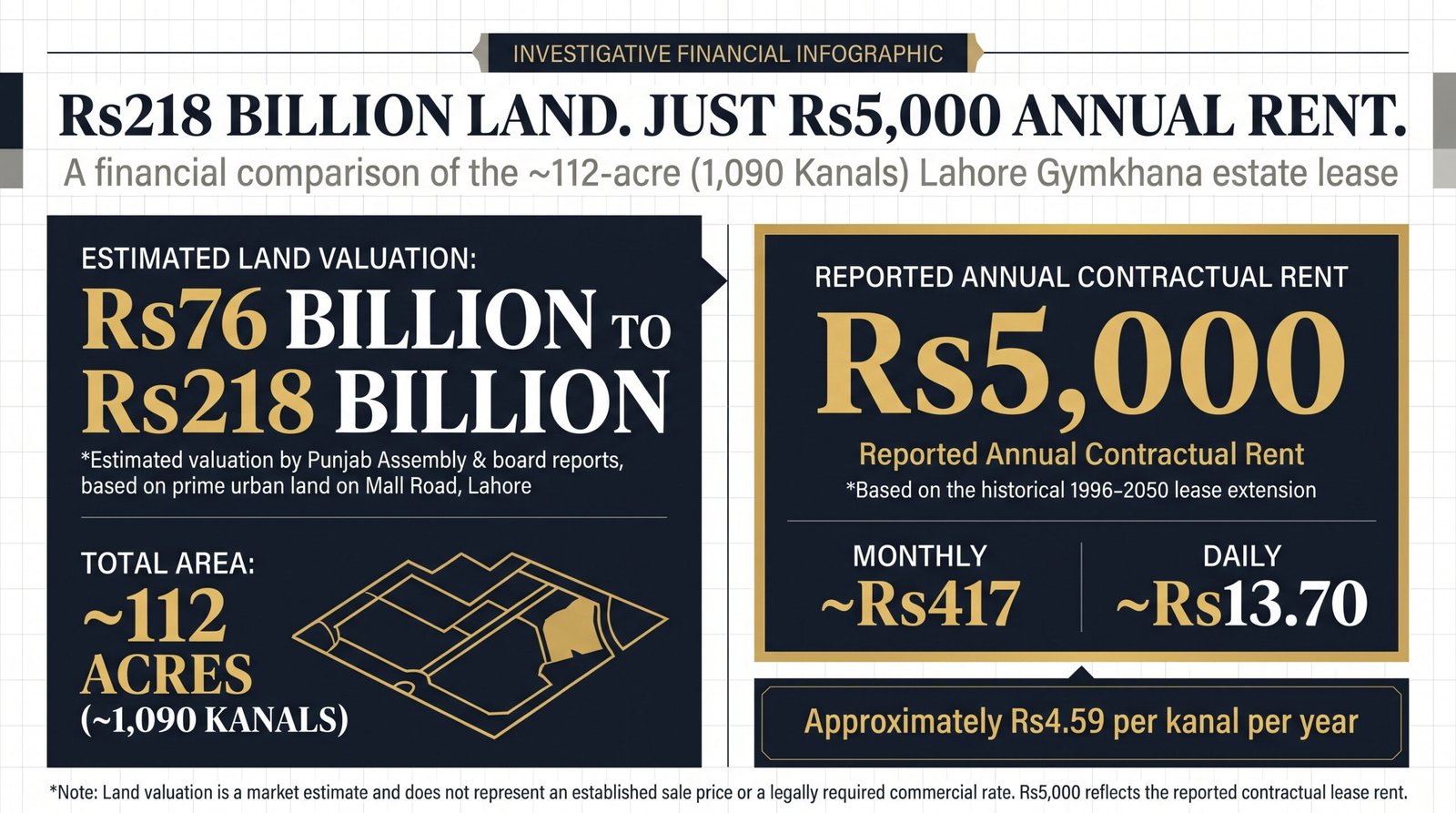
At Rs5,000 annually, the government receives approximately Rs13.70 a day from the main estate.
Spread across approximately 1,090 kanals, that works out to about Rs4.59 per kanal per year.
For comparison, even an annual rent of Rs10 million would represent a substantial increase over the existing payment while remaining modest relative to the reported land valuation.
The central issue is not necessarily whether the government should charge unrestricted commercial rent for recreational land.
It is whether a transparent, legally defensible and periodically reviewed method exists for determining what the public should receive in exchange for allowing a private institution to use a valuable state asset.
A Colonial-Era Club And A Lease That Survived Generations
Lahore Gymkhana traces its history to 1913, when the city was part of British India.
Its original arrangements involved land used for golf and recreation, and the institution subsequently developed into a prominent social club.
The rent was reportedly fixed at Rs1,600 annually in 1921 and remained unchanged for decades.
The lease arrangements underwent extensions over the years, including a major renewal in 1996.
That renewal has now become central to the parliamentary controversy.
According to records discussed before the Punjab Assembly, the lease was extended for a further 50-year period running from 2000 to 2050.
The renewal was approved in 1996, approximately four years before the existing term was due to expire.
The annual rent was fixed at Rs5,000.
The questions are obvious.
Why was a lease involving more than 100 acres of valuable government land renewed so far in advance?
What valuation was undertaken?
Which authority approved the concession?
Was the arrangement subjected to financial scrutiny?
And why was there no effective mechanism to adjust the rent in line with changing economic conditions?
These questions have acquired renewed importance because the land belongs to the state, not to the private membership of the club.
The 1996 Decision And The Role Of Former Chief Minister Arif Nakai
One of the most consequential disclosures during the October 2026 parliamentary proceedings concerned the circumstances in which the Rs5,000 annual rent was determined.
Officials from the Punjab Board of Revenue reportedly informed the committee that the nominal rent had been fixed following directions attributed to then chief minister Sardar Muhammad Arif Nakai.
One account of the proceedings described the instruction as verbal, while another referred to correspondence issued through the Board of Revenue.
The distinction matters.
A verbal instruction, a written administrative direction and a legally authorised decision supported by valuation records are not necessarily equivalent.
The committee accordingly demanded the original lease deed, government summaries, file notings, approval orders and the legal justification for the rental amount.
It also sought to establish which competent authority had approved the arrangement and under which provisions of law.
The reported involvement of a chief minister who was himself a member of the club raises a legitimate question about whether potential conflicts of interest were identified and managed.
However, the available material does not establish personal wrongdoing by Nakai or prove that the lease was unlawfully executed.
That determination requires examination of the original record and applicable law.
The broader institutional question remains: why did subsequent governments allow the arrangement to continue without resolving the concerns now being raised by legislators?
Could Punjab Have Earned Billions In Rent?
The financial implications are substantial, although estimates of potential revenue require careful interpretation.
During the parliamentary examination, comparative rental assessments suggested that applying certain residential rental benchmarks to the estate could produce theoretical annual rental values of approximately Rs3.9 billion to Rs5.2 billion.
These figures are not audited losses to the provincial treasury.
Nor do they represent sums automatically recoverable from the club.
They are illustrative estimates based on hypothetical alternative rental treatment of the land.
The distinction is essential because the club operates under a long-term lease and the estate’s recreational character may justify a different rental framework from ordinary commercial development.
Nevertheless, the comparison highlights the extraordinary scale of the concession.
Punjab’s 2023 policy for gymkhana clubs reportedly permits state land to be leased at 10 per cent of assessed market rent, with annual increases.
Applying a similar formula to the residential rental estimates cited in the proceedings would produce an indicative annual payment of Rs390 million to Rs520 million.
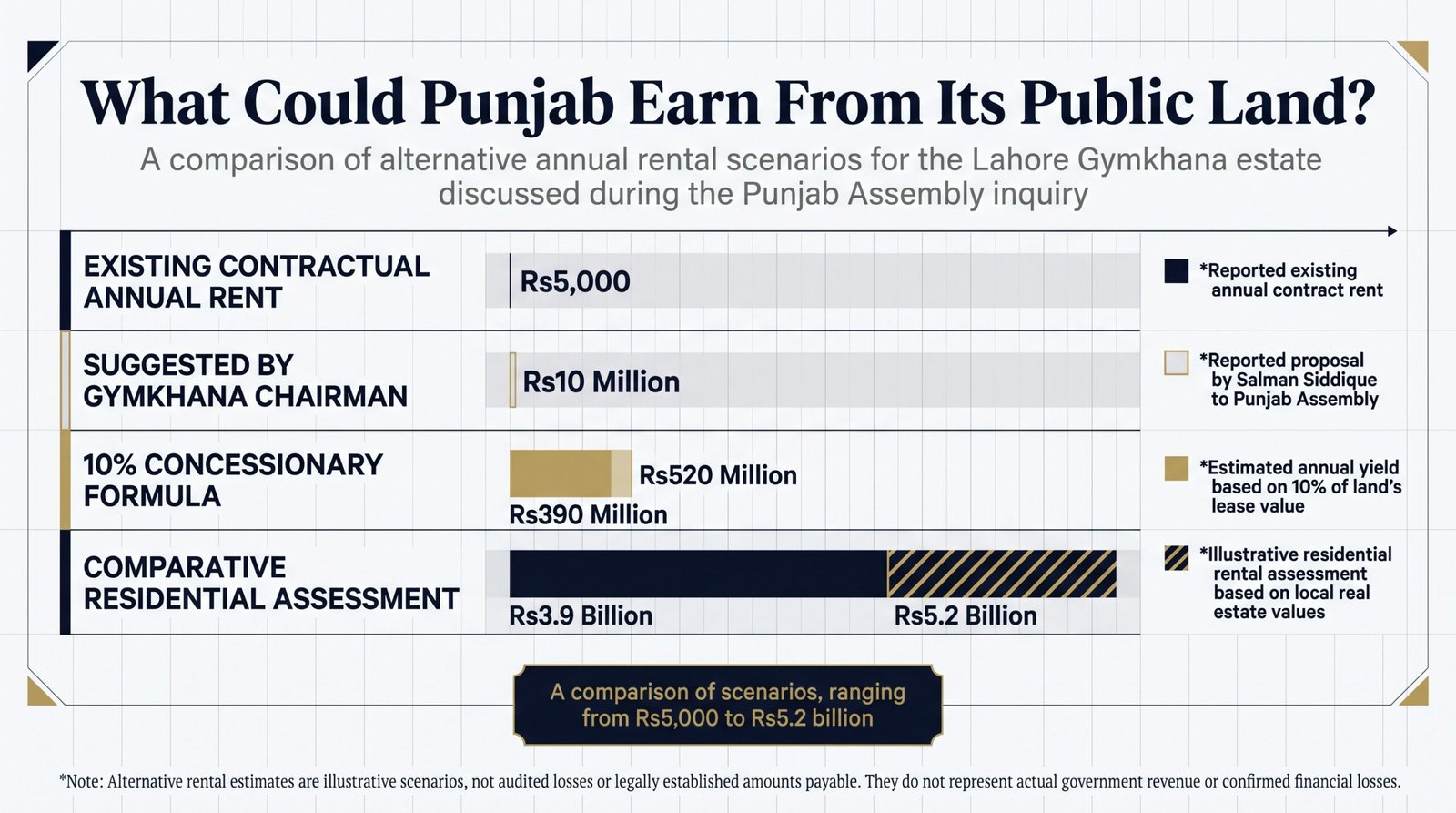
That is dramatically higher than Rs5,000.
The Board of Revenue has maintained that the 2023 policy does not apply to Lahore Gymkhana because its existing lease predates the policy.
Whether that position is legally unavoidable, or whether alternative powers exist to review the arrangement, is a question for the provincial Law Department and ultimately the courts.
The difference between a contractual entitlement and a desirable public policy cannot simply be ignored.
But neither can the state disregard the economic implications of concessions involving public assets worth tens or hundreds of billions of rupees.
A Club Chairman Acknowledges The Rent Is Inadequate
The controversy took a significant turn in October 2026 when Lahore Gymkhana Chairman Salman Siddique appeared before the Punjab Assembly’s special committee.
According to reports of the proceedings, Siddique acknowledged that the annual rent of Rs5,000 was inadequate given the size of the estate and the club’s improved financial position.
He suggested that the institution should be paying at least Rs10 million annually and expressed willingness to cooperate with the inquiry.
The acknowledgement is significant because it demonstrates that concern over the rental arrangement is not confined to legislators or outside critics.
However, Rs10 million annually would still be only a fraction of the amounts generated by some of the comparative rental models discussed before the committee.
It would also amount to approximately 0.0046 per cent of the reported upper land valuation of Rs218 billion each year.
A land-value percentage is not, by itself, a proper rental valuation.
But the comparison illustrates why a transparent methodology is needed.
The government must establish whether any revised amount should be based on recreational land-use valuation, a concessionary public-purpose formula, a negotiated lease revision or another legally sustainable mechanism.
Government Grants: Why Did An Exclusive Club Receive Public Money?
Another important dimension concerns financial assistance provided by successive governments.
Documents discussed in parliamentary proceedings identify four historical grants totalling Rs64 million.
These reportedly comprised:
- Rs2 million from President General Zia-ul-Haq in 1985.
- Rs2 million from Prime Minister Nawaz Sharif in 1985.
- Rs50 million from Chief Minister Chaudhry Pervaiz Elahi in 2006.
- Rs10 million from Chief Minister Shehbaz Sharif in 2014.
The grants span different political administrations.
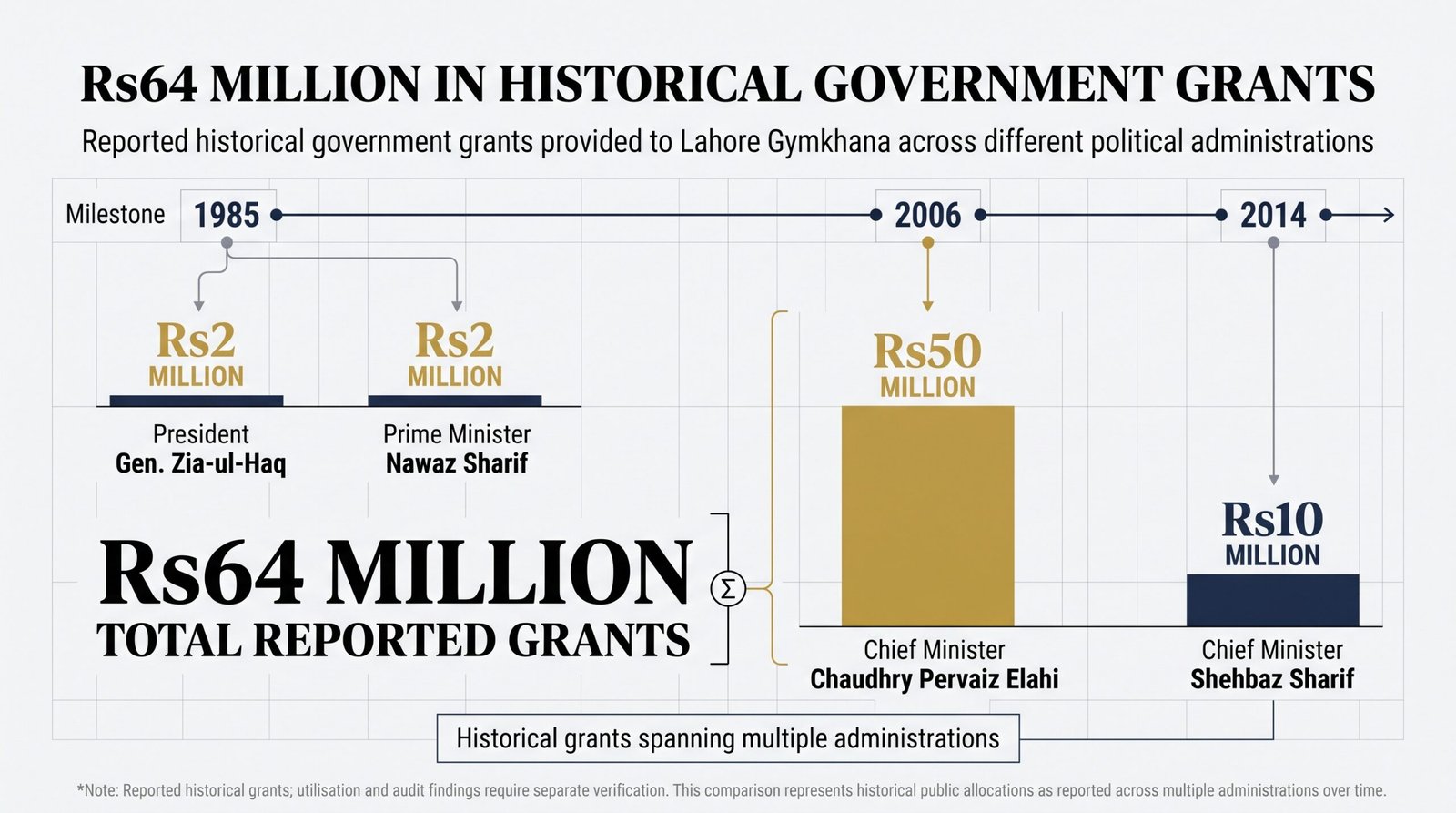
They therefore raise questions about a longstanding institutional practice rather than the decisions of any single government.
The central issue is whether public funds were allocated for clearly defined public purposes, whether the expenditures were properly authorised, and whether the intended benefits were delivered.
It would be incorrect to conclude that the grants were misappropriated merely because the recipient was a private members’ club.
Equally, the club’s private status cannot by itself settle whether public funding was justified.
The Punjab Assembly committee has sought audit findings and supporting documentation concerning the grants.
The full utilisation records, approval files and audit conclusions remain essential to determining whether the expenditure complied with the relevant financial rules.
Membership Privileges: Who Actually Benefits?
Lahore Gymkhana’s membership arrangements form another part of the controversy.
According to material reported from the parliamentary inquiry, the club’s rules provide preferential membership arrangements for civil servants in Grade 18 and above and commissioned officers of the armed forces.
These categories reportedly qualify for membership on concessional terms.
The arrangements have attracted scrutiny because senior government officials may also serve within institutions responsible for managing public property, supervising lease compliance or advising governments on financial matters.
Preferential membership does not, by itself, establish misconduct or an unlawful conflict of interest.
But it raises a governance question that deserves examination.
What safeguards exist to ensure that officials who benefit from a club’s membership privileges are not involved in decisions concerning its public-land lease without appropriate disclosure or recusal?
The committee has also examined the club’s membership criteria and access arrangements.
The club previously resisted disclosure of its membership list, reportedly describing the information as confidential.
There may be legitimate privacy considerations concerning individual members.
However, the public interest in understanding the categories of officials receiving institutional concessions is distinct from unrestricted publication of private personal information.
A credible review should examine membership rules, concessionary fee structures, governance arrangements and relevant conflict-of-interest safeguards without unnecessarily exposing private individuals.
The Right-To-Information Battle
The club’s legal position concerning public accountability has also been challenged in court.
In proceedings arising from requests for information about the lease and related records, Lahore Gymkhana argued that its corporate status meant it was not a public body for the purposes of the relevant right-to-information framework.
The Lahore High Court dismissed the club’s challenge in January 2023.
The court’s observations emphasised the public character of the underlying land and the substantial benefit associated with its concessionary use.
The decision is important because it illustrates the distinction between private corporate management and the public obligations that may arise when an institution occupies state-owned property.
A private organisation does not automatically become a government department merely because it leases public land.
Nevertheless, public authorities remain accountable for the terms on which state property is allocated, and the law may impose disclosure obligations on recipients of substantial public benefits.
The exact scope of the High Court ruling and any subsequent appellate proceedings must be considered when determining what information the club is legally required to disclose.
Buildings, Approvals And The Missing Paper Trail
The parliamentary investigation has also raised questions about structures developed on the Gymkhana estate.
Reported facilities include the main clubhouse, golf clubhouse, swimming pool, guest accommodation, health club, administrative buildings, mosque and café.
The Board of Revenue has reportedly stated that it could not locate records of the government approvals required for certain structures.
The absence of records in a department’s files is not conclusive proof that construction was unauthorised.
Approvals may exist in other official archives or may have been issued under different administrative arrangements.
Nevertheless, the reported documentary gaps require reconciliation.
The committee has sought sanctioned building plans, construction permissions, relevant fee records and evidence of compliance with the lease conditions.
There is also a separate question concerning structural safety and the applicability of planning and building regulations.
If permanent structures were erected without the approvals required at the relevant time, the authorities would need to determine the appropriate legal and administrative consequences.
Responsibility would have to be assessed individually and on the basis of the applicable law.
The Alleged Additional Land In Possession
Official records discussed during the inquiry also indicate a possible discrepancy between the land recorded in the club’s name and the area under its actual possession.
The reported difference is approximately three kanals and 16 marlas.
The Punjab Assembly committee has directed the relevant authorities to reconcile revenue records and physical possession, including particular khasra numbers.
Such a discrepancy could arise from several causes, including historical surveying differences, boundary changes, record errors or unauthorised occupation.
It would therefore be premature to describe the additional area as proven encroachment.
A definitive conclusion requires a certified demarcation, reconciliation of the record of rights and examination of any supplementary permissions.
The findings should be placed in the public domain because the question concerns government property.
The Bagh-e-Jinnah Cricket Ground Controversy
Separate from the main Gymkhana estate is the question of land used for cricket within Bagh-e-Jinnah, formerly Lawrence Gardens.
Reports based on official records have described an additional cricket ground occupying land associated with the provincial Agriculture Department.
There are discrepancies in published accounts concerning its precise size and legal arrangements.
One set of reports describes approximately three-and-a-half acres without a recorded lease, while later accounts refer to a six-acre ground subject to a separate long-term arrangement and nominal annual rent.
These differences must be resolved against the original land and lease records.
What is clear is that legislators have questioned the use of public garden land by an exclusive members’ institution.
The issue raises broader questions about access to recreational space in central Lahore.
Should a public cricket ground be reserved for a limited membership?
Are there contractual rights restricting access?
Could broader public use be introduced without compromising legitimate sporting and maintenance requirements?
These are policy and legal questions requiring evidence, rather than assumptions about the present legality of the club’s occupation.
The Audit Dispute: Can Public Assets Escape Public Scrutiny?
A particularly important part of the controversy concerns the scope of audit oversight.
During the October 2026 committee proceedings, officials discussed the club’s resistance to a commercial audit by government audit authorities.
The club’s representatives indicated that the legal dispute remained before the Supreme Court and that the institution would comply with the eventual judicial determination.
The distinction between auditing a private company’s entire business and auditing its receipt or use of public resources is important.
A club may maintain its own corporate accounts and comply with company law while separate questions remain about the use of state land, public grants and other concessions.
Whether the Auditor General has jurisdiction over particular aspects of Lahore Gymkhana’s finances depends on the constitutional and statutory framework and the outcome of the relevant litigation.
No final conclusion about that jurisdiction should be drawn while the matter remains unresolved.
Nevertheless, the public authorities responsible for the lease should be able to account for the terms of the concession, rent collection, compliance monitoring and the expenditure of public funds.
Was Even The Nominal Rent Paid Regularly?
The controversy is complicated further by reports that the club had not consistently paid even the modest annual rent.
Earlier reporting based on official records referred to a notice issued by the Additional Deputy Commissioner’s office in August 2020 concerning rent reportedly unpaid since 2011.
The present status of those alleged arrears has not been independently established.
It is therefore necessary to determine whether the outstanding amounts were subsequently paid, adjusted, disputed or recovered.
If arrears remain, the authorities should disclose the recoverable amount, any applicable penalties and the steps taken to enforce the lease.
The monetary sum involved may be small compared with the land valuation.
The institutional significance is much greater.
If the state cannot demonstrate effective collection and monitoring of rent under a major lease, questions arise about the broader administration of public property.
Twenty Months Of Parliamentary Delay
The Punjab Assembly established Special Committee No. 6 in September 2024 to examine Lahore Gymkhana’s land and lease arrangements.
The committee was initially expected to submit its findings within two months.
However, by June 2026, it had reportedly met only once, on September 30, 2024, and had not produced the required report.
The delay lasted approximately 20 months.
The committee’s terms of reference included the legality of the lease, compliance with the government’s 2023 policy, building approvals, potential financial implications for the treasury, land-use arrangements and membership rules.
These were substantial questions involving a valuable public asset.
The prolonged delay raises a separate accountability issue concerning the effectiveness of legislative oversight.
Why was the inquiry not completed within its original timeframe?
Were records unavailable?
Did government departments fail to cooperate?
Were there procedural obstacles?
Or did the committee simply fail to pursue its mandate with sufficient urgency?
The available reports do not establish the cause of the delay.
But the passage of time itself demonstrates the need for enforceable reporting deadlines and public disclosure of parliamentary findings.
October 2026: Parliamentary Scrutiny Intensifies
The issue returned to the Punjab Assembly’s agenda in October 2026.
Special Committee No. 6, chaired by Samiullah Khan, summoned senior government officials and representatives of Lahore Gymkhana.
The proceedings examined the 1996 lease, valuation methodology, government approvals, public grants, land records and the unresolved audit dispute.
Among the legislators raising questions were Amjad Ali Javed, Chaudhry Iftikhar Hussain Chhachhar, Ahmad Iqbal Chaudhry and Syed Ali Haider Gilani.
The committee demanded documentary evidence rather than relying solely on departmental explanations.
It also directed further fact-finding, including legal examination of the relevant records.
The proceedings reflected a growing concern that the public interest cannot be assessed solely through the club’s internal financial and corporate arrangements.
The government, as custodian of public land, must be able to explain why a particular concession was granted, how it has been monitored and whether it continues to serve a legitimate purpose.
November 2026: The Investigation Expands Across Punjab
The controversy has now developed beyond Lahore Gymkhana.
On November 3, 2026, it was reported that the Punjab Assembly’s Public Accounts Committee-I had directed provincial authorities to compile records of government land leased to public and private members’ clubs across Punjab.
The committee, chaired by Chaudhry Iftikhar Hussain Chhachhar, ordered the relevant departments to provide lease documentation and compliance information within 30 days.
The directions were issued during scrutiny of audit matters relating to the Board of Revenue and associated institutions.
The development is significant because Lahore Gymkhana may not be an isolated case.
Punjab has a wider network of gymkhana clubs and other institutions occupying public land under various concessionary arrangements.
The financial, legal and public-interest implications of those arrangements may differ substantially.
A province-wide review could establish whether there are consistent standards for land valuation, lease duration, rent escalation, construction approvals, public access and audit oversight.
It could also reveal whether the government maintains an accurate central inventory of valuable land allocated to recreational and membership institutions.
The 2023 Gymkhana Policy: A Wider Question Of State Subsidies
In May 2023, Punjab’s caretaker government introduced a policy allowing land to be allocated to gymkhana clubs at a concessionary proportion of market rent.
The policy reportedly provides for rent at 10 per cent of market levels, subject to an annual increase.
According to figures presented in earlier reporting, concessionary rents for gymkhana land in different districts have varied considerably.
This raises a wider policy question.
What public benefit justifies such concessions?
Recreational institutions can provide legitimate social, sporting and community benefits.
But where access is restricted primarily to paying members, the government should establish how those benefits compare with the public value of the land and any financial concessions.
A concession may be justified by public-purpose obligations, affordable sports facilities, youth programmes or broader community access.
The essential requirement is that those obligations should be explicit, measurable and enforceable.
Otherwise, the government risks providing valuable public assets without a clearly documented return to the wider population.
Can The Government Terminate The Lease?
Perhaps the most consequential legal question concerns the government’s powers under the 1996 lease.
According to the Punjab Law Department’s opinion reported during parliamentary proceedings, Clause 6 allows the government to terminate the lease on six months’ notice for a public purpose or in circumstances permitted by the agreement.
Clause 8 has also been cited as restricting compensation for structures erected on the land.
These reported provisions could have major implications for the future of the estate.
However, the existence of a termination clause does not automatically establish that the government may repossess the property without satisfying contractual conditions, procedural requirements or other applicable laws.
Any decision would require a detailed legal examination of the original deed and relevant judicial precedents.
Possible policy options include renegotiating the rental terms, imposing clearer public-benefit obligations, revising access arrangements, enforcing existing conditions or considering recovery of the land for a legally established public purpose.
Each option carries different legal, financial and administrative consequences.
The choice must ultimately be based on law, evidence and a transparent assessment of the public interest.
Should Part Of The Estate Become A Public Park?
One proposal discussed in the Punjab Assembly would substantially alter the present use of the land.
Resolution No. 288, moved by Amjad Ali Javed and Rao Kashif Rahim Khan, called for approximately 100 acres to be converted into a public park and urban forest while retaining a smaller portion for the club.
The proposal also raised the possibility of wider public access to the cricket ground.
Supporters have linked the idea to Lahore’s need for accessible green space and efforts to address environmental deterioration.
The proposal requires careful evaluation.
The Gymkhana estate already contains significant open and green areas, and any redevelopment or change of use should preserve existing tree cover and ecological value.
A public park could improve access, but its management, security, maintenance, sporting facilities and environmental impact would need to be assessed.
Conversely, retaining the current arrangement would require a clear explanation of why exclusive access remains appropriate for land owned by the public.
The question is not simply whether the estate should remain green.
It is who should be able to benefit from that green space and on what terms.
Delhi Gymkhana And The International Comparison
The controversy has also drawn attention to Delhi Gymkhana, another institution with roots in the colonial period.
In 2026, Indian authorities moved to recover land leased to Delhi Gymkhana, invoking provisions relating to public purpose.
The comparison is relevant because both institutions have historical leases involving valuable public land.
However, the two cases arise under different legal systems, lease documents and administrative circumstances.
The Indian decision does not establish what the Punjab government is legally entitled or required to do.
It does, however, illustrate how governments may reassess longstanding recreational land concessions when questions arise about public purpose and the management of state assets.
The Broader Pattern: Public Land And Private Privilege
Lahore Gymkhana is part of a wider debate about valuable public land occupied by membership institutions, clubs and other organisations.
Similar questions have arisen over recreational facilities in Lahore and Islamabad.
These arrangements are not necessarily unlawful, and they cannot all be treated as identical.
Some institutions may provide substantial public services, maintain valuable sporting infrastructure or operate under legally protected arrangements.
Others may benefit from concessions whose original justifications have not been reviewed for decades.
A comprehensive government inventory should identify the land area, ownership, legal instrument, lease duration, rent, concessions, public-benefit conditions and compliance status of each institution.
Such a review would allow comparisons based on documented facts rather than institutional reputation or political influence.
It would also help establish whether concessionary state-land policies are being administered consistently.
Successive Governments And The Responsibility To Protect Public Assets
The Lahore Gymkhana controversy cannot be reduced to the actions of one chief minister, one political party or one club chairman.
The lease arrangement has continued through numerous provincial administrations.
Historical grants were reportedly provided under different governments.
Questions about land valuation, rent collection, building permissions and oversight persisted for years before parliamentary scrutiny intensified.
Responsibility must therefore be examined across institutions and administrations.
The Board of Revenue is central because of its role in managing state land and maintaining lease records.
The provincial government is responsible for the policy framework.
Relevant planning and regulatory authorities must account for construction permissions and land-use compliance.
Audit authorities have a role within the jurisdiction established by law.
And the Punjab Assembly must ensure that its inquiries produce findings rather than remaining indefinitely unresolved.
Where particular officials are alleged to have acted improperly, the evidence must be examined individually.
But the larger problem is institutional: whether public assets are subject to consistent oversight regardless of the identity or influence of their users.
What Lahore Gymkhana Must Explain
A complete public account from Lahore Gymkhana would need to address several matters.
First, the club should explain the legal and historical basis of its lease and whether it accepts the land valuation methodology presented before the Assembly.
Second, it should provide an account of rent payments, including the status of any historical arrears.
Third, it should identify the approvals obtained for buildings and other permanent structures, together with the relevant records.
Fourth, it should explain the purposes for which government grants were received and how those funds were utilised.
Fifth, it should clarify its membership rules, concessionary categories and the safeguards governing potential conflicts of interest.
Sixth, it should explain the scope of its objections to government auditing while respecting the pending judicial proceedings.
Finally, it should describe the public benefits delivered through its sporting, recreational and other activities.
The club’s history, sporting contribution and corporate status are relevant considerations.
But they do not eliminate legitimate questions concerning the management of state-owned land.
What The Punjab Government Must Answer
The government faces an equally substantial set of questions.
Why was the 1996 lease approved on the terms reported?
What valuation or legal advice supported the decision?
Were rent reviews considered during subsequent administrations?
Why was the 2023 gymkhana policy deemed inapplicable to the existing arrangement?
What steps were taken to recover any unpaid rent?
Have the alleged land discrepancies been conclusively resolved?
What is the status of building approvals and public-grant audits?
And what action will follow the findings of the parliamentary and legal inquiries?
The government must also explain whether it intends to maintain the present arrangement, negotiate revised terms or consider other lawful options for the estate.
Any decision should account for contractual rights, public access, environmental preservation, financial implications and the legitimate interests of affected parties.
The Real Cost Of A Concession
It would be misleading to calculate Punjab’s historical financial loss simply by multiplying today’s estimated commercial rent by the number of years Lahore Gymkhana has occupied the estate.
Land values, rental markets, contractual obligations and applicable policies have changed substantially over time.
A reliable estimate would require year-by-year valuation, an assessment of legally recoverable amounts and consideration of the estate’s permitted use.
Nevertheless, the financial implications cannot be dismissed.
The reported land valuation reaches Rs218 billion.
The contractual annual rent is reported at Rs5,000.
Comparative rental assessments presented during the inquiry run into hundreds of millions or billions of rupees annually, depending on the assumptions used.
The discrepancy is substantial enough to justify independent financial and legal examination.
It also illustrates the difference between a concession that is merely longstanding and one whose continued public benefit has been demonstrated.
The Question Punjab Can No Longer Avoid
Lahore Gymkhana has survived political transitions, changes in government, administrative reforms and repeated public debates over the management of state assets.
Its lease has remained in place while the surrounding city has undergone enormous economic transformation.
The club’s members have continued to enjoy a prominent recreational institution on prime public land.
Yet the provincial government is now being asked to explain why the annual rent remains so low, whether the lease was properly approved, how public grants were spent, whether all structures were authorised and what obligations the club owes to the wider public.
These questions do not establish that Lahore Gymkhana has committed a criminal offence or that its lease is invalid.
They do establish the need for a transparent examination of the decisions made by the state and the obligations arising from the club’s use of public property.
The latest parliamentary proceedings provide an opportunity to resolve matters that have remained contested for years.
But the outcome will depend on whether the authorities produce the original records, complete the legal and financial scrutiny and disclose their findings.
The ultimate test is not whether Lahore Gymkhana can afford to pay more rent.
It is whether Punjab can demonstrate that one of its most valuable public assets is being managed under a lawful, transparent and defensible arrangement that serves the public interest.
For an estate reportedly valued at up to Rs218 billion, an annual rent of Rs5,000 is no longer a figure that can be left unexplained.