

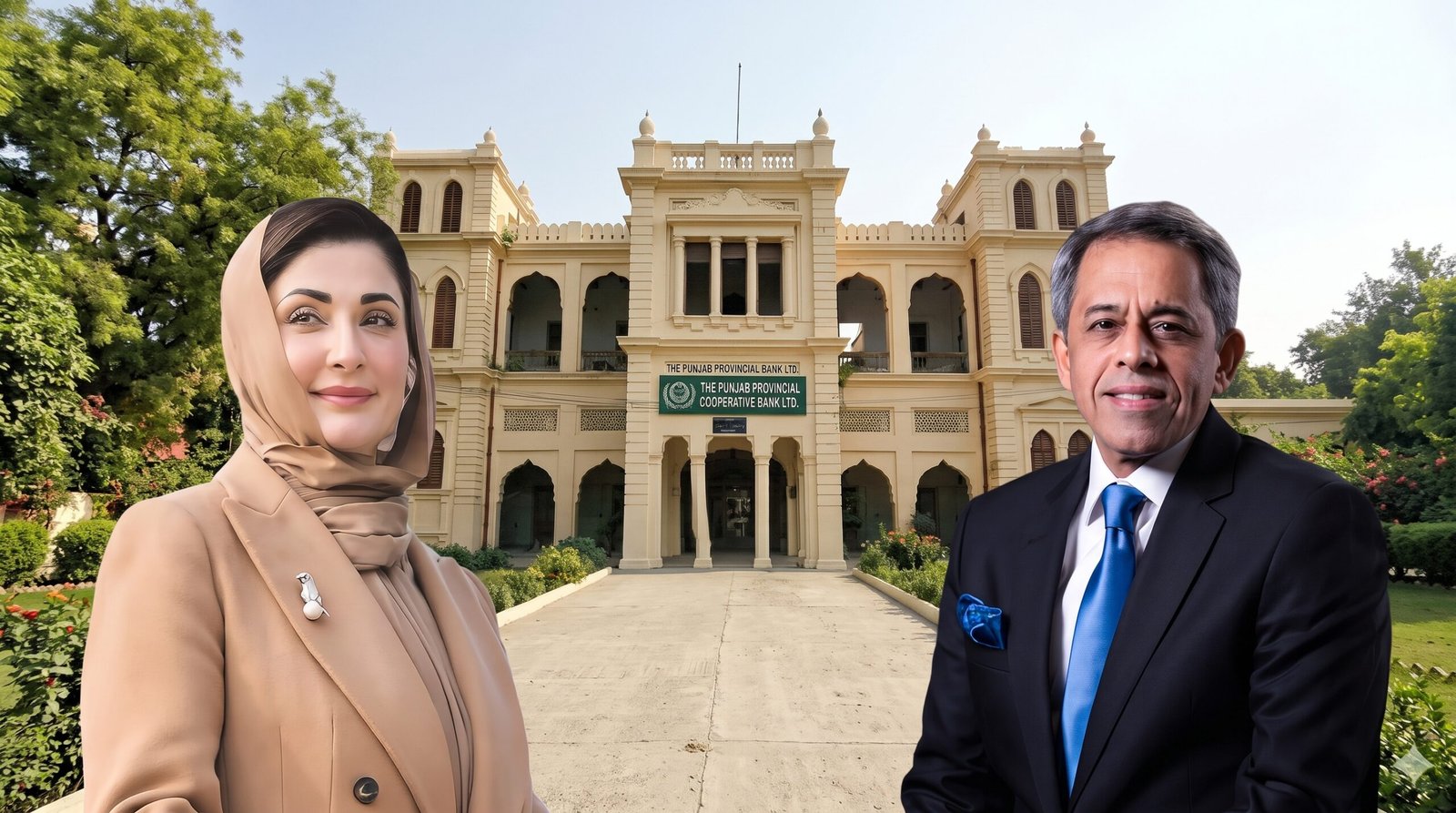
LAHORE: Punjab Chief Minister Maryam Nawaz Sharif has set in motion an ambitious restructuring of the century-old Punjab Provincial Cooperative Bank Limited (PPCBL), with plans to transform the Rs51 billion financial institution into Punjab Kisan Bank and place it under the administrative control of the Finance Department, a senior source in the Chief Minister’s Office confirmed to The Scoop.
The move represents a significant development in Punjab’s agricultural banking landscape, as the provincial government seeks to modernise an existing financial institution with substantial assets, an established branch network and a renewed mandate to serve the province’s farming community.
At the centre of the transformation is Shahram Raza Bakhtiari, President and Chief Executive Officer of PPCBL, a veteran banker with more than 36 years of experience in the financial sector, who has been building a management team comprising professionals with expertise in strategy, retail banking, digital transformation and financial services.
Appointed approximately a year ago, Bakhtiari has been spearheading efforts to strengthen the institution’s management capabilities, modernise its operations and prepare it for a broader agricultural financing role.
The recent recruitment of Muhammad Hassan Tariq as Group Head of Strategy, Products & Transformation, Mir Aamir Nawaz as Group Head of Retail Banking and Sheraz Sharif as Group Head of Digital Banking reflects the bank’s emphasis on assembling a professional leadership team capable of undertaking a complex institutional overhaul.
According to the senior Chief Minister’s Office source, the provincial government is serious about restructuring and rebranding PPCBL as Kisan Bank, aligning the institution with Maryam Nawaz’s agricultural financing vision, which took shape in 2024 and was reinforced through her October 28, 2026 announcement concerning Apna Kisan Bank.
The restructuring comes as PPCBL has reported improvements in its financial position, strengthened its management structure and initiated digital modernisation measures.
Chief Minister’s Office Confirms Major Restructuring
An official notification issued by the Chief Minister’s Office on November 4, 2026, and obtained by The Scoop, confirms that Maryam Nawaz has directed the transfer of administrative control of Punjab Kisan Bank Limited, formerly Punjab Provincial Cooperative Bank Limited, from the Cooperatives Department to the Finance Department.
The notification, marked “Top Priority”, was issued by Principal Secretary to the Chief Minister Sajid Zafar Dall.
The directive invokes Rule 3(4) of the Punjab Government Rules of Business, 2011, and instructs the Implementation and Coordination Wing of the Services and General Administration Department to process consequential amendments to the First and Second Schedules of the Rules of Business.
The amendments are to be prepared in consultation with the Cooperatives Department, Finance Department and Law and Parliamentary Affairs Department through a summary submitted to the chief minister.
However, a senior source in the Chief Minister’s Office confirmed to The Scoop that the government’s intentions extend beyond transferring administrative control from one department to another.
The provincial administration intends to undertake a comprehensive restructuring of the institution, including its rebranding as Kisan Bank, strengthening its financial and operational capabilities and developing a more focused agricultural banking model.
The source indicated that the existing bank’s financial resources, infrastructure and professional management team are important components of the proposed transformation.
While the November 4 directive formally establishes the administrative decision, the detailed restructuring framework, final corporate naming arrangements and implementation timetable have yet to be publicly disclosed.
Maryam Nawaz’s Agricultural Banking Vision Moves Towards Implementation
The proposed transformation is closely linked to Maryam Nawaz’s agricultural financing agenda, which has remained a prominent component of her government’s economic policies since she assumed office in 2024.
The Punjab government introduced the Kisan Card programme to improve farmers’ access to institutional financing and agricultural inputs, particularly fertilisers and seeds.
The programme was intended to reduce dependence on informal borrowing and provide farmers with more structured financial support.
On October 28, 2026, Maryam Nawaz announced plans for Apna Kisan Bank alongside a Rs17 billion subsidised agricultural financing package.
The announcement included financing proposals aimed at supporting agricultural activities, mechanisation and productivity.
Under the announced arrangements, eligible borrowers would be able to access financing of up to Rs10 million at zero markup, up to Rs30 million at two per cent and up to Rs50 million at five per cent, subject to the applicable programme conditions.
The chief minister also announced an increase in the Kisan Card financing limit for DAP fertiliser from Rs30,000 to Rs33,500 per acre.
The latest decision to restructure PPCBL provides a potential institutional platform for implementing the government’s broader agricultural financing objectives.
However, the provincial administration has not yet publicly clarified which financing schemes will be operated directly through the restructured bank or whether the entire announced Rs17 billion package will be channelled through the institution.
Shahram Raza Bakhtiari: Veteran Banker Leading The Transformation
The leadership of Shahram Raza Bakhtiari is a central element of PPCBL’s ongoing modernisation and proposed transformation into Kisan Bank.
With more than 36 years of professional experience, Bakhtiari has held senior leadership positions at prominent financial institutions, including serving as President and Chief Executive Officer of Silkbank and holding senior responsibilities at Standard Chartered Bank Pakistan and Union Bank.
His professional background encompasses commercial banking, retail banking, credit management, institutional leadership, business development and organisational transformation.
Appointed approximately a year ago, Bakhtiari has been leading efforts to modernise the century-old institution and strengthen its management structure.
An important aspect of his approach has been the recruitment of experienced banking professionals with expertise across strategy, products, retail distribution, digital banking and financial operations.
The management structure being developed under his leadership is particularly relevant to the bank’s proposed transformation.
Unlike conventional commercial banking, agricultural financing requires products and repayment structures that reflect seasonal incomes, crop cycles, commodity price fluctuations, weather-related risks and the economic circumstances of farmers.
Transforming PPCBL into a modern agricultural financing institution will therefore require a combination of commercial banking discipline, technological innovation, professional governance and an understanding of rural financial markets.
Bakhtiari’s extensive banking experience provides expertise relevant to these requirements.
As President and Chief Executive Officer, he carries overall executive responsibility for aligning the institution’s financial, operational and strategic priorities.
His role is also significant because the transformation is being undertaken within an established financial institution rather than a newly created banking organisation.
The challenge is to modernise an existing institution, preserve its financial stability and develop the capabilities required to support an expanded agricultural lending mandate.
Also Read: Pakistan After USA Midterms
Bakhtiari Builds Experienced Banking Leadership Team
One of the most notable developments in PPCBL’s modernisation has been the strengthening of its senior management team.
The recruitment of professionals with experience in international and domestic financial institutions reflects an emphasis on specialised expertise in banking strategy, retail distribution, product innovation and digital transformation.
Three executives in particular represent important components of the management structure being developed under Bakhtiari’s leadership.
Muhammad Hassan Tariq: Strategy, Products And Transformation
Muhammad Hassan Tariq joined PPCBL in April 2026 as Group Head of Strategy, Products & Transformation.
A seasoned banking professional with more than two decades of senior executive experience, Tariq has worked with international financial institutions including ABN AMRO and Royal Bank of Scotland, as well as leading Pakistani banks such as MCB Bank, United Bank Limited, Faysal Bank, Silkbank and MCB Islamic Bank.
His professional experience spans retail and consumer banking, commercial and SME lending, wealth management, strategic planning, product development and digital financial services.
As Group Head of Strategy, Products & Transformation, Tariq is responsible for developing the bank’s corporate strategy, introducing banking products, improving customer experience and supporting institution-wide transformation initiatives.
His mandate includes business transformation, product innovation, digital adoption and the development of scalable customer acquisition channels.
Throughout his career, Tariq has managed substantial banking portfolios and led sales, product and digital teams serving large customer bases.
He holds a postgraduate degree in Business and Information Technology from the University of the Punjab and has completed specialised executive programmes in leadership, credit management and restructuring.
His experience in strategy and banking transformation is particularly relevant to the proposed Kisan Bank, which will require new agricultural financing products, modern customer acquisition systems and improved service delivery.

Mir Aamir Nawaz: Strengthening Retail Banking And Distribution
Another important addition to the management team is Mir Aamir Nawaz, Group Head of Retail Banking.
An experienced retail banking executive, Nawaz brings expertise in managing extensive banking distribution networks, lending businesses and retail portfolios.
His professional background includes senior responsibilities at institutions such as Dubai Islamic Bank, United Bank Limited and Soneri Bank.
His experience in managing large branch networks and retail lending operations is particularly relevant to PPCBL’s proposed transformation.
A modern agricultural bank requires an effective distribution network capable of reaching farmers across Punjab, developing customer relationships and delivering financial products efficiently.
Nawaz’s expertise in retail banking, lending and distribution provides capabilities that could support the expansion and modernisation of the institution’s customer-facing operations.
His responsibilities are expected to be important in developing a banking model that combines established branch infrastructure with modern retail financial services.
Sheraz Sharif: Developing The Digital Banking Ecosystem
Sheraz Sharif, Group Head of Digital Banking, is another important member of the bank’s management team.
Sharif brings experience in digital banking and the development of digital financial ecosystems, including building technology-enabled banking services and customer-focused digital platforms.
His expertise is particularly relevant to the institution’s ambition to modernise its operations and develop more efficient banking channels.
Digital banking could play an important role in improving access to agricultural finance by simplifying loan applications, accelerating processing and reducing reliance on manual procedures.
The bank’s existing digital modernisation initiatives provide a foundation for developing these capabilities.
Sharif’s responsibilities in digital banking complement the strategic and operational functions of the wider management team.
A Coordinated Leadership Structure
The recruitment of Tariq, Nawaz and Sharif reflects the development of a management structure covering three important areas of modern banking: strategy and transformation, retail distribution and digital financial services.
Together, these functions are essential to the proposed restructuring of PPCBL.
Tariq brings expertise in strategy, products and organisational transformation; Nawaz contributes experience in retail banking, lending and distribution; while Sharif provides capabilities in digital banking and technology-enabled financial services.
Under Bakhtiari’s overall executive leadership, the combination of these specialised functions provides an organisational foundation for the bank’s modernisation.
The effectiveness of the team will ultimately depend on coordinated execution, financial discipline and measurable improvements in the institution’s banking operations.
Rs51 Billion In Assets: Financial Strength Behind The Overhaul
The scale of the proposed restructuring becomes clearer when PPCBL’s financial position is examined.
According to the Pakistan Credit Rating Agency’s March 2026 assessment, the bank reported total assets of approximately Rs51.41 billion as of September 2025, compared with Rs35.84 billion in June 2024.
This represents asset growth of approximately 43 per cent over the period.
The bank’s deposits increased from approximately Rs7.98 billion in June 2024 to Rs10.85 billion in September 2025.
Its equity stood at approximately Rs37.35 billion, while gross advances reached Rs15.2 billion.
The institution also reported a capital adequacy ratio of approximately 25.7 per cent as of September 2025.
These figures demonstrate that the government is restructuring an established financial institution with substantial resources, an existing customer base and a significant capital position.
The bank’s financial resources could provide a foundation for expanding lending operations, subject to prudent risk management, regulatory requirements and the availability of suitable financing opportunities.
However, the government has not yet disclosed whether the restructuring will involve additional capital injections, changes in ownership or new financial commitments.
Credit Rating Upgrade Reflects Improving Financial Position
PPCBL’s recent financial performance provides another important dimension to the transformation.
In March 2026, PACRA upgraded the institution’s long-term credit rating from BBB+ to A-, while maintaining its short-term rating at A2 with a stable outlook.
The rating agency highlighted improvements in the bank’s financial profile, capitalisation, management structure and asset quality.
According to PACRA, the bank’s non-performing loan ratio declined to approximately 1.2 per cent by September 2025.
The improvement followed measures that included the charge-off of approximately Rs1.276 billion in legacy exposures.
While a charge-off does not necessarily represent cash recovery, the reduction in reported non-performing exposures is relevant to assessing the institution’s asset-quality indicators.
The bank’s capital adequacy ratio of approximately 25.7 per cent as of September 2025 also indicates a substantial capital buffer at that reporting date.
These developments provide an important financial backdrop to the restructuring being pursued under Bakhtiari’s executive leadership.
However, financial improvements recorded across different periods cannot be attributed exclusively to any individual executive without a detailed assessment of management decisions and their timing.
The challenge for the bank’s leadership will be to maintain financial stability while expanding agricultural lending and introducing new banking services.
Finance Department Control Could Strengthen Financial Oversight
The transfer of PPCBL from the Cooperatives Department to the Finance Department represents a consequential administrative decision.
The Cooperatives Department has historically been responsible for cooperative societies and related institutional arrangements.
The Finance Department, by contrast, oversees provincial fiscal management, budgeting and financial resource planning.
Placing Kisan Bank under the Finance Department could facilitate closer coordination between the institution’s financial operations and the government’s agricultural development priorities.
It may also allow more systematic monitoring of capital requirements, lending performance, government-supported financing programmes and the fiscal implications of subsidised agricultural credit.
The move could support a more integrated approach to agricultural banking and provincial financial planning.
However, administrative supervision by the Finance Department does not replace the regulatory responsibilities of the State Bank of Pakistan.
The institution must continue to comply with applicable banking laws, prudential requirements and governance standards.
Any changes to its regulated operations, corporate structure or licensing arrangements would need to follow the relevant legal and regulatory procedures.
Punjab Government Holds Approximately 95 Per Cent Of Bank
The ownership structure of PPCBL is another important factor in the restructuring.
According to PACRA, the Government of Punjab holds approximately 95 per cent of the bank, while cooperative societies collectively own the remaining five per cent.
The provincial government is therefore already the institution’s overwhelmingly dominant shareholder.
The administrative transfer could bring the oversight of the government’s ownership interests closer to the department responsible for provincial financial management.
However, the government has not announced any change in ownership percentages.
It has also not publicly disclosed whether the restructuring will involve a new board, additional capital or changes to the rights of cooperative shareholders.
These matters will require clarification as the transformation progresses.
Digital Banking To Become Important Part Of Transformation
Digital transformation is expected to be an important component of PPCBL’s modernisation programme.
The bank has already entered into an agreement with AutoSoft Dynamics for the implementation of a Loan Origination System intended to automate important stages of the lending process.
The technology is designed to streamline loan applications, credit assessments, approvals and disbursements.
Such systems can improve processing efficiency, reduce manual paperwork, strengthen recordkeeping and support more consistent lending decisions.
The bank’s board has also considered initiatives aimed at improving digital capabilities, operational efficiency and customer services.
At its 16th meeting, the board reviewed the institution’s performance and approved measures relating to digital transformation and organisational development.
For an agricultural financing institution, digital banking could eventually improve access to credit for farmers, particularly if supported by reliable borrower identification, land records and agricultural data.
However, technological modernisation must be accompanied by appropriate cybersecurity safeguards, staff training and accessible customer services.
The proposed transformation will also need to account for farmers who have limited access to digital banking facilities.
Why Punjab Needs A Dedicated Agricultural Banking Model
Agriculture remains central to Punjab’s economy, supporting rural employment, food production, exports and several major industries.
Yet farmers continue to face challenges in obtaining affordable and timely institutional financing.
Small and medium-sized farmers, in particular, may struggle with collateral requirements, complicated documentation, seasonal repayment schedules and limited access to formal banking services.
Many agricultural borrowers require financing before sowing crops but generate income only after harvesting and selling their produce.
Traditional banking products do not always accommodate these cash-flow patterns.
A restructured Kisan Bank could potentially introduce financing products specifically designed around agricultural production cycles.
These could include seasonal crop loans, financing for tractors and machinery, irrigation systems, livestock development, cold storage, food processing and other productive investments.
The institution could also explore financing arrangements for tenant farmers and agricultural enterprises that are underserved by conventional banking channels.
However, expanding agricultural credit must be accompanied by effective risk assessment, transparent lending criteria and strong loan recovery mechanisms.
The objective should be to improve financial inclusion without compromising the institution’s long-term sustainability.
A Century-Old Institution Entering A New Era
PPCBL traces its origins to 1924 and obtained scheduled bank status in 1955.
For more than a century, the institution has been associated with cooperative banking and agricultural financing.
Its established branch network, financial resources and institutional history provide a foundation for the government’s proposed transformation.
Rather than creating an entirely new bank, the Punjab government is seeking to reshape an existing institution around a renewed agricultural financing mandate.
This approach could allow the government to utilise established banking infrastructure while introducing modern management practices, new financial products and improved technology.
Nevertheless, the restructuring must address the interests of existing cooperative borrowers, minority shareholders, employees and other stakeholders.
The government will also need to clarify how the new banking identity will relate to the existing Kisan Card programme and other agricultural financing initiatives.
The Real Test Of Maryam Nawaz’s Kisan Bank Vision
The proposed transformation of PPCBL into Kisan Bank represents an important stage in Maryam Nawaz’s agricultural financing agenda.
The November 4 notification establishes the administrative transfer, while a senior Chief Minister’s Office source has confirmed that the government intends to undertake a wider restructuring and rebranding programme.
The October 28 announcement of Apna Kisan Bank provides the policy context for the initiative.
The institution enters this process with more than Rs51 billion in reported assets, substantial government ownership, an established branch network and a strengthened management structure.
At the executive level, Shahram Raza Bakhtiari brings decades of banking experience and overall leadership responsibility, supported by Muhammad Hassan Tariq, Mir Aamir Nawaz, Sheraz Sharif and other specialists in strategy, operations, technology and financial management.
The recruitment of experienced banking professionals provides the institution with capabilities relevant to its proposed transformation.
However, the success of the initiative will ultimately depend on implementation rather than appointments or administrative changes alone.
The government will need to establish transparent governance arrangements, clearly defined lending priorities, sustainable financing mechanisms and measurable performance indicators.
The most important outcomes will include improved access to affordable agricultural credit, stronger loan recovery, greater financial inclusion and measurable support for productive investment in Punjab’s farming economy.
For Bakhtiari and his management team, the transformation represents a substantial institutional responsibility: modernising a century-old bank while preserving financial discipline and expanding its relevance to agricultural borrowers.
For the Punjab government, it provides an opportunity to demonstrate how an existing public-sector financial institution can be repositioned to support wider economic development.
Maryam Nawaz’s decision has set the institutional transformation in motion, with veteran banker Shahram Raza Bakhtiari leading the bank’s executive management through a potentially defining period in its history. Whether Kisan Bank becomes a major instrument of agricultural development will ultimately depend on the financial services it delivers to Punjab’s farmers.