

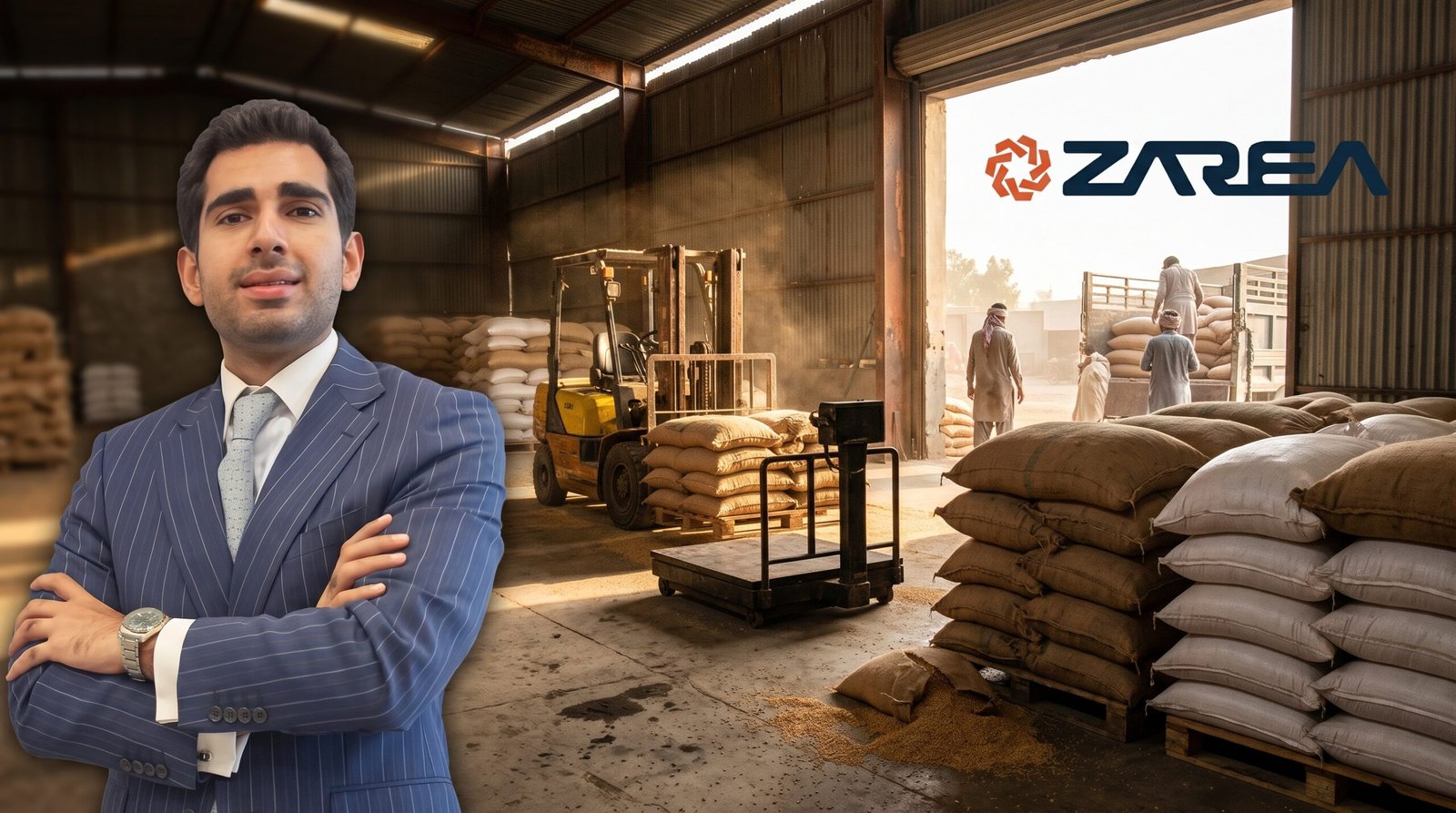
Zarea Limited, one of Pakistan’s emerging technology-enabled commodity trading companies, is seeking to raise Rs3 billion through a rights issue to repay a recently issued Rs2 billion Sukuk and finance an ambitious expansion of its agricultural commodities business, marking a significant development in the company’s financing strategy.
The proposed fundraising comes less than two years after Zarea’s listing on the Pakistan Stock Exchange (PSX) and just weeks after the company secured Rs2 billion through a privately placed Islamic financing instrument.
While the transaction is intended to strengthen Zarea’s balance sheet, reduce financing obligations and support future expansion, its timing raises an important question: why is a company reporting substantial profitability seeking fresh shareholder capital to repay debt raised only weeks earlier?
The question becomes particularly relevant against the backdrop of Zarea’s financial performance, with annual revenue exceeding Rs2.7 billion and profit after taxation approaching Rs1.4 billion during the financial year ended June 2026.
The proposed transaction also highlights the financial demands of Zarea’s evolving business model as it expands beyond its digital marketplace operations into increasingly capital-intensive agricultural commodity trading.
Rs3 Billion Rights Issue: Where Will The Money Go?
According to disclosures submitted to the Pakistan Stock Exchange, Zarea’s board approved the issuance of 120 million ordinary shares on October 30, 2026, with the draft offer document subsequently released on November 2.
The shares will be offered at Rs25 each, comprising a face value of Re1 and a premium of Rs24.
The proposed subscription price represents a discount of approximately 29.30 per cent to the reference market price of Rs35.36 recorded on October 23, 2026.
The issue represents approximately 45.71 per cent of Zarea’s existing paid-up share capital, with shareholders entitled to subscribe to 16 new shares for every 35 shares already held.
Of the Rs3 billion expected to be raised, the company intends to allocate Rs2 billion towards repayment of its Sukuk principal, Rs951.5 million towards additional working capital and approximately Rs48.5 million towards transaction expenses.
The allocation means that approximately two-thirds of the proposed equity proceeds will be used to retire an existing financing obligation rather than directly finance new business expansion.
However, replacing short-term debt with permanent equity can provide financial flexibility, particularly for businesses requiring substantial working capital.
The company has yet to finalise the book closure and subscription dates for the proposed issue.
Why Did Zarea Raise A Rs2 Billion Sukuk Just Weeks Before The Rights Issue?
One of the most consequential aspects of Zarea’s fundraising strategy is the sequence of its financing decisions.
On October 6, 2026, Zarea issued a privately placed, unsecured, short-term Sukuk worth Rs2 billion.
The instrument carries a return linked to six-month KIBOR plus 2.50 percentage points and has a six-month tenure, with repayment scheduled for April 5, 2027.
Less than a month later, the company announced a rights issue under which Rs2 billion would be earmarked for repayment of the Sukuk principal.
Zarea expects to meet the estimated Rs148 million profit payment on the Sukuk through internally generated resources.
The proposed arrangement would effectively replace a short-term financing obligation with permanent shareholder capital.
Such a restructuring can reduce refinancing risks and future financing costs while improving a company’s debt-to-equity position.
Nevertheless, the timing invites closer examination of whether the Sukuk was originally intended as temporary bridge financing ahead of an anticipated equity issue or whether management subsequently reassessed the company’s longer-term funding requirements.
These are materially different financing considerations.
If the Sukuk was conceived as bridge financing, the rights issue could represent the planned completion of a broader capital-raising strategy.
Alternatively, if the decision to raise equity followed a reassessment of financing requirements, shareholders would reasonably expect clarity on the assumptions that changed.
Neither scenario, by itself, indicates financial distress or inappropriate conduct. However, the distinction is important for understanding Zarea’s financial planning and capital allocation decisions.
Strong Profitability, But Growing Demand For Capital
Zarea’s decision to raise fresh equity comes despite substantial reported growth in revenue and profitability.
According to the company’s financial information displayed by the Pakistan Stock Exchange, revenue increased from approximately Rs159.07 million in FY2023 to Rs441.76 million in FY2024.
It subsequently climbed to approximately Rs1.34 billion in FY2025 before reaching Rs2.76 billion in FY2026.
Profit after taxation followed a similarly strong trajectory, increasing from Rs81.25 million in FY2023 to Rs292.81 million in FY2024, Rs671.05 million in FY2025 and approximately Rs1.38 billion in FY2026.
These historical figures are drawn from the PSX financial summary. The company’s consolidated annual reporting presents slightly different figures, and the two reporting bases should not be treated as interchangeable.
Nevertheless, both indicate a business that has expanded rapidly over a relatively short period.
The company’s reported earnings per share increased from Rs3.04 in FY2025 to Rs5.25 in FY2026.
However, accounting profitability and available operating cash are not interchangeable.
A company may report substantial earnings while requiring additional financing because cash remains tied up in inventory, supplier advances, receivables or other working-capital commitments.
This distinction is particularly important for commodity trading businesses, where procurement often requires substantial upfront capital.
For Zarea, the central financial question is therefore not simply why a profitable company is raising money, but whether its expanding operations can generate sufficient cash to finance future growth without repeated dependence on external capital.
Also Read: Why retail tax reform keeps failing
Agricultural Commodities To Drive Next Phase Of Expansion
Zarea’s rights issue disclosures suggest that agricultural commodity trading will become increasingly important to its future revenue.
The company projects annual sales of approximately Rs4.59 billion in FY2027, compared with Rs2.76 billion in FY2026.
This represents expected growth of approximately 66.5 per cent.
Within the forecast, agricultural commodity sales are projected to reach approximately Rs4.03 billion, while platform fee revenue is expected to contribute Rs567.55 million.
The projections underline the changing composition of Zarea’s operations.
The company initially attracted market attention through its technology-enabled business-to-business marketplace, which seeks to connect commodity buyers and sellers and improve trading efficiency.
However, direct commodity trading introduces a different financial and operational structure from a predominantly platform-based business.
A digital marketplace can potentially expand transaction volumes without necessarily purchasing and holding the underlying commodities.
Direct trading, by contrast, requires the company to finance procurement, manage inventory, arrange logistics and recover payments from customers.
It also exposes the business more directly to commodity price movements, counterparty risks and working-capital pressures.
Consequently, revenue growth in direct commodity trading does not automatically translate into proportionate increases in profitability or free cash flow.
For investors, the sustainability of Zarea’s expansion will depend on the margins, cash conversion and capital efficiency of its growing agricultural operations.
Working Capital Requirements Expected To Increase Sharply
The financial projections accompanying the rights issue reveal the scale of Zarea’s anticipated working-capital requirements.
The company expects net working capital to increase from approximately Rs815.5 million in FY2026 to Rs2.19 billion in FY2027.
This represents an increase of roughly Rs1.37 billion.
Of this additional requirement, Rs951.5 million is expected to be financed through the rights issue, while approximately Rs419.44 million is projected to come from internally generated cash.
The company’s projected net operating cycle is also expected to increase from approximately 156 days to 200 days.
The forecast incorporates approximately 65 days of receivables, 175 days of inventory and supplier advances, and 40 days of creditor financing.
An extended operating cycle can increase the amount of capital committed to business operations before cash is recovered.
In agricultural commodity markets, this can create exposure to changing prices, storage requirements, seasonal procurement patterns and delayed payments.
The challenge for Zarea will be to ensure that higher trading volumes generate sufficient returns to compensate for the additional capital committed to operations.
Latest Quarterly Results: Revenue Jumps 54%, But Profit Growth Remains Modest
Zarea’s consolidated financial results for the quarter ended September 30, 2026, provide another perspective on its evolving business economics.
The company reported consolidated quarterly revenue of approximately Rs1.209 billion, compared with Rs783.59 million during the corresponding period a year earlier.
This represents year-on-year revenue growth of approximately 54.3 per cent.
Consolidated profit attributable to owners increased to approximately Rs577.55 million, compared with Rs558.18 million in the corresponding quarter of the previous financial year.
The increase in profit was approximately 3.5 per cent, considerably slower than the growth in revenue.
Earnings per share increased from Rs2.13 to Rs2.20.
The results indicate that Zarea achieved strong revenue expansion and improved gross profitability, but these gains did not translate into comparable growth in its bottom line.
Consolidated gross profit increased from approximately Rs230.32 million to Rs580.28 million, representing growth of nearly 152 per cent.
However, other income declined sharply from approximately Rs401.60 million to Rs86.09 million.
At the same time, finance costs increased from approximately Rs1.61 million to Rs11.09 million.
The substantial reduction in other income and higher financing expenses help explain why consolidated profit increased only modestly despite stronger revenue and gross profit.
The figures also highlight the importance of examining the composition of Zarea’s earnings rather than relying solely on headline revenue growth.
For shareholders, a central question is how much of the company’s future profitability will be generated by recurring trading and platform operations, as opposed to other income.
Changing Margins Highlight An Evolving Business Model
Zarea’s historical financial ratios also illustrate the changing economics of its operations.
According to the PSX financial summary, the company’s gross profit margin stood at approximately 70.34 per cent in FY2024.
This declined to 33.12 per cent in FY2025 and 31.55 per cent in FY2026.
The change coincides with the company’s substantial expansion in revenue and commodity trading activities.
A greater contribution from direct trading can produce higher reported sales while reducing percentage margins compared with a fee-based marketplace model.
However, determining the precise reasons for Zarea’s changing margins requires a more detailed examination of segment-level financial performance.
The distinction matters because investors may value a predominantly technology-based marketplace differently from a business whose growth increasingly depends on purchasing, financing and reselling physical commodities.
While both models can be commercially successful, they carry different capital requirements, operating risks and valuation considerations.
Rights Issue To Expand Share Capital And Affect Ownership
The proposed rights issue will increase Zarea’s outstanding shares from 262.5 million to 382.5 million.
Existing shareholders who subscribe fully to their entitlements can broadly maintain their proportional ownership.
However, shareholders who neither subscribe nor sell their entitlements may experience dilution.
The company has calculated a theoretical ex-right price of approximately Rs32.11 and a theoretical value of Rs7.11 per right share.
These calculations are theoretical and do not guarantee future market prices.
The increase in outstanding shares also has implications for earnings per share.
Even if the company’s absolute profit remains unchanged, distributing those earnings across a larger number of shares would reduce earnings per share.
The proposed transaction will therefore need to generate sufficient financial benefits through reduced borrowing costs, stronger liquidity and additional business growth to justify the expansion of the equity base.
CEO Ali Alam Qamar Among Major Subscribers
Zarea’s sponsors and directors have committed to subscribing to approximately 60 million shares, representing Rs1.5 billion of the proposed rights issue.
Chief Executive Officer Ali Alam Qamar has committed to subscribing to approximately 18.4 million shares, representing an investment of around Rs460 million.
Goldfinger (Private) Limited has committed to subscribing to approximately 41.14 million shares, equivalent to around Rs1.03 billion.
Chairperson Misbah Momin has committed to subscribing to approximately 457,143 shares, representing approximately Rs11.43 million.
According to the disclosed post-issue shareholding projections, Ali Alam Qamar’s ownership is expected to decline from approximately 41.52 per cent to 33.31 per cent.
The remaining Rs1.5 billion portion of the proposed issue has been underwritten by a consortium comprising Dawood Equities, Adam Securities, Pak Libya Holding Company and K-Trade Securities.
These commitments provide subscription support for the proposed fundraising, although they do not eliminate the operational and financial risks associated with the company’s expansion.
Balance Sheet Expected To Strengthen
Zarea projects that the rights issue will improve several financial indicators.
The company’s net assets are expected to increase from approximately Rs3.39 billion to Rs6.34 billion, while book value per share is projected to rise from Rs12.92 to Rs16.58.
Its debt-to-equity ratio is expected to decline from approximately 0.41 times to 0.05 times.
Meanwhile, the current ratio is projected to increase from 2.97 times to 18.97 times.
If realised, these changes would strengthen the company’s reported financial position and reduce its reliance on short-term debt.
However, the projections are based on assumptions concerning completion of the rights issue, debt repayment and future operating requirements.
They should not be interpreted as guaranteed outcomes.
Can Zarea Build A Sustainable Agricultural Trading Business?
Zarea’s planned expansion comes at a time when Pakistan’s agricultural supply chains continue to face structural challenges involving market access, price discovery, storage, financing and distribution.
Technology-enabled platforms have the potential to address some of these inefficiencies by connecting buyers and suppliers, improving transaction visibility and creating more organised procurement channels.
However, building a scalable commodity trading operation requires more than technological infrastructure.
It also demands disciplined capital allocation, reliable supplier relationships, effective inventory management, strong customer credit controls and the ability to manage changing market conditions.
For Zarea, the transition towards larger agricultural trading operations could create substantial commercial opportunities.
At the same time, the shift raises questions about whether the company can maintain its historical profitability while deploying considerably more capital into physical commodity transactions.
The projected increase in working-capital requirements and lengthening operating cycle suggest that cash management will be particularly important.
The Scoop Seeks CEO’s Perspective
The Scoop has sent an interview questionnaire to Zarea Chief Executive Officer Ali Alam Qamar seeking his perspective on the company’s growth strategy, agricultural expansion, financial sustainability, capital restructuring and long-term business ambitions.
The questions also examine how Zarea intends to balance its technology marketplace operations with direct commodity trading and what financial milestones shareholders should expect following the proposed rights issue.
A separate interview is expected to explore the company’s business model, future investment plans and management’s vision for its next phase of growth.
The Bigger Question: Will Growth Translate Into Shareholder Value?
Zarea’s Rs3 billion rights issue represents an important stage in the company’s development from an emerging technology-enabled marketplace into a larger commodity trading enterprise.
Its historical financial performance demonstrates rapid reported growth, while the proposed capital restructuring could reduce borrowing obligations and support further expansion.
Nevertheless, the company’s future performance will depend on more than achieving higher sales.
Investors will need to assess whether Zarea can convert projected revenue growth into sustainable operating cash flows, maintain healthy margins and generate adequate returns on the additional equity being raised.
The decision to repay a recently issued Sukuk through fresh shareholder capital also makes the company’s financing strategy an important subject for scrutiny.
Ultimately, the success of the transaction will not be measured merely by whether Zarea raises Rs3 billion or achieves its projected Rs4.59 billion in annual sales.
It will be determined by whether the additional capital strengthens the business, improves cash generation and creates sustainable long-term value for shareholders.
For a company that has built its identity around transforming Pakistan’s traditional commodity markets, the next challenge is to demonstrate that rapid expansion can be matched by equally disciplined financial management.
Also read: Cherat Cement Seals Rs24 Billion Deal To Acquire Controlling 64% Stake In Nimir Industrial Chemicals