

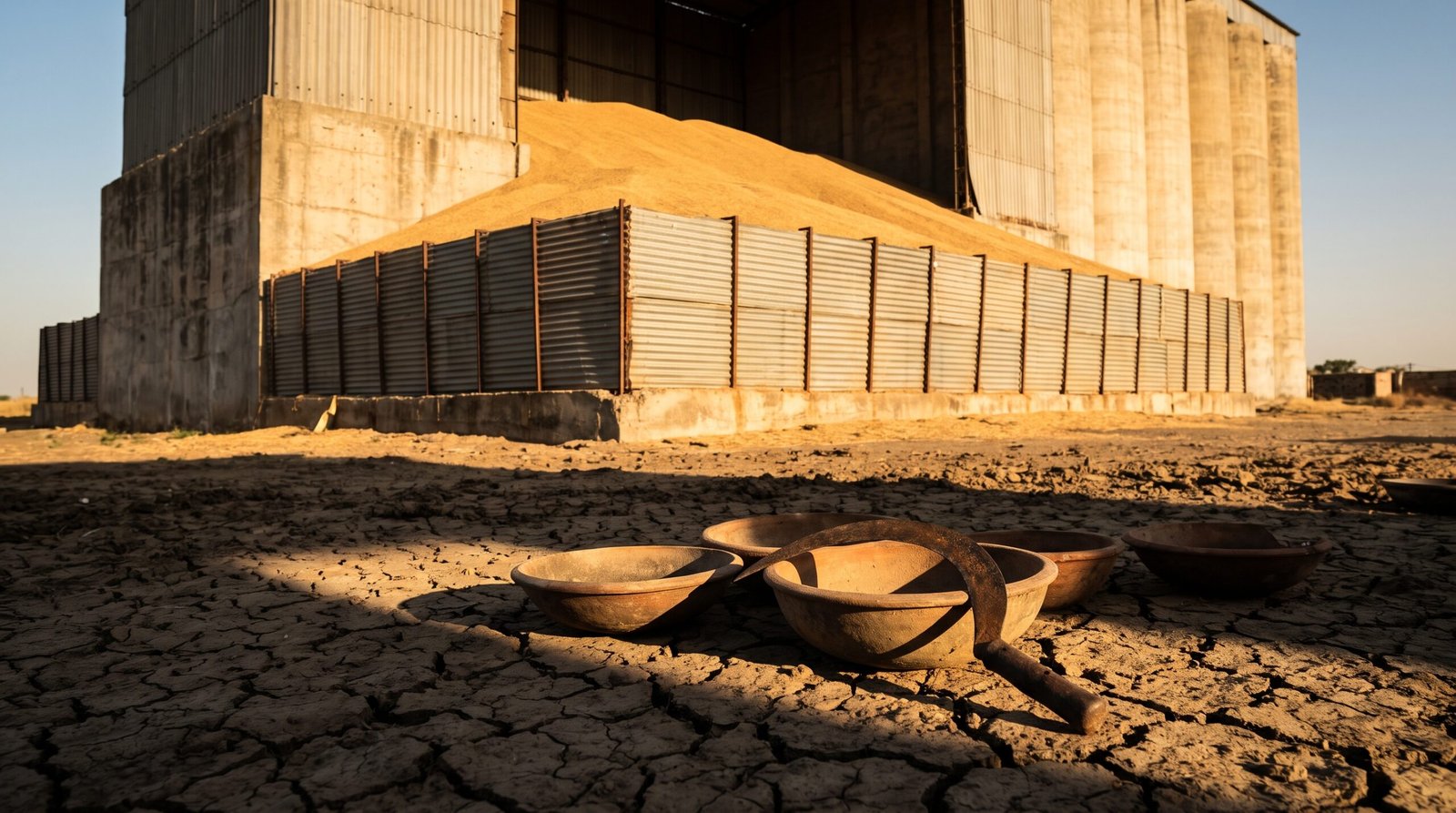
A labourer can help fill a granary and still be unable to feed his children. A city can become more expensive while becoming less habitable for those who keep it working. Such contradictions expose a weakness in the way we describe prosperity. We count what a society produces and possesses, but pay insufficient attention to who can use it, on what terms, and with what security.
The Part I of this series examined the failure of institutions to recognise danger and correct mistakes. We must now consider why correction can become politically difficult even when the damage is visible. An arrangement that impoverishes many people may remain profitable for those able to defend it.
Wealth itself is not the problem. Better tools, productive enterprises, scientific knowledge and dependable infrastructure enlarge human possibilities. The question is whether accumulation strengthens the capacity of society to sustain its members, or gives a minority increasing power to appropriate what others produce.
This distinction matters because inequality alone cannot explain civilisational collapse. Unequal societies have endured for centuries. Some have increased production and improved living standards while remaining deeply unequal. Any serious argument must invariably identify the conditions under which concentrated ownership weakens resilience, rather than treat the existence of rich and poor as a complete explanation.
Archaeology provides useful evidence, though not a simple verdict. A large comparative study published in PNAS in 2025 examined inequality through differences in residential size. It associated greater inequality with land-limited production and settlement hierarchies, among other factors.
House size is an imperfect measure of wealth, and wealth does not capture every form of power. Nevertheless, the findings direct attention towards control over resources and the organisation of production.1
The wider research programme also found that some societies practising land-intensive agriculture avoided extreme inequality through their arrangements of governance. Agricultural development did not prescribe one unavoidable social outcome. Institutions influenced how its gains were distributed.2
Consider the difference between a cultivator with secure access to land and one who must surrender an increasing share of the harvest merely to remain on it. Both may contribute to rising output. Their ability to survive a bad season differs sharply. One can retain seed, maintain equipment and build reserves. The other may enter each agricultural year already indebted.
When this insecurity becomes widespread, a temporary shock can destroy productive capacity. Households sell tools or livestock, withdraw children from school, reduce food consumption or abandon treatment. The economy may subsequently recover while the damage to their health, education and earning capacity persists. Aggregate recovery does not necessarily restore what vulnerable people have lost.
Also Read: Why Civilisations Collapse—I
Amartya Sen’s work on famine explains why access deserves separate attention from availability. His analysis examined how people obtain command over food through production, employment, exchange and other entitlements. A failure of purchasing power can leave particular groups hungry even when food remains available. This does not make harvests irrelevant. It shows why measuring supply alone cannot establish whether people can eat.3
Famine is not synonymous with civilisational collapse. The relevance of this analysis is narrower and more useful: a society can possess resources while failing to protect the people whose work sustains it. Physical abundance offers little security to someone excluded from access.
The political consequences depend on how institutions respond. Distress can produce public provision, changes in bargaining power and reform. It can also bring harsher extraction and repression. We should not assume that deprivation automatically generates either rebellion or progress. People may endure intolerable conditions because they lack the means to act together.
A further difficulty arises when wealth allows influential groups to withdraw from common services. Private education, healthcare, transport and security can protect them from deterioration experienced by everyone else. Their immediate interest in repairing public provision may weaken. The insulation is incomplete, but it can last long enough to postpone action.
This is a plausible mechanism, not an accusation against every household using private services. People understandably seek reliable care and education. The institutional problem arises when those making public decisions neither depend on the systems they administer nor face effective consequences for their failure.
Research comparing inequality in the Roman and Han empires offers another reason for caution. A 2025 study reconstructed income distributions and suggested that high inequality may help explain the Han state’s limited resilience during an early imperial crisis. Such estimates depend on fragmentary evidence and modelling assumptions. They support investigation of a relationship; they do not establish inequality as the sole cause of imperial breakdown.4
We should ask more specific questions. Did extraction leave households unable to withstand shocks? Did powerful interests obstruct reforms? Did the state lose access to resources required for essential functions? Did competition among elites disrupt administration? Each proposition requires evidence about timing, institutions and alternatives.
For Pakistan, the practical distinction is between rewarding productive activity and protecting privileged access. A business that improves production and creates worthwhile employment contributes differently from an interest that secures returns through exclusion, preferential treatment or control over scarce opportunities. Sound policy must recognise that difference.
An indiscriminate campaign against wealth would discourage the investment society needs. Equally, celebrating every private gain as a contribution to national prosperity would conceal the costs imposed on others. Public policy should examine how returns are earned and whether the rules allow newcomers to compete.
The same care is necessary in taxation. Raising revenue is essential, but collections alone tell us little about the quality of the settlement between state and citizen. Predictable rules, broad compliance and visible public services matter. Repeatedly extracting more from people already within reach while protecting influential interests weakens both confidence and productive effort.
Nor can cash assistance carry the entire burden of social protection. It can prevent immediate deprivation, but lasting security also requires access to education, healthcare, housing, justice and opportunities to earn. People should not have to depend on discretionary favour to obtain what public institutions are established to provide.
We need measures of prosperity that expose insecurity. Are household earnings keeping pace with necessities? Can a worker survive illness without losing essential assets? Can small enterprises obtain fair access to markets? Are public systems maintained before they fail? These questions reveal weaknesses that rising property values or impressive construction may conceal.
The connection with collapse is not intrinsical but conditional. Concentration becomes dangerous when it depletes the capacity of ordinary people to reproduce their livelihoods, undermines common provision and gives beneficiaries the power to prevent correction. A society may continue to display wealth throughout this process.
This argument also leads to the next difficulty. What appears to be new wealth may partly represent the depletion of soil, water or other resources whose replacement costs are ignored. The accounts record income while the material conditions of future production deteriorate.
A society cannot judge its strength by how much its most protected members can accumulate. It must also ask whether the people and resources on which that accumulation depends remain capable of sustaining life.
Endnotes
- Economic inequality is fueled by population scale, land-limited production, and settlement hierarchies across the archaeological record. PNAS 122(16), e2400691122 (2025).
- University of Oxford. New analysis of archaeological data reveals how agriculture and governance have shaped wealth inequality (15 April 2025).
- Amartya Sen. Ingredients of Famine Analysis: Availability and Entitlements. The Quarterly Journal of Economics (1981). See also: Amartya Sen. The Possibility of Social Choice. Nobel Lecture (1998).
- A comparison of income inequality in the Roman and Chinese Han empires. Nature Communications 16, 3248 (2025).
[To be continued]