

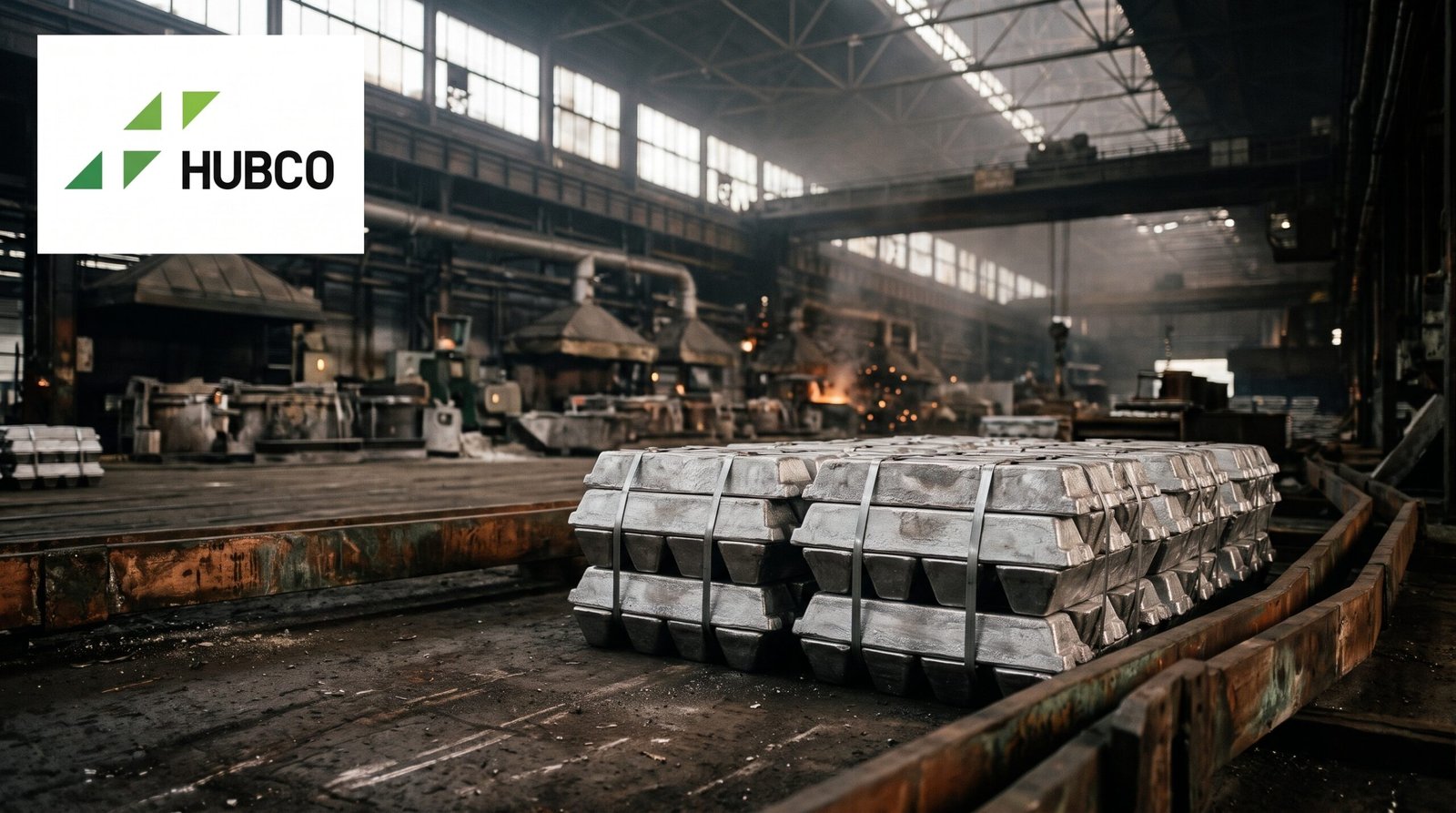
KARACHI: There are few industrial businesses on earth that consume more electricity than primary aluminium smelting, and few economies with more paid-for electricity sitting idle than Pakistan. Put those two realities together, and the strategic logic behind The Hub Power Company Limited’s (HUBCO) latest diversification bet becomes immediately clear.
In a November 16 disclosure to the Pakistan Stock Exchange (PSX), HUBCO announced that its wholly owned subsidiary, Hub Power Holdings Limited (HPHL), has engaged a Chinese design institute to conduct a bankable feasibility study for a proposed 300,000-tonne-per-year aluminium smelter. While the company has not yet disclosed an estimated capital outlay, site location, or construction timeline—noting that any final investment decision remains contingent on the study’s findings, regulatory approvals, and financing—the proposal represents a rare attempt to convert Pakistan’s most expensive macroeconomic liability into a hard-currency export engine.
“Solidified Electricity” Meets Pakistan’s Power Paradox
In global commodities markets, primary aluminium is often described as “solidified electricity.” Refining alumina into raw aluminium through the Hall-Héroult electrolytic process requires massive, uninterrupted baseload power—typically between 13,000 and 15,000 kilowatt-hours (kWh) per tonne of metal produced.
At that intensity, a 300,000-tonne smelter would consume roughly 4.0 to 4.5 billion kWh (4.0–4.5 TWh) of electricity every year. That translates into a continuous, round-the-clock baseload demand of roughly 450 to 515 megawatts (MW)—equivalent to absorbing the entire output of a mid-sized power plant, 24 hours a day, 365 days a year.
For Pakistan, that appetite is not a drawback; it is the entire point. The country’s national grid is trapped in a structural surplus, with installed generation capacity exceeding 45,000 MW against average demand that frequently plunges far below half that level—especially during winter months and amid the rapid migration of industrial and residential consumers toward off-grid rooftop solar. Under take-or-pay contracts, the state is forced to pay trillions of rupees annually in fixed capacity charges to Independent Power Producers (IPPs) for electricity the grid never dispatches.
By anchoring a 500 MW industrial off-taker directly to the country’s surplus generation, a domestic smelter could effectively allow Pakistan to export its trapped electricity in the form of a globally traded, dollar-denominated industrial metal.
HUBCO’s Post-IPP Transformation
The aluminium proposal also underscores how aggressively HUBCO is reinventing itself as Pakistan’s legacy IPP era winds down. Long known as the country’s flagship private power producer, HUBCO has spent the past several years systematically diversifying beyond traditional power purchase agreements—particularly following the termination of its legacy 1,292 MW oil-fired Hub plant contract under the government’s IPP renegotiation drive.
Through Hub Power Holdings Limited, the group has already pivoted into indigenous Thar coal mining and generation, electric vehicles (partnering with China’s BYD through Mega Motor Company), and minerals. Moving into heavy metals smelting fits squarely into that playbook: leveraging HUBCO’s deep engineering, energy-sector, and Chinese institutional partnerships to build capital-intensive, export-oriented industrial assets.
The Make-or-Break Variable: One Number
On paper, the concept is among the most commercially sensible ideas Corporate Pakistan has produced in years. Whether it survives the feasibility stage, however, depends almost entirely on a single number: the price HUBCO pays for its electricity.
Electricity typically accounts for 30 to 40 per cent of the total production cost of primary aluminium. Globally, competitive smelters—such as those operated by Emirates Global Aluminium (EGA) in the UAE, Aluminium Bahrain (Alba), or hydro-powered smelters in Canada and Iceland—thrive because they secure long-term baseload power at roughly 3 to 5 US cents per kWh.
| Cost & Scale Benchmark | Global Competitive Smelters | Pakistan Grid Reality | What HUBCO’s Smelter Needs |
| Power Intensity | 13,000–15,000 kWh / tonne | ~4.0–4.5 billion kWh / year (for 300k tonnes) | ~450–515 MW continuous baseload |
| Electricity Tariff | 3 to 5 US cents / kWh | 12 to 16+ US cents / kWh (industrial grid) | Marginal-cost or captive/wheeling tariff |
| Estimated Capex | $3,500–$5,000 / tonne capacity | $1.0–$1.5 billion+ (typical greenfield scale) | Long-term project finance & Chinese backing |
At Pakistan’s standard industrial grid tariffs—which have hovered between 12 and 16 US cents per kWh due to capacity charges, cross-subsidies, and taxes—an aluminium smelter would be dead on arrival. To make the unit economics work, HUBCO will need one of two breakthroughs:
- A Marginal-Cost Surplus Tariff: A long-term sovereign commitment allowing energy-intensive export industries to draw surplus grid power at marginal fuel cost (excluding legacy capacity surcharges), turning otherwise idle megawatts into incremental revenue for the grid.
- Dedicated Wheeling or Captive Generation: Direct bilateral power procurement under the Competitive Trading Bilateral Contract Market (CTBCM), or pairing the smelter with dedicated low-cost Thar coal or hybrid renewable-plus-baseload generation.
Supply Chain and Capital Hurdles
Beyond power pricing, the feasibility study will have to solve two additional realities. First, Pakistan lacks commercial-scale bauxite mining and alumina refining, meaning the smelter will rely heavily on imported alumina—making a coastal site near Port Qasim or HUBCO’s existing industrial footprint in Hub, Balochistan, a logical logistical choice to minimise inland freight costs.
Second, primary aluminium smelters are notoriously capital-intensive. Globally, a 300,000-tonne greenfield smelter typically requires $1 billion to $1.5 billion in capital expenditure, alongside robust environmental controls for fluoride and carbon emissions—especially as European and global buyers tighten carbon-border standards like the EU’s CBAM.
A Test Case for Industrial Policy
If HUBCO and the federal government can align on a globally competitive power tariff, the payoff would extend far beyond one company’s balance sheet. At current global prices, 300,000 tonnes of primary aluminium represents roughly $750 million to $850 million in annual gross value—offering both import substitution for Pakistan’s domestic construction, automotive, and packaging sectors and a substantial new stream of export earnings.
For now, the project remains at the drawing board. But in an economy desperate to break out of its cycle of circular debt and low-value exports, HUBCO’s wager asks policymakers a simple, unavoidable question: would Pakistan rather keep paying billions to leave its power plants switched off, or price its surplus electricity sensibly enough to turn it into metal?