

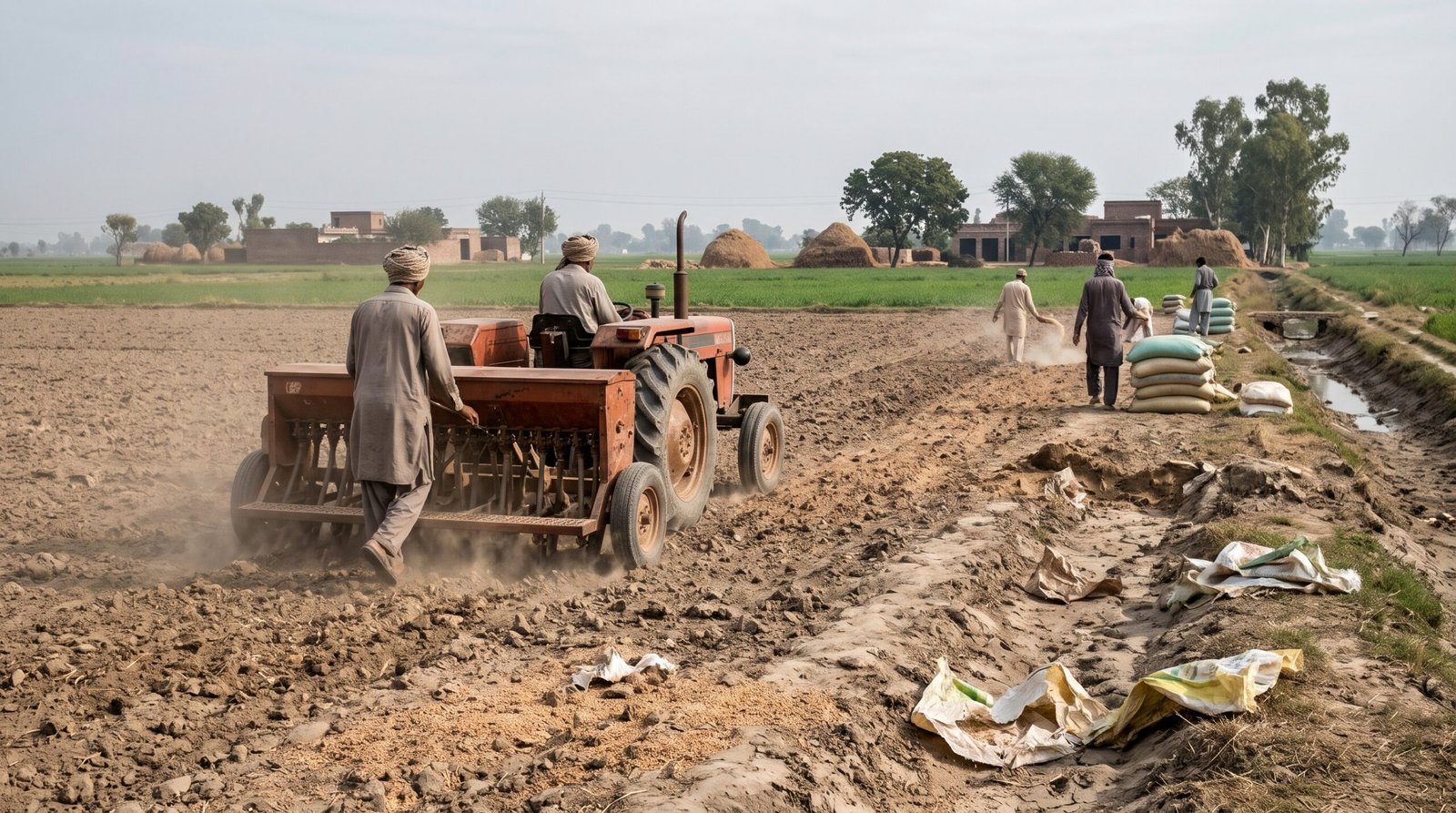
LAHORE: Punjab’s ambitious plan to cultivate wheat across 16.5 million acres and produce 22.5 million tonnes during the 2026–27 Rabi season faces a crucial test as farmers enter the final recommended sowing window amid rising fertiliser costs, concerns over irrigation water availability, seed quality and uncertainty surrounding the implementation of the government’s wheat pricing and procurement arrangements.
A detailed two-page agricultural advisory, dated November 13 and covering November 16–30, reviewed by The Scoop, identifies timely sowing, approved seed varieties, balanced fertiliser application, disease prevention and effective weed management as essential measures for protecting wheat productivity.
The recommendations come at a particularly sensitive time for Pakistan’s agricultural economy. Although the federal government has announced an indicative wheat price of Rs4,500 per 40 kilogrammes, growers must still finance costly agricultural inputs months before they can sell their harvest.
The emerging challenge is therefore not simply how much wheat Punjab can cultivate, but whether farmers can afford the inputs required to achieve the production targets.
November 20 Deadline: Late Sowing Could Reduce Productivity
According to the advisory, the most suitable period for wheat cultivation in Punjab’s irrigated areas is November 1–20.
Wheat can still be planted until November 30, while cultivation may extend into early December where agricultural circumstances necessitate delays.
However, the Agriculture Department warns that productivity begins declining progressively when cultivation takes place after the optimum sowing period.
The distinction matters because late-sown wheat faces a different growing environment, including a shorter period for crop development and the possibility of exposure to higher temperatures during critical growth stages.
Farmers harvesting rice, cotton, sugarcane and other preceding crops may face additional difficulties preparing their fields within the recommended timeframe.
The advisory recommends adjustments to seed rates where cultivation is delayed, but increasing seed quantity alone cannot necessarily compensate for the loss of favourable growing conditions.
With Punjab accounting for a substantial proportion of Pakistan’s wheat cultivation, delays across major producing districts could have consequences extending beyond individual farmers to national food security and future flour prices.
Approved Wheat Varieties: Agriculture Department Warns Against Rust-Susceptible Seeds
One of the most significant aspects of the new recommendations concerns the selection of wheat varieties.
For irrigated regions, the department identifies approved varieties including Akbar-19, Falak-24, Sawera-24, Urooj-22, Ujala-2016, Johar-2016, Anaj-2017, Fakhr-e-Bhakkar-17, Bhakkar Star-19, Ghazi-19, Nishan-21 and Dilkash-20.
For rain-fed agricultural regions, varieties recommended in the document include Markaz-19, MA-21, Nishan-21, Shiraz-23 and Urooj-22.
The department has specifically cautioned farmers against cultivating Faisalabad-2008, Pakistan-13 and Barani-17 because of their susceptibility to wheat rust.
Wheat rust is a serious fungal disease capable of damaging crops and reducing productivity, particularly when susceptible varieties encounter favourable conditions for disease development.
The warning highlights the importance of varietal selection in an agricultural system where many growers retain seed from previous harvests rather than purchasing certified seed every season.
Using a variety that previously performed well does not necessarily guarantee continued resistance to disease.
The department has also emphasised the importance of clean, healthy, disease-free and certified seed, with a minimum germination rate of 85 per cent.
Seed Rates Revised for Different Sowing Conditions
The advisory recommends approximately 40–45 kilogrammes of wheat seed per acre in irrigated areas during the regular sowing period, with higher quantities required under delayed planting conditions.
For cultivation between December 1 and 10, the recommended seed rate increases to 50 kilogrammes per acre.
In rain-fed areas, the advisory recommends 50 kilogrammes per acre.
Farmers are advised to use properly calibrated sowing drills to ensure more uniform seed placement and crop establishment.
The department further recommends seed treatment before cultivation to reduce risks associated with fungal diseases, including smut, Karnal bunt and other seed-related infections.
Several fungicide formulations and application rates are identified in the advisory.
However, the suitability of a particular treatment depends on the registered product, the condition of the seed and local agricultural guidance.
The recommendations reinforce the wider need for reliable certified seed supplies and accessible agricultural extension services.
Fertiliser Costs Could Become a Major Obstacle
Perhaps the most economically significant component of the advisory concerns fertiliser application.
The department recommends different quantities of diammonium phosphate (DAP), urea and potassium fertilisers depending on soil fertility and rainfall conditions.
For relatively poor irrigated land, the advisory recommends two 50kg bags of DAP, two bags of urea and one bag of sulphate or muriate of potash per acre.
For moderately fertile irrigated land, the recommendations include one-and-a-half bags of DAP, one-and-three-quarter bags of urea and one bag of potassium fertiliser.
For more fertile land, the quantities fall to approximately one-and-a-quarter bags of DAP, one-and-a-half bags of urea and one bag of potassium fertiliser.
Rain-fed areas have separate recommendations depending on expected rainfall.
The financial implications are considerable.
Pakistan Bureau of Statistics data for the week ended October 15, 2026, recorded average retail prices of approximately Rs17,118 for a 50kg bag of DAP, Rs4,780 for Sona urea and Rs15,548 for sulphate of potash.
Applying those indicative prices to the document’s recommendations produces the following estimates for fertiliser expenditure per acre, assuming sulphate of potash is selected:
- Low-fertility irrigated land: Approximately Rs59,344.
- Medium-fertility irrigated land: Approximately Rs49,590.
- Higher-fertility irrigated land: Approximately Rs44,116.
- Low-rainfall agricultural areas: Approximately Rs29,672.
- Higher-rainfall agricultural areas: Approximately Rs48,395.
These are illustrative calculations based on October national-average retail prices, rather than verified current quotations for individual farming districts.
They exclude seed purchases, land preparation, irrigation, machinery, labour, pesticides, transport, land rent and other agricultural expenses.
They also assume the potassium source is sulphate of potash; actual expenditure could differ if another approved product is used.
Nevertheless, the calculations demonstrate that fertiliser alone can represent a substantial upfront financial commitment.
For farmers cultivating several acres, the difference between applying the recommended nutrients and reducing fertiliser expenditure could be financially significant.
Reducing necessary fertiliser application may save money immediately but can compromise productivity and ultimately reduce harvest income.
This creates a difficult choice for cash-constrained growers.
Also Read: Mari Energies Unveils Major Copper-Gold Discovery Near Reko Diq In Balochistan
Wheat Production Target: Punjab Aims for 22.5 Million Tonnes
The Punjab government has established a wheat cultivation target of approximately 16.5 million acres for the current Rabi season.
Provincial agricultural authorities have also identified a production ambition of 22.5 million tonnes.
Achieving that volume would require average productivity of approximately 1,364 kilogrammes per acre, equivalent to around 34.1 maunds of 40 kilogrammes each.
The target is significant, but it should not be confused with a guaranteed yield for individual farmers.
Productivity varies substantially according to soil conditions, irrigation facilities, crop management, weather, seed quality and disease pressure.
Punjab Agriculture Minister Syed Ashiq Hussain Kirmani has repeatedly emphasised the importance of achieving cultivation targets to safeguard national food security.
The provincial government has also announced financial and agricultural support measures.
According to official statements, Rs150 billion has been earmarked under the Kissan Card programme to facilitate purchases of agricultural inputs.
The government has also announced a Rs450 million subsidy for certified wheat seeds supplied through the Punjab Seed Corporation.
Approved 50kg seed bags have been advertised at Rs7,000, and agricultural officials have been directed to take action against overcharging, hoarding and profiteering.
The actual impact of these interventions will depend on whether farmers can obtain the promised support within the sowing period.
Delayed access to subsidised inputs could reduce the practical value of assistance intended to improve crop productivity.
Rs4,500 Wheat Price: Will Farmers Receive the Promised Return?
The federal government’s announcement of an indicative wheat price of Rs4,500 per maund represents an important attempt to restore confidence among growers.
The price is Rs1,000 higher than the previous year’s indicative benchmark of Rs3,500.
Federal Minister for National Food Security Rana Tanveer Hussain has said that the new wheat policy was developed through consultations with provincial governments and was intended to protect farmers while ensuring market stability.
However, the economic outcome for growers will depend on whether the announced price translates into actual market receipts or purchases through an effective procurement arrangement.
The distinction is critical.
A farmer achieving the provincial target’s implied average yield of approximately 34.1 maunds per acre would generate gross revenue of about Rs153,400 per acre if the entire crop were sold at Rs4,500 per maund.
That figure represents a hypothetical gross receipt, not profit, and should not be treated as a forecast of individual farm income.
The farmer must still recover the costs of fertiliser, seed, irrigation, machinery, labour and other inputs.
At the same time, there is no automatic assurance that every grower will sell their entire harvest at the indicative price.
The government has indicated that Punjab’s wheat procurement mechanism is expected to be finalised by March 15, 2027.
That means important implementation questions remain, including the role of private buyers, market monitoring, storage arrangements and the practical mechanism for supporting prices during the harvest.
Farmer organisations have welcomed the higher price in principle but have also raised concerns about effective procurement and production costs.
In October, the National Assembly Standing Committee on National Food Security recommended a minimum support price of Rs5,000 per 40 kilogrammes or above.
The committee also identified rising input costs, inadequate mechanisation, poor-quality seed and insufficient agricultural research among the sector’s major challenges.
The eventual success of the wheat pricing policy will therefore be judged by what farmers actually receive, rather than by the announced benchmark alone.
Irrigation Water Shortages Pose an Additional Threat
Beyond fertiliser prices and crop establishment, irrigation availability remains another important concern.
The Famine Early Warning Systems Network, in its October 2026 food security outlook, cited an Indus River System Authority projection of a 22 per cent irrigation water shortfall for Sindh and Punjab during the October 2026–March 2027 period.
Such a shortfall could complicate crop management in areas dependent on canal irrigation.
Wheat requires adequate moisture during important developmental stages, while water stress can negatively affect crop establishment, growth and grain formation.
The actual consequences will depend on district-level water availability, groundwater access, irrigation scheduling and rainfall.
The Punjab advisory recommends careful land preparation and techniques intended to improve the efficiency of water use.
For rice-growing areas, farmers have been advised to stop irrigation 15–25 days before paddy harvesting and prepare fields promptly for the subsequent wheat crop.
The document also recommends zero-tillage cultivation after rice harvesting where suitable.
Such practices may help reduce the time between harvesting rice and planting wheat, while limiting unnecessary field operations.
This becomes particularly relevant when late harvesting threatens to push wheat cultivation beyond the optimum sowing window.
Weed Management, Crop Diseases and Micronutrients
The advisory places considerable emphasis on controlling weeds before they compete with wheat for nutrients, moisture and sunlight.
It identifies herbicide options for managing grassy weeds and advises growers to select treatments appropriate to their fields.
The department also recommends the judicious use of zinc and boron micronutrients, with application decisions taking into account earlier fertiliser use and soil requirements.
Notably, the photographed document specifies six kilogrammes per acre of 33 per cent zinc sulphate and 2.5 kilogrammes of a 17 per cent boron formulation, while a separate departmental advisory reported on November 12 cited five kilogrammes for zinc sulphate application.
This difference warrants clarification from agricultural authorities before growers apply the products.
Soil testing, correct product identification and advice from qualified agricultural extension staff remain important to avoiding unnecessary expenditure or inappropriate application.
Farmers are also advised to take steps to minimise disease transmission and to protect treated seed from consumption by people, livestock and birds.
Pakistan’s Food Security Depends on More Than Cultivated Acreage
Pakistan remains heavily dependent on domestic wheat production for its staple food requirements.
The Pakistan Economic Survey 2025–26 provisionally estimated national wheat production at 29.61 million tonnes, compared with 28.40 million tonnes in the preceding year.
Yet national food security cannot be evaluated solely on the basis of crop production figures.
Storage, procurement, transportation, market prices, household purchasing power and the distribution of available stocks are equally important considerations.
The federal government has announced plans to maintain strategic wheat reserves of up to six million tonnes to protect against supply disruptions.
It has also indicated that domestic procurement should receive priority over unnecessary wheat imports.
However, maintaining reserves and stabilising domestic prices will require effective coordination between federal and provincial authorities.
Any deterioration in the forthcoming harvest could create additional pressure on food inflation, particularly for households already struggling with the cost of essential commodities.
Equally, production incentives must remain economically viable for growers if the country intends to sustain wheat cultivation in subsequent seasons.
The Critical Questions for Punjab
The Agriculture Department’s latest recommendations set out the technical requirements for improving crop performance. But several wider questions remain unresolved.
Can the government ensure timely and affordable supplies of certified wheat seed and fertiliser across all producing districts?
Will farmers have sufficient access to irrigation water during the critical growth stages of the crop?
Can agricultural extension services reach smallholders who lack access to modern equipment, soil testing and specialist advice?
Will growers be able to sell their harvest at a price that covers rising production costs and provides a reasonable return?
And will the provincial government establish an effective procurement and market-support mechanism before the harvest begins?
These questions are especially important because the consequences of wheat policy extend well beyond the agricultural sector.
They influence rural purchasing power, food inflation, the flour industry, public finances and Pakistan’s dependence on imported agricultural commodities.
The Road Ahead
Punjab’s wheat production campaign is entering a decisive stage.
The government has announced ambitious cultivation and production targets, a higher indicative wheat price, certified seed subsidies and expanded access to agricultural financing.
The Agriculture Department has also issued detailed recommendations covering approved varieties, sowing dates, fertiliser application, field preparation, disease management and weed control.
However, successful implementation will depend on whether these measures translate into tangible support for farmers.
For the 2026–27 wheat season, three factors will be particularly important: how much land is cultivated within the optimum sowing window, whether farmers can afford and obtain essential inputs, and whether irrigation supplies remain sufficient during crop development.
The coming months will determine whether Punjab can convert its agricultural targets into actual production and whether the government’s renewed wheat policy succeeds in rebuilding confidence among growers.
For Pakistan, the stakes extend beyond another agricultural season. The outcome will help determine food security, rural incomes and the stability of one of the country’s most economically and socially important crops.