

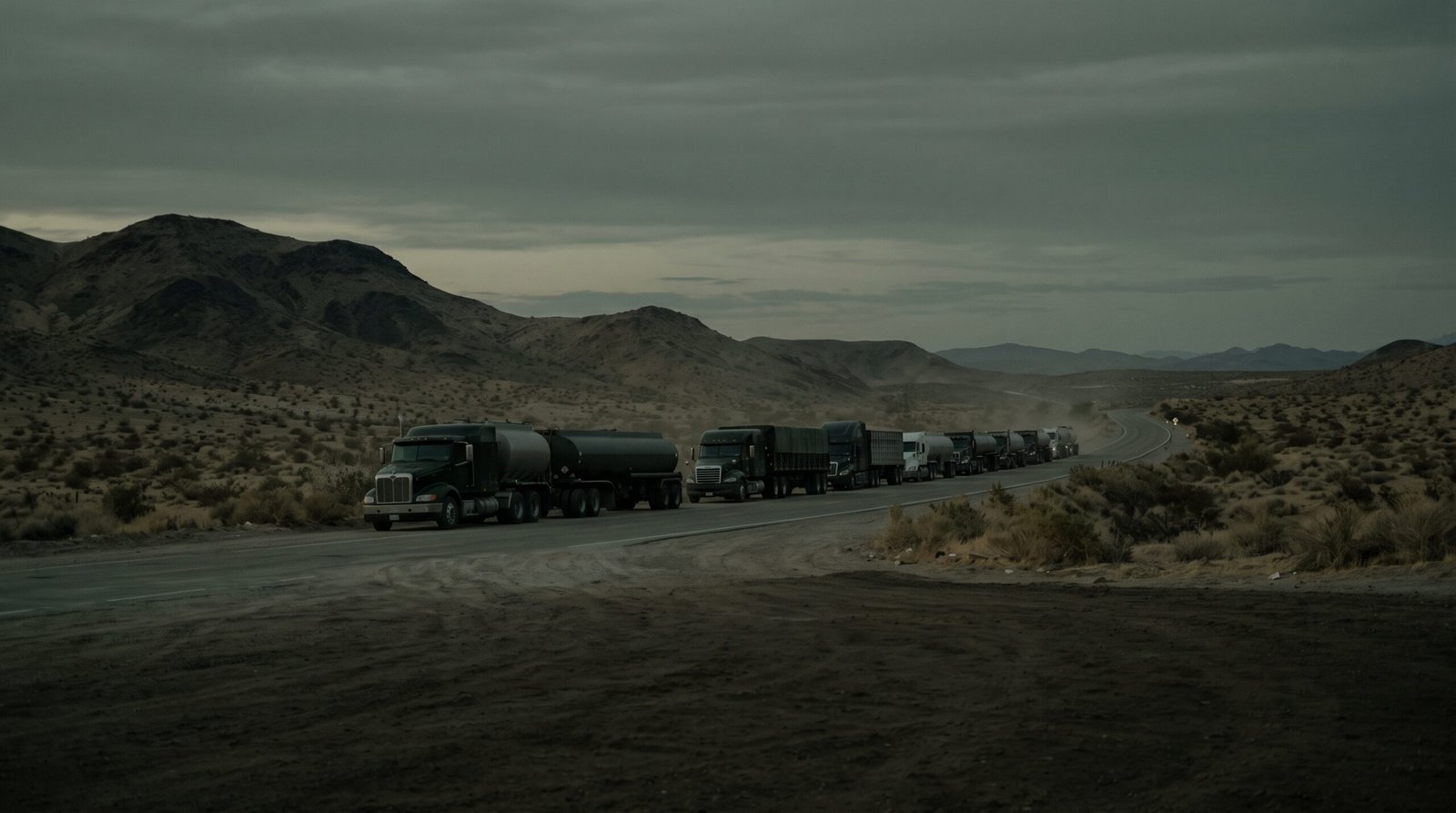
Pakistan’s criminal economy is far larger and more complex than the familiar image of armed gangs, street-level extortionists and occasional border seizures. Behind the headlines lies an extensive network of illegal petroleum trading, narcotics trafficking, illicit cigarettes, non-custom-paid vehicles, counterfeit products and financial transactions operating beyond the formal regulatory system.
While enforcement agencies regularly announce seizures worth billions of rupees, the central question remains: how much of this illicit economy is being dismantled, and how much continues through different channels?
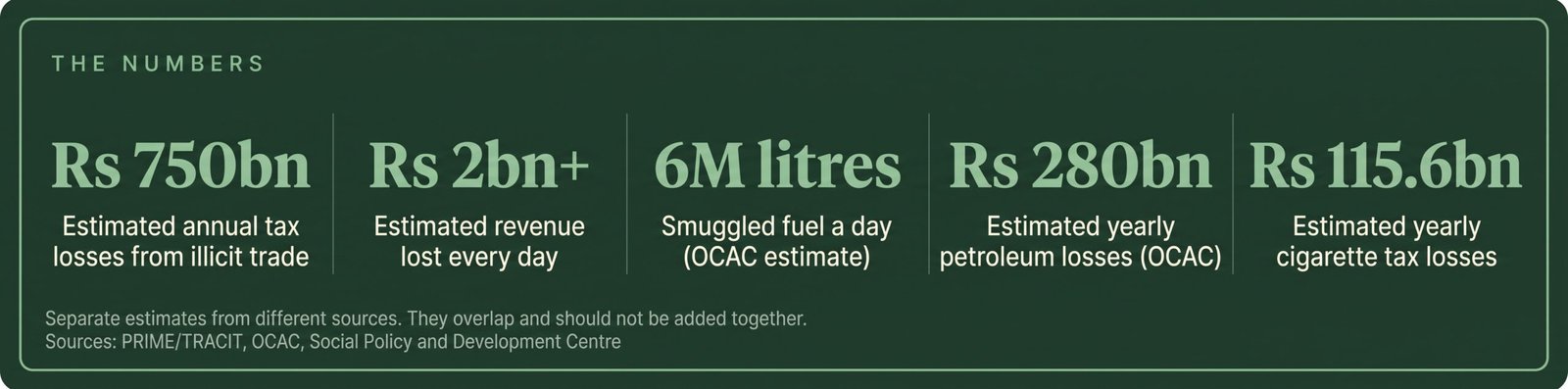
Research by the Policy Research Institute of Market Economy (PRIME) and the Transnational Alliance to Combat Illicit Trade (TRACIT) has estimated Pakistan’s annual tax losses from illicit trade and smuggling at approximately Rs 750 billion.
That is equivalent to more than Rs 2 billion in estimated revenue losses every day.
The figure does not represent the profits of criminal organisations. It measures estimated tax revenue forgone through illicit trade, and should not be confused with the value of smuggled goods or the size of Pakistan’s wider informal economy.
Nevertheless, the estimate raises questions about border management, taxation, financial crime, regulatory enforcement and the ability of state institutions to identify the beneficiaries of illegal commerce.
Fuel Smuggling: A Multibillion-Rupee Business
Among the most economically significant illicit markets is petroleum.
In July 2026, the Oil Companies Advisory Council (OCAC) warned that approximately six million litres of smuggled fuel were entering Pakistan daily.
The petroleum industry body estimated the resulting annual loss to the national exchequer at Rs 280 billion.
If sustained throughout the year, six million litres daily would amount to approximately 2.19 billion litres annually.
OCAC warned that smuggled petroleum was undermining legitimate businesses, government revenue and Pakistan’s energy sector.
However, the six-million-litre figure is an industry estimate, not a publicly demonstrated measurement of every litre crossing Pakistan’s borders.
The Iran–Pakistan border has historically featured prominently in reporting on informal petroleum trade.
Differences in fuel prices, taxation and regulatory requirements create commercial incentives for cross-border trading.
The challenge extends beyond the border itself. Investigators must determine how illegally imported fuel reaches domestic markets, who finances the consignments and which businesses ultimately distribute the products.
The issue also has a socioeconomic dimension. Border communities in Balochistan often depend on cross-border commerce because of limited employment opportunities and longstanding trading relationships.
Effective enforcement must therefore distinguish organised criminal profiteering from the economic circumstances of local communities.
Also Read: Is The Deepal S05 Pakistan’s New Automotive Love Affair?
Narcotics: Pakistan’s International Trafficking Challenge
Pakistan’s geographic position places it near major regional narcotics production and trafficking corridors.
Its borders, ports and commercial transportation networks create legitimate trading opportunities but can also be exploited by criminal organisations.
United Nations reporting released in April 2026 highlighted significant drug seizures involving international enforcement cooperation.
Reported results included 1.7 tonnes of methamphetamine in 2024 and 1.3 tonnes in 2025.
Other reported seizures included 2.6 tonnes of opium in 2025, more than 14 tonnes of red phosphorus and approximately 100 kilogrammes of cocaine.
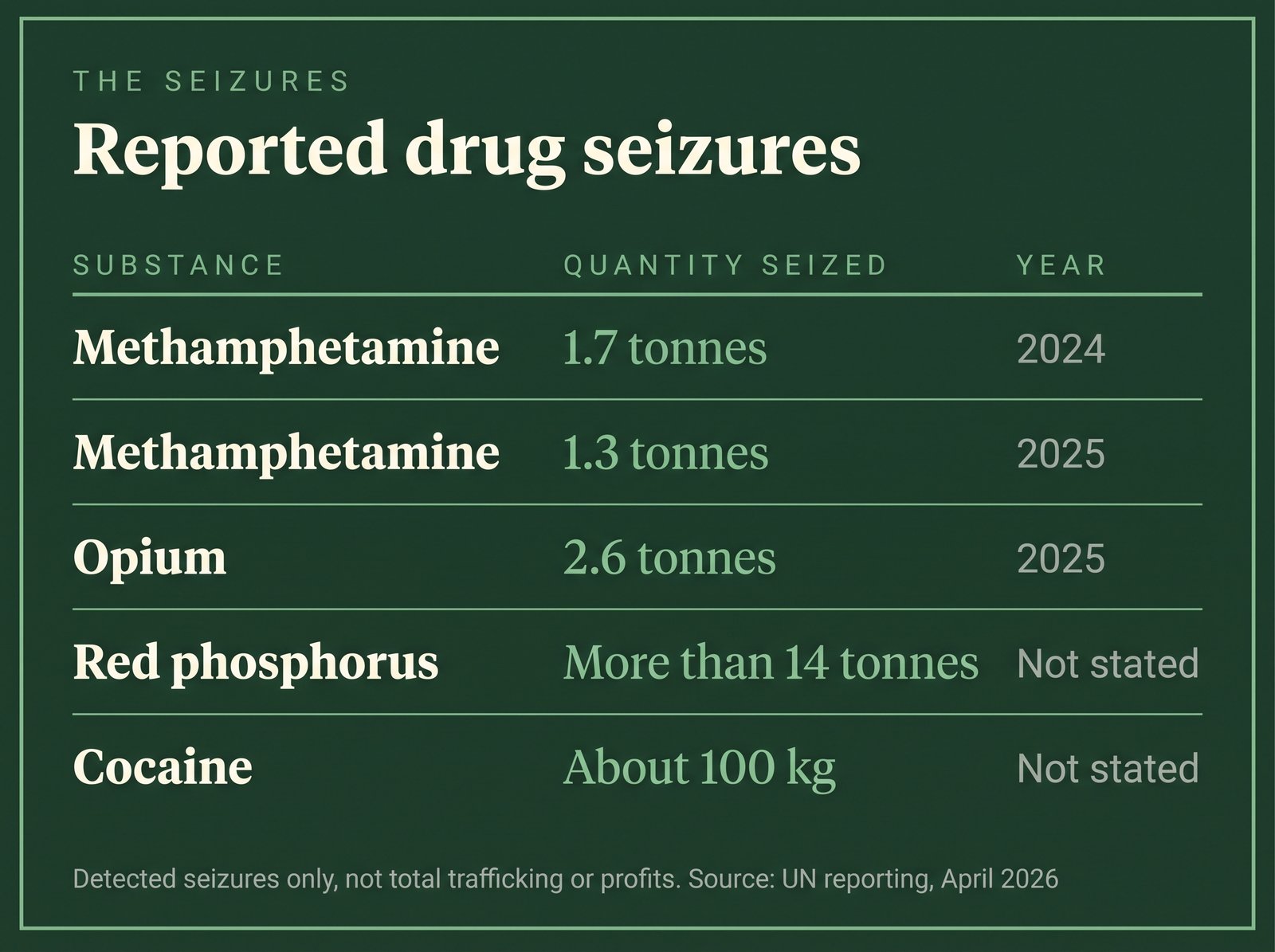
These figures demonstrate the scale of intercepted trafficking activity.
They do not, however, establish the total quantity of narcotics passing through Pakistan or the annual profits earned by trafficking networks.
The distinction matters because seizure statistics represent only detected criminal activity.
The financial networks supporting narcotics trafficking may involve multiple countries, intermediaries and payment mechanisms.
Karachi’s Underworld: The Evolution Of Extortion Networks
Pakistan’s organised criminal economy is not confined to smuggling.
Karachi has a documented history of gang violence, kidnapping, extortion and disputes over criminal territory.
Security operations disrupted several longstanding criminal groups, but subsequent police investigations indicate that extortion remains a concern.
In 2025, Karachi police identified three alleged organised extortion networks associated with individuals believed to be operating from overseas.
Police named Wasiullah Lakho, Samad Kathiawari and Jamil Chhanga as alleged leaders of separate networks linked to Lyari.
According to the police account reported at the time, suspected operators were using foreign telephone numbers to contact businesses in Karachi.
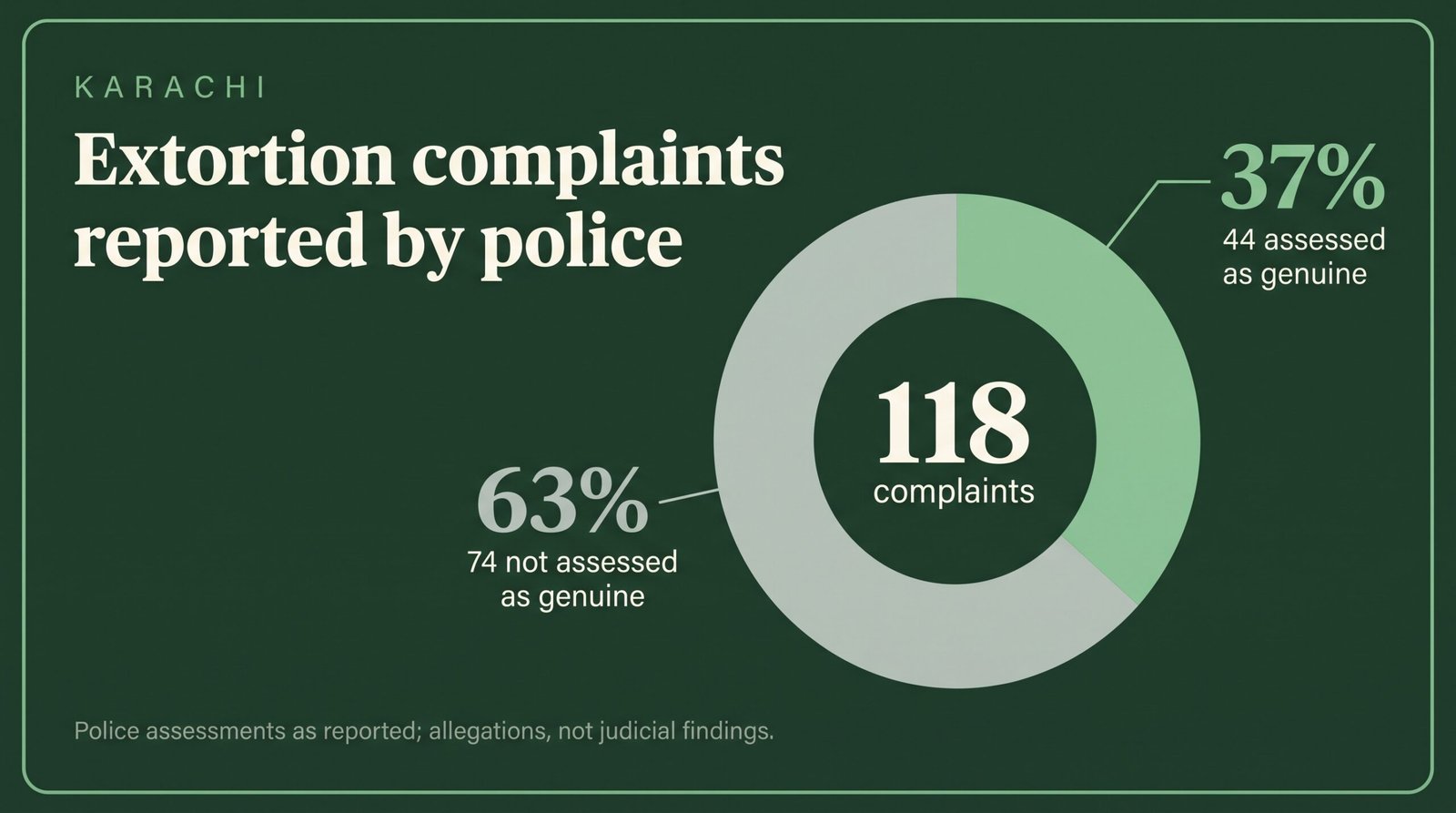
Police also reported receiving 118 extortion complaints during the relevant period, of which 44 were assessed as genuine.
These are police allegations and investigative assessments, not judicial findings of guilt against the named individuals.
The cases nevertheless illustrate how organised crime can evolve.
Criminal intimidation no longer necessarily requires physical presence in the city where the victims operate.
Cross-border communications and financial relationships can allow alleged operators to maintain influence from outside Pakistan.
Cigarettes: Billions In Disputed Tax Losses
Pakistan’s illicit cigarette market has become a major concern for tax authorities, manufacturers and independent researchers.
A March 2026 policy brief by the Social Policy and Development Centre estimated annual tax revenue losses from illicit cigarettes at Rs 115.6 billion.
However, estimates of the market’s size differ significantly.
Industry organisations, independent researchers and government officials have presented varying assessments, reflecting differences in methodology and the categories included.
Smuggled cigarettes, counterfeit products, unregistered domestic manufacturing and tax non-compliance are related but distinct issues.
Treating all of them as one category can distort the scale of cross-border smuggling.
The underlying problem is nevertheless significant: products sold outside the tax system create competition for compliant manufacturers and deprive the government of potential revenue.
Vehicles, Electronics And Precious Metals
Non-custom-paid vehicles, mobile phones, precious metals and other consumer products also feature in customs enforcement operations.
A PRIME assessment compiling reported FBR enforcement figures for 2025 identified approximately Rs 9.8 billion in seized vehicles, Rs 1.8 billion in cigarettes, Rs 1.1 billion in diesel, Rs 500 million in precious metals and Rs 200 million in mobile phones.
The assessment also referred to narcotics seizures valued at approximately Rs 60 billion.
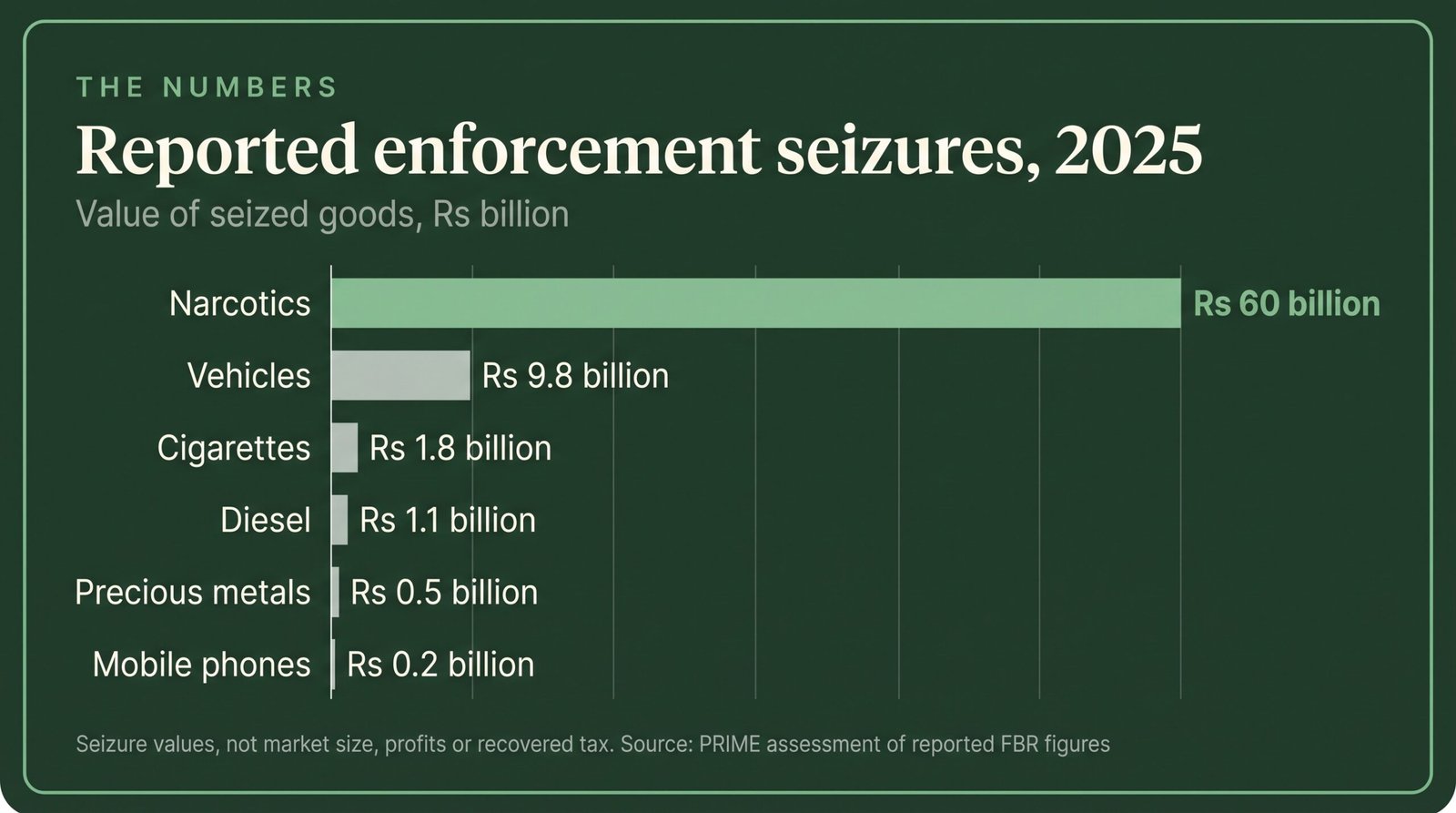
These figures describe reported enforcement activity rather than the total size of the respective illicit markets.
The value of seized goods should not be confused with criminal profits or recovered tax revenue.
The more important questions concern financing, ownership, distribution and the eventual outcome of enforcement proceedings.
When Illegal Commerce Meets Legitimate Businesses
One particularly revealing Customs investigation emerged in October 2025.
Pakistan Customs reported coordinated operations involving more than Rs 1.1 billion in allegedly smuggled cigarettes and manufacturing materials.
In Daska, officials described an illicit cigarette manufacturing network operating behind what appeared to be a rice-milling business.
The case illustrates why financial and commercial investigations are essential.
The apparent legitimacy of a business does not necessarily establish that every activity conducted through it is lawful.
Equally, the existence of cash transactions, informal commercial relationships or unusual trading patterns does not automatically prove money laundering.
Such allegations require documentary evidence, investigation and judicial scrutiny.
Also Read: Chinese Vs Japanese Vs Korean SUVs: Who Is Winning Pakistan’s Rs 7 Million–15 Million Market?
The Protection And Corruption Question
Large-scale smuggling raises unavoidable questions about regulatory failures and possible official facilitation.
Illegal trade can exploit weaknesses in customs enforcement, border surveillance, taxation and administrative oversight.
But an enforcement failure is not itself evidence that a particular public official or institution is complicit.
Proving corruption requires financial records, investigative findings, credible witness testimony or judicial proceedings.
A serious investigation must therefore examine documented cases of official misconduct rather than treating allegations as established facts.
The relevant questions are whether corrupt facilitation has been identified, whether disciplinary or criminal proceedings followed, and whether any resulting convictions or recoveries were secured.
Are Crackdowns Actually Working?
Customs Enforcement Hyderabad reported 914 seizure cases during FY2025–26, a 25% increase over the preceding financial year.
The total realisable value of seized goods was reported at Rs 4.555 billion.
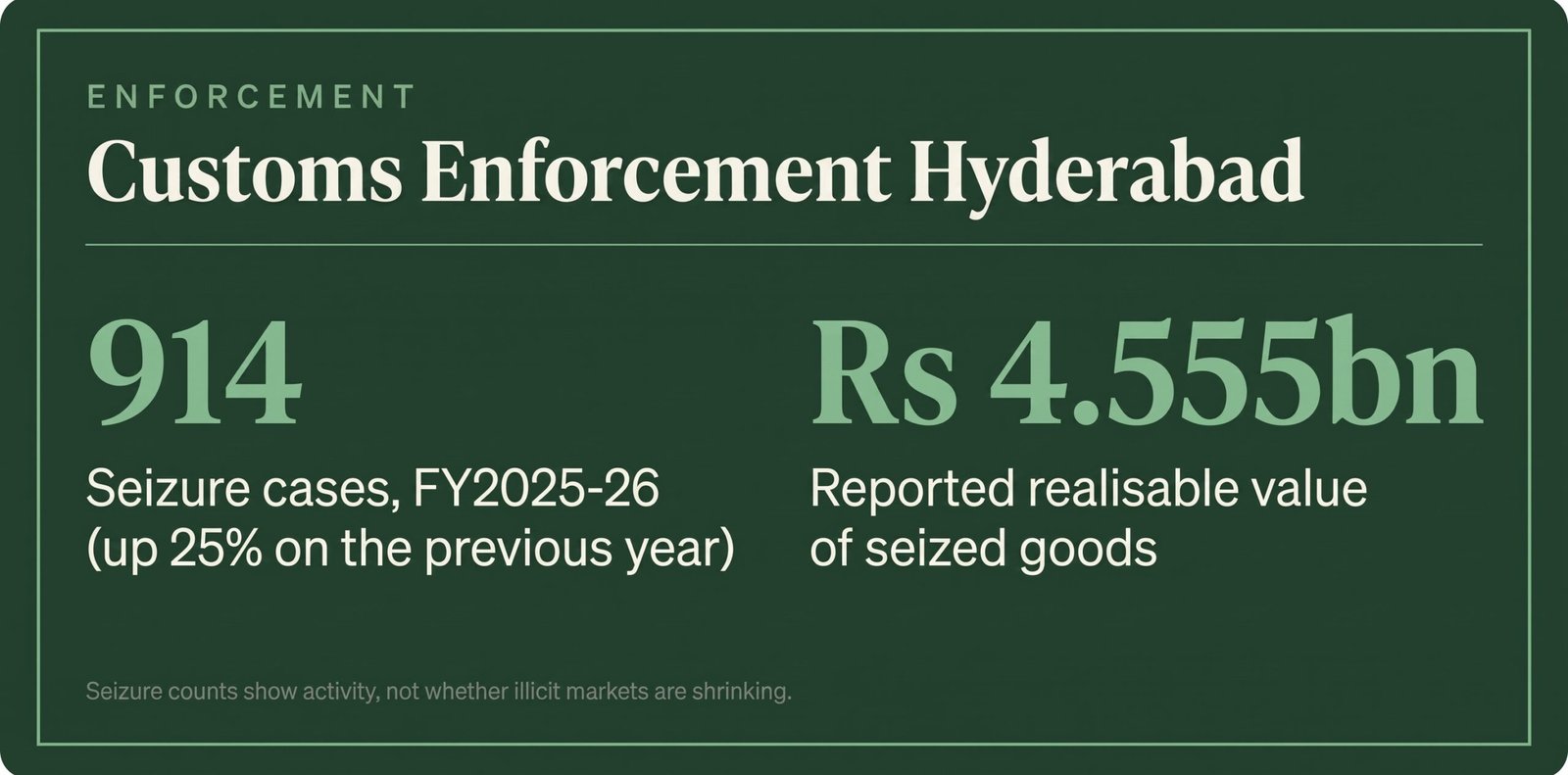
Such figures demonstrate enforcement activity but cannot independently establish whether illicit markets are shrinking.
A larger number of seizures could reflect improved enforcement, increased smuggling activity or a combination of both.
A meaningful assessment requires prosecution and conviction data, alongside information about asset confiscation and financial recoveries.
The ultimate objective should be to disrupt criminal organisations rather than merely intercept individual consignments.
The Economic Cost Of Illicit Trade
The consequences of illicit trade extend beyond lost tax revenue.
Legitimate manufacturers and importers face competition from products that may evade duties, taxes and regulatory costs.
Consumers can face risks from counterfeit medicines, adulterated fuel and products that fail to meet safety standards.
At the same time, indiscriminate enforcement can damage legitimate traders and vulnerable border communities.
Pakistan therefore needs an approach combining credible law enforcement, transparent financial investigations, consistent regulation and viable channels for legitimate trade.
Who Ultimately Profits?
The available evidence establishes that Pakistan faces substantial estimated revenue losses from illicit trade, significant narcotics trafficking activity and continuing organised crime investigations.
What it does not establish is a definitive national hierarchy of criminal organisations or a reliable estimate of their combined profits.
The Rs 750 billion annual illicit-trade estimate, Rs 280 billion petroleum-sector estimate and Rs 115.6 billion cigarette-sector estimate cannot simply be added together because their coverage and methodologies may overlap.
The unanswered question is who finances illegal commerce, who controls the proceeds and how much criminal wealth is ultimately recovered.
Until Pakistan can demonstrate not only what it seizes, but also who is convicted and what assets are confiscated, the full economic power of its criminal underworld will remain difficult to measure.
1 comment