

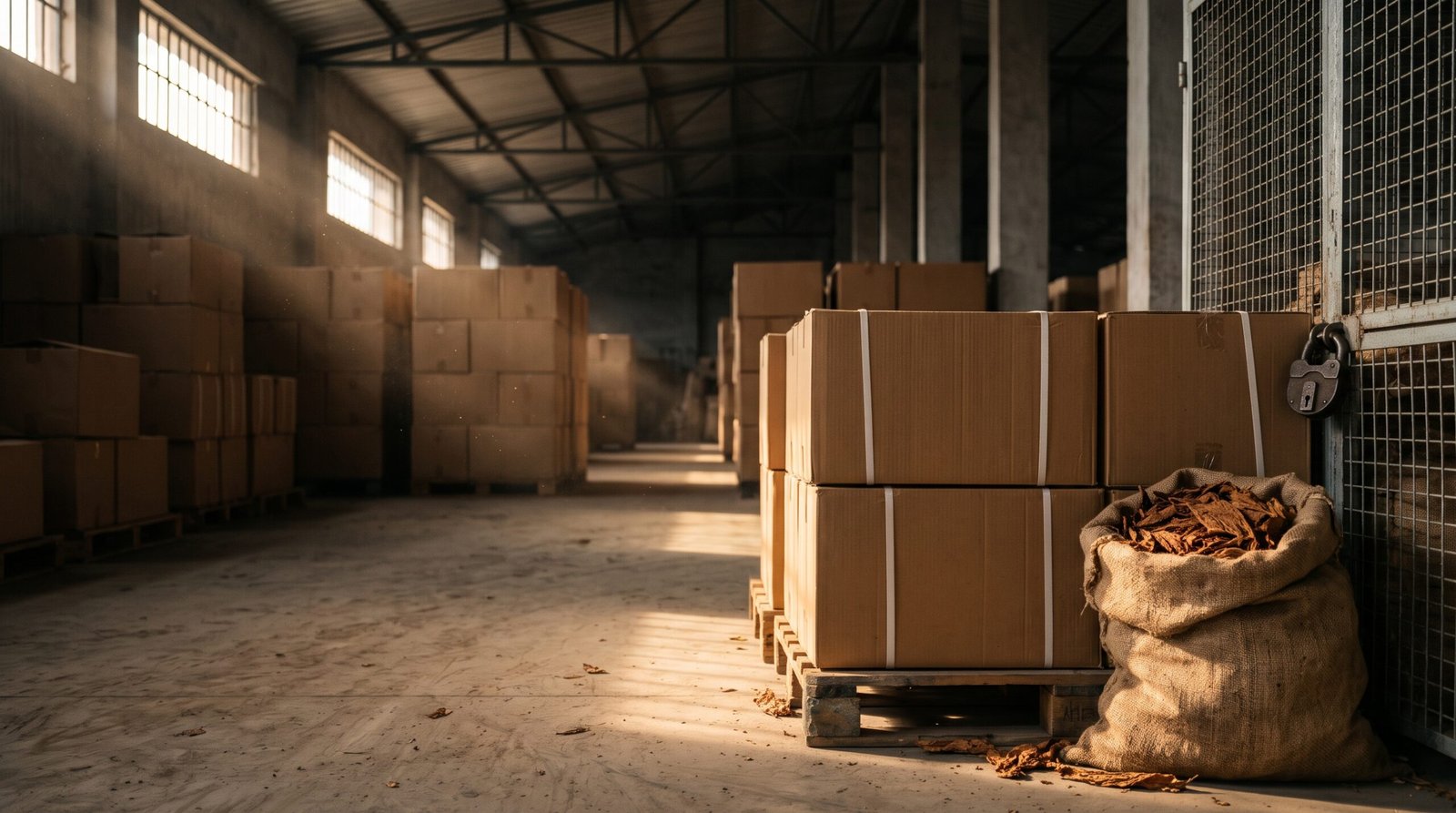
In October 2026, the Federal Board of Revenue’s Inland Revenue Enforcement Network conducted 58 raids and seized 38.62 million cigarette sticks and 16,800 kilograms of raw tobacco. Its hub-wise report, published by Business Recorder on November 23, 2026 put the duties and taxes involved at Rs. 332.859 million.
The Sindh–Balochistan hub accounted for nearly half of that estimated liability. What happened after the seizures is the question Parliament should ask. How much duty was assessed, how much survived adjudication, and how much reached the treasury? The report provides no answers. Six years after Track and Trace became the centrepiece of Pakistan’s response to illicit cigarettes, the most visible measure of enforcement is still what officers take away on the day of a raid. 1
When we wrote about the illicit tobacco trade in 2019 and 2020, the immediate controversies were the introduction of a cheaper third excise tier in 2017, the abandonment of the proposed health levy in 2019 and the procurement dispute that reached the Islamabad High Court. Beneath them was a question of administration. Could the state reconcile leaf bought from growers, tobacco processed at green-leaf threshing plants, cigarettes made and removed from factories, and duty actually paid? That question has survived the introduction of digital stamps and successive changes in the law. The missing record is the one that connects these transactions. 2
The latest figures on market size illustrate the cost of that gap. In November 2026, press coverage of an Asia-Pacific study put Pakistan’s illicit cigarette share at 54 percent and foregone annual revenue at around US$1 billion. Separate figures reported alongside it suggested that the tax-paid market grew from 36.5 billion to 41.5 billion sticks in fiscal year (FY) 2025–26, that tax receipts rose from Rs. 284 billion to Rs. 329 billion and that the estimated illicit share fell from 54 to 48 percent.
The larger tax-paid volume is an encouraging signal if verified. To establish how much illicit consumption changed, FBR would need to publish comparable estimates of both total and illicit volumes for the same periods. To attribute the change to enforcement, it would also need to account for prices, inventories and underlying demand. 3
There is also FBR’s own figure. In June, officials told a Senate subcommittee that annual cigarette tax theft was around Rs. 40 billion. In September, the full committee reviewed a subcommittee report centred on an estimated US$1 billion in annual losses. FBR should lay out the scope, period and calculation behind its Rs. 40 billion figure and reconcile it with the larger estimate reviewed by the committee. Parliament cannot set a credible recovery target while the basis of the figures remains unclear. 4
A March 2026 brief by the Social Policy and Development Centre (SPDC) offers a different estimate. Drawing on a 2025 survey of more than 6,600 smokers, it put illicit cigarettes at 34.2 percent of consumption, about 18.3 billion out of 53.6 billion sticks. The SPGC’s earlier national survey put the share at about 33 percent in 2023. SPDC classified roughly three-fifths of illicit volume in the 2025 estimate as smuggled and two-fifths as domestically produced. That division matters.
Inland Revenue can follow leaf, factory output and duty payments. Customs must establish how foreign packs entered the country and work with Inland Revenue to trace the domestic distribution of those consignments. The proportions remain survey estimates, with uncertainty around the classification of individual packs and total consumption. 5
SPDC estimated Rs. 115.6 billion in foregone excise and sales tax by applying tax assumptions to the volume it classified as illicit. That exercise values the tax associated with those sales. The potential cash gain from enforcement depends on how consumers respond when cheap illicit packs become harder to buy. Some would switch to duty-paid cigarettes, some would cut down or quit, and some would seek other untaxed products.
A fiscal projection should model those responses explicitly. The same discipline applies to the much-quoted figure of 54 percent from a 2025 retail survey. In that survey the percentage referred to brands found on sale. A shop can stock a dozen illicit brands and sell most of its cigarettes under one duty-paid label. A count of brands can guide inspections. Measuring the market requires weighting the cigarettes people actually buy. 5–6
The official revenue record demands scrutiny of its own. Table 14 of FBR’s FY2024–25 Yearbook shows domestic cigarette excise falling from Rs. 234.24 billion in FY2023–24 to Rs. 121.19 billion in FY2024–25, a 48.3 percent decline. The Yearbook cites several explanations, including reduced legal sales, a shift to cheaper brands and substitution towards untaxed products, without quantifying their respective effects.
The Rs. 284 billion and Rs. 329 billion figures reported in November 2026 were depicting as overall tax receipts without a breakdown by tax head. Readers need a reconciliation by tax head and period before drawing conclusions from the two series.
Also Read: What The Producing Provinces Are Owed
FBR should publish domestic cigarette excise, sales tax, import-stage collections, refunds and adjustments separately, alongside tax-paid clearances by tier. Its own numbers should settle which part of the reported recovery came from additional duty-paid sticks and which part reflected the mix of sales, collections under different tax heads or the timing of payments. [3, 6]
A peer-reviewed study published in Tobacco Control in 2026 shows where enforcement can improve. Researchers collected one pack per brand variant within sampling blocks in nine selected districts in August 2023 and October 2024. In the second wave, stamps appeared on about 98 percent of the sampled Pakistan Tobacco Company packs, 84 percent of Philip Morris packs and 4 percent of those from other domestic manufacturers. Some stamps present on packs failed app validation.
The sampling design speaks to compliance across the variants observed. Estimating what proportion of all cigarettes sold bore valid stamps would require a sales-weighted sample. The researchers also found that the app could check stamps and manufacturer registration but could not follow the product through the supply chain. 8
The Finance Act, 2026 widened the statutory basis for action. Amended sections 26 and 27 of the Federal Excise Act extend seizure and confiscation provisions to goods subject to prescribed production monitoring that evade it.
Section 45A governs electronic or other monitoring. The two domestic cigarette rates remain Rs. 5,050 and Rs. 16,500 per thousand sticks, with the upper tier applying above an on-pack printed retail price of Rs. 12,500 per thousand. That is Rs. 101 or Rs. 330 in excise per pack of 20, before sales tax. Such a wide difference warrants scrutiny of the clustering of declared prices near the threshold and of changes in the mix of brands. It also makes a third, cheaper tier a particularly poor substitute for enforcing the existing law. 9
The first audit should start at the threshing plants. The Pakistan Tobacco Board and FBR should reconcile recorded leaf purchases and opening stocks with processed output, closing stocks, documented waste, exports and deliveries to cigarette factories. The comparison must allow for moisture and processing losses and for legitimate non-cigarette uses. At the factory, auditors should compare inputs, independently recorded production, stamps issued and used, declared removals and payments.
Customs should supply a parallel record of legal imports and the disposition of intercepted consignments. Each discrepancy should generate an inquiry with a recorded outcome. Pakistan ratified the WHO Protocol to Eliminate Illicit Trade in Tobacco Products in 2018. Article 8 places responsibility for tracking and tracing on the state and bars delegation of its obligations to the tobacco industry. Audit access, control of the data and publication of results belong with the public authorities. 9–10
The Senate inquiry shows why the audit must extend to exemptions and to the state’s own warehouses. On November 10, 2026 the subcommittee sought records to examine allegations that tobacco-related imports cleared under the former federally administrated tribal areas (FATA) and provincially administrated tribal areas (PATA) exemption scheme were diverted to companies outside those areas.
At the November 23, 2026, hearing, the Rs. 720 billion figure cited concerned the value of unaccounted-for imports across commodities under the scheme. Tobacco was one line of inquiry. In a separate case, the committee examined the reported theft of 2,828 cartons of seized cigarettes from FBR warehouses. A seizure register should record every transfer and the final disposition of the goods. 11
The Public Accounts Committee should ask for a quarterly return covering seizures by type, demands raised, amounts recovered, goods confiscated or destroyed under the law, court outcomes and time taken to close cases. Aggregate figures can be published without prejudicing individual proceedings.
A recurring national consumption and pack survey with disclosed funding, methods, geographic coverage and uncertainty would provide the separate measure of whether illicit trade is contracting. It should report total volumes as well as shares. An illicit share can rise even when fewer illicit cigarettes are sold, if legal sales fall faster.
The health test is whether fewer people take up smoking and whether existing smokers smoke less or quit. In its 2025, Pakistan profile the WHO estimated that taxes accounted for 60.91 percent of the retail price of the most-sold brand in 2024 and that it was less affordable than in 2022. Those figures should be updated alongside retail prices and consumption.
The government should protect the real value of cigarette duty, examine a phased narrowing of the gap between the tiers and help smokers quit through primary healthcare. Giving the cheapest legal cigarettes a tax cut in the hope of winning customers back from illicit suppliers would put the Treasury in the business of making smoking cheaper. 12
Pakistan now has stamps, stronger powers and a running tally of raids. It can use them to answer the question raised six years ago. Start with what happened to the 38.62 million sticks seized in October 2026. Publish where the cases led, what was collected, and which sources of supply were closed. A seizure becomes evidence of progress when the authorities can show what changed after it.
Notes
- Business Recorder, October IREN seizure figures, 23 November 2026
- Huzaima Bukhari and Dr. Ikramul Haq, Illicit tobacco trade–II · SRO 407(I)/2017, Federal Board of Revenue
- The Express Tribune, Asia-Pacific report and FY2025–26 figures, 12 November 2026 · Associated Press of Pakistan, tax-paid volumes and estimated illicit share, 11 November 2026
- Dawn, FBR’s Senate briefing, 19 June 2026 · Senate Standing Committee on Interior and Narcotics Control, 22 September 2026
- Social Policy and Development Centre, The Revenue Loss Due to Illicit Cigarette Trade in Pakistan, March 2026
- Dawn, reporting on the IPOR retail survey, 22 February 2025
- Federal Board of Revenue, FY2024–25 Yearbook, Table 14
- Tobacco Control, Tracking the Track-and-Trace, 2026
- Federal Board of Revenue, Finance Act, 2026 · Pakistan Trade Information Portal, Federal Excise Act, 2005, sections 26, 27 and 45A and First Schedule
- WHO FCTC, Pakistan’s Protocol status · WHO FCTC, Article 8 and industry non-delegation
- Senate subcommittee, inquiry into alleged diversion of tobacco-related imports, 10 November 2026 · Business Recorder, report on the 23 November hearing · Senate subcommittee, reported theft of seized cartons, 12 March 2026
- WHO, Report on the Global Tobacco Epidemic 2025, Pakistan country profile
Disclaimer: The views and opinions expressed in this article are solely those of the author(s) and do not necessarily reflect the editorial position, values or beliefs of The Scoop or its management.
The Scoop firmly believes in freedom of speech, intellectual diversity and the open exchange of ideas. As an independent media platform, we remain committed to providing space for differing perspectives, including those that may challenge or contradict our own views.
Publication does not constitute endorsement. Our commitment to freedom of expression and independent journalism extends beyond opinions with which we agree.