

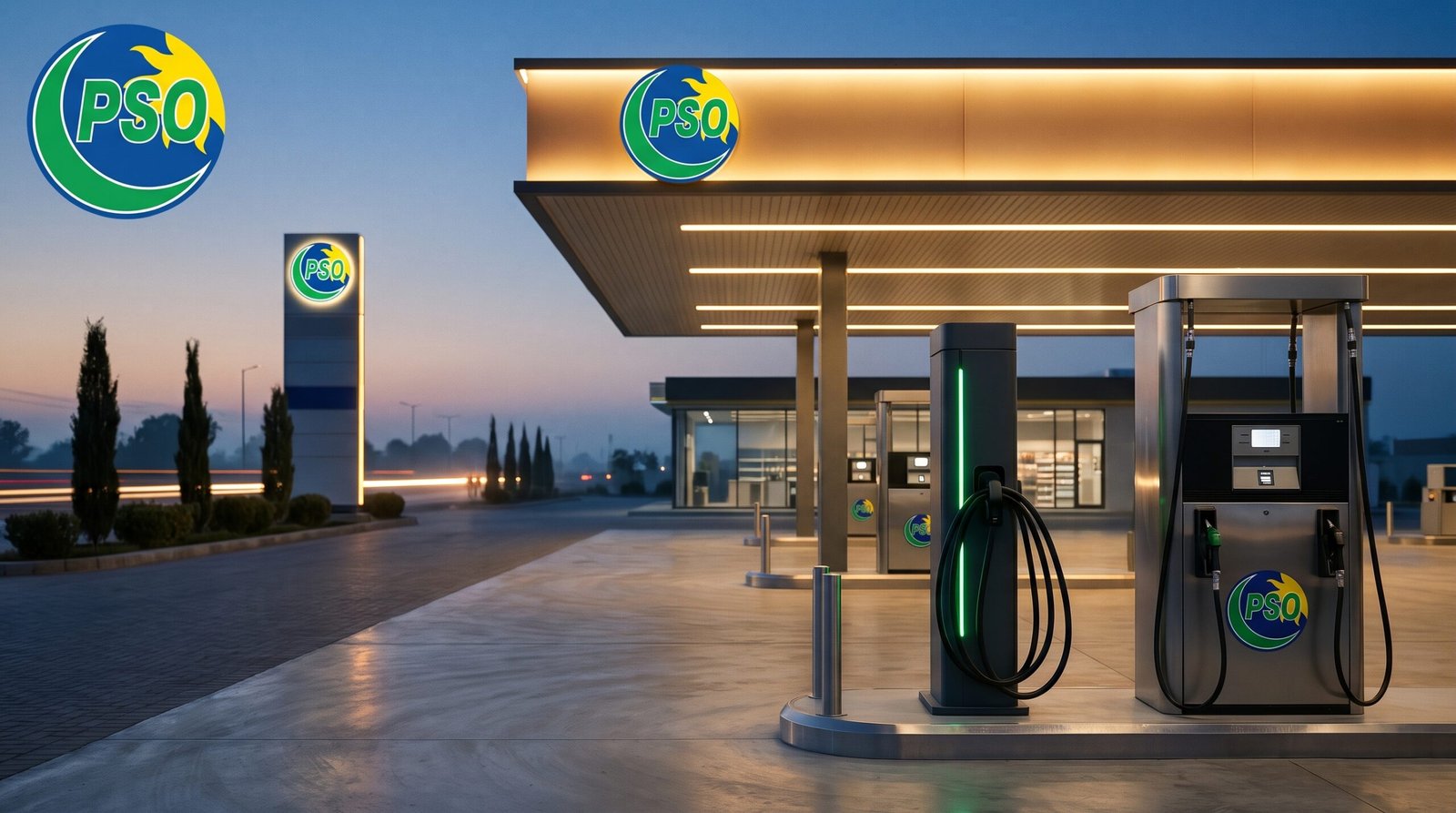
KARACHI: Pakistan State Oil Company Limited (PSO) plans to roll out more than 300 electric vehicle (EV) charging stations across major urban centres and highways over the next two to three years, while committing Rs1.5 billion to Rs1.8 billion toward automating its supply chain and roughly 3,600 retail outlets in order to qualify for enhanced oil marketing company (OMC) margins.
Disclosed during the state-owned energy giant’s corporate briefing on November 25—and detailed in research notes by Topline Securities and Intermarket Securities—the capital expenditure roadmap places digitisation, energy diversification, and supply-route resilience at the heart of PSO’s post-FY26 growth strategy.
Unlocking OGRA Margins and Defending Market Share Gains
Management informed analysts that it expects a phased rollout of revised OMC margins approved by the Oil and Gas Regulatory Authority (OGRA): a partial margin upward revision ahead of completion, followed by the full increase once network automation wraps up between March and June 2027.
Alongside retail digitisation, PSO is expanding beyond traditional liquid fuels. Management characterised EV charging as an already profitable vertical warranting sustained capital deployment, while singling out passenger car motor oils and industrial lubricants as priority growth pillars within its higher-margin lubricants segment.
Those investments build on a sharp operational recovery in core fuel volumes during the first quarter of FY27:
- Diesel Market Share: Rebounded from roughly 42 per cent to over 47 per cent.
- Petrol Market Share: Climbed from approximately 38 per cent to over 46 per cent.
Management attributed the resurgence to improved supply chain efficiency, consistent nationwide product availability, and the adoption of the daily pricing mechanism, pledging continued spending on retail branding and forecourt upgrades to protect those gains.
Scaling LPG Storage and Securing Hormuz-Free Supply Routes
With liquefied petroleum gas (LPG) prices now deregulated, PSO is also preparing an aggressive push into the domestic LPG segment, where it currently holds a modest 2.6 per cent share. Management estimates Pakistan’s existing LPG market at 2.4 million to 2.5 million tonnes, with headroom to expand toward 3 million tonnes.
To capture that growth, PSO plans to strike distribution and supply-chain partnerships while investing directly in both port and inland storage infrastructure—addressing what executives flagged as a critical industry bottleneck given that Pakistan currently relies on just two port terminals for LPG imports. Management also pushed back against media reports alleging an approximate Rs1 billion loss on PSO’s maiden imported LPG cargo, which is slated to offload within days, insisting the company retains full discretion over its selling price.
On the international procurement front, PSO has signed a long-term petrol and LPG supply agreement with Oman’s OQ Trading. Backed by roughly $200 million in trade credit, the deal bolsters Pakistan’s energy security by establishing supply corridors that bypass the geopolitically sensitive Strait of Hormuz.
Also Read: Ghani Dairies Commissions 600 kW Solar Power System To Cut Energy Costs Amid Rapid Herd Expansion
Qatar LNG Renegotiation Enters the Final Stretch
Negotiations to revise Pakistan’s long-term liquefied natural gas (LNG) supply contract with Qatar have reached their final stages, with formal sign-offs awaited from the Economic Coordination Committee (ECC) and the Prime Minister’s Office. Management expects the renegotiation to conclude by the end of December 2026.
Addressing regional security concerns, PSO clarified that the attack on Qatar’s Ras Laffan complex caused no damage to the two LNG facilities supplying Pakistan. Qatar has met Pakistan’s full LNG requirements over the past two months, and management anticipates no further supply disruptions. Highlighting the commercial value of the bilateral arrangement, executives noted that Qatar delivered 12 LNG cargoes through the Strait of Hormuz between March and June 2026, generating savings of more than $300 million for the federal government relative to prevailing spot-market prices.
Financially, however, LNG remains a drag on PSO’s bottom line. The segment posted a loss of Rs7.9 billion in FY26—narrowing 7 per cent year-on-year. Because taxation on the LNG business is levied on import value rather than profitability, PSO cannot claim a tax shield on the division’s hefty finance costs; consequently, scaling down LNG volumes would directly lower the company’s effective tax rate.
Circular Debt, Borrowings, and FY26 Earnings Snapshot
While receivables from the gas sector have stabilised, legacy circular debt continues to weigh heavily on PSO’s balance sheet:
- SNGPL Recoveries: PSO recovered Rs34 billion from Sui Northern Gas Pipelines Limited (SNGPL) during FY26, with no fresh receivables accumulating from the gas utility.
- Outstanding Receivables: According to Intermarket Securities, total circular debt receivables stand at Rs258 billion—equivalent to Rs549 per share—while overdue late payment surcharges exceed Rs200 billion and are booked in financial statements only upon actual cash receipt. Management noted that the federal government continues working on a broader circular debt resolution plan, with details to be shared once finalised.
- Borrowing Profile: Year-end borrowings climbed 8 per cent to Rs384.3 billion in FY26 as elevated petroleum prices inflated working capital requirements, though average borrowings across the year remained lower than in FY25. Short-term debt continues hovering near FY26 levels, split roughly 70 per cent foreign financing and 30 per cent domestic financing.
- FY26 Profitability: Petroleum products expanded to 79 per cent of net sales in FY26—up from 68 per cent in FY25—though segment profit eased from Rs23.8 billion to Rs20.7 billion. Overall, PSO posted an FY26 net profit of Rs15.1 billion—down 28 per cent year-on-year—with earnings per share (EPS) of Rs32.10 and a cash dividend of Rs10 per share, as a one-off prior-year tax charge overshadowed stronger underlying operational performance.