

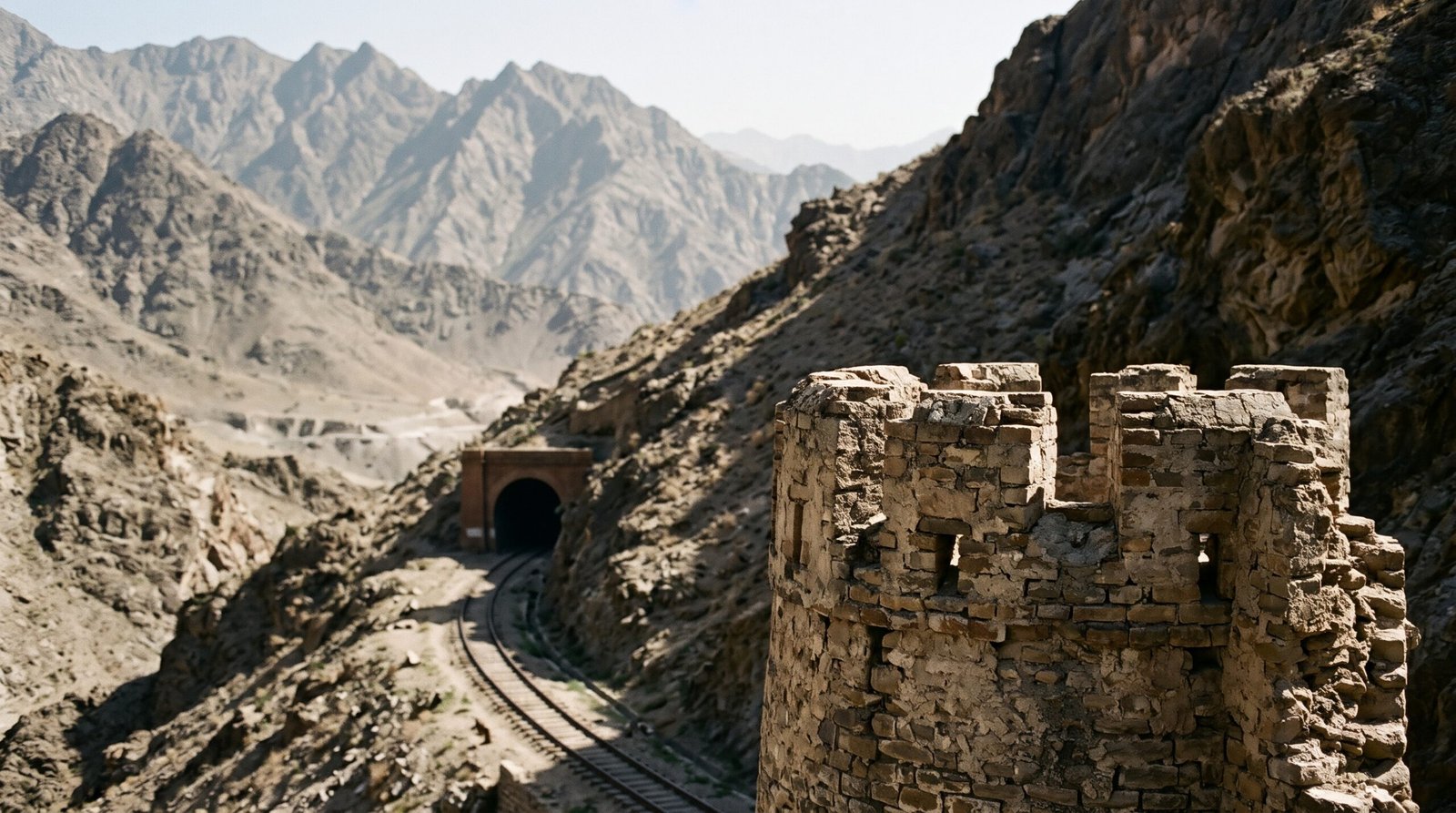
Anyone who drives from Peshawar toward Torkham passes through the Khyber Pass, and with it a museum of the Raj: forts, picket towers and a railway line threaded through dozens of tunnels. The pass looks ancient, but the modern story of the tribal areas that became FATA is a nineteenth-century story of ambition, fear and slow conquest. It took Britain the better part of a century to bring those hills into its empire, and it never did so completely. This is an account of how that happened, what was built along the way, and the young officer whose first book made the frontier famous in English.
In the 1830s, the British had no presence on the frontier known as KPK now, at all. The Indus was the edge of what they knew. Beyond it lay the Sikh Empire of Maharaja Ranjit Singh, whose forces occupied Peshawar in 1834. His general Hari Singh Nalwa built forts, including one at Jamrud at the mouth of the Khyber, and died fighting the Afghans there in 1837. The hill tribes, the Afridis, Mohmands, Orakzais, Wazirs and Mahsuds, remained independent in practice. They answered to no distant capital, and for centuries they had taken payment from anyone who wanted to use their passes. The Sikh state held the plains by force and the hills not at all.
Britain’s interest was strategic, not territorial. The East India Company feared Russia’s advance across Central Asia, the rivalry later called the Great Game, and believed that whoever controlled Afghanistan held the doors to India. That fear pulled British armies northwest in 1839, when the Company marched into Afghanistan to replace the ruler Dost Muhammad with the more pliable Shah Shuja. The occupation of Kabul was costly and resented. In January 1842, the British garrison and its thousands of camp followers began a winter retreat toward Jalalabad, and Afghan tribesmen destroyed the column in the passes. Dr. William Brydon, the lone European to reach Jalalabad, became the symbol of the disaster. An avenging army under General George Pollock forced the Khyber that spring, then withdrew. The lesson the British drew was one they never forgot: holding the pass meant either controlling the tribes above it or paying them. The next hundred years of frontier policy were an argument between those two answers.
The real turning point came in 1849. After Ranjit Singh died in 1839, the Sikh state had slid into factional chaos, and after the Second Anglo-Sikh War the Company annexed the entire Punjab. Overnight it inherited a frontier running along the foothills from Hazara to Dera Ismail Khan, with the districts of Peshawar, Kohat, Bannu, Dera Ismail Khan and Hazara now British territory. The tribal hills lay just beyond them. The Company had no plan for those hills, but it did have a cadre of soldier-administrators, many trained under Henry and John Lawrence, who believed in the energetic, personal rule of a single officer.
Herbert Edwardes had already gone into the Bannu valley in 1847-48. He tore down hundreds of the fortified village towers that had sheltered local wars, organized the collection of revenue and built a fort to anchor government authority in the valley. John Nicholson, who served at Bannu and Peshawar in the early 1850s, became so famous for his force of character that a group of local devotees reportedly venerated him as a saint, “Nikalseyn.” He is better remembered for his death at Delhi in 1857, but his frontier years defined what Britons expected of a frontier officer. James Abbott in Hazara and Frederick Mackeson in Peshawar belonged to the same school. The British also raised the Punjab Irregular Force in 1849, later called the Punjab Frontier Force and nicknamed the “Piffers.” It recruited Pashtuns, Sikhs and Punjabis under British officers and was posted in forts along the border from Hazara to the south, forts that became the military skeleton of the new frontier.
The tribes did not accept the new border passively, and once the British held the plains they felt obliged to answer raids from the hills. The answer was a long series of small wars. Sir Charles Napier led troops against the Afridis around the Kohat Pass in 1850, a hard introduction to how costly a conventional army found broken mountain country. A campaign against the Mahsuds in 1860 was the first major British push into Waziristan. The Ambela campaign of 1863, aimed at the settlement at Sittana where followers of the reformer Sayyid Ahmad Barelvi had gathered, turned into one of the hardest frontier fights of the century, with heavy casualties before the tribes agreed to terms.
The pattern repeated itself. A raid, a murder or a threat to a road would bring a column into the hills, which burned towers, destroyed crops, exacted a fine or a promise and withdrew. These were called punitive expeditions. They bought a temporary quiet and left a lasting grievance.
Behind these expeditions lay a quarrel inside the British government over what frontier policy should be. The Close Border school, associated with John Lawrence, later Viceroy, held that Britain should hold the plains, defend them with forts and troops and leave the hills alone. It was cheaper and less likely to provoke the tribes or Afghanistan. The Forward school argued that the border could not be secured by waiting, because if Russia reached Kabul the hills would become a base against India. It wanted garrisons, roads and political officers pushed out into the hills in advance, and eventually a fixed boundary with Afghanistan. Neither side won outright, which is why British conduct on the frontier so often looks inconsistent, with advances followed by retreats and treaties followed by wars.
The Forward school won its great victory in the Second Afghan War of 1878-80. After Amir Sher Ali received a Russian mission and refused a British one, the Viceroy, Lord Lytton, sent three columns across the frontier in November 1878. The Treaty of Gandamak in 1879 gave Britain the Kurram Valley and control of the Khyber, but its envoy in Kabul, Sir Louis Cavagnari, a former Deputy Commissioner of Peshawar, was killed with his escort that September, and the war resumed. It ended with the accession of Abdur Rahman Khan and a British withdrawal, though Britain kept the frontier lands it had taken. For the tribal belt the consequences were permanent. The Khyber was now a British-controlled route, the Kurram Valley was British, and the old policy of leaving the hills alone was finished.
From the late 1870s the British built what became the agencies. In 1878 they raised a force of local Afridis to guard the Khyber, the Khyber Rifles, under Robert Warburton, an officer whose mother was Afghan and who spoke Pashto fluently. Kurram came under British administration, and a local militia was raised to hold it, a protection the Shia Turi tribe, a minority among Sunni neighbors, generally welcomed. In 1893 Sir Mortimer Durand, the Foreign Secretary of the Government of India, concluded an agreement with Abdur Rahman Khan fixing the limits of the Amir’s territory and the British sphere. The line ran through the heart of Pashtun country and divided tribes between two states, and Afghanistan has never fully accepted it. In the mid-1890s, after a boundary commission and an attack on a British escort at Maizar, the posts at Tochi and Wana grew into the agencies of North and South Waziristan. After the siege of Chitral in 1895, the British occupied the Malakand Pass to guard the road to Chitral, and Malakand became the northern anchor of the frontier system.
It was there, two years later, that Winston Churchill arrived.
A small correction to the popular image first. Churchill, later a Knight of the Garter and, from 1946, a member of the Order of Merit, went to the Malakand in 1897 as a lieutenant in the 4th Queen’s Own Hussars, a regiment of the regular British Army rather than the Indian Army. His regiment was stationed at Bangalore, and he went to the frontier in a dual role, as a serving officer attached to the field force and as a war correspondent. That double identity is what makes his account unusual.
In the summer of 1897 he was twenty-two, bored in southern India and ambitious beyond his rank. He had already seen a little of war, having gone to Cuba in 1895 as an observer of the Spanish campaign. His own memoir, My Early Life, makes plain that his motives were as political as military. He wanted medals, he wanted a name, and he understood that a record of active service and a published book could carry a young man toward Parliament. His mother, Lady Randolph Churchill, a gifted social operator, used her connections to help him get where the fighting was.
The fighting came sooner than anyone expected. In late July 1897 a wave of risings began in the Malakand and Swat region. The Malakand camp and the fort at Chakdara were attacked at night by thousands of tribesmen, many of them inspired by a charismatic preacher the British called the “Mad Mullah” of Swat, Mullah Saidullah, also known as the Sartor Faqir. The British held, narrowly. Then the Mohmands and Afridis rose too, in what became the great frontier uprising of 1897-98. Churchill read the news while on leave and set out at once. He arranged to be attached to the Malakand Field Force under Brigadier-General Sir Bindon Blood, an officer he had befriended, and obtained a commission from the Daily Telegraph in London, paid at five pounds a column, as well as a place as correspondent for the Pioneer of Allahabad, the leading English-language paper in British India. When a vacancy arose, Blood made him an orderly officer, which attached him to the force in a military capacity too.
Churchill reached the frontier in early September. He joined the punitive operations against the Mamund tribe in the Mamund Valley, where a brigade under General Jeffreys was sent to chastise tribesmen who had joined the rising. On 16 September a British force was ambushed and fought a bitter engagement around the village of Shahi-Tangi, and Churchill was with it under fire. He helped with the wounded, used his own rifle, and recalled the action in his letters and later in My Early Life with the relish of a very young man who had survived. His reporting in these weeks made his name. His letters in the Telegraph were vivid and confident and told readers in London about a war most of them had never heard of. They were also critical. He argued that the army’s burning of crops and razing of villages achieved little lasting effect and that the Forward Policy was costing too many lives. Such views from a lieutenant were unusual, and they did not make him popular with some senior officers.
When the fighting ended he wrote his first book, The Story of the Malakand Field Force: An Episode of Frontier War, published in 1898. It was part military narrative, part reporting and part polemic. He described the geography and the tribes, the fighting at Malakand, Chakdara and the Mamund Valley, and the conduct of the officers and men, British and Indian, paying particular tribute to the Sikh, Punjabi and Pashtun soldiers who served in the ranks. He wrote with a clarity and energy that earned praise. He described the tribes with the mixture of admiration and condescension typical of his era and class, as brave, proud and hospitable, and at the same time as bound by custom and ruled by passion and by what he called fanaticism. Some of his remarks about Islam were harsh enough that he cut them from later editions. The book also contained his views on policy, urging caution and criticizing the destruction of crops and villages as both cruel and ineffective.
The book sold well and brought him fame and a useful sum, which with his newspaper fees helped fund his early career. It also drew the attention of the Prime Minister, Lord Salisbury, who met him. For a cavalry subaltern with political ambitions, it was an excellent start. He received the Indian Medal with the clasp “Punjab Frontier 1897-98,” and the next year he went to the Sudan, serving with the 21st Lancers at Omdurman and writing a second book, The River War. His early reputation as a soldier-correspondent was built on the Malakand, and the frontier supplied a foretaste of the qualities that marked his later career: sympathy for the fighting man, a readiness to criticize mismanagement and an appetite for the pen as well as the sword.
For the people of the Malakand, of course, the same events looked very different. To them the British were a foreign force that had come to seize roads and passes, and the tribesmen who attacked the camp were defending their homes and their faith. Churchill’s account is a primary source of real value, but it is the view of a young British officer. Today a hill picket on the Malakand heights is still known as Churchill’s Picket, and the forts at Malakand and Chakdara are heritage sites. Historians have studied how his writing shaped British perceptions of the frontier, and Pakistani scholars read him critically as a witness to a colonial conquest.
The wider uprising followed. In August and September 1897 the frontier erupted from Malakand to the Khyber. The Afridis seized the Khyber forts and the posts on the Samana ridge. On 12 September a detachment of twenty-one Sikh soldiers of the 36th Sikhs held the small post of Saragarhi to the death, an action still commemorated by the Sikh regiment’s successors. The government sent the Tirah Expeditionary Force, some 35,000 to 40,000 men under General William Lockhart, into the Afridi and Orakzai heartland in the autumn, and the Dargai Heights were taken in a famous and costly assault in which the Gordon Highlanders played a central part. By spring 1898 the tribes had submitted, but the campaign had been expensive and had shaken the government.
The shock of 1897 persuaded the new Viceroy, Lord Curzon, to make a decisive reform in 1901. He separated the frontier districts from the Punjab and created the North-West Frontier Province under a Chief Commissioner reporting directly to the Government of India, with Sir Harold Deane as its first holder. He also reduced the number of regular troops in advanced tribal positions, which were costly and provocative, and relied instead on locally raised militias: the Khyber Rifles, the Kurram Militia, the Tochi Scouts and the South Waziristan Scouts, later grouped together as the Frontier Corps. Regular troops were kept in cantonments at Peshawar, Kohat and Bannu, from where they could move when needed. This arrangement lasted, with adjustments, until the end of the Raj.
The frontier was never quiet for long. In 1919 the Third Anglo-Afghan War brought Afghan forces under Amir Amanullah across the border. The war itself was short, but the Waziristan campaign that followed was long, bitter and costly. The British then adopted what they called peaceful penetration, pushing roads and garrisons into the hills instead of simply raiding them. They built a large cantonment at Razmak in the 1920s in the heart of Mahsud country, with posts at Wana and Miranshah, and used the Royal Air Force to bomb tribal villages, a method that spared ground columns but caused great suffering and deepened resentment. In the late 1930s a long campaign against a religious leader, the Faqir of Ipi, drew tens of thousands of troops into Waziristan and pushed many new roads through it.
It is fair to ask what Britain actually built. Its priorities were strategic, but some of what it left still matters. Military roads linked the Khyber and Waziristan to the plains, and many modern highways follow their alignments. The railway reached Peshawar across the great bridge over the Indus at Attock, opened in 1883, with branches to Kohat and Thal and to Bannu and Tank. The Khyber Railway from Jamrud to Landi Kotal, completed in 1925, climbed through the pass with dozens of tunnels, bridges and culverts, a feat of engineering built mainly to carry troops and supplies, though it later served trade and visitors too. Cantonments, forts and telegraph lines at Peshawar, Nowshera, Kohat, Bannu, Dera Ismail Khan, Razmak, Landi Kotal and Miranshah became the first permanent government buildings in many places, and in several cases towns grew up around them.
Social investment was modest and concentrated in the settled districts, not the tribal belt itself. Edwardes College in Peshawar grew out of a mission school founded in 1853. Islamia College was founded in 1913 with the support of Chief Commissioner Sir George Roos-Keppel, a fluent Pashto speaker. The Lady Reading Hospital opened in Peshawar in 1927, and mission doctors such as Theodore Pennell treated patients from the hills at Bannu. The Upper Swat Canal, completed in 1914, brought water to the Peshawar and Mardan plains and changed the economy of the frontier as a whole. Within the agencies themselves, schools and dispensaries were few. In 1932 the NWFP became a Governor’s province with a legislative council, but the tribal areas remained outside it, answerable to the Governor as the Crown’s agent.
When Britain left in 1947, it left the tribal belt much as it had made it: the agencies, the Frontier Corps, the Durand Line, the roads and the railways. After the referendum in the North-West Frontier Province that summer, the province joined Pakistan, and the new government under Muhammad Ali Jinnah chose to reach agreements with the tribes and withdraw the regular army from Waziristan, keeping the tribal belt largely as the British had left it. The areas that became known as FATA thus entered independence with the colonial map intact.
That inheritance explains much of what followed. The empire had built a region with remarkable infrastructure and remarkably little else: highways without hospitals, railways without factories, forts without schools. The economy stayed poor and dependent on subsistence, trade and allowances, and migration for work, first into the army and later to the Gulf and the cities, became the main path out of poverty. When Pakistan merged FATA into Khyber Pakhtunkhwa in 2018, it began, for the first time, to close that gap. The measure of that merger will be whether the children of the old agencies get the schools, clinics and opportunities that the empire never thought to give them.
Churchill’s Malakand is a useful reminder of how this history came to be written. The first popular account of the tribal frontier in English came from a young officer in search of glory, who admired the fighting qualities of the people he described and doubted the wisdom of the policy that had sent him there. His account is vivid, honest in places and blinkered in others. It deserves to be read alongside the voices of those who actually lived in the hills, whose own history of that summer remains largely unwritten in English.
Authors’ note and disclaimer: This article is a work of historical commentary based on documented accounts of the British Raj on the North-West Frontier, including Winston Churchill’s *The Story of the Malakand Field Force* and *My Early Life*. Primary source archival records were collected directly by the author, Engineer Arshad H. Abbasi, from the India Office Records (Political and Secret Department files) at the British Library.