
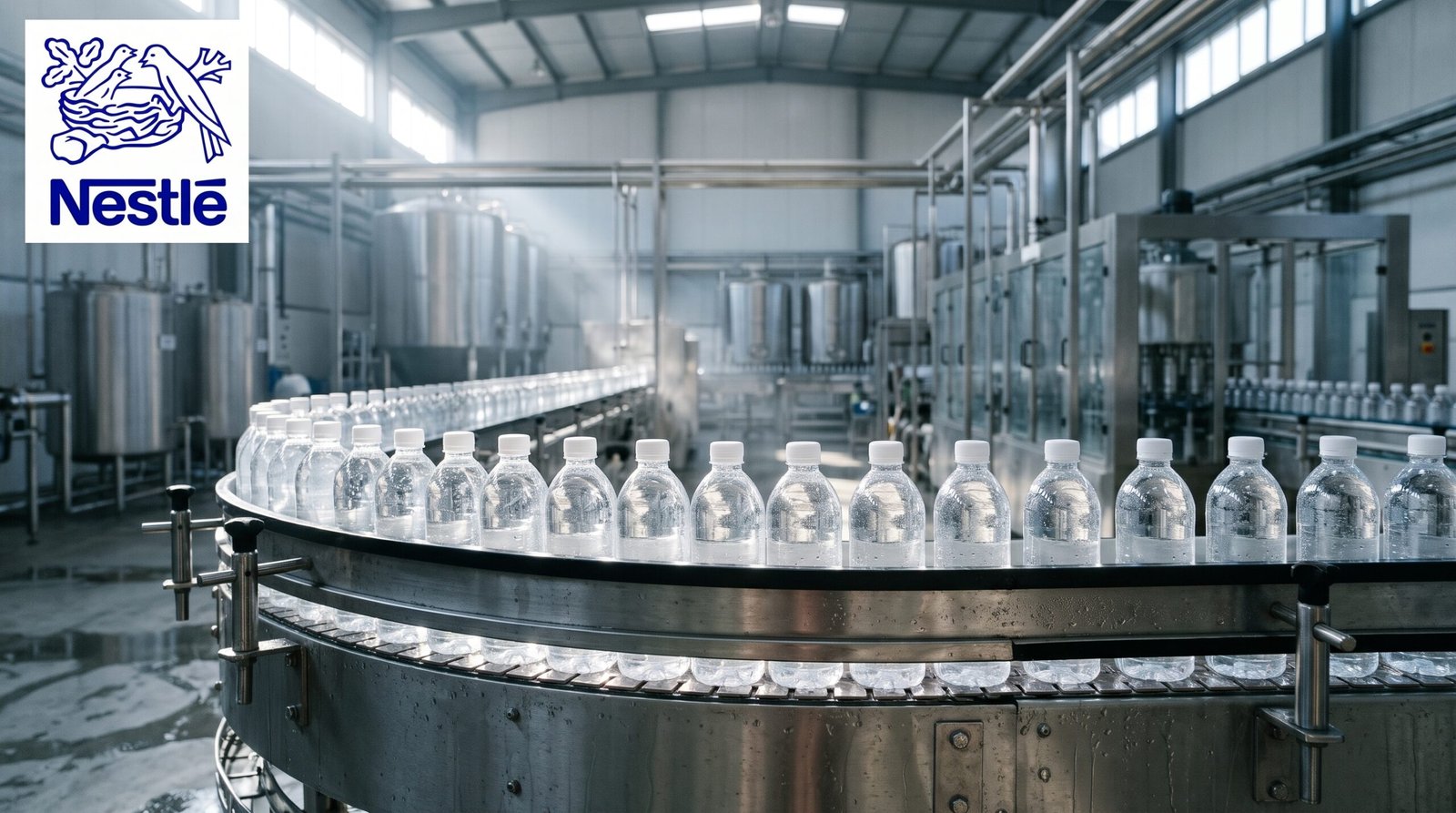
LAHORE: Very few global consumer staples can trace their origin story to Pakistan. Nestlé Pure Life is a rare exception: launched locally in 1998, the bottled water label grew out of the Pakistani market to become one of Swiss food giant Nestlé S.A.’s flagship billion-franc global brands.
Twenty-eight years later, Nestlé Pakistan Limited is preparing to part ways with the business it helped create.
On November 18, the board of directors of Nestlé Pakistan approved a Scheme of Arrangement to separate the company’s water business and transfer it into a newly formed, wholly owned subsidiary—Waters and Premium Beverages Pk (Private) Limited—in exchange for shares in the new entity. Once the corporate restructuring takes effect, Nestlé Pakistan intends to divest its entire shareholding in the subsidiary at fair market value.
The ultimate destination for the business is Peranel, a global joint venture through which parent company Nestlé S.A. is carving out its worldwide water and premium beverages portfolio, with US private equity firm Platinum Equity taking a 50 per cent ownership stake.
For investors on the Pakistan Stock Exchange (PSX), however, the announcement raises an immediate governance question. Nestlé Pakistan has yet to disclose how much revenue or operating profit its water division generates, what the carved-out business is worth, or what sale price it expects to realise—even as minority shareholders who hold roughly 41 per cent of the company prepare to vote on a transaction in which their controlling shareholder sits on both sides of the table.
Anatomy of a Two-Step Carve-Out
Under the board-approved structure, the exit will unfold across two distinct corporate phases. First, the Scheme of Arrangement will legally ring-fence the water division’s assets, bottling infrastructure, distribution rights, and liabilities inside Waters and Premium Beverages Pk (Private) Limited. Second, once the carve-out is complete, Nestlé Pakistan will execute a share sale to transfer the subsidiary into the Peranel joint venture fold.
| Deal Element | Current Status / Details |
| Seller | Nestlé Pakistan Limited (listed on the PSX) |
| Carve-Out Vehicle | Waters and Premium Beverages Pk (Private) Limited (wholly owned subsidiary) |
| Ultimate Acquirer | Peranel (global water & premium beverages JV between Nestlé S.A. and Platinum Equity) |
| Transaction Mechanism | Scheme of Arrangement (asset hive-off) followed by share sale at “fair market value” |
| Shareholding Split | Majority owned by Nestlé S.A.; roughly 41% held by minority shareholders |
| Key Undisclosed Metrics | Standalone water revenue, EBITDA/operating profit, independent valuation, and sale price |
Because the restructuring proceeds via a formal Scheme of Arrangement under Pakistan’s Companies Act, 2017, the transfer cannot be completed by board resolution alone. It will require sanction from the relevant High Court, clearance from creditors, and formal shareholder approval at an Extraordinary General Meeting (EGM)—processes that will eventually compel more detailed financial disclosures.
Also Read: Packages Group Moves Upstream As IGI Targets 60% Controlling Stake In Nimir Resins
Why Vevey Is Reshaping Its Global Water Empire
Nestlé Pakistan’s carve-out is not an isolated local retreat, but the Pakistani leg of a sweeping global portfolio overhaul orchestrated from Nestlé’s headquarters in Vevey, Switzerland.
For years, packaged drinking water has sat uneasily inside the Swiss conglomerate’s broader financial model. Compared with Nestlé’s highest-margin global engines—such as coffee, pet care, and specialised nutrition—mass-market bottled water is capital-intensive, heavily exposed to resin packaging and freight costs, and increasingly subject to environmental and groundwater regulations worldwide.
By folding its global water and premium beverages portfolio into Peranel alongside Platinum Equity—a buyout firm with deep operational experience in large-scale beverage carve-outs—Nestlé S.A. can deconsolidate heavy bottling operations, sharpen management focus on core packaged foods and dairy, and unlock capital while still retaining a 50 per cent stake in the spun-off venture’s upside.
What Pure Life Means Inside Pakistan’s Beverage Market
Locally, letting go of Pure Life marks a defining structural shift for Nestlé Pakistan. Since its 1998 debut, Pure Life effectively pioneered Pakistan’s organised bottled water category, building an entrenched brand premium across both retail single-serve packs and recurring 19-litre home and office delivery networks.
Even as competition intensified from multinational rivals—including PepsiCo’s Aquafina and Coca-Cola’s Dasani—alongside aggressive local bottlers, Pure Life remained the sector’s primary benchmark for quality and distribution reach. At the same time, bottled water operations in Pakistan have operated under tighter regulatory and cost pressures in recent years, ranging from groundwater extraction levies to steep packaging, energy, and freight inflation.
Because Nestlé Pakistan’s published financial statements do not break out standalone net profitability for Pure Life separately from its broader dairy, nutrition, and beverage segments, outside investors currently have no reliable way to calculate how much of the company’s top-line scale or bottom-line earnings will walk out the door once the subsidiary is sold.
The Related-Party Dilemma for 41% Minority Investors
That opacity sits at the heart of the governance test facing minority shareholders. In a standard third-party divestment, a board’s sole incentive is to extract the highest possible price from an arm’s-length buyer. Here, Nestlé S.A. controls the majority stake in Nestlé Pakistan while simultaneously holding half of Peranel—creating an inherent tension in which paying less benefits the parent’s global joint venture, while selling higher benefits Nestlé Pakistan’s minority investors.
Before minority shareholders—a register that has long included prominent local corporate and institutional holders—can meaningfully evaluate the Scheme of Arrangement, four critical questions will need transparent answers:
- Standalone Financial Performance: What share of Nestlé Pakistan’s revenue, gross margin, and free cash flow does the water division contribute today?
- Valuation Independence: Who will conduct the fair market valuation, what earnings multiples or discounted cash-flow assumptions will be applied, and how will the brand value and distribution network built in Pakistan since 1998 be priced?
- Use of Proceeds: Once the subsidiary is sold, will the cash proceeds be returned directly to shareholders through a special dividend, or retained on Nestlé Pakistan’s balance sheet to pay down debt and fund expansion in dairy and nutrition?
- Transitional Arrangements: Will Nestlé Pakistan continue providing shared administrative, logistics, or distribution services to the carved-out entity on arm’s-length terms after the handover?
Under Pakistan’s corporate governance framework and Securities and Exchange Commission of Pakistan (SECP) related-party rules, material transactions involving controlling shareholders demand rigorous audit-committee scrutiny, independent third-party valuation reports, and full pre-vote disclosure.
For Nestlé S.A., folding Pure Life Pakistan into Peranel brings clean strategic alignment to a global private-equity partnership. For Nestlé Pakistan’s minority shareholders, however, the real measure of the deal will not be the elegance of Vevey’s global restructuring—it will be whether the price paid for a homegrown icon fairly compensates the Pakistani investors who backed it for nearly three decades.