


Binance Holdings Ltd. has published its most detailed account yet of the catastrophic security breach that resulted in the theft of $6.3 billion in digital assets. In a comprehensive incident report released on Tuesday, the exchange revealed that the attackers did not rely on a single technical vulnerability, but rather orchestrated a highly sophisticated, multi-stage social engineering campaign heavily reliant on malicious software and fake job interviews.
Richard Teng, co-chief executive officer of Binance, emphasised the complexity of the operation. “This was not a single mistake or a single breach. It was a campaign built over many months,” Teng stated. He noted that the attackers seamlessly blended sham recruitment interviews, compromised devices, AI techniques, and malware disguised as legitimate developer tools to infiltrate the exchange’s inner architecture.
The ‘Contagious Interview’ Tactic
At the heart of the breach was a social engineering strategy that cybersecurity firm Palo Alto Networks has previously dubbed the “Contagious Interview.”
According to Binance’s autopsy, the infiltration began when a company engineer was approached on a prominent job-hunting platform by an individual posing as a project director. The target was subsequently interviewed via a social chat application by a person claiming to be the chief executive officer of a fictitious firm. During this rigorous but entirely fabricated interview process, the Binance employee was asked to download a technical assignment containing a “malicious code repository.”
This single download triggered a cascade of unauthorised activities within Binance’s internal networks.
AI Tools and Lateral Movement
The breach was compounded by earlier, seemingly unrelated security lapses. The report disclosed that in June, a different engineer had accidentally downloaded malicious software while attempting to install what the company described as “a popular AI coding tool.” This error inadvertently exposed the specific roles of various employees, highlighting those who held critical access to Binance’s digital wallets.
Armed with this intelligence, the hackers moved laterally. Nine days prior to the primary heist, the attackers used the laptop compromised during the fake job interview to infiltrate the computers of two additional software engineers responsible for wallet security. The hackers reportedly utilised an “internal AI tool” to cement their access and assume control of the laptops, though Binance refrained from specifying the exact nature of the tool or how it was manipulated.
Also Read: The $6.4 Billion Binance Heist: Inside The Largest Crypto Hack in History
The North Korean Nexus
Binance, alongside the US Federal Bureau of Investigation (FBI) and other law enforcement agencies, has attributed the historic attack to North Korean state-sponsored hackers—an allegation the Democratic People’s Republic of Korea has routinely denied.
The techniques deployed against Binance are tried-and-true hallmarks of North Korean cyber-warfare. In 2022, North Korean operatives utilised identical fake job offers to trick an engineer at the crypto-gaming platform Axie Infinity, resulting in a $590 million theft. Three years later, in 2025, similar tactics were used to breach the Bybit exchange, netting $1.5 billion—the previous record for the largest digital asset heist.
The threat from state-sponsored actors is accelerating rapidly. In 2026 alone, Binance reported identifying and blocking 57 separate attempted attacks connected to North Korea before this breach successfully bypassed their defences.
Market Fallout and Recovery Efforts
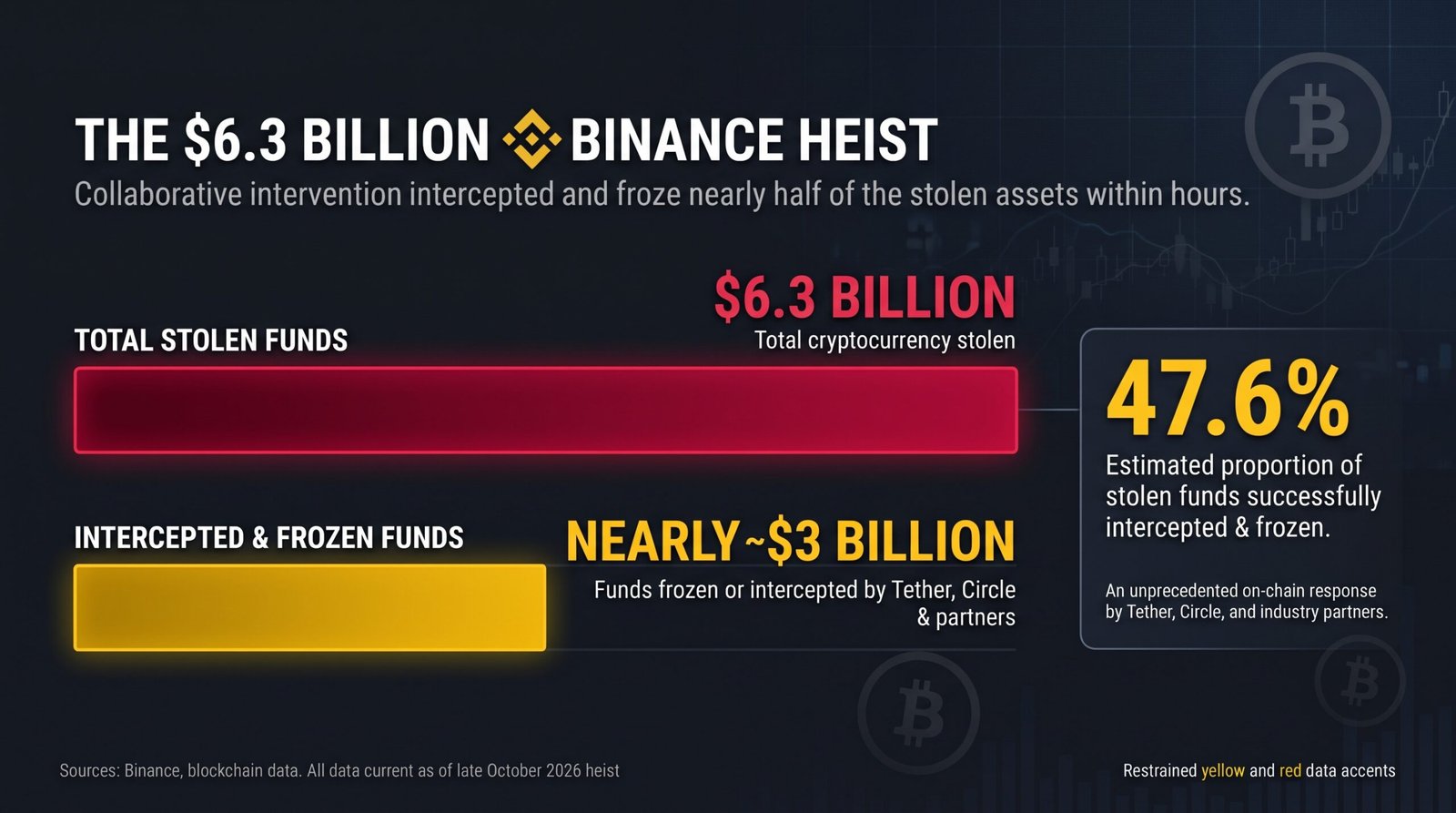
The sheer scale of the October 29 heist sent immediate shockwaves through the digital asset sector. In the chaotic hours following the exploit, stablecoin issuers Tether and Circle Internet Group Inc., alongside other industry partners, successfully froze or intercepted nearly $3 billion in stolen funds.
To contain the crisis, Binance paused all platform withdrawals for nearly two days, sparking widespread market anxiety. However, the exchange has moved aggressively to stabilise the situation, committing to absorb the financial impact entirely. Binance confirmed it has nearly replenished the stolen cryptocurrency using a combination of its corporate treasury reserves and two dedicated insurance funds. By Tuesday, consumer confidence appeared to be recovering, with Binance reporting that hourly deposits had once again begun to outpace withdrawals.
The broader market reaction has remained surprisingly resilient. Bitcoin initially tumbled by more than 4 per cent to nearly $76,000 following news of the exploit, but the flagship cryptocurrency has since pared back those losses, trading steadily around $77,600 as the market digests the exchange’s swift recovery measures.
Binance stated it has since implemented aggressive mitigation protocols, including rebuilding the affected cryptographic infrastructure, redeveloping the exploited internal AI tool, and deploying enhanced AI-powered security detectors to prevent future social engineering compromises.