

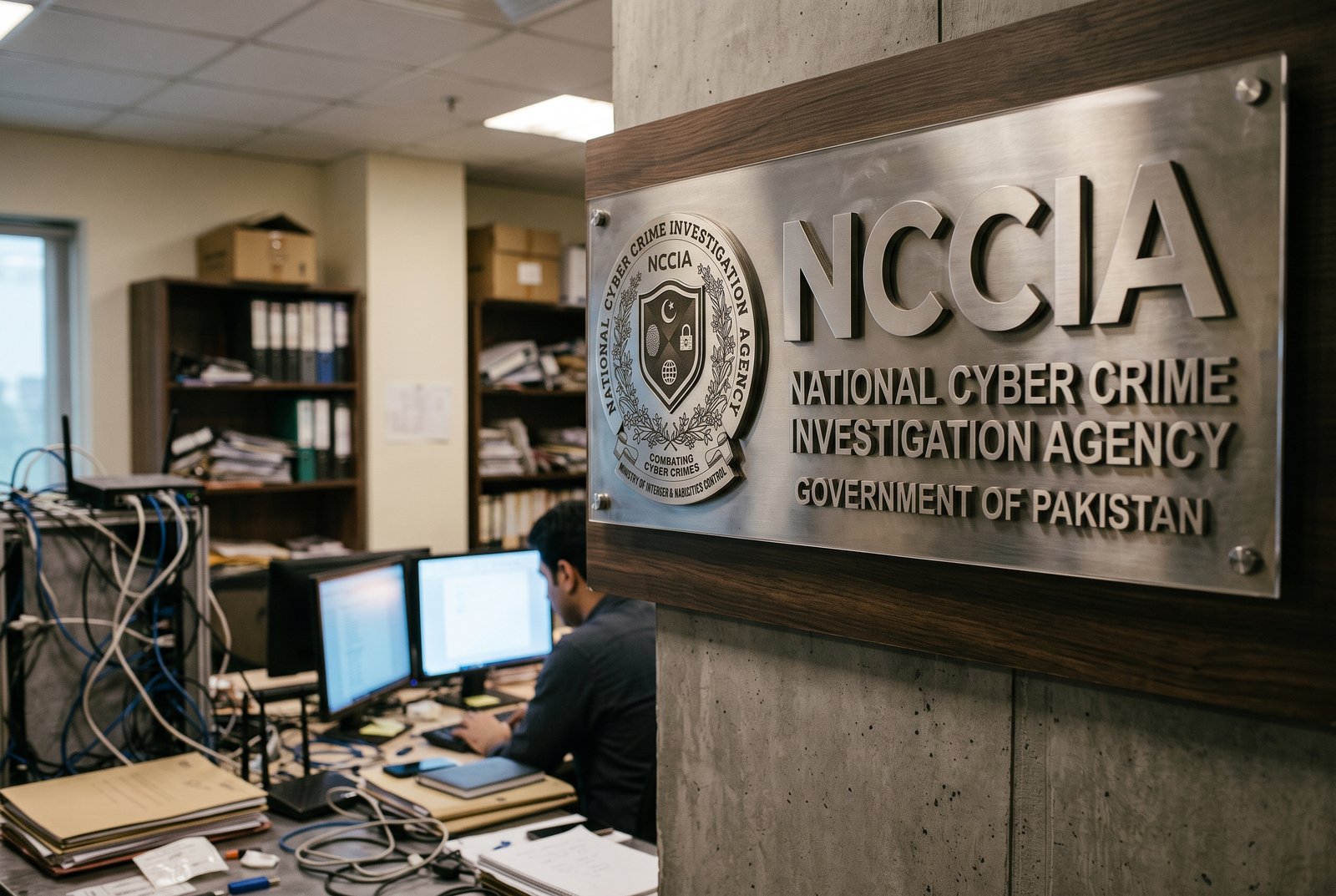
Pakistan’s National Cyber Crime Investigation Agency (NCCIA) has rolled out a comprehensive public awareness campaign targeting the rising tide of digital gender-based violence, online harassment, and extortion. Operating under the banner “A Safer Digital Pakistan is a Shared Responsibility,” the federal body is actively urging citizens—particularly women—to report cyber offenses rather than enduring them in silence.
The official campaign poster prominently highlights four distinct digital crimes that have increasingly plagued social media users across the country: online harassment, the creation of fake profiles, the unauthorized dissemination and misuse of personal photographs, and digital blackmail. In a direct public appeal, the agency’s Urdu messaging translates to a firm warning for perpetrators and an empowering call to action for victims: “Blackmailing women, leaking personal pictures, or making fake profiles is a crime. Do not stay silent, unmask the harassers.”
To streamline the reporting process and provide immediate assistance, the NCCIA is heavily promoting its dedicated 24/7 toll-free cybercrime helpline, 1799.
The Institutional Shift: From FIA to NCCIA
The campaign brings renewed attention to Pakistan’s evolving digital law enforcement infrastructure. The NCCIA is a relatively new entity, formally established in May 2024 to succeed and replace the Cyber Crime Wing (CCW) of the Federal Investigation Agency (FIA).
This structural transition was initiated by the federal government to create a specialized, dedicated institutional framework capable of tackling increasingly sophisticated digital crimes. While the FIA historically managed cyber offenses alongside its much broader anti-corruption, immigration, and counter-terrorism mandates, the creation of the NCCIA centralized digital forensics, cyber security operations, and digital prosecution under one roof.
PECA and the Legal Framework
The NCCIA derives its investigative and enforcement authority primarily from the Prevention of Electronic Crimes Act (PECA) 2016. Under PECA, offenses such as the non-consensual transmission of intimate images, digital spoofing, and cyberstalking carry severe penalties, including substantial fines and imprisonment.
However, enforcement has historically been hindered by chronic underreporting. Victims of online harassment frequently refrain from pursuing legal action due to societal stigma, fear of retaliation, or a lack of confidence in the investigative process. The NCCIA’s current campaign aims to dismantle these barriers by explicitly framing digital abuse not as a private shame, but as a prosecutable federal crime, backed by a centralized helpline designed to initiate legal action.
Expanding Digital Vigilance
The agency’s operational footprint extends across the country, with regional directorates and reporting centers established in major cities including Islamabad, Lahore, Karachi, Peshawar, Quetta, and Gilgit. Beyond criminal prosecution, the NCCIA’s mandate relies heavily on digital forensics—retrieving, preserving, and analyzing electronic data to uncover digital evidence that holds up in legal proceedings.
As smartphone penetration and social media usage deepen across Pakistan, the sheer volume of cyber complaints has surged. By promoting the 1799 helpline and digital reporting mechanisms, the NCCIA is signaling a more proactive, victim-centric approach to digital security. The ultimate test for the agency, however, will be translating this heightened public awareness into swift, transparent investigations and securing convictions in the courts, thereby establishing a credible deterrent against online predators.